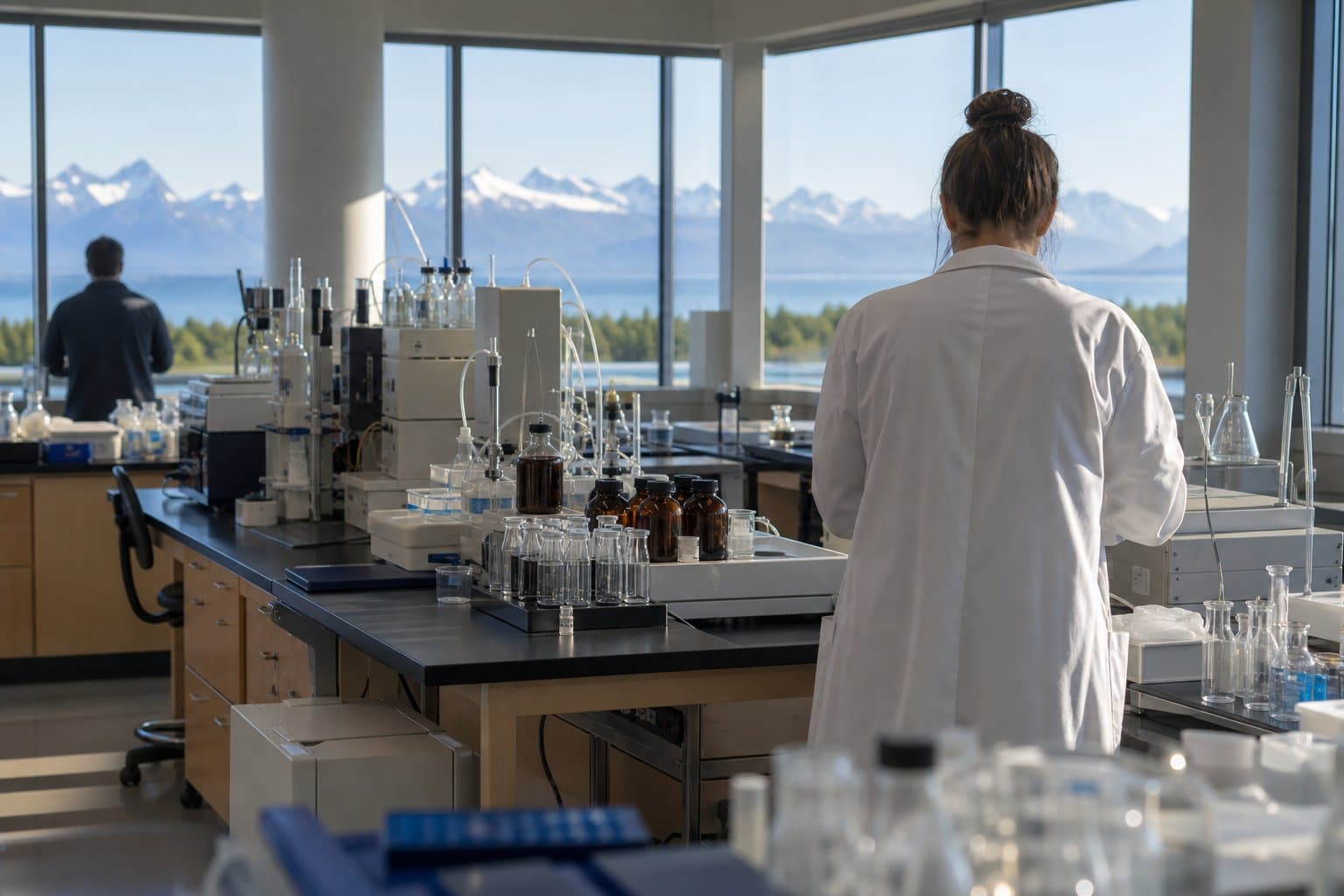
UAA chemist wins $365,000 NSF grant to study oil spill byproducts in cold water
Federal Grant Funds Arctic Oil Spill Research at UAA
The National Science Foundation has awarded $364,999 to the University of Alaska Anchorage to study how sunlight breaks down oxidized polycyclic aromatic hydrocarbons, or OPAHs: toxic compounds formed when spilled crude oil and fuel weather in water. The compounds are known to be present in the environment, but little is documented about the mechanisms that drive their degradation, according to the award abstract.
The standard grant, award 2604039, runs from Aug. 1, 2026, through July 31, 2029. Principal investigator Zachary Redman, a professor at UAA, will determine the relative contributions of direct and indirect photochemical pathways to OPAH breakdown, then measure how temperature and salinity shift degradation rates under simulated subarctic conditions, the range that governs behavior in Alaska's cold, brackish coastal waters.
The project also uses Orbitrap mass spectrometry to identify transformation products that could serve as markers distinguishing spill residue from background natural organic matter after a release. That kind of forensic marker matters to spill responders working in Arctic waters, whose method choices depend on accurate information about how oil behaves and transforms in cold, brackish conditions. It also matters to Arctic coastal and Indigenous communities whose subsistence and cultural practices are affected both by spills and by the methods used to clean them up.
Interest in Arctic-specific spill science has grown as climate change and increased shipping raise spill risks in northern waters, and national and international bodies, including the National Academies, NOAA and the U.S. Arctic Research Commission, have identified gaps in that research. A 2014 National Academies report on Arctic spill response, however, put its highest priority on controlled field releases of oil and on biodegradation and dispersant toxicity work, not on laboratory characterization of oxidation products.
The award carries NSF's Research in Undergraduate Institutions designation, and the abstract commits the project to training undergraduates on advanced analytical instrumentation. Those experiences, the abstract says, are intended to improve retention of students in STEM programs and increase post-graduation opportunities for those pursuing research careers inside and outside academia.
AI-assisted, reviewed by editors. Spot an error?
Related Coverage
UAF scientist leads $36K Antarctic sea ice study amid record lows
Alaska News · 2mo ago · 79% match
NSF awards UAF $877,501 for mass spectrometer to support fisheries and minerals research
Alaska News · 2w ago · 79% match
NSF awards UAF $1.6 million to build Alaska prescribed-burn forecasting tools
Alaska News · 1h ago · 79% match
How bubbles can throw off the sound Alaska uses to count its fish
Alaska News · 2w ago · 76% match
NSF awards UAF $1.77 million to build AI geohazard forecasting tools
Alaska News · 2w ago · 76% match
Comments
Sign in to leave a comment.
No comments yet. Be the first to share your thoughts.