AI image
NSF awards UAF $1.77 million to build AI geohazard forecasting tools
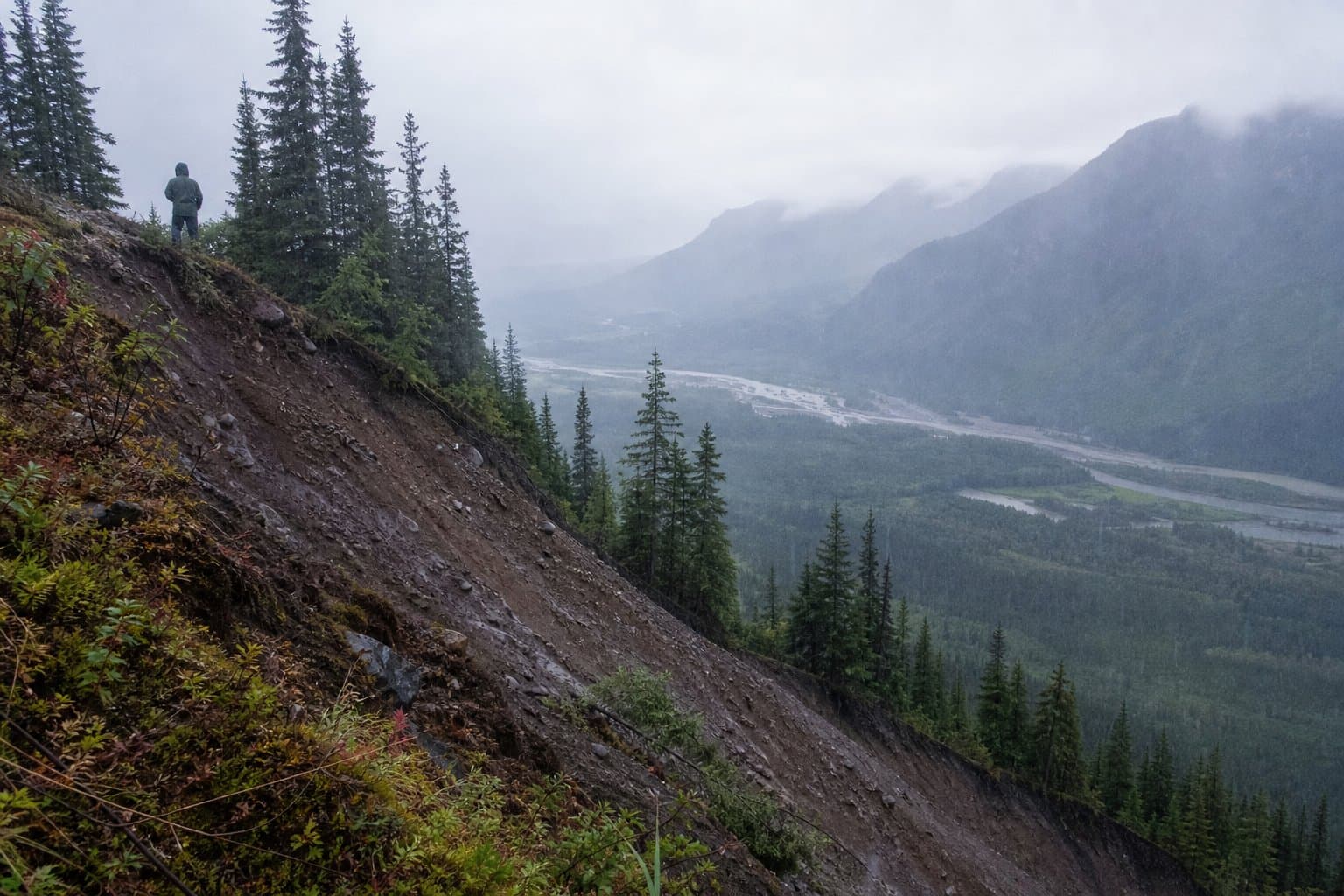
A $1.77 million National Science Foundation award to the University of Alaska Fairbanks will fund artificial intelligence software that fuses seismic sensors, satellite imagery, weather data, and groundwater readings into a single, continuously updating hazard forecast. Alaska's landslide-prone terrain will serve as the primary proving ground over the next six years.
The core concept is a digital twin: a continuously refreshed computational model of a region that draws on multiple data streams simultaneously to estimate where and when a slope failure is most likely to occur. Measurements that could warn of a landslide are currently gathered by separate systems that rarely exchange data. GAIA, the Geophysical AI-driven Integration and Assimilation project, is designed to close that gap with open software infrastructure that aggregates those streams and runs them through physics simulations in near real time. Carl Tape, a professor of geophysics in UAF's Department of Geoscience and the project's principal investigator, wrote in the award abstract that "heavy rain can saturate a hillslope, an earthquake can weaken that same slope, and the slope may then fail during a later storm."
Alaska as Test Bed
Alaska's recent landslide record gives the test-bed choice weight. Michael West, director of the Alaska Earthquake Center, testified before a U.S. House subcommittee in May 2025 that "These disasters are becoming a near-annual experience in my state," citing a 2023 Wrangell slide that killed six people and a 2024 Ketchikan slide as examples. The award abstract states the team will test the full system on landslides in Alaska and the Pacific Northwest.
Open Infrastructure, Open Questions
The project runs through July 2032 and is jointly funded by NSF's Office of Advanced Cyberinfrastructure and the Directorate of Geosciences. Software, datasets, and trained models will be released openly, and the architecture is designed as a template for other data-rich scientific fields. The project also includes a student-training component delivered through open tutorials, online workshops, and graduate courses. The award carries NSF award number 2608510 and was dated July 10, 2026.
Source: National Science Foundation, National Science Foundation: NSF Award [AI and Geosciences, Software Institutes] → University of Alaska Fairbanks Campus: Collaborative Research: Frameworks: Geophysical AI-driven Integration & Assimilation (GAIA) (PI: Carl Tape).
Made by our human newsroom with AI. How humans and AI work here · Grow with our newsroom
Stay informed. Support what matters.
Free, permanent access to local news you can verify. Subscribe to support Melinda Communities.News and go ad-free.
Related Coverage
UAF will study the landslides thawing under Alaska's pipeline
Alaska News · 1mo ago
UAF's satellite water-depth mapping wins NSF money to test whether it can become a product
Alaska News · 1mo ago
Alaska won up to $160M to hunt critical minerals with AI and microbes
Alaska News · 2mo ago
NSF awards UAF $877,501 for mass spectrometer to support fisheries and minerals research
Alaska News · 2mo ago
NSF backs UAF-led critical minerals coalition with $15 million
Alaska News · 2mo ago
Comments
Sign in to leave a comment.
No comments yet. Be the first to share your thoughts.