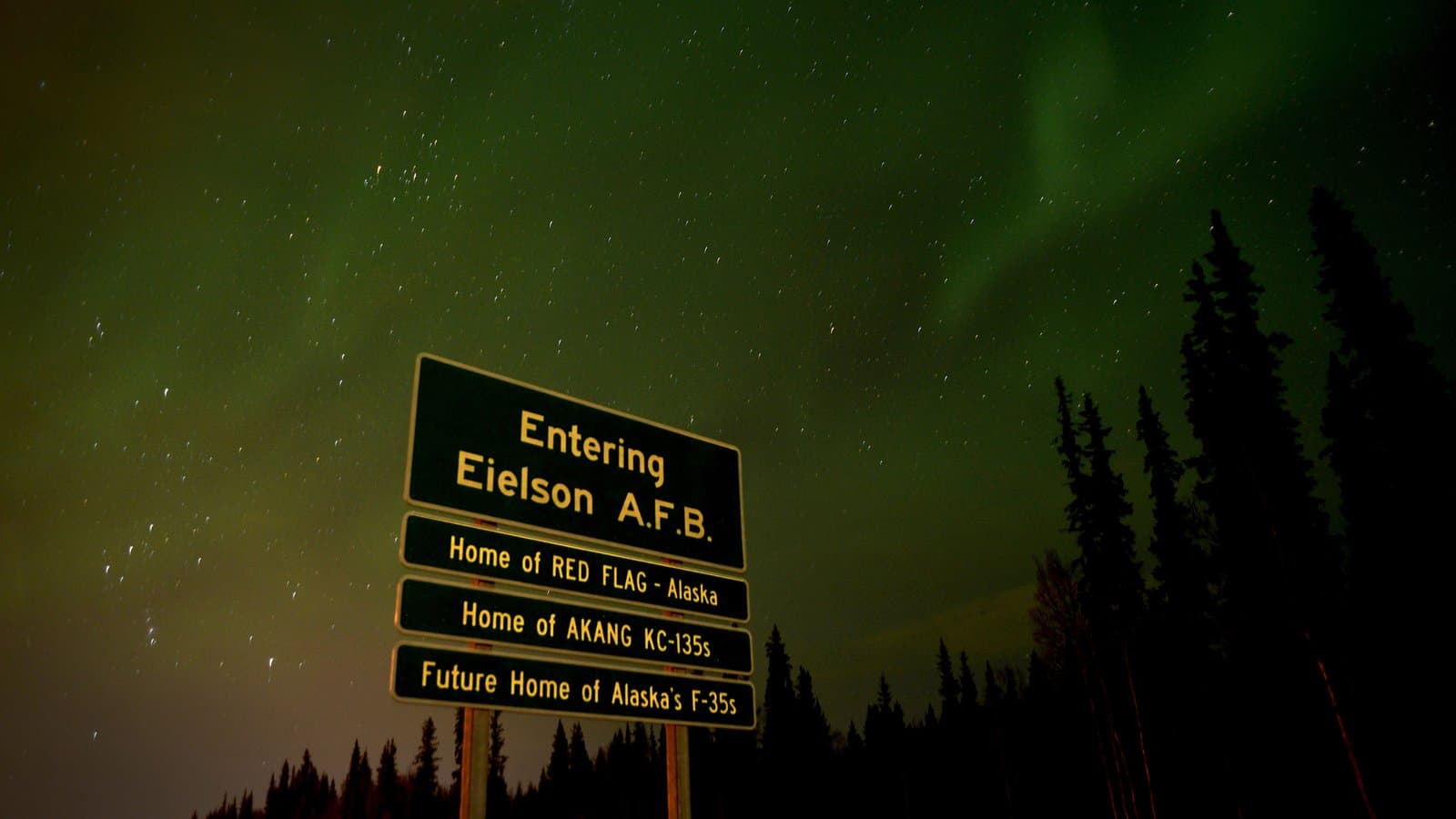
Photo: Capt. Kay Nissen via DVIDS · Photo source · US government work
Northern lights could show over Interior Alaska on Thanksgiving night
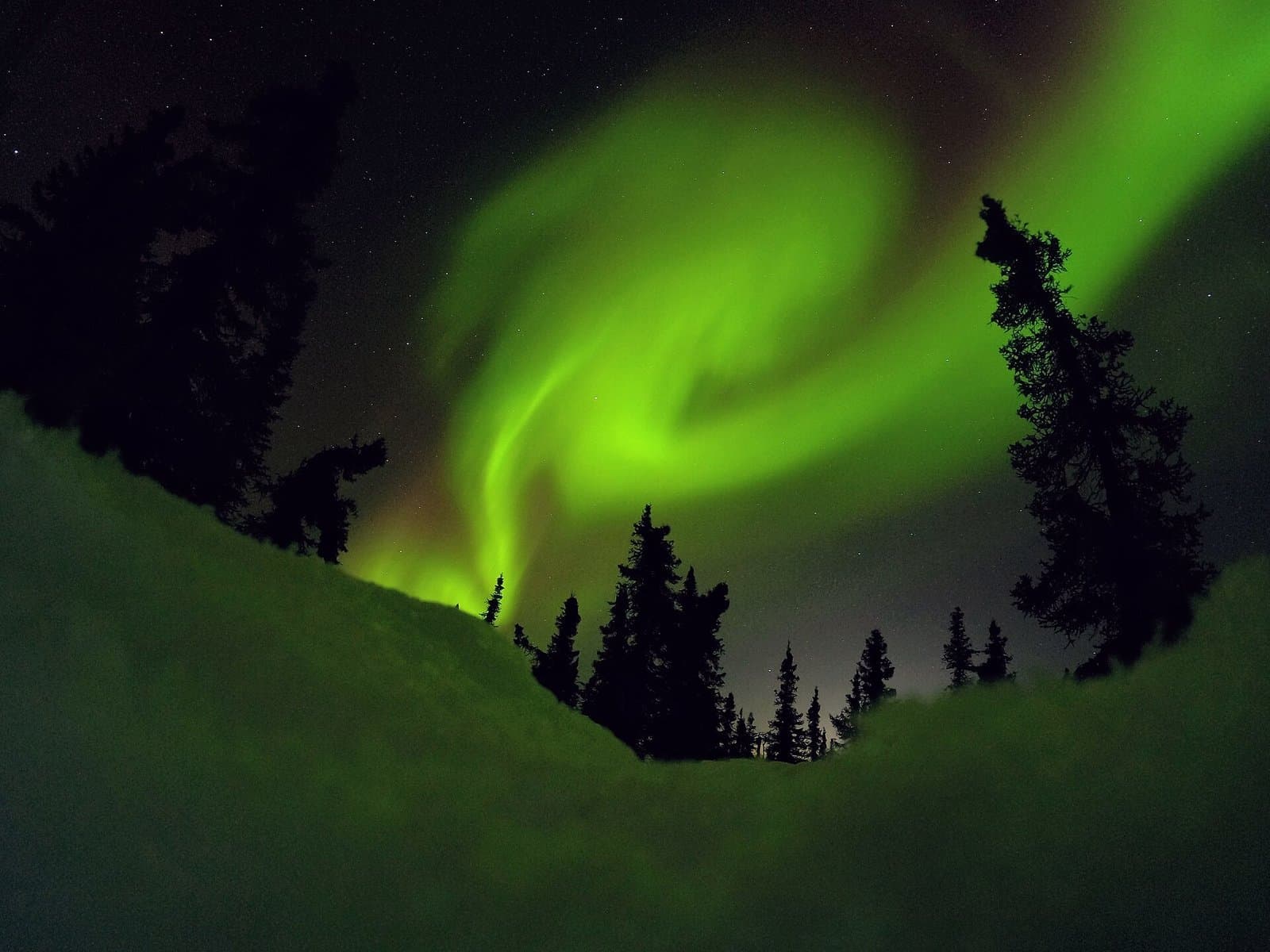
Federal forecasters expect a minor geomagnetic storm Thanksgiving night that could bring the northern lights over Interior Alaska.
The storm is forecast to be strongest from 6 to 9 pm, after dark. NOAA's forecast map for Thursday night shows a high likelihood of aurora over most of mainland Alaska, so the bigger question for most of the state is clouds.
Fairbanks and Delta Junction have the best odds of a clear enough sky, based on National Weather Service cloud forecasts.
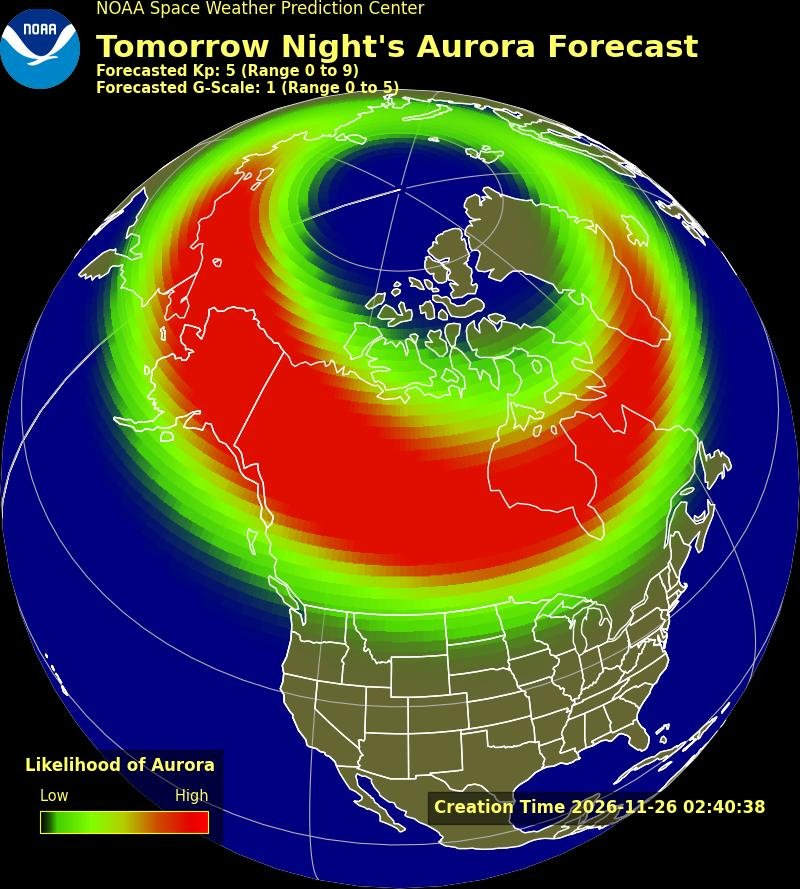
It's a forecast, and it may not happen. The storm could arrive earlier, later or weaker than predicted, and cloud forecasts change.
Where the sky might be clear
Here's how the weather service's cloud forecasts looked Wednesday for the 6 to 9 pm peak and after.
Fairbanks: about half cloudy, 49%, during the peak, thinning to 36% from 9 pm to midnight and 29% after midnight, when the storm is expected to ease.
Delta Junction: about 50% to 55% cloudy through 9 pm, 63% from 9 pm to midnight, then 44% to 49% after midnight.
Glennallen: about 46% cloudy from 3 to 6 pm, then clouding up to 65% during the peak and about 80% later.
Utqiagvik: a long shot. It's forecast at 60% to 69% cloudy from 6 pm to midnight and clears to about 23% only after the storm is expected to ease.
Tok: a long shot at 79% to 82% cloudy through midnight.
Much of the rest of the state looks clouded out:
Anchorage: 69% to 91%
Wasilla: 84% to 90%
Soldotna: 68% to 92%
Nome: 77% to 91%
Juneau: 88% to 100%
Ketchikan: 83% to 98%
What's causing it
The sun has a coronal hole, a patch of its outer atmosphere where the magnetic field opens up and lets the solar wind stream out faster. That fast wind is forecast to reach Earth on Thursday.
NOAA's Space Weather Prediction Center rates the storm G1, or minor, the lowest of the five levels on its scale. The center measures these storms with the K index, which runs from 0 to 9; a 5 or higher counts as a storm.
Its forecast hits 5 twice Thursday: from noon to 3 pm, in daylight, and again from 6 to 9 pm. It drops below storm level after 9 pm.
At this level, NOAA's scale says, the aurora is commonly visible at high latitudes, including northern Michigan and Maine.
The moon
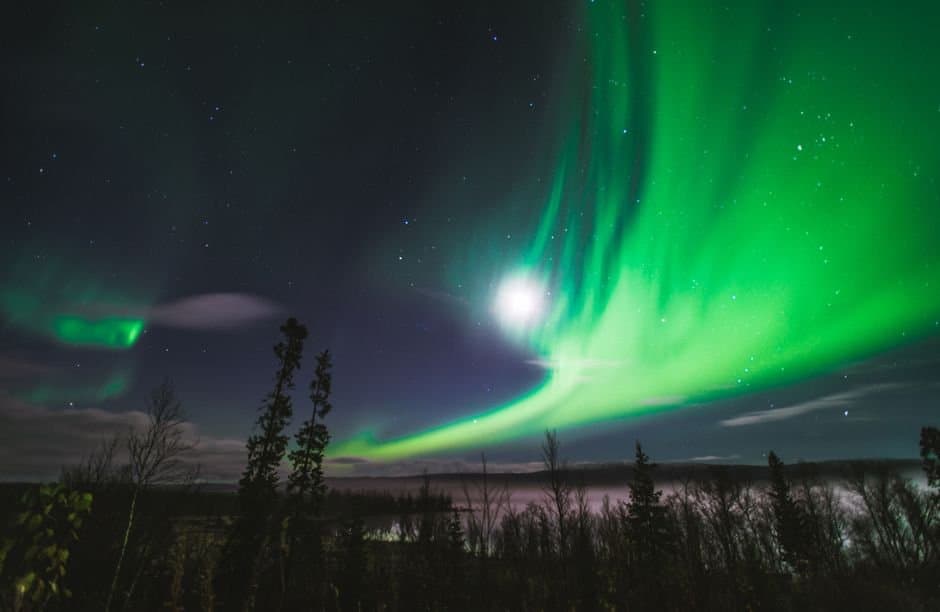
The moon will work against viewers. It's more than 90% lit, rises in the afternoon and stays up all night, which can wash out a faint display. It will still be fairly low in the sky during the evening peak.
A strong display can still show through. In late September, the northern lights over Fairbanks were bright enough to outshine a nearly full moon.
The sun sets about 3 pm in Fairbanks and Delta Junction and about 3:30 pm in Glennallen. The sky is fully dark by about 6:30 pm in all three.
Where to watch
The University of Alaska Fairbanks Geophysical Institute suggests these spots around Fairbanks:
Chena Lakes Recreation Area
Tanana Lakes Recreation Area
Cleary Summit, 2,233 feet up and about 20 miles from town
Ester
Wickersham Dome
Murphy Dome, 2,877 feet up and about 25 miles out
Haystack Mountain on the Elliott Highway
Explore Fairbanks, the area's visitor bureau, recommends all-wheel or four-wheel drive on the Cleary Summit and Murphy Dome roads in snow.
Near Delta Junction, the turnoff for Quartz Lake State Recreation Area is at Mile 277.8 of the Richardson Highway, north of town, according to Alaska State Parks.
Anywhere, getting away from town lights and finding an open view to the north helps. So does higher ground.
The space weather center will update its forecast as the solar wind stream gets closer, and the weather service updates its cloud forecasts through the day Thursday.
What did you make of this story? (no account needed)
Made by our human newsroom with AI. Reviewed by Cale Green. How humans and AI work here · Grow with our newsroom ·
Keep Alaska News free for everyone.
No paywall, ever. Members pay so everyone can read the meetings and records Alaska News covers.
Get Alaska News in your inbox
Create your free account and get the day’s top stories around 6 each morning, in a few minutes’ read.
Top stories, around 6 each morning.
Stories on what you follow, on Sundays.
Source: NOAA Space Weather Prediction Center, Northern lights possible over Fairbanks and Delta Junction Thanksgiving night, Nov. 26.







Comments
Sign in to leave a comment.
No comments yet. Be the first to share your thoughts.