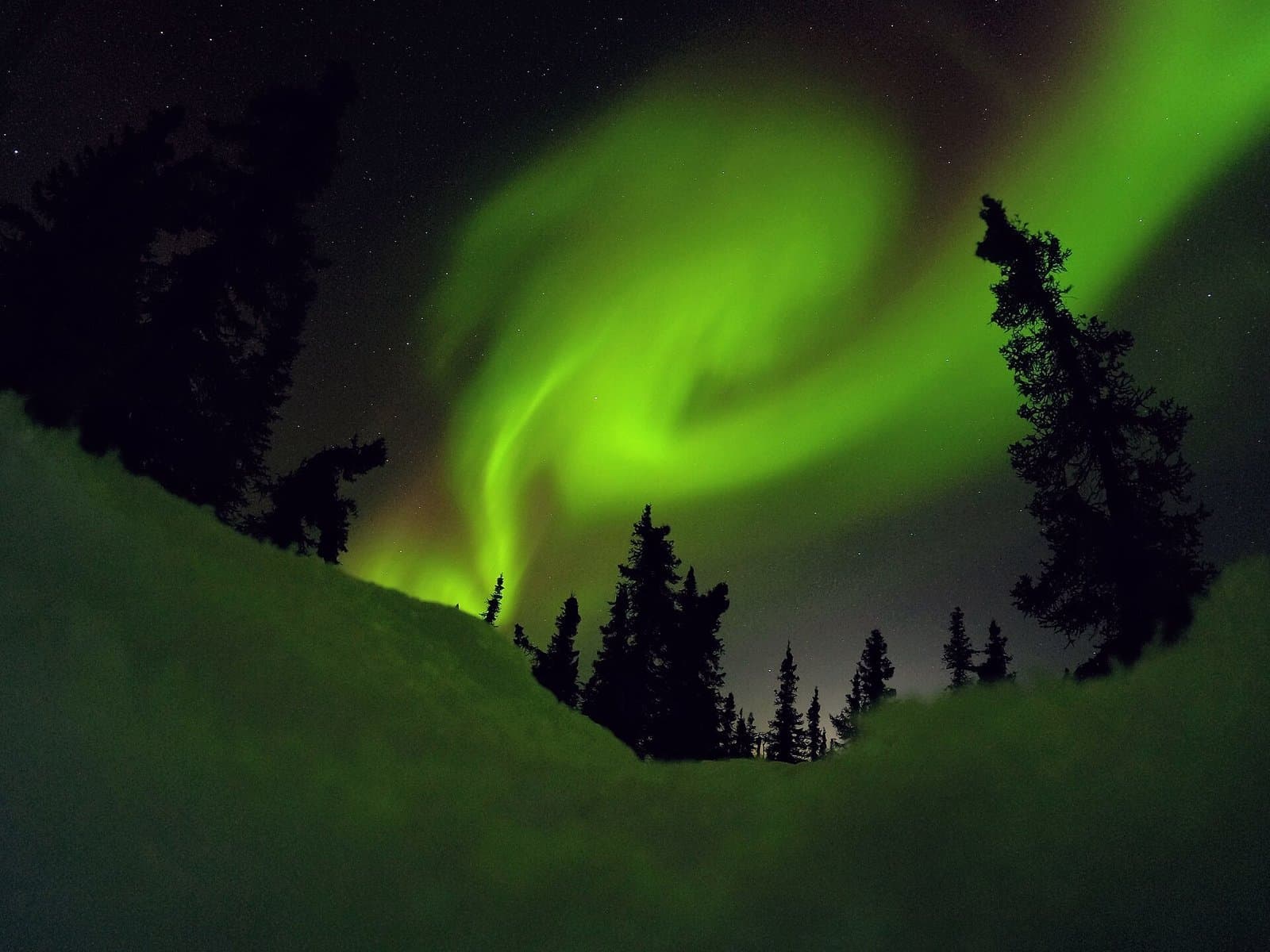
Fairbanks has best chance for northern lights early Friday as G2 storm nears
Fairbanks has the best chance for northern lights early Friday among six Alaska communities checked, according to NOAA and National Weather Service forecasts. Viewing is possible from about 1 am until civil twilight begins at 7:36 am, with geomagnetic activity forecast to strengthen toward morning as clouds increase. Storms can arrive early, late or weaker than predicted.
NOAA's Space Weather Prediction Center issued a watch Tuesday for a G2, or moderate, geomagnetic storm Friday, likely when a coronal mass ejection arrives. A G2 storm can affect high-latitude power systems, satellite operations, radio communications and satellite drag.
The center's 3-day forecast, issued 4:30 pm Thursday Alaska time, has the K index reaching 4.67, the low end of G1, from 4 to 7 am Friday, then 5 from 7 to 10 am. The peak, a K index of 6 (G2), comes late Friday morning, after sunrise. The University of Alaska Fairbanks Geophysical Institute says aurora can generally be seen outside civil twilight, which in Fairbanks begins at 7:36 am Friday, according to the U.S. Naval Observatory. That leaves the 4 to 7 am window, and the first half hour of the 7 to 10 am window, in darkness.
At the forecast dark-hour level, aurora typically reaches Fairbanks, the Interior and the Arctic, not Southcentral or Southeast Alaska. Fairbanks is forecast near 10 percent cloud cover at 9 pm Thursday, about 25 percent from 1 to 4 am and 42 percent by the 4 am hour. Utqiagvik expects 61 to 69 percent cloud cover overnight, near 85 percent by 4 am. Nome stays overcast at 96 to 99 percent all night. Anchorage rises from 27 to 58 percent. Juneau is clearer than Fairbanks from 1 to 4 am, at 14 percent, and Ketchikan clears from 4 to 7 am, at 19 percent. Aurora is unlikely in Anchorage, Juneau or Ketchikan unless the storm arrives earlier or stronger than forecast.
The moon, a thin waning crescent about 4 percent lit, will not interfere. Arrival timing is uncertain by hours, and forecasters are still analyzing a second ejection, from a Thursday morning solar flare, that the center says could add activity. NOAA forecasts a K index of about 3 to 4 Friday night, rising to 5, G1, from 7 to 10 pm Saturday, mostly after dark in Fairbanks, though that forecast is three days out. NOAA's 30-minute aurora forecast shows aurora location in near real time.
Source: Northern lights: Fairbanks has the best chance before dawn Friday, ahead of a storm forecast to peak in daylight.
Made by our human newsroom with AI. Reviewed by Cale Green. How humans and AI work here · Grow with our newsroom
Stay informed. Support what matters.
Free, permanent access to local news you can verify. Subscribe to support Walter AlaskaNews and go ad-free.
Related Coverage
Northern lights outshine a nearly full moon over Fairbanks as solar wind keeps the aurora active
Alaska News · 1w ago
An eclipsed Moon rises over Alaska Wednesday, with aurora possible after
Alaska News · 1mo ago
Northern lights draw crowds to Fairbanks and Kodiak viewing spots
Alaska News · 5mo ago
Fairbanks and Kodiak Residents Capture Last Aurora Displays Before Midnight Sun
Alaska News · 5mo ago
Aurora Borealis Lights Up Kodiak and Interior Alaska Skies
Alaska News · 5mo ago
Comments
Sign in to leave a comment.
No comments yet. Be the first to share your thoughts.