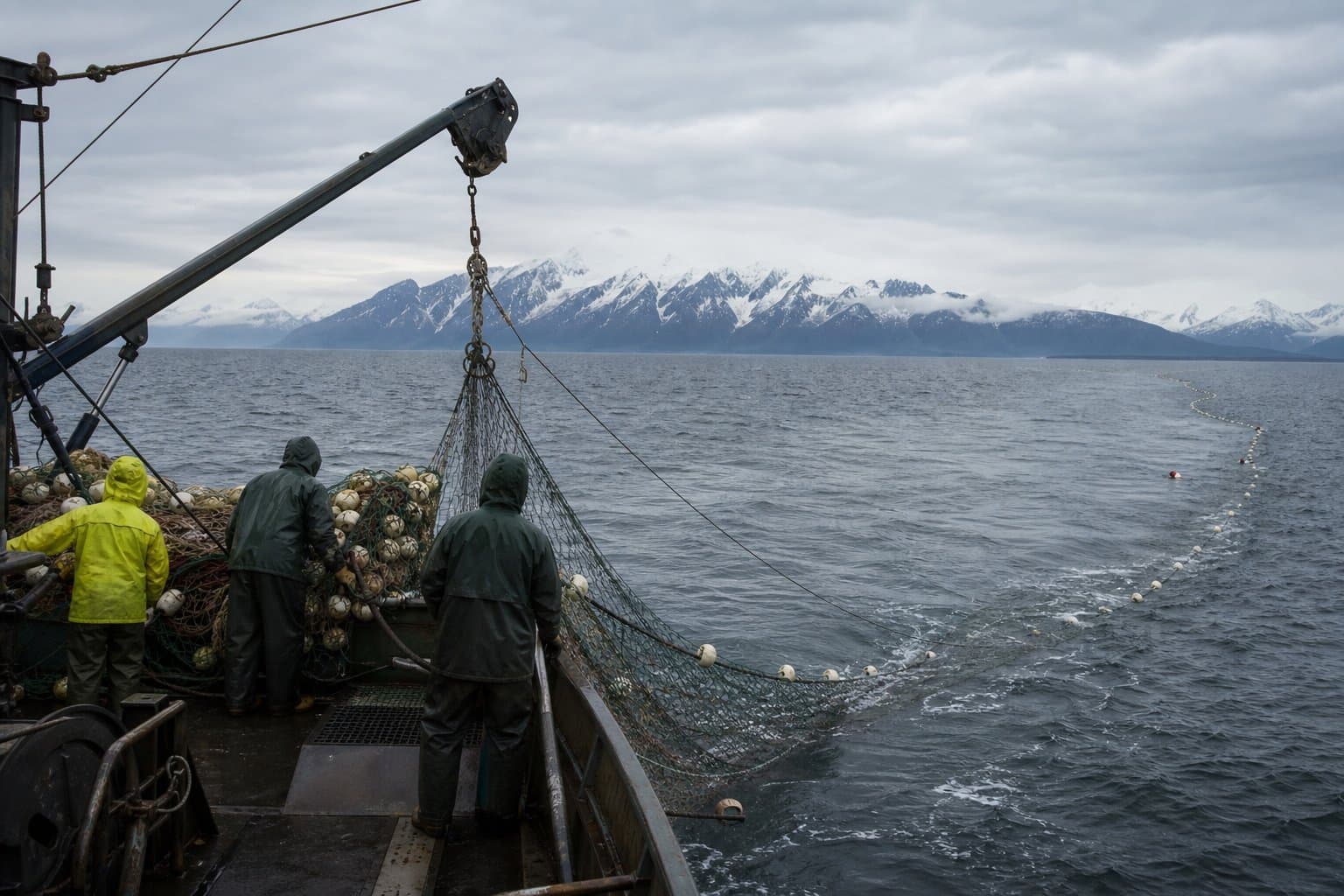
AI image
Ninth Circuit upholds federal Cook Inlet salmon management against drift fleet challenge
Cook Inlet's commercial salmon harvesters lost again in federal court Tuesday, leaving in place the split federal-state system that governs where and when the drift fleet can fish offshore.
A three-judge Ninth Circuit panel affirmed a lower court ruling upholding Amendment 16, the federal rule that put Cook Inlet's federal waters, the zone running from three to 200 miles offshore, under federal rather than state management. The panel rejected every claim brought by the United Cook Inlet Drift Association and the Cook Inlet Fisherman's Fund under the Magnuson-Stevens Act, the law governing fishing in federal waters.
The two groups argue Amendment 16 wrongly splits a single fishery into separate federal and state fisheries, and that it fails to produce the optimum yield the act requires, meaning the greatest overall benefit a fishery can sustain. The panel heard argument in Anchorage on Aug. 10 and issued an unpublished memorandum, which does not set precedent.
Federal managers closed commercial salmon fishing in those waters from Aug. 5 through Aug. 15 this year, after the harvest approached the 2026 coho limit of 16,619 fish.
The fleet has lost in state court too. The Alaska Supreme Court ruled against the Cook Inlet Fisherman's Fund last October, and the U.S. Supreme Court declined in May to take the group's appeal. That petition, filed on behalf of 1,345 Upper Cook Inlet set net and drift net fishermen, argued that Alaska's resident-only personal use fishery and its 34-inch size threshold for Kenai River kings violate the Commerce Clause and federal fishing law. It put annual losses at just under $50 million in first wholesale value, the price processors pay, and said the region's processors have dropped from 15 to three.
The East Side Set Net fishery, worked from beaches rather than boats, was closed entirely in 2023 and 2024.
Those closures trace to the state's handling of Kenai River late-run king salmon, which Fish and Game has designated a stock of concern, a run failing to meet its spawning targets. Setnetters can fish only when the department projects 14,250 large kings returning. Sport king fishing in Upper Cook Inlet was closed May 1 through Aug. 15, and dipnetters may not keep kings. The department says the restrictions are necessary to rebuild the run.
The courts have settled who manages Cook Inlet's federal waters. Who gets the fish inside them is a separate fight, and it has moved back to the Alaska Board of Fisheries.
The board voted 4-2 last year to restrict the drift fleet with new fishing windows and a two-mile buffer off the shoreline. It has scheduled Proposal 186, which would further cut drift opportunity in the Central District, for its Statewide Finfish and Supplemental Issues meeting. Regulations adopted in March remain under Department of Law review, so the 2026 season ran under the old rules.
Source: US appeals court upholds Cook Inlet salmon harvest split in harvester challenge.
Made by our human newsroom with AI. How humans and AI work here · Grow with our newsroom
Stay informed. Support what matters.
Free, permanent access to local news you can verify. Subscribe to support Bill AlaskaNews and go ad-free.
Related Coverage
A court struck down a fishery council's power. Alaska's council has the same one.
Alaska News · 1mo ago
Board restricts Cook Inlet drift gillnet fishery to protect coho salmon
Alaska News · 6mo ago
The state ordered Cook Inlet setnetters onto gear their permits don't allow
Alaska News · 2mo ago
Federal Decision Keeps Chinook Management in Alaska's Hands
Alaska News · 5mo ago
Cook Inlet drift fleet limited to Area 3 for a single 12-hour opener Thursday
Alaska News · 2mo ago
Comments
Sign in to leave a comment.
No comments yet. Be the first to share your thoughts.