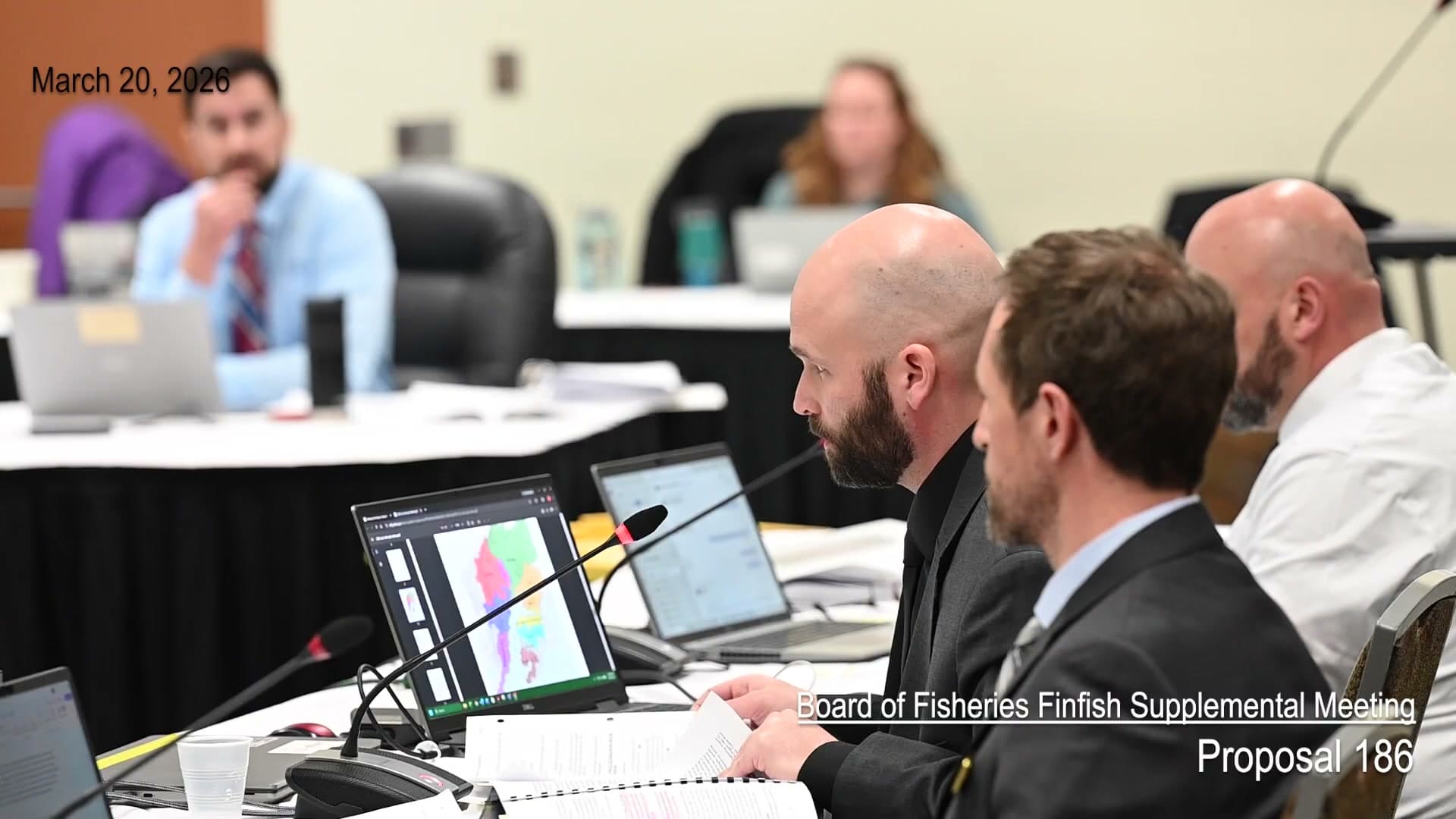
Frame from "Alaska Board of Fisheries Finfish Supplemental Meeting on March 20, 2026 - Proposal 186 Deliberation" · Source
Board restricts Cook Inlet drift gillnet fishery to protect coho salmon
The Alaska Board of Fisheries voted Friday to sharply restrict the Cook Inlet drift gillnet fishery to protect northern Cook Inlet coho salmon populations that have failed to meet escapement goals for years.
The board approved substitute language 4-2 that limits drift gillnet fishing to expanded Kenai and Kasilof sections only, establishes Monday and Thursday fishing windows of 12 hours each, and creates a 2-mile buffer from the Kenai Peninsula shoreline. The changes eliminate Area 2 from state waters and restrict additional fishing time to runs exceeding 2.3 million sockeye salmon in the Kenai River.
The limited entry fishery has approximately 355 participants and has documented bycatch impacts on marine mammals including beluga whales, harbor seals, Dall's porpoise, harbor porpoise, and Steller sea lions.
Federal fishery management for commercial salmon fishing in the Cook Inlet exclusive economic zone was established in 2023, affecting the drift gillnet fishery and closing a portion of historically used fishing area while allowing continued operation in state waters.
Conservation concerns drive action
The Deshka River has not met its coho escapement goal in six years, and the Little Susitna River has missed its goal for three years, despite sport fishery closures in those systems. New genetics data revealed that 90 percent of coho caught by the drift fleet are northern-bound fish, undermining the effectiveness of conservation corridors that managers had relied on to pass fish north.
A board member said the problem is Northern Cook Inlet coho numbers have declined with increased use of Central District drift gillnet fishery to harvest large runs of Kenai and Kasilof sockeye in recent years. Coho escapement goals are not being achieved despite significant sport fishery restrictions and closures in area rivers.
The commercial drift fleet caught between 85,000 and 88,000 coho in 2024 while harvesting a record 3.5 million sockeye salmon worth $30 million in ex-vessel value, double the 10-year average.
A board member said in this last year, the Cook Inlet drifters caught 87,000 coho. Drifters had their best year in 30 years with catching 3.5 million reds.
Colton Lipka, the Upper Cook Inlet Regional Management Coordinator for Commercial Fisheries, said the department has concerns about consistently achieving coho escapement goals and has managed all fisheries conservatively to allow passage of coho to northern Cook Inlet drainages. He said increased drift gillnet fishing opportunity in years with large Kenai and Kasilof sockeye runs makes coho conservation efforts harder.
Patrick Fowler, the sportfish management coordinator for Cook Inlet, characterized coho abundance in northern Cook Inlet as below average. Fish Creek met its escapement goal in two of the last three years, and McRoberts Creek met its goal in each of the last three years, but overall abundance remains below historical levels.
Allocative impacts and timing concerns
The board amended the substitute language to clarify that regular fishing periods run from 7 a.m. to 7 p.m. on Mondays and Thursdays, with additional time up to 16 hours per day when warranted by run strength.
Lipka estimated the restrictions could reduce sockeye harvest by roughly one million fish in a year like 2024, though the actual impact will depend on how sockeye move into the inlet. The last two years have seen a strong eastern run pattern with fish staying close along the coast.
One board member opposed the proposal, citing concerns about substitute language delivered after public testimony closed and the proximity to the regular Cook Inlet meeting cycle scheduled for later this year.
The board member said he would not support this proposal at this time, but he liked some of the aspects included. He felt it would be better dealt with in a normal Cook Inlet cycle.
Supporters argued the board needed to act before coho populations trigger a stock of concern designation, which would lead to an action plan and additional closures.
A board member said the board has an opportunity to try and get ahead of it a little bit here. The board member appreciated that sometimes with a conservation focus, there can be allocative consequences. But for the board member, the focus is on avoiding future problems and compounding future problems with coho not meeting their escapement goals.
Another board member emphasized the need to focus harvest on high-productivity rivers while protecting struggling systems.
The board member said what he was seeing with this proposal is focus. There is a very tailored approach here to isolate that mixed stock fishery, to harvest as close to the high productivity rivers as possible while not interfering with the more marginalized streams to the north.
The North Pacific Fishery Management Council reduced the coho total allowable catch for the federal exclusive economic zone fishery this year on a precautionary basis, reflecting similar conservation concerns.
The department plans to bring language to the regular Cook Inlet board meeting addressing how the commissioner manages the fishery when sockeye runs fall below 2.3 million fish and in-river goals are not being met. The Kenai River sockeye forecast for this year is approximately 4.5 million fish.
The restrictions apply only to state waters. The National Marine Fisheries Service administers a federal fishery management plan that regulates salmon fishing in the exclusive economic zone within Upper Cook Inlet, and those regulations remain separate from state management.
This article is based on a public meeting — Alaska Board of Fisheries Finfish Supplemental Meeting on March 20, 2026 - Proposal 186 Deliberation ().
AI-assisted. How we use AI Transcript byLucas Brown
Stay informed. Support what matters.
Free, permanent access to local news you can verify. Subscribe to support Alaska News and go ad-free.
Related Coverage
Board Restricts Fishing Gear to Protect Chinook in Chignik, Area M
Alaska News · 7mo ago
Cook Inlet drift fleet limited to Area 3 for a single 12-hour opener Thursday
Alaska News · 1mo ago
ADF&G closes Northern District set gillnet fishing for 12 hours Monday
Alaska News · 1mo ago
Board Cuts Area M June Salmon Fishing Time 30% to Protect Yukon-Bound Chum
Alaska News · 7mo ago
A coho cap could close Cook Inlet's sockeye season early, fishermen warn
Alaska News · 3mo ago
Comments
Sign in to leave a comment.
No comments yet. Be the first to share your thoughts.