House Resources gas line bill would cost municipalities $13B under governor's plan
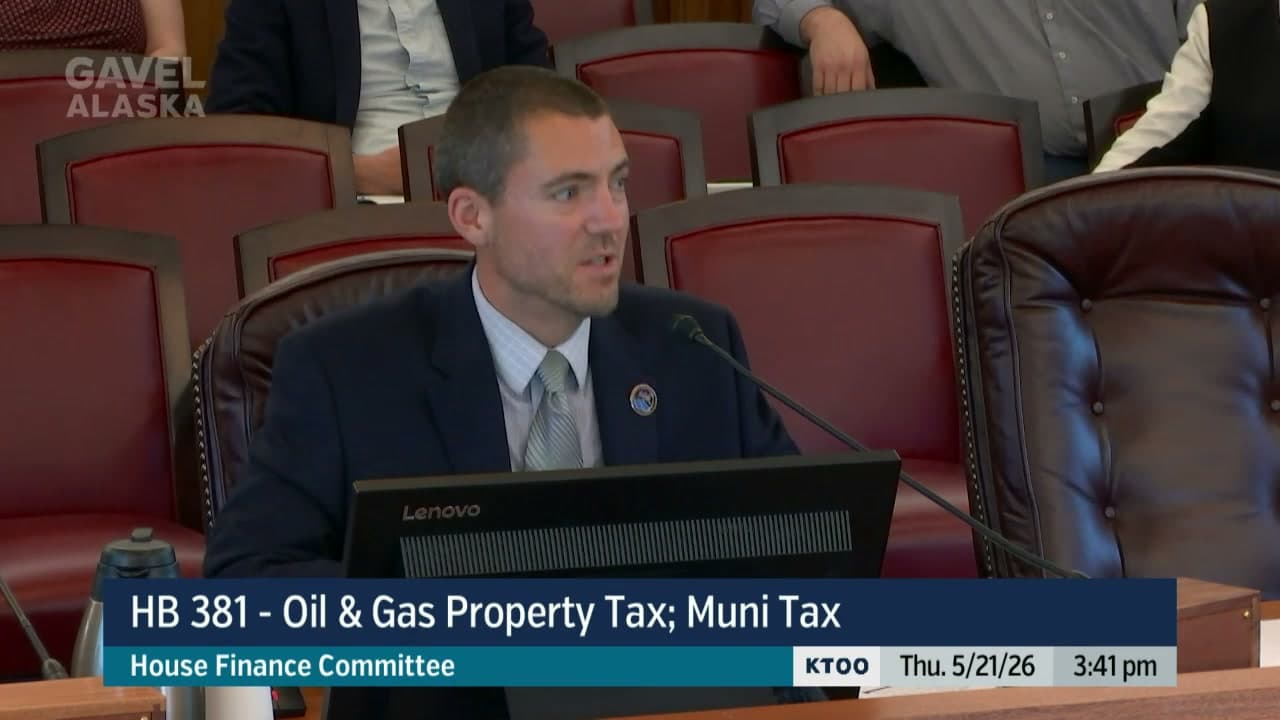
The governor's version of House Bill 381 would cut Alaska municipal property tax revenue by more than $13 billion over the life of the Alaska LNG project, the Department of Revenue told the House Finance Committee on Thursday.
Municipalities would collect over $17 billion in cumulative revenue through 2062 under current law if the project proceeds. The governor's bill would replace property tax with a 6-cent-per-thousand-cubic-feet volumetric tax across the entire project.
The House Resources version before the committee applies the volumetric tax only to the pipeline. It retains property tax on the gas treatment plant and LNG facility. That structure would increase municipal revenue above current law levels, according to Department of Revenue modeling.
Dan Stickel, chief economist at the Department of Revenue, said municipalities could negotiate down the property tax on those facilities or replace it with a negotiated equity share under the House Resources version.
The North Slope Borough and Kenai Peninsula Borough would receive the largest shares under that version. The gas treatment plant sits in the North Slope Borough. The LNG facility would be located in the Kenai Peninsula Borough. Both facilities would remain subject to property tax unless the boroughs negotiate alternative arrangements.
The House Resources version includes a sunset provision in 2056. After that date, the volumetric tax would revert to current-law property tax.
The governor's companion bill, House Bill 2001, would allow the legislature to appropriate between zero and $90 million in community impact aid. That aid would come from state general funds, reducing the state's net revenue from the project.
Representative Andy Josephson, an Anchorage Democrat, questioned how municipalities would handle increased demand for services during construction and operation without the property tax revenue from the governor's version.
Stickel said he could not speak for the administration but would provide a follow-up response.
The House Resources version would generate $781 million in annual state revenue and $583 million in annual municipal revenue once full export operations begin in 2033, according to the department's modeling. That compares to about $1 billion in annual state revenue under current law.
Both versions would reduce state revenue compared to current law. The governor's version would cut cumulative state revenue by about $7 billion over the project's life. The House Resources version represents a smaller reduction.
The breakeven price for delivered LNG would be $9.07 per thousand cubic feet under current law, $8.96 under the House Resources version, and $8.48 under the governor's version. Current Asian market prices range from $8 to $9 per thousand cubic feet. Senator Sara Hannan noted that even the governor's $8.48 breakeven sits at the high end of that range, questioning whether the tax relief would make Alaska LNG attractive to Asian buyers.
Stickel said the project is economically challenged at current market prices even with the tax changes in the governor's version. He told the committee that the governor's bill would make the project more attractive to investors, while the House Resources version represents a tax decrease overall but to a much smaller extent.
Representative Forrest Dunbar, an Anchorage Democrat, said producers have greater control over the project's viability than the state does through their upstream gas pricing decisions. He noted that Department of Revenue evidence shows producers can make a profit at 45 cents per thousand cubic feet upstream, giving them roughly twice the ability to influence the project's economics compared to state tax policy.
This article is based on a public meeting — House Finance, 5/21/26, 1:30pm ().
Made by our human newsroom with AI. How humans and AI work here · Grow with our newsroom Transcript byLucas Brown
Watch key moments from the source meeting. Click to expand.
Stay informed. Support what matters.
Free, permanent access to local news you can verify. Subscribe to support Walter AlaskaNews and go ad-free.
Related Coverage
House panel hears gas line tax bill with 15-cent volumetric fee
Alaska News · 4mo ago
House panel hears tax proposal for Alaska LNG project
Alaska News · 5mo ago
House Finance begins review of Alaska LNG tax bill with competing rate proposals
Alaska News · 4mo ago
Senate Finance weighs Alaska LNG tax worth $124M a year — and whether it's enough for host communities
Alaska News · 3mo ago
Alaska LNG tax bill ties $26.5B in revenue to volume, not value
Alaska News · 4mo ago
Comments
Sign in to leave a comment.
No comments yet. Be the first to share your thoughts.