AI image
Cordova science center gets NOAA grant to rebuild Prince William Sound ocean profiler
The Prince William Sound Science and Technology Institute in Cordova, which operates the Prince William Sound Science Center, has a $354,971 National Oceanic and Atmospheric Administration grant to replace the control computer and battery on a robotic instrument that has tracked conditions in the Sound since 2014. Both parts are no longer made, according to the federal award record. The one-year grant began Thursday, Oct. 1, and runs through Sept. 30, 2027.
Neither manufacturer is still in business, and no comparable instrument is built anywhere today, the record says. It lists those who benefit from the instrument's data as commercial and subsistence fishermen, shellfish and seaweed growers, Sound residents, state and federal fishery managers, and oil spill response planners who need measurements of water structure, how temperature and salinity layer from surface to depth, along the tanker route from the Valdez Marine Terminal.
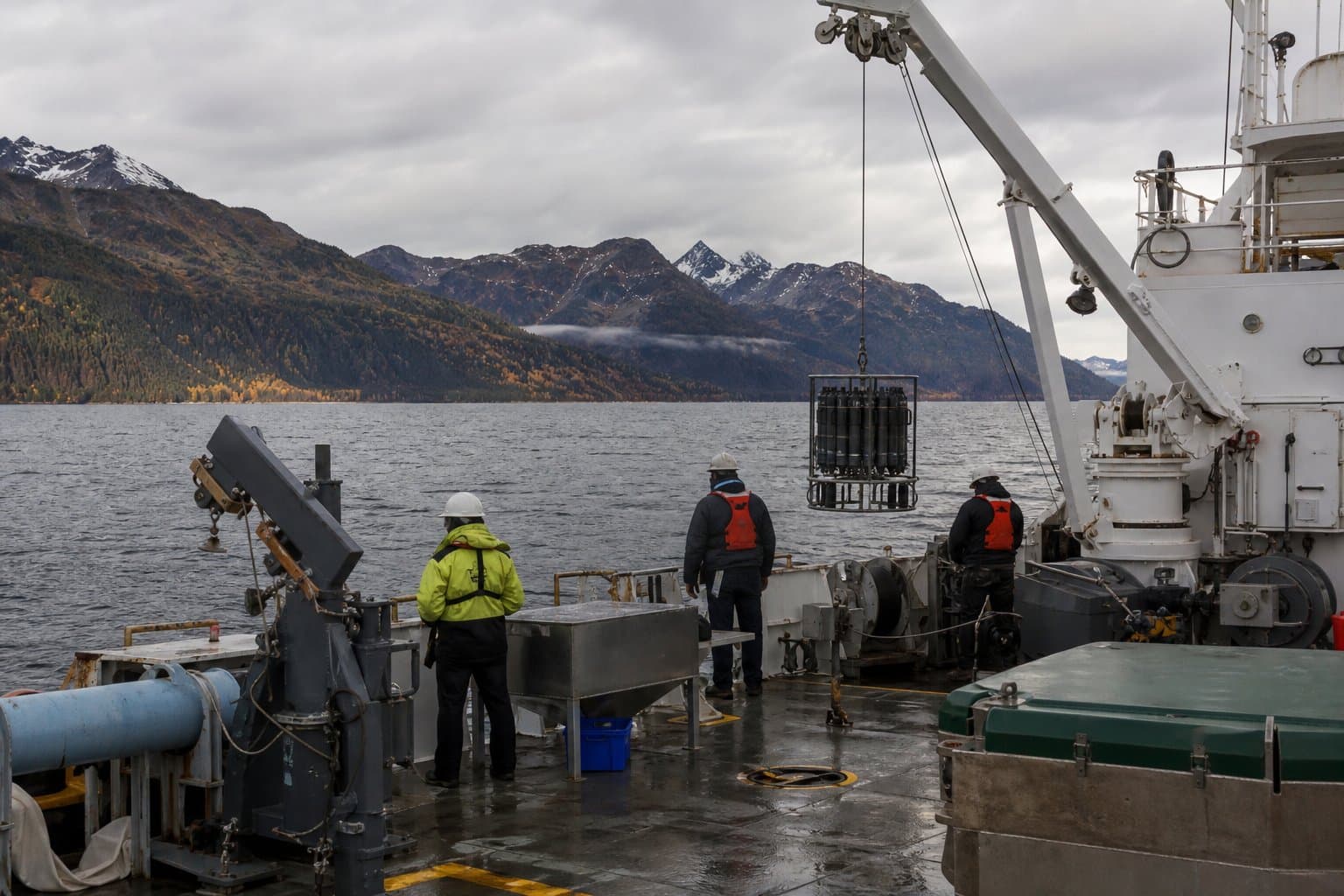
The robotic float, deployed each spring in the middle of the Sound, measures temperature, salinity, oxygen, nutrients and plankton from 200 feet to the surface every two inches, Katrina Hoffman, then the institute's president and CEO, said in 2018 written testimony to the U.S. Senate Commerce Committee.
Under the grant, the Georgia Institute of Technology, which receives part of the money as a subrecipient, is to lead the engineering: a control system built around a low-power microcontroller, with winch control tracking line and tension, two-way cellular communication, and an independent safety function that returns the instrument to depth if the software or radio link fails. Georgia Tech is also to develop a rechargeable battery from commercially available cells, built in modules a technician can swap in the field, sized to roughly double the current endurance of 70 profiles per charge.
The two platforms to be rebuilt are surplus from the National Science Foundation's Ocean Observatories Initiative, which is ending its profiling work.
Testing is planned to move from bench to test tank to the water near the research center, where the instruments would profile several times per hour, with results checked against vessel samples.
Planned outcomes include two working replacement instruments, spare parts, and a permanently archived design package of drawings, parts lists, wiring and software. The record says that package would let other institutions build the instrument for the first time in a decade, "at a cost well below the original commercial price."
Source: Department of Commerce, Department of Commerce: [PROJECT GRANT (B)] Department of Commerce: PRINCE WILLIAM SOUND SCIENCE AND TECHNOLOGY INSTITUTE for PURPOSE: THE COASTAL OCEAN SUPPORTS MOST OF THE NATION'S FISHERIES, MUCH OF ITS ($354,971).
AI-assisted. Reviewed by Cale Green. How we use AI
Stay informed. Support what matters.
Free, permanent access to local news you can verify. Subscribe to support Bill AlaskaNews and go ad-free.
Related Coverage
How bubbles can throw off the sound Alaska uses to count its fish
Alaska News · 2mo ago
A federal minerals program is funding science on the seafloor mining wants to dig
Alaska News · 2mo ago
Sitka gets $1.1 million state grant to upgrade Eliason Harbor electrical systems and floats
Alaska News · 2d ago
Cordova hospital gets $3 million to replace generator after four tries drew no bidders
Alaska News · 1d ago
Knik Tribe awarded $5 million to design fish passage fixes on Talkeetna Spur Road
Alaska News · 1mo ago
Comments
Sign in to leave a comment.
No comments yet. Be the first to share your thoughts.