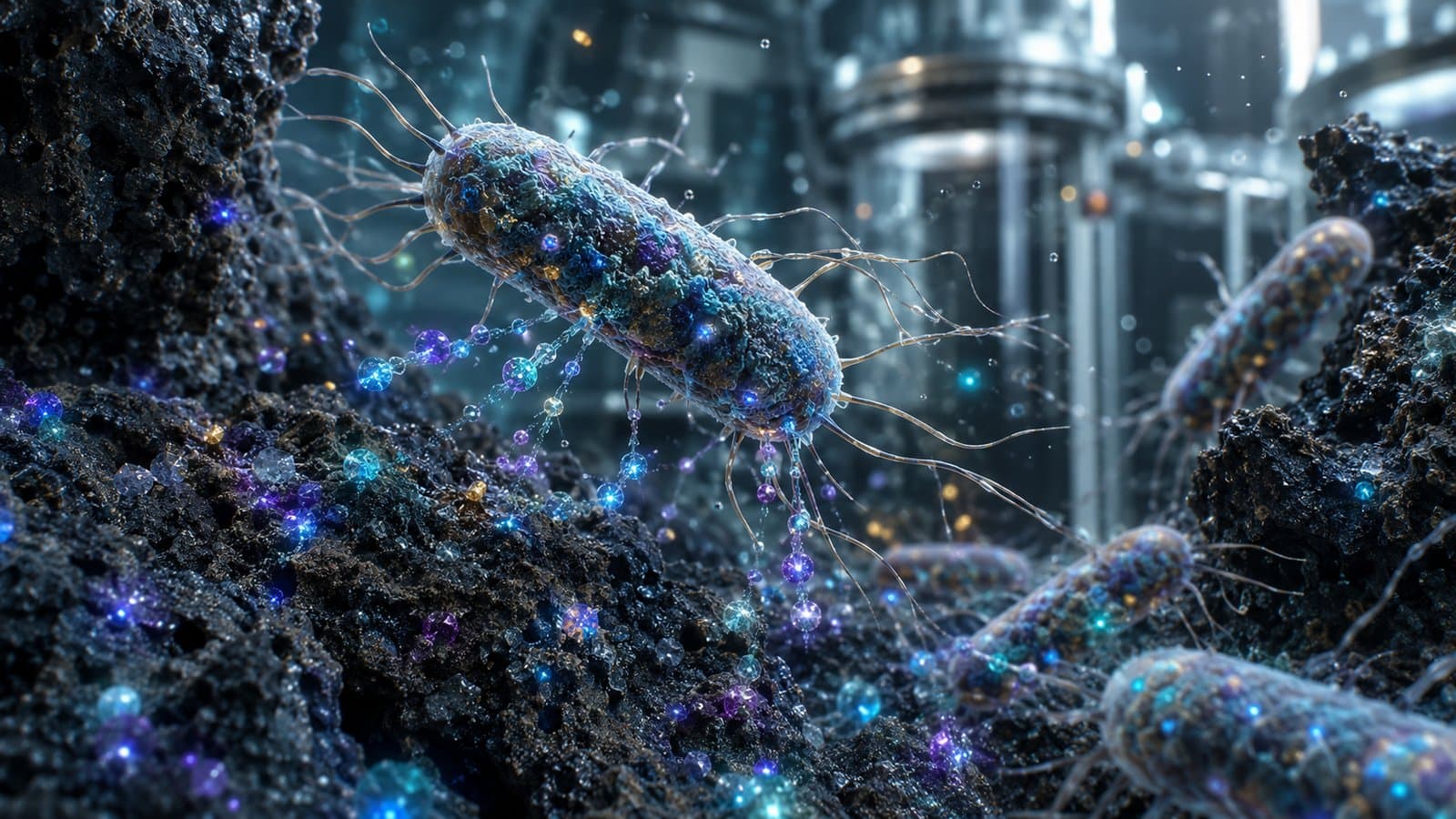
Generated image by Cale Green
Can a bacterium pull rare earths out of coal waste? Alaska researchers just got $4.7M to find out
The University of Alaska Anchorage will receive about $3.8 million from the National Science Foundation to test whether a bacterium can pull rare earth elements out of coal mining refuse and ash, with a parallel $913,000 award going to the University of Alaska Fairbanks. The four-year project starts in September.
The appeal is a supply-chain one. Rare earth elements are essential to energy technology, advanced manufacturing and national defense, and the U.S. leans heavily on foreign sources for them — even though large domestic supplies sit locked inside coal mining waste. The project is pitched as a way to reach that supply using biology rather than conventional mining.
At its technical core is a bacterium, Shewanella oneidensis, which the researchers will test for its ability to leach rare earths out of coal refuse and ash. Software would first screen waste samples to predict which hold the most promise, and machine-learning controllers would tune a computer-modeled version of the recovery process — including how much power it draws from a simulated grid — before anything runs in a real facility, with results judged on cost and environmental impact.
The science is far from settled. The U.S. Geological Survey concluded in 2019 that coal and coal fly ash aren't currently economic rare earth resources, though they could become viable and are being studied, and other researchers have found rare earth concentrations in coal waste that run above average but generally below recoverable levels. Environmental analysts, commenting on such efforts broadly rather than this project specifically, also caution that turning coal waste into a rare earth source could prolong coal dependence and open new pollution pathways if extraction isn't carefully controlled.
Brandon R. Briggs of UAA leads the project, with Srijan Aggarwal holding the Fairbanks award; Montana Technological University and the University of Wyoming round out a three-state partnership. It follows NSF's selection of a UAF-led Critical Mineral Accelerator as a Regional Innovation Engine, worth $15 million over two years and up to $160 million over a decade.
Source: National Science Foundation ().
Drafted with AI. Edited by Cale Green (1 revision). No full editor review is on record. Who is accountable.
Stay informed. Support what matters.
Free, permanent access to local news you can verify. Subscribe to support Melinda Communities.News and go ad-free.
Related Coverage
Alaska won up to $160M to hunt critical minerals with AI and microbes
Alaska News · 2mo ago
UAF will lead a project to mine critical minerals out of old mine waste
Alaska News · 1mo ago
NSF backs UAF-led critical minerals coalition with $15 million
Alaska News · 1mo ago
A federal minerals program is funding science on the seafloor mining wants to dig
Alaska News · 1mo ago
NSF awards UAF $877,501 for mass spectrometer to support fisheries and minerals research
Alaska News · 2mo ago
Comments
Sign in to leave a comment.
No comments yet. Be the first to share your thoughts.