Photo by Cale Green
Anchorage is considering expanding its surveillance network. The privacy rules are still a draft.
The Anchorage Assembly on Tuesday will consider nearly $599,000 for equipment connected to the Police Department’s Real-Time Crime Center.
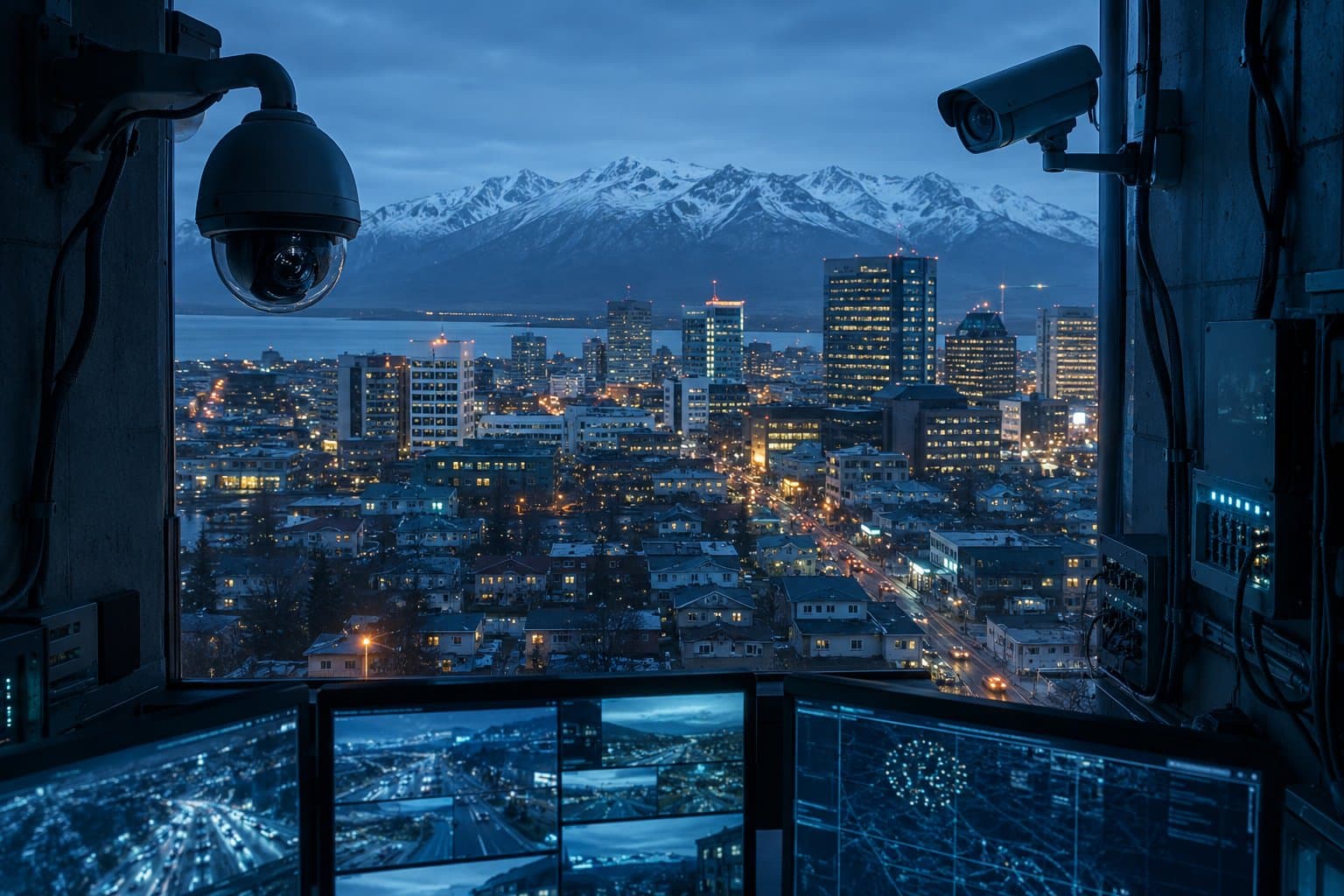
The center allows analysts to combine city cameras, private cameras shared voluntarily with police, traffic feeds, police databases, automated license-plate readers and drones dispatched ahead of officers to some calls.
The appropriation is part of roughly $1.4 million in police spending on Tuesday’s agenda. Another measure would spend about $419,000 in seized funds on special operations related to criminal investigations. A third would accept $400,000 from the FBI for improvements to a police training range shared with other agencies.
Anchorage has already begun operating the crime center.
Last year, the Assembly approved a five-year contract worth roughly $12 million with Axon Enterprise, which also supplies APD’s body cameras and Tasers. The contract included vehicle cameras, drones, license-plate readers and software capable of connecting hundreds of camera feeds. Cameras in Town Square Park were feeding directly into the center by November.
Tuesday’s vote would provide additional equipment for the system.
Police Chief Sean Case has said the technology can give officers more information before they arrive at dangerous calls. Drones may reach a scene first and show whether someone is armed, injured or in immediate danger. APD has also cited missing-person searches, active crimes and disaster response as potential uses.
The system also gives police the ability to collect and search records showing when and where vehicles are seen.
Alaska’s constitution provides stronger privacy protections than the federal Constitution in some circumstances. In 1972, voters added:
“The right of the people to privacy is recognized and shall not be infringed. The legislature shall implement this section.”
Alaska courts have held that the government must justify intrusions into privacy and consider whether less intrusive methods are available.
APD has drafted a policy governing the crime center. It prohibits predictive policing, limits access to trained employees and requires system activity to be logged. It generally prohibits monitoring protests and other protected activity without a specific public-safety threat. The police chief must review the center quarterly and issue an annual public report.
The public version of the policy is still marked “DRAFT,” and its effective-date fields are blank.
It also does not answer several questions about license-plate data.
The policy says footage from APD-owned cameras that does not become evidence will generally be deleted after 14 days. It does not clearly state whether that limit applies to license-plate records, private-camera files, database results or information received from another agency.
The policy does not specify how long routine plate records will be kept, what justification is required before an employee searches a vehicle’s history, who may place a vehicle on a watchlist or whether Anchorage can search records collected by partner agencies.
It does not require an independent audit of searches. It says violations may result in internal discipline, but the policy is for departmental use and does not ordinarily create a separate legal remedy for someone whose information is misused.
Automated license-plate systems can help police locate stolen vehicles, suspects and missing people. They can also create searchable records of vehicles whose owners are not suspected of a crime.
The funding measures also arrive through separate sources rather than the city’s ordinary general-fund appropriation. They still require Assembly approval, but the crime center has been assembled through a series of contracts, grants and equipment purchases rather than one vote establishing the full system and its rules.
Anchorage has already approved the cameras, drones and plate-reading technology. Tuesday’s vote would expand the equipment before APD has adopted a final public policy covering retention, historical searches, watchlists, agency sharing, audits and misuse.
The Assembly meeting begins Tuesday at 5 p.m.
Assembled from public records the newsroom collected ().
Drafted with AI. Edited by Cale Green (2 revisions). No full editor review is on record. Who is accountable.
Discussed in
Stay informed. Support what matters.
Free, permanent access to local news you can verify. Subscribe to support Walter AlaskaNews and go ad-free.
Related Coverage
Anchorage weighs surveillance rules 11 months after buying the system
Alaska News · 2w ago
As a crime center vote nears, Anchorage weighs whether its privacy limits should be policy or law
Alaska News · 3w ago
Anchorage Assembly takes up a $599,000 crime center purchase and surveillance limits
Alaska News · 2w ago
Mayor's substitute puts Anchorage's surveillance network before the Assembly Tuesday
Alaska News · 4d ago
In 1997 Anchorage voters rejected automated camera enforcement. Its new surveillance system needed no vote.
Alaska News · 4w ago
Comments
Sign in to leave a comment.
No comments yet. Be the first to share your thoughts.