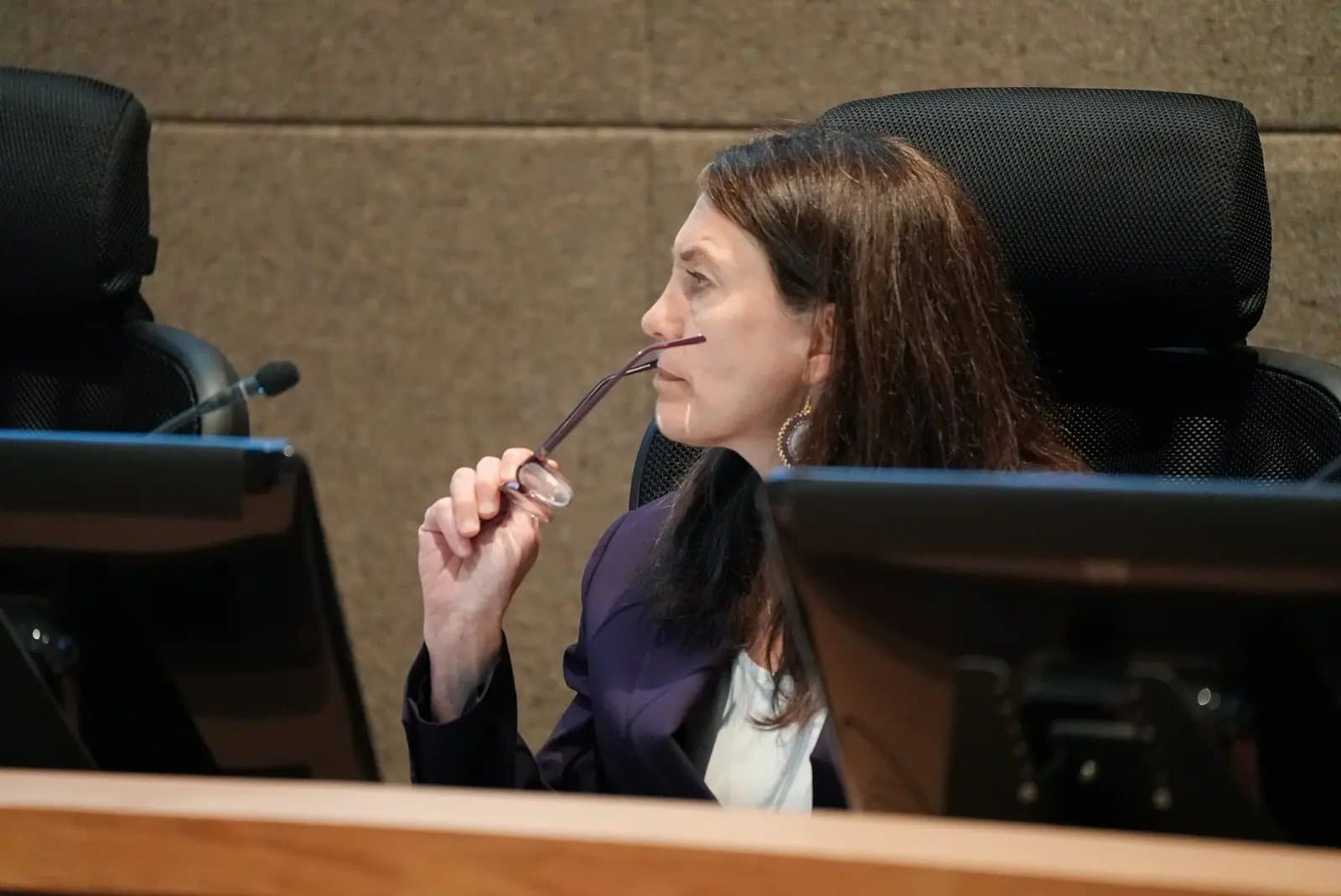
Photo of Mayor LaFrance, June 2026
Mayor's substitute puts Anchorage's surveillance network before the Assembly Tuesday
Anchorage did not decide to build a police surveillance network. It acquired one in pieces, over years, through purchases and agreements that each made sense on their own. Traffic cameras came through capital projects meant to manage intersections. Police access came through an agreement between two departments. Plate readers, patrol-car cameras, drones, private-camera connections and the software to search across all of it came inside a five-year Axon contract. This month the Assembly added a $599,000 video wall for the room where it all comes together.
The Assembly voted on the large expenditures. What it never approved in a single public decision was what those purchases now form: a system that can put public cameras, privately owned feeds, vehicle locations and outside data in front of one department at once. On Tuesday it continues a hearing on two competing ordinances for governing that system. One writes fixed limits into law. Mayor Suzanne LaFrance's substitute writes some protections into code and leaves the rest, including how long data is kept, to police policy.
How the cameras became police cameras
The last time Anchorage voters were asked about cameras, in April 1997, they amended the city charter so that vehicle violations must be enforced by a sworn officer. The vote followed a year of photo radar that ended with thousands of tickets thrown out. The charter provision does not prohibit police from using cameras, and it does not require a referendum on surveillance. But the 1997 ballot is the one time the public drew a line around automated enforcement, and everything since has come through procurement and administration.
The roughly 280 intersection cameras went up over years for traffic engineering: watching congestion, checking signal timing, letting electricians diagnose a problem without driving out. Each records on a continuous loop to a card inside the camera, overwriting itself every three to seven days. Police began requesting clips for crashes and investigations, and as the camera count grew, traffic engineering staff spent more of their time pulling video for officers.
In February 2025, Traffic Engineering and APD signed a memorandum giving police direct access through a workstation on the traffic system. Traffic Engineering remained custodian of recordings stored on its equipment. Footage downloaded for police work became an APD record governed by police retention rules. The agreement itself never went to the Assembly for approval.
Six months later, the Assembly approved a resolution stating that Anchorage had no published limitations or procedures for its traffic cameras and calling for a policy by Oct. 15. The resolution did not establish those rules. It asked the administration to write them.
Before that deadline, the Assembly approved a five-year, $11.8 million Axon package combining Tasers and interview-room equipment with an integrated camera-and-data system: body and patrol-vehicle cameras, evidence storage, 375 Fusus user licenses, capacity for 750 additional camera streams, plate readers and real-time locations for hundreds of patrol vehicles, drones, and 375 Auror licenses listed at no separate charge. Because Axon priced the products through overlapping bundles, the contract does not disclose how much Anchorage paid specifically for Fusus or the surveillance capabilities. The camera-access agreement was revised the following month.
At the time, city code governed police drones and banned municipal facial recognition. It did not govern the intersection cameras, plate readers or crime center. On Sept. 1, 2026, the Assembly separately approved up to $598,998 from fines and forfeitures for the Real-Time Crime Center's audiovisual buildout.
What the police say it does
Police Chief Sean Case has not been coy about the center's scope. APD's current policy says it may monitor and analyze public and private cameras, plate readers, drones, dispatch and public safety databases during active incidents and investigations. The same policy contains real limits: predictive analytics is prohibited in the center, observation of protests and other protected activity is restricted, and APD-owned camera feeds are deleted after 14 days unless preserved as evidence. Owners of private cameras who connect them keep control of access and retention until police collect a recording.
At an Aug. 21 work session, APD told the Assembly fewer than 10 employees can run historical plate searches, every search is logged, plate locations are held 14 days, and the readers do not photograph drivers. Its public page says the department does not use facial recognition or Flock cameras. It uses Axon plate readers instead. Both systems perform the core function at issue: scanning plates and creating searchable records of where and when vehicles were seen.
APD drew a line between people and objects. Its presentation said ordinary video cannot be used to find and track people, only objects. The line is not as clean as APD made it sound. In video processing, a person can be an object. APD's February 2025 critical-incident video shows moving masks keeping officers and the suspect visible as the rest of the Axon Fleet footage blurs around them. Axon Evidence includes object tracking and automated head detection for redaction. This is not evidence of citywide cross-camera tracking. It is evidence that APD's Axon workflow can already follow human subjects through recorded video.

That documented use of post-production tracking makes the remaining gap more important. The public record does not explain how APD processes live or archived footage in the crime center. APD calls its review manual, but has not said where software enters the process. An officer might choose a camera and watch it, or software might filter and index the footage before an officer confirms a result. No public document identifies which Fusus features are enabled, whether traffic feeds are recorded after reaching APD, or which licensed analytics are active.
A traffic engineering employee who spoke with Alaska News described a practical limit. Most of the signal network runs on old copper wire. When the city tested sending about four camera feeds to central storage at the resolution and frame rate Axon's staff requested, the network threw errors and the test was stopped to protect the signal system. Lower-rate sampling, a frame every few seconds from every camera, was discussed and not tested. Asked whether the few feeds that do reach the police platform are recorded, the employee said he does not know. That account establishes a bandwidth limit, not a privacy safeguard. It does not answer whether the feeds that reach the police platform are recorded, how APD can process them, or what becomes possible after the network is upgraded.
Two ordinances
The original, from Assembly members Daniel Volland, Sydney Scout and Keith McCormick, defines surveillance broadly as technology that collects, retains, analyzes, processes or shares information tied to a person. It would delete surveillance data after 14 days unless it became evidence, ban predictive analytics, bar the city from outside surveillance data networks, restrict purchases of historical plate or location data, require Assembly approval for surveillance acquisitions, and let residents sue.
The substitute narrows the definition to technology that uses machine learning or artificial intelligence to locate or identify people, and exempts systems used for traffic management and other routine functions "even if such technology observes or analyzes, or is capable of observing or analyzing" people's movements. Eight pages later it lists traffic cameras among the data the crime center uses.
The substitute does put things in code: a ban on discriminatory use and a restatement of constitutional limits; bans on selling surveillance data and APD sharing covered data outside law enforcement; required policies, training, annual reports and notice of material policy changes; Assembly approval for contracts that materially expand a listed technology; and Assembly power to suspend a technology after finding "knowing, material and consistent" violations. What it does not put in code is the 14-day limit. The department would set its own retention period in policy and notify the Assembly if it changes. Predictive analytics could be one input as long as police do not act on it alone. A private lawsuit becomes unavailable if the city investigates and adequately remedies the violation within 45 days.
The mayor's memorandum argues the original definition could sweep in smartphones and meeting cameras and create an unworkable approval regime. Her press release says the department already operates under "some of the strongest privacy protections in the nation," through the constitution and departmental policy. The memorandum also supplies the argument for the other side: "Police chiefs and administrations change, and departmental policy can change with them." Under the substitute, retention is departmental policy.
Information from outside
The system is not limited to what Anchorage's own cameras see. In 2019 the Assembly approved an Accurint subscription that APD described as public records, commercially available data and cross-jurisdictional information, at up to $149,000 over five years; the record does not show whether it was renewed after 2024. The Assembly also approved LeadsOnline options through 2028, giving investigators nationwide access to records of people's transactions with pawnshops, scrap yards, eBay, OfferUp, gold buyers and other secondhand stores.
Auror is the third route. Auror's own account of a 2026 retail security conference says APD focused on 20 repeat offenders and generated 194 cases and 181 arrests or warrants in about 10 weeks, results attributed to Deputy Chief Brian Wilson. Auror separately sells facial recognition to retailers. The company says police users cannot access that module and retailers cannot send matches to police through the platform, though a retailer who gets a match may decide to call police on its own.
A resolution adopted by the North Star Community Council last week alleges that police have acted on facial-recognition information obtained through such platforms. Available records do not establish whether that has happened. The unanswered questions are whether the ordinance governs an identification passed to police by a private company and what limits apply if that information enters APD's other systems.
Whether Accurint, LeadsOnline or Auror counts as surveillance technology under the substitute depends on the product and its use. The original addressed purchased location data and outside networks directly. The substitute does not.
The constitution, written for this
Article I, Section 22 of the Alaska Constitution says: "The right of the people to privacy is recognized and shall not be infringed." It was adopted in 1972 amid concern about computerized government information systems, including the state's developing criminal history network; a legislative history records that the final broad language replaced a draft aimed specifically at information gathered by or available to the state.
Alaska courts have read it as broader than federal protection. In State v. Glass, the Alaska Supreme Court required a warrant for secretly recording a private conversation even though a participant could have repeated it. In John Doe v. Department of Public Safety, it recognized that compiling scattered public records into a searchable system creates a privacy burden the individual records do not. In State v. McKelvey, it required a warrant for aerial observation of a home with a telephoto lens and rejected the idea that protection shrinks as technology becomes common.
None of those cases holds that recording public roads or keeping plate locations for 14 days is unconstitutional. No Alaska appellate court has decided whether integrating many public observations into a searchable record of a person's movements is a search. Until one does, whatever the Assembly writes, or leaves to policy, is the protection.
What the contract permits
The Axon agreement gives Anchorage ownership of its evidence and bars advertising uses. It also enrolls the city by default in Axon's Customer Experience Improvement Program, which lets the company extract selected content, strip identifying elements, and use it to improve products; the contract's example is license plate characters disassociated from the vehicle, time and place. Anchorage can opt out. The record does not show whether it has. Query logs and metadata generated as officers use the system belong to Axon as an independent controller, which means deleting a video and deleting every record of its use are not the same act.
What's next
The hearing continues at 6 pm Tuesday at the Loussac Library. Written comment and phone testimony registration are due by 5 pm Monday.
Source: Anchorage Assembly ().
AI-assisted, reviewed by Cale Green. Who is accountable.
Stay informed. Support what matters.
Free, permanent access to local news you can verify. Subscribe to support Walter AlaskaNews and go ad-free.
Watch the short version
Related Coverage
Anchorage weighs surveillance rules 11 months after buying the system
Alaska News · 2w ago
In 1997 Anchorage voters rejected automated camera enforcement. Its new surveillance system needed no vote.
Alaska News · 3w ago
Ordinance would make police ask before buying surveillance tech
Alaska News · 3w ago
Anchorage is considering expanding its surveillance network. The privacy rules are still a draft.
Alaska News · 1mo ago
As a crime center vote nears, Anchorage weighs whether its privacy limits should be policy or law
Alaska News · 3w ago
Comments
Sign in to leave a comment.
No comments yet. Be the first to share your thoughts.