
DOT says cameras don't read plates; vendor policy allows video storage
Temporary cameras that recently appeared in Palmer, Wasilla and Anchorage are there to count pedestrians and vehicles, not to read license plates, the Alaska Department of Transportation and Public Facilities says. The vendor's own materials back that up — as far as it goes. What they also show is that the same systems can record, upload and store public-traffic video, with no time limit on how long the company keeps it.
The cameras are made by Miovision, whose portable Scout system is marketed for counting vehicles, pedestrians and bicycles and studying traffic and road safety. DOT&PF said in a social media post that the devices are collecting anonymous traffic data to help decide where to add pedestrian crossings between bus stops and shopping centers, as part of an upcoming highway safety project, and are usually installed for three to seven days before being moved or removed. "They do NOT read or record license plates," the department wrote.
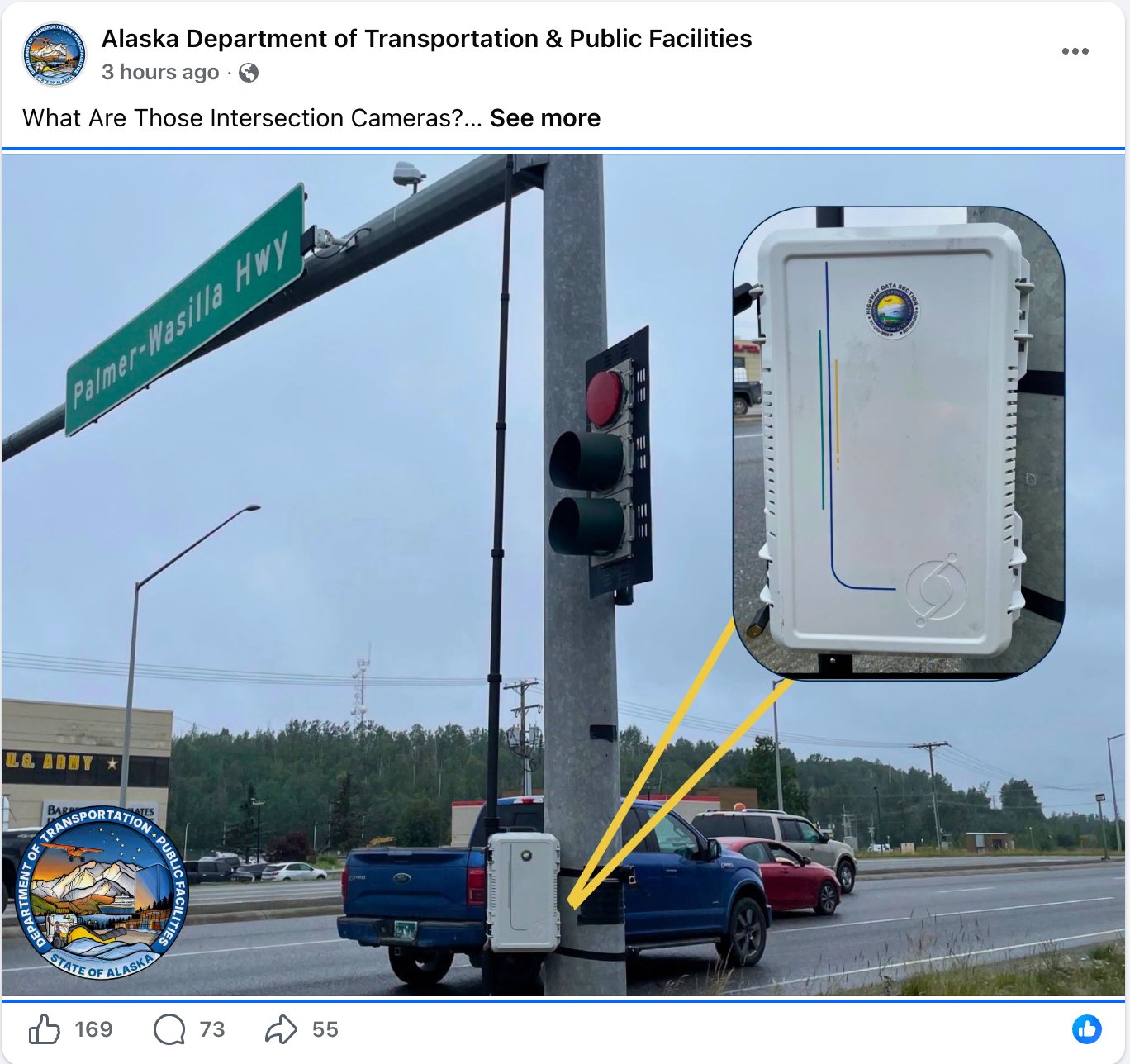
That claim holds up for a standard traffic-count deployment. But Miovision's privacy policy describes capabilities that go further than counting. It says the company's mobility products are "required to be deployed and configured by customers so as to obfuscate the identity of individuals" — meaning obscuring identities is something the buyer sets up, not something the hardware guarantees on its own. The policy also says some products "enable recording and/or uploading of traffic video," that uploaded video "may be stored in our systems," and that the company processes public-traffic video to train and validate its algorithms. It sets no retention period for that video.
So the department's statement is accurate as far as it goes: a routine Scout traffic count is not a license-plate-reader system. What the vendor material can't answer is how Alaska configured these particular units — whether video is being uploaded, how long any raw video is kept, who can access it, and whether retained footage could be tied back to a specific time and place. The department hasn't been asked those questions and has published nothing addressing them.
Source: Alaska DOT says temporary traffic cameras do not read license plates.
AI-assisted. How we use AI
From prior coverage
Anchorage Assembly to vote July 21 on $351K for pedestrian and bike count program
Alaska News · 2mo ago
Anchorage is considering expanding its surveillance network. The privacy rules are still a draft.
Alaska News · 2mo ago
Anchorage Assembly will vote June 23 on $214,684 for a pedestrian safety campaign
Alaska News · 3mo ago
Palmer meeting set for Glenn Highway safety project feedback
Alaska News · 4mo ago
Stay informed. Support what matters.
Free, permanent access to local news you can verify. Subscribe to support Walter AlaskaNews and go ad-free.
Watch the short version
Related Coverage
Anchorage police detail the limits on their Real-Time Crime Center
Alaska News · 1mo ago
Anchorage is considering expanding its surveillance network. The privacy rules are still a draft.
Alaska News · 2mo ago
Mat-Su considers banning plate readers before it has them
Alaska News · 2w ago
In 1997 Anchorage voters rejected automated camera enforcement. Its new surveillance system needed no vote.
Alaska News · 1mo ago
As a crime center vote nears, Anchorage weighs whether its privacy limits should be policy or law
Alaska News · 1mo ago
Comments
Sign in to leave a comment.
No comments yet. Be the first to share your thoughts.