Generated AI Image
As a crime center vote nears, Anchorage weighs whether its privacy limits should be policy or law
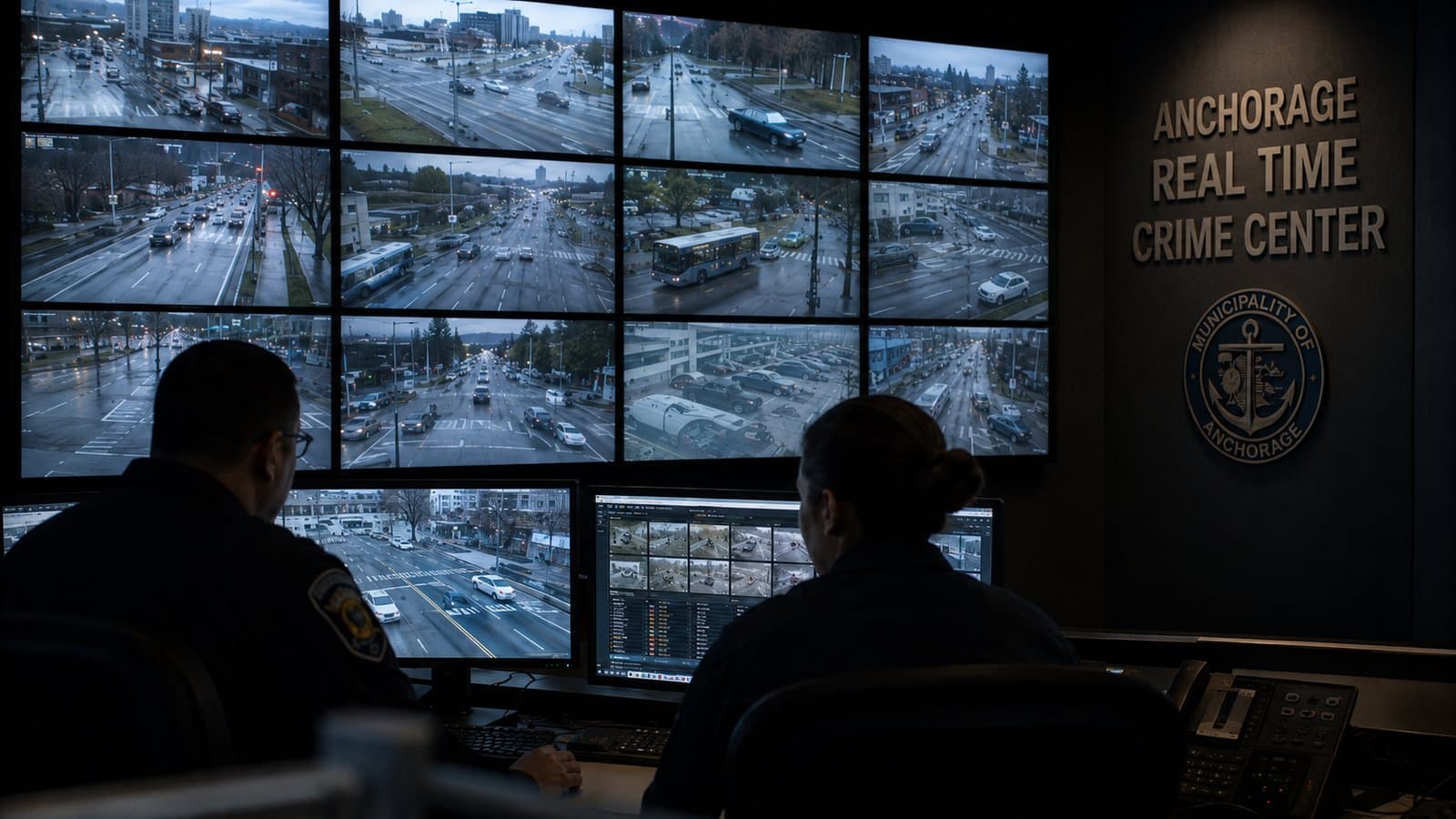
The Anchorage Assembly votes Sept. 1 on roughly $600,000 for the police department's Real Time Crime Center, a purchase it has twice postponed and one Chief Sean Case says buys no new surveillance power. At a work session Friday, members pressed him on the question a pending surveillance ordinance turns on: whether the privacy limits on that system should stay department policy, which a chief can change, or be written into law.
The contract, with ThunderCat Technology and capped at just under $599,000, covers a video wall, an 86-inch conference display, video-processing equipment and an air-gapped control network — equipment, Case said, not new surveillance capability, with the underlying technology already bought. He called the current room inadequate: one operator runs computer-aided dispatch off a mobile computer built for a patrol car, and another had to switch to a landline mid-call when the cell connection failed. Moving out of "that closet" is what the money buys, he said: "The technology in and of itself has already been purchased."
Case said the license plate reader system logs every plate it reads, not just hits, keeps that data 14 days, and limits historical searches to about 10 employees under internal APD policy. He acknowledged he could change that policy, and so could a successor — "I can change a policy" — though he said Alaska's constitutional right to privacy, its strict search-and-seizure rules, penalties for misusing a police database, and municipal code, which already restricts the city's use of facial recognition, still constrain any chief. Assembly member Sydney Scout pressed the point. "What does it take to change a policy in the police department?" she asked, noting that the protections officials keep citing are internal practices, not law. Assistant Municipal Attorney Dean Gates said code supersedes policy: if the Assembly adopts conflicting rules, the department must rewrite its own.
The surveillance ordinance, laid on the table this week, would do that. Its sponsors say it would restrict surveillance to incident-based public safety purposes, bar retaining data on people not suspected of wrongdoing, make clear that the Assembly, not vendors, controls what the system can do, and require Assembly approval before the department buys new surveillance technology. Case argued that code cannot keep pace with changing technology. The ACLU of Alaska has argued that such limits belong in binding law rather than policy that can change without notice, and privacy advocates with the Flip the Flock campaign are urging residents to request the department's plate reader and crime center policies, retention settings and audit logs.
Case also detailed how the system has been used. The department released license plate data to a federal agency once in 2026, in a violent felony case, with a commander's approval, he said. Residents and businesses have registered 236 private cameras with the department, which Case said it cannot view. Assembly member George Martinez asked where the purchase money comes from; Case said it is federal asset-forfeiture money earned by APD officers on federal task forces, which can buy equipment but cannot replace an existing municipal funding stream. "We can't supplant with this, with this money," he said.
The purchase returns to the Assembly Sept. 1 without a public hearing, having arrived on the consent agenda as a memorandum. The Assembly holds a public hearing on the surveillance ordinance the same day at the Z.J. Loussac Library; testimony forms are due by 5 pm Aug. 31.
This article is based on a public meeting of Municipality of Anchorage — Anchorage Assembly: Worksession re AM 524-2026, Real Time Crime Center ().
Made by our human newsroom with AI. How humans and AI work here · Grow with our newsroom Transcript byLucas Brown
Stay informed. Support what matters.
Free, permanent access to local news you can verify. Subscribe to support Walter AlaskaNews and go ad-free.
Related Coverage
Anchorage paid to expand the crime center, then put off the rules
Alaska News · 1mo ago
Anchorage Assembly takes up a $599,000 crime center purchase and surveillance limits
Alaska News · 1mo ago
Anchorage is considering expanding its surveillance network. The privacy rules are still a draft.
Alaska News · 2mo ago
Anchorage weighs surveillance rules 11 months after buying the system
Alaska News · 1mo ago
Anchorage police detail the limits on their Real-Time Crime Center
Alaska News · 1mo ago
Comments
Sign in to leave a comment.
No comments yet. Be the first to share your thoughts.