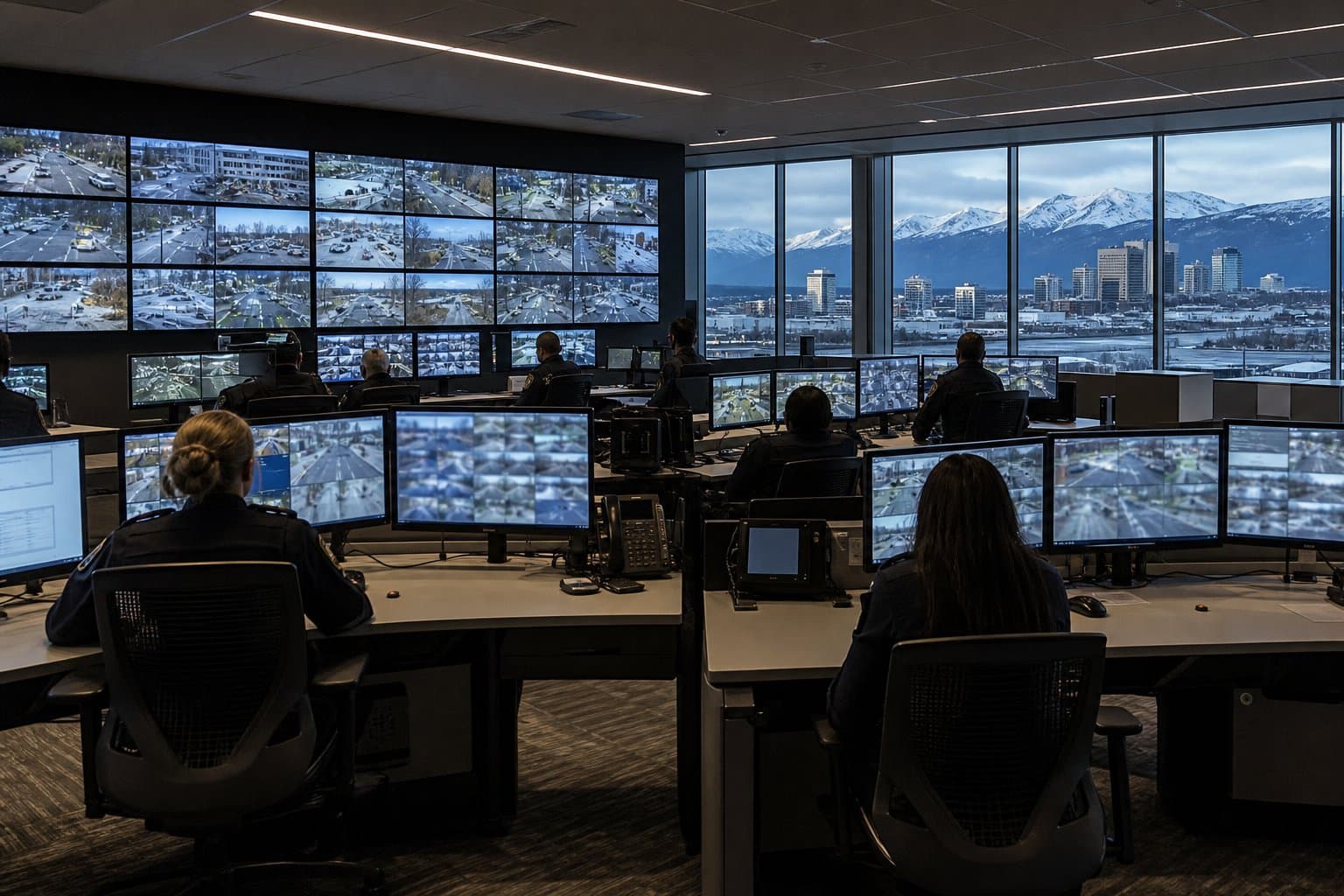
AI image
In 1997 Anchorage voters rejected automated camera enforcement. Its new surveillance system needed no vote.
In 1997, Anchorage voters were handed a question: should the city let cameras write traffic tickets? They rejected automated enforcement so decisively that the result still shapes the city charter, which allows only a sworn officer to issue a citation. The cameras themselves never went away — Anchorage still runs traffic cameras at intersections. What voters killed was letting a machine do the ticketing. Nearly thirty years later, a far more powerful surveillance system has arrived in the city with no public vote at all. It came as a line in a contract.
That system — a Real-Time Crime Center built to pull in as many as 750 camera feeds, plus automated license plate readers and drones — went to the Anchorage Police Department in an $11.8 million deal the Assembly approved last September. It was an ordinary contract vote, not a ballot question, and it carried no change to the city's surveillance code. Now some Assembly members are trying to write rules for the system after the fact, in an ordinance that has drawn unusually heavy public backlash. The debate itself has been revealing — as much about how officials understand the technology as about the technology itself.
Part of the argument has turned on shrinking the thing down. In the funding discussions, members described the system in the most modest terms available — cameras, equipment, a computer in a room. The sponsors of the ordinance push back on that instinct in their findings, noting that the license plate readers and drone-detection tools arrived bundled into the Axon contract "at no additional cost," and arguing that treating surveillance capability as incidental equipment is how it enters a city without the scrutiny a standalone purchase would draw. Strip the context from anything and it looks small; what matters is what the equipment does, not what it is.
Another thread has exposed a gap in how members understand what they're voting on. At one point, an Assembly member questioned how the system could take in hundreds of camera feeds, reasoning that no one could watch them all at once. That is true of human monitoring — a person can't watch hundreds of screens. But a Real-Time Crime Center does not depend on someone watching. It runs on software — computer vision and machine learning — that can process feeds automatically, flag whatever it is set to look for, and store footage to be searched later. The limits that apply to a human watching a bank of monitors do not apply to a machine sorting through all of them. Much of what the ordinance is trying to govern turns on that distinction. (The Axon platform's public materials say it does not currently use facial recognition.)
The ordinance — from Assembly Members Keith McCormick and Sydney Scout and Vice Chair Daniel Volland — would move the guardrails from departmental policy into binding law. It would require Assembly approval before any city agency acquires or expands surveillance technology, "regardless of dollar value," including free trials. It would cap license plate data at 14 days unless it's evidence, limit live camera monitoring to logged, time-limited sessions, and let residents sue over violations. It would also make evidence gathered in violation inadmissible in a municipal case unless it helps the defendant — a sharper consequence than the department's current policies, each of which states by its own terms that it "does not apply in any criminal or civil proceeding."
Police say meaningful limits already exist. Chief Sean Case has told the Assembly that policy sets 14-day retention for plate reader data, restricts crime-center access to fewer than 10 employees, and requires him to weigh quarterly whether the program's benefits outweigh the privacy risks. The distinction the ordinance's backers keep returning to is that those are the department's own rules, which a future chief could rewrite — and that Anchorage code, as it stands, says nothing about crime centers or license plate readers at all.
For now, the two sides are still talking. The Assembly has kept the measure alive and continued its public hearing, giving residents more time to weigh in as the sponsors work through compromises. What Anchorage is weighing is a harder version of a question it once settled at the ballot box. In 1997, the stakes were a ticket in the mail. This time it is a system that can watch, record and search — and no one is being asked to vote.
Source: Anchorage Municipal Assembly.
Made by our human newsroom with AI. How humans and AI work here · Grow with our newsroom
Stay informed. Support what matters.
Free, permanent access to local news you can verify. Subscribe to support Walter AlaskaNews and go ad-free.
Related Coverage
Mayor's substitute puts Anchorage's surveillance network before the Assembly Tuesday
Alaska News · 1mo ago
Anchorage weighs surveillance rules 11 months after buying the system
Alaska News · 1mo ago
Anchorage is considering expanding its surveillance network. The privacy rules are still a draft.
Alaska News · 2mo ago
As a crime center vote nears, Anchorage weighs whether its privacy limits should be policy or law
Alaska News · 1mo ago
Warrant rule for sharing police camera data splits Anchorage Assembly surveillance drafts
Alaska News · 3w ago
Comments
Sign in to leave a comment.
No comments yet. Be the first to share your thoughts.