AI Generated Image
Analysis: Ranked choices and late ballots could flip three Alaska legislative races
Three Republican lawmakers who lead on first choices in Alaska's latest election count could lose their seats once ranked choices and the last absentee ballots are counted, an Alaska News analysis of state election data shows.
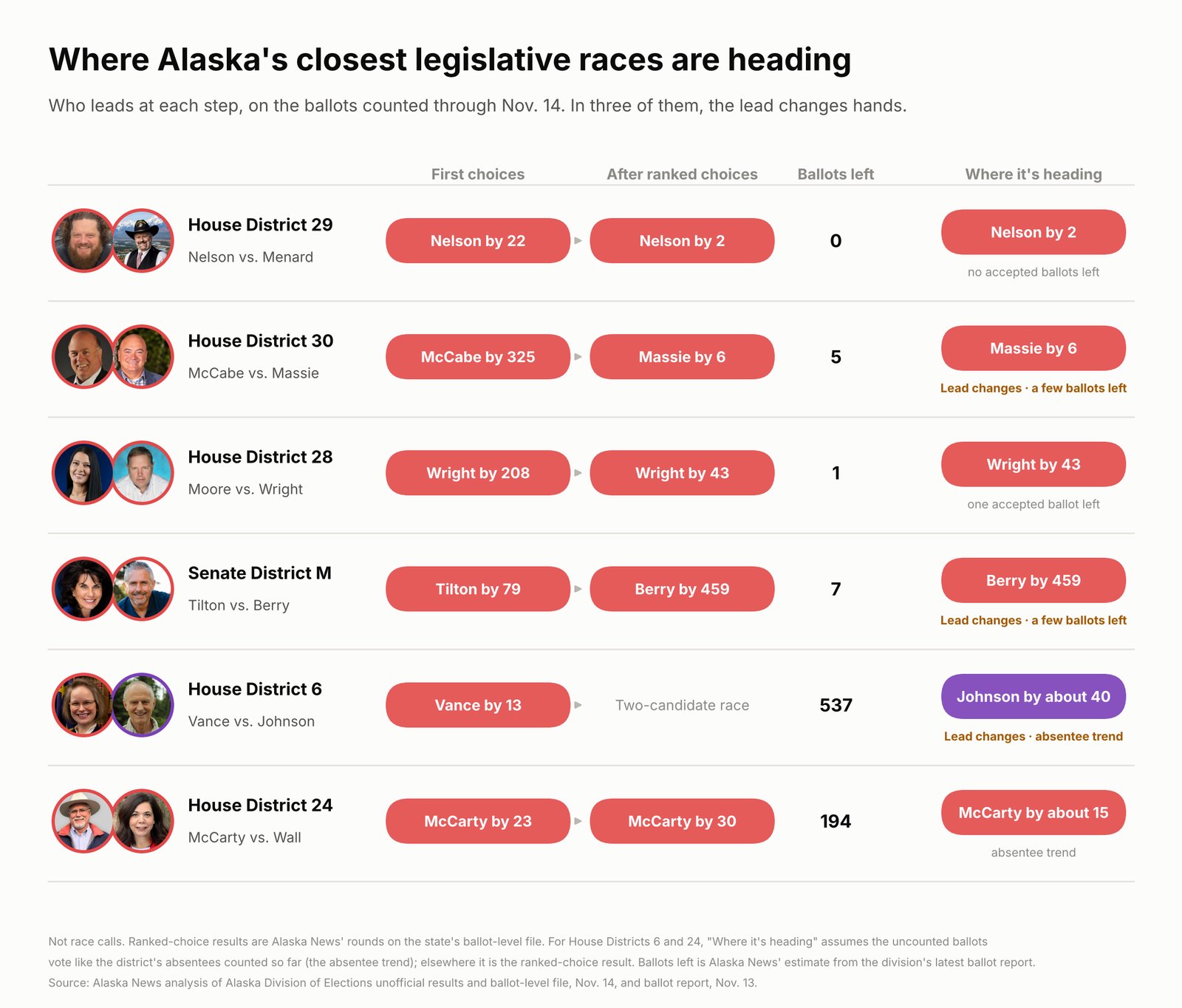
Rep. Kevin McCabe in House District 30 and Sen. Cathy Tilton in Senate District M would fall behind fellow Republicans after ranked choices, on the ballots counted through Saturday, Nov. 14. Rep. Sarah Vance leads her nonpartisan challenger in House District 6 by 13 votes, but he has won most of the absentee votes counted there, and hundreds of absentee ballots are still uncounted.
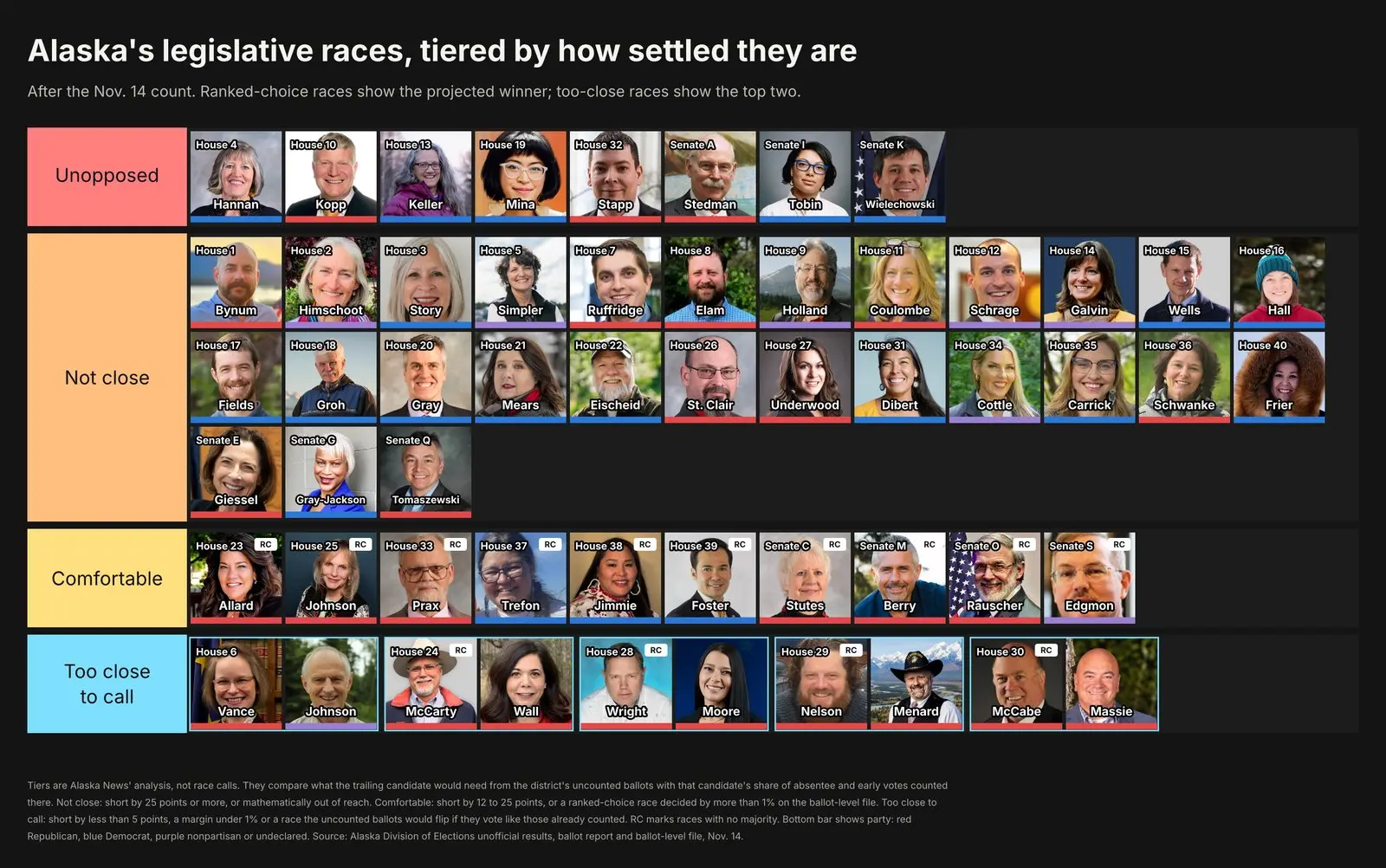
They're among the closest of the 50 legislative races on this year's ballot, five of which Alaska News rates too close to call. The results will help settle the makeup of a Legislature where both chambers are run by bipartisan coalitions.
Alaska News ran ranked-choice rounds on the ballot-level file the Division of Elections posted with Saturday's results, which records how each ballot was marked without identifying voters. In the Mat-Su districts, the file includes every ballot counted so far. The rounds follow state law: last-place candidates are eliminated one at a time, and their ballots move to each voter's next choice. The division plans to run its own rounds after its final count of absentee and questioned ballots Nov. 18.
Four of the closest races, in and around the Mat-Su, follow the same pattern. In each, a Republican incumbent faces a Republican challenger, and the result turns on the minority of ballots for Democrats and other candidates that rank one of them. On the ballots counted so far, only one of the four incumbents, Republican Rep. Garret Nelson, would hold on, and by just 2 votes.
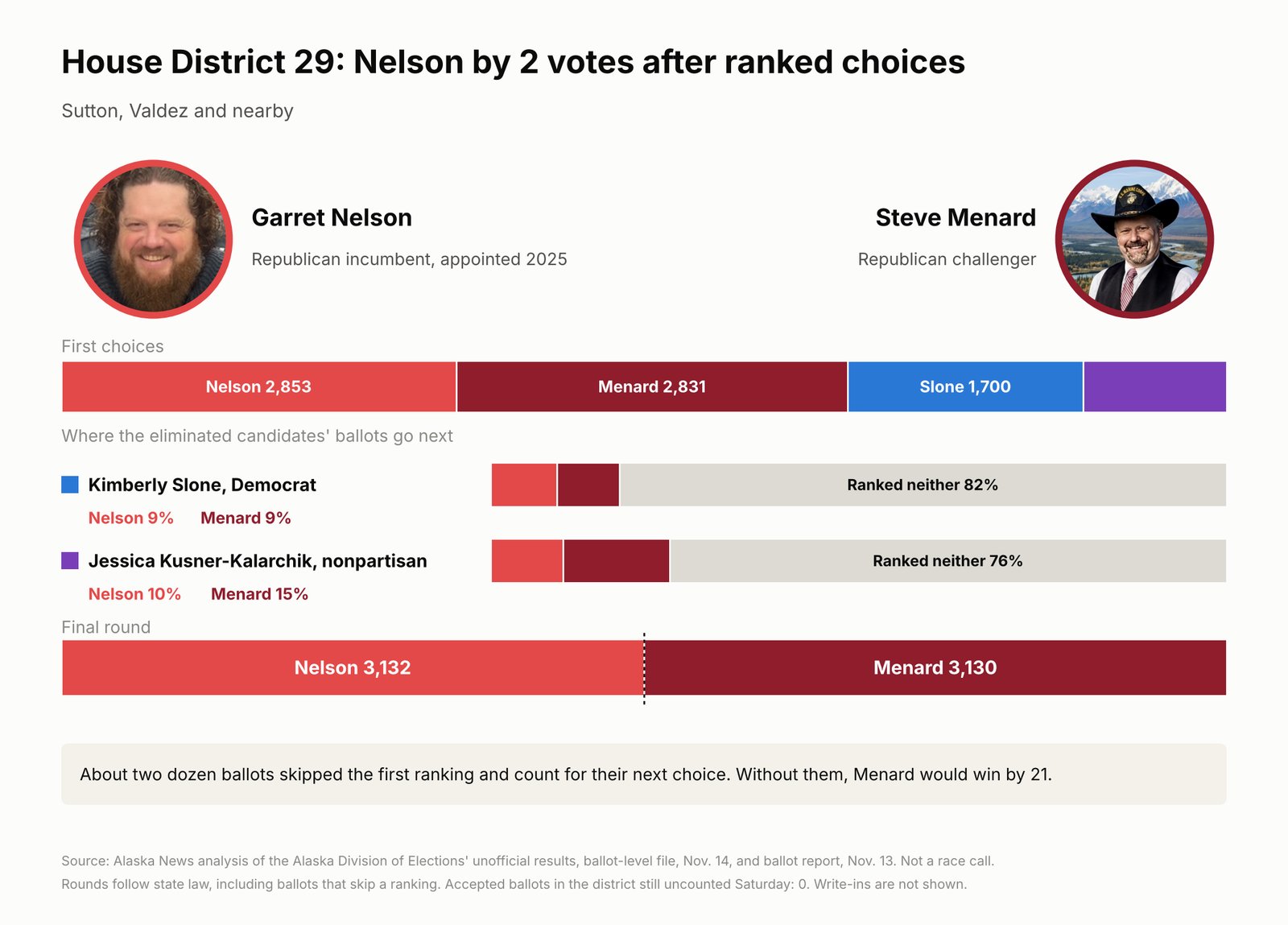
In House District 29, which includes Sutton and Valdez, Nelson, whom Gov. Mike Dunleavy appointed last December, leads Republican Steve Menard by 22 first-choice votes. Neither has a majority, so ballots for Democrat Kimberly Slone and nonpartisan Jessica Kusner-Kalarchik would move to their voters' next choices. Most rank neither Republican, and the rest lean slightly toward Menard. Nelson would finish with 3,132 votes to Menard's 3,130.
That 2-vote edge comes from about two dozen ballots that left the first choice blank and ranked a candidate second. The state's first-choice totals leave them out, but state law counts a skipped ranking for the voter's next choice. Without them, Menard would win by 21. No accepted ballots from the district are left to count, by Alaska News' count.
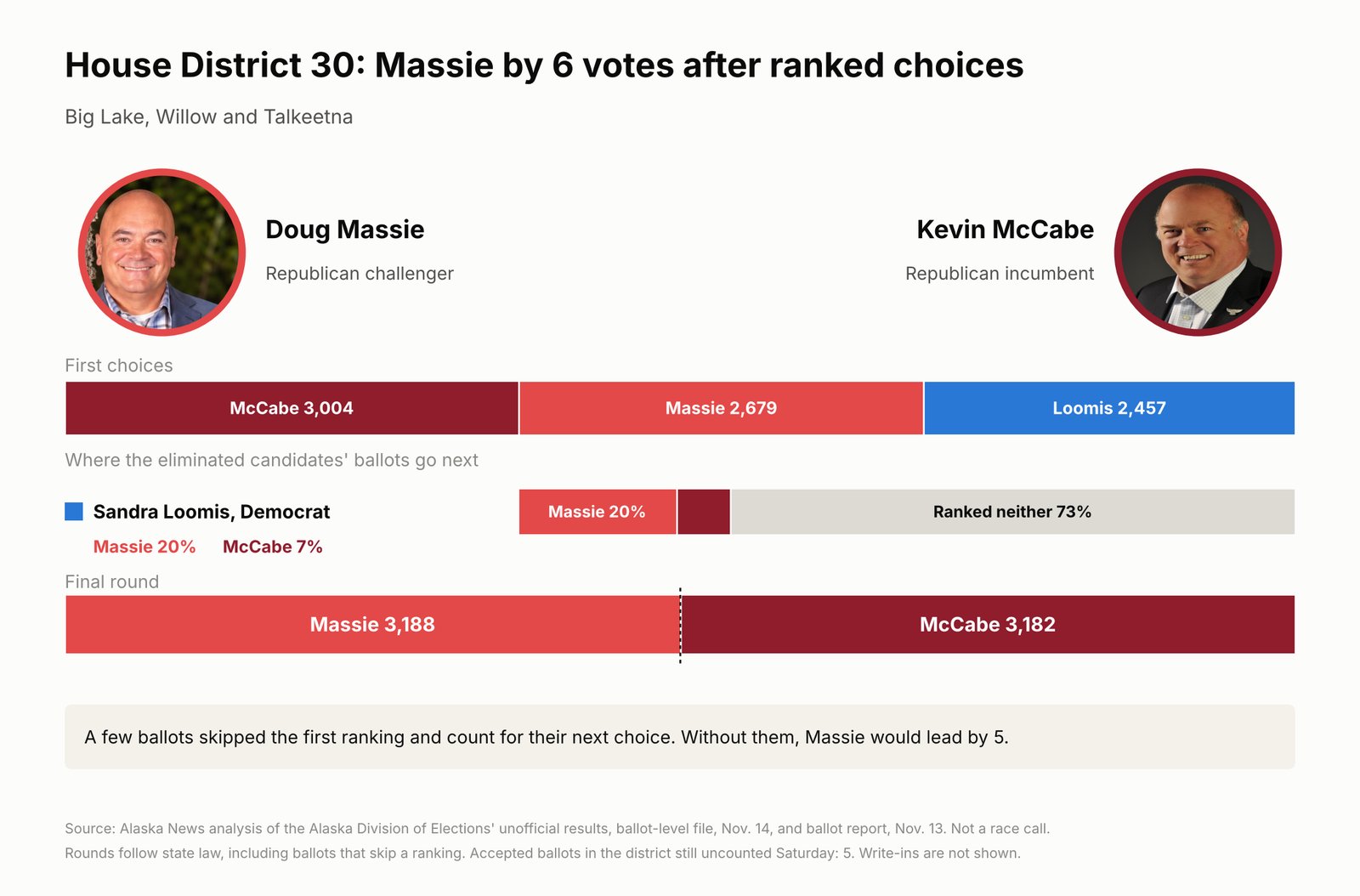
House District 30, which includes Big Lake, Willow and Talkeetna, is nearly as close. McCabe leads Republican Doug Massie by 325 first-choice votes, but about 20% of the ballots for Democrat Sandra Loomis rank Massie next, compared with 7% for McCabe. That would put Massie ahead 3,188 to 3,182. Without the few ballots there that skipped the first ranking, Massie would lead by 5.
Alaska recounts a race automatically only if it ends in a tie. But both margins fall within the range where the state pays for a recount if a losing candidate or 10 voters ask for one: 20 votes or fewer, or less than 0.5% of the votes for the two candidates. They have five days after the state finishes reviewing the results to ask. Absentee ballots from overseas can still arrive through Nov. 18.
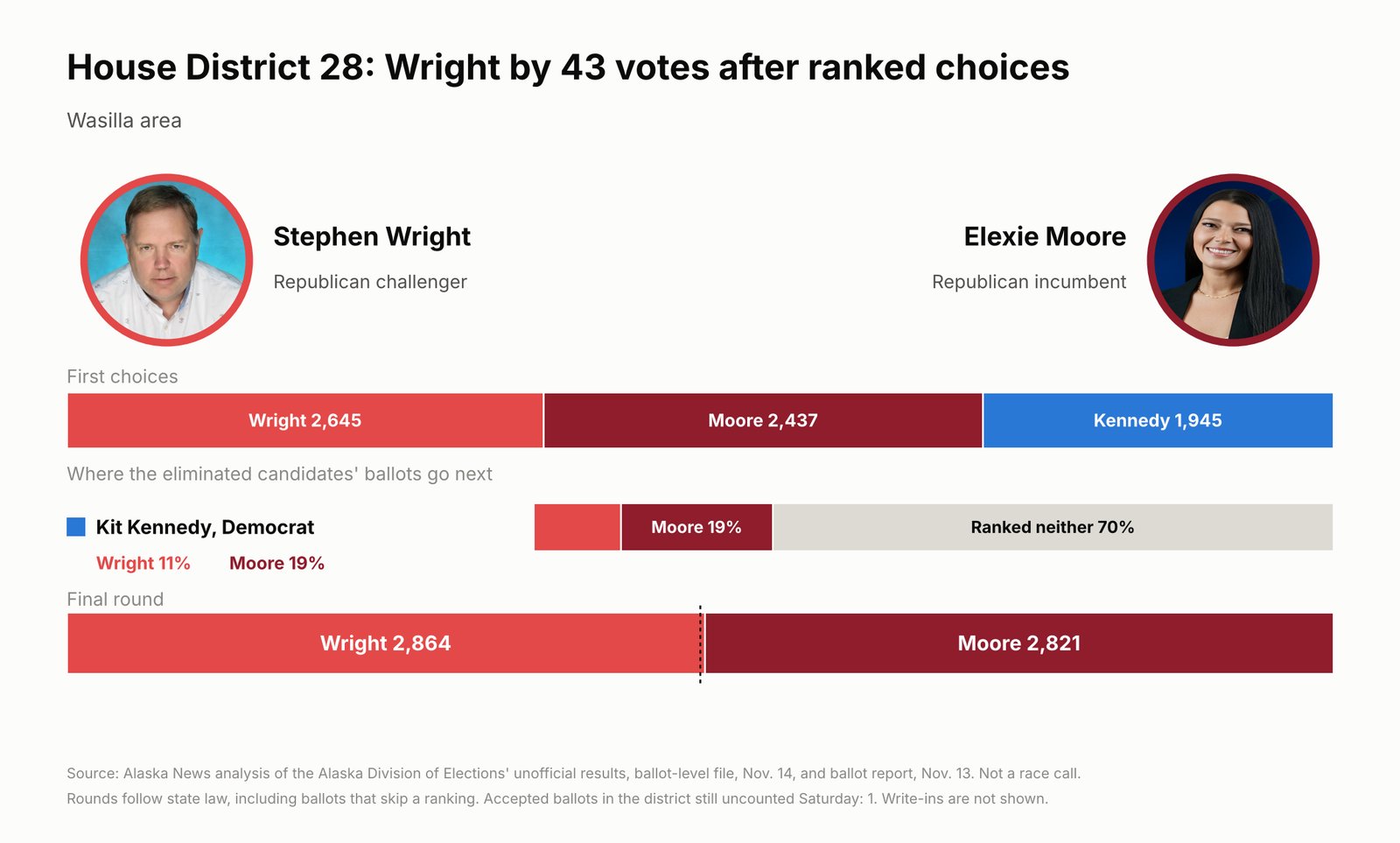
The other two Mat-Su incumbents would lose on the ballots counted so far. In House District 28, in the Wasilla area, Republican Stephen Wright leads Republican Rep. Elexie Moore by 208 first-choice votes. Ballots for Democrat Kit Kennedy favor Moore, 19% to 11%, but most rank neither, and Wright would win the final round by 43.
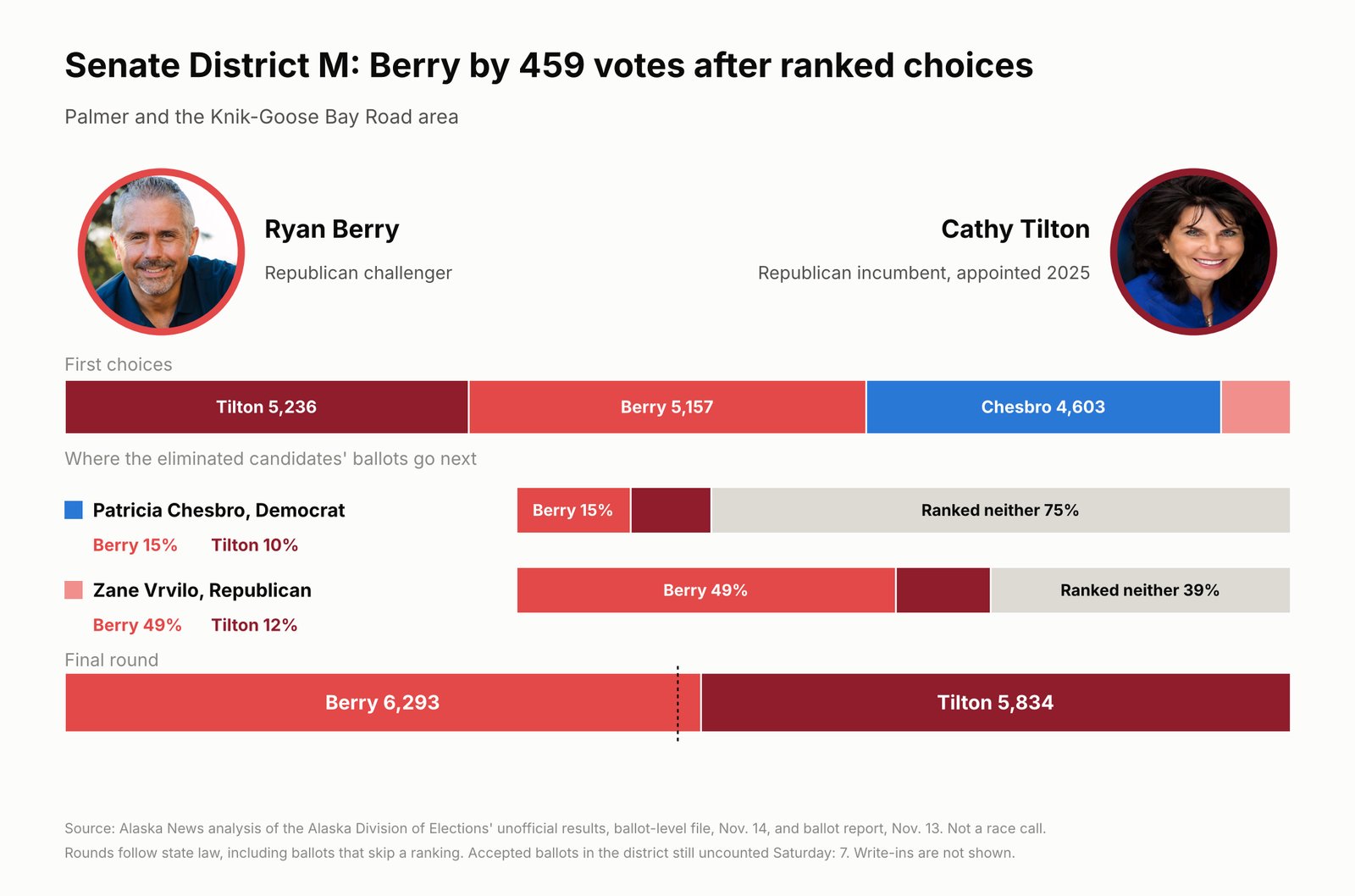
In Senate District M, which covers Palmer and the Knik-Goose Bay Road area, Tilton leads Republican Ryan Berry by 79 first-choice votes. Dunleavy appointed Tilton to the seat last November. But about half the ballots for Republican Zane Vrvilo rank Berry next, compared with 12% for Tilton, and ballots for Democrat Patricia Chesbro favor Berry too. Berry would win by 459, with seven ballots there uncounted.
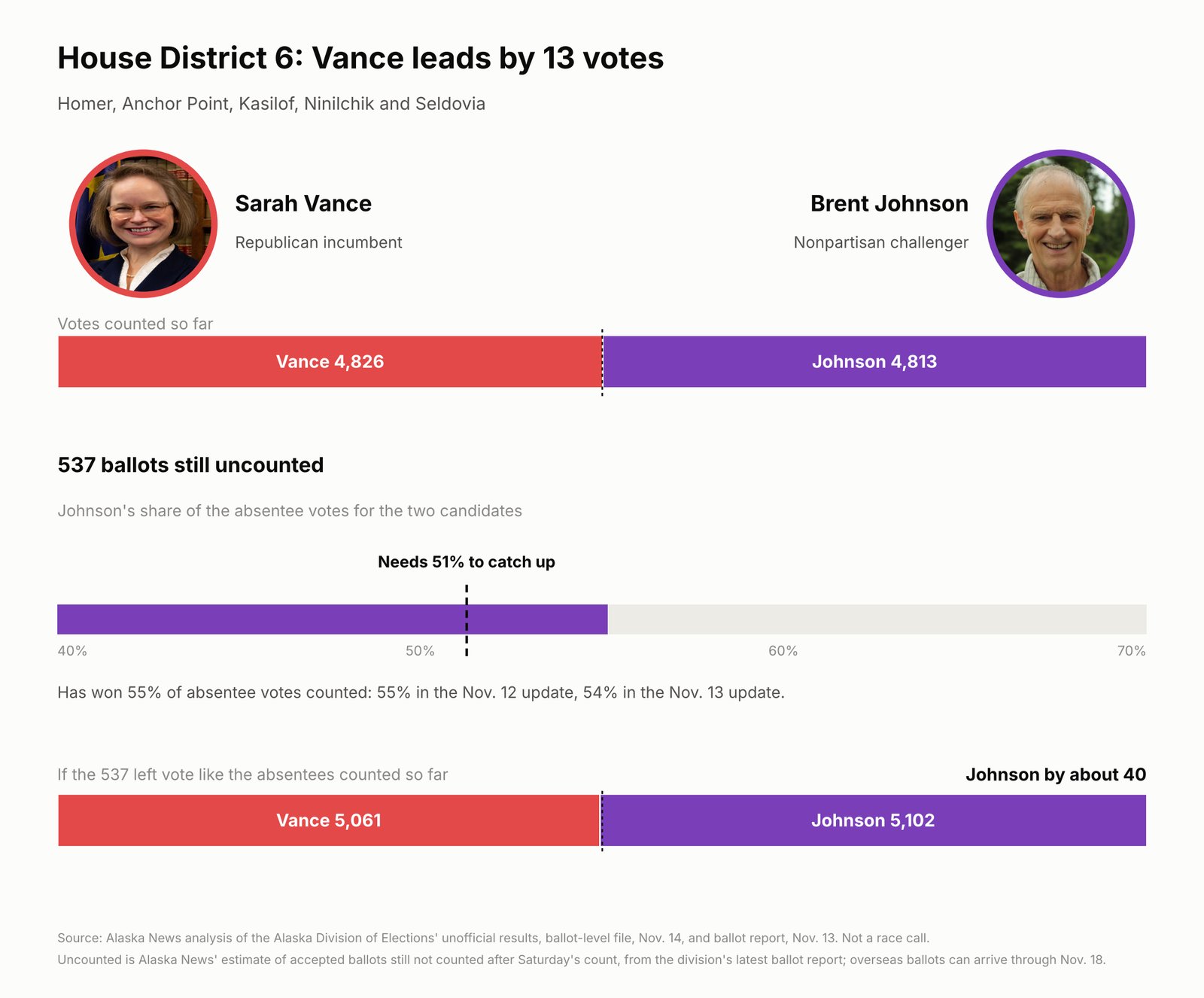
Vance's race in House District 6, which includes Homer, Anchor Point, Kasilof, Ninilchik and Seldovia, is the closest on first choices and the only one too close to call that could change the House's party count.
After Saturday's count, she leads nonpartisan Brent Johnson 4,826 to 4,813, down from 164 votes Thursday; Johnson has won the district's ballots counted since then 781 to 630. About 535 absentee ballots from the district still haven't been counted, by Alaska News' count from the division's latest ballot report, and Johnson has won 55% of the district's absentee votes counted so far.
If the rest vote the same way, he would finish about 40 votes ahead, by Alaska News' math.
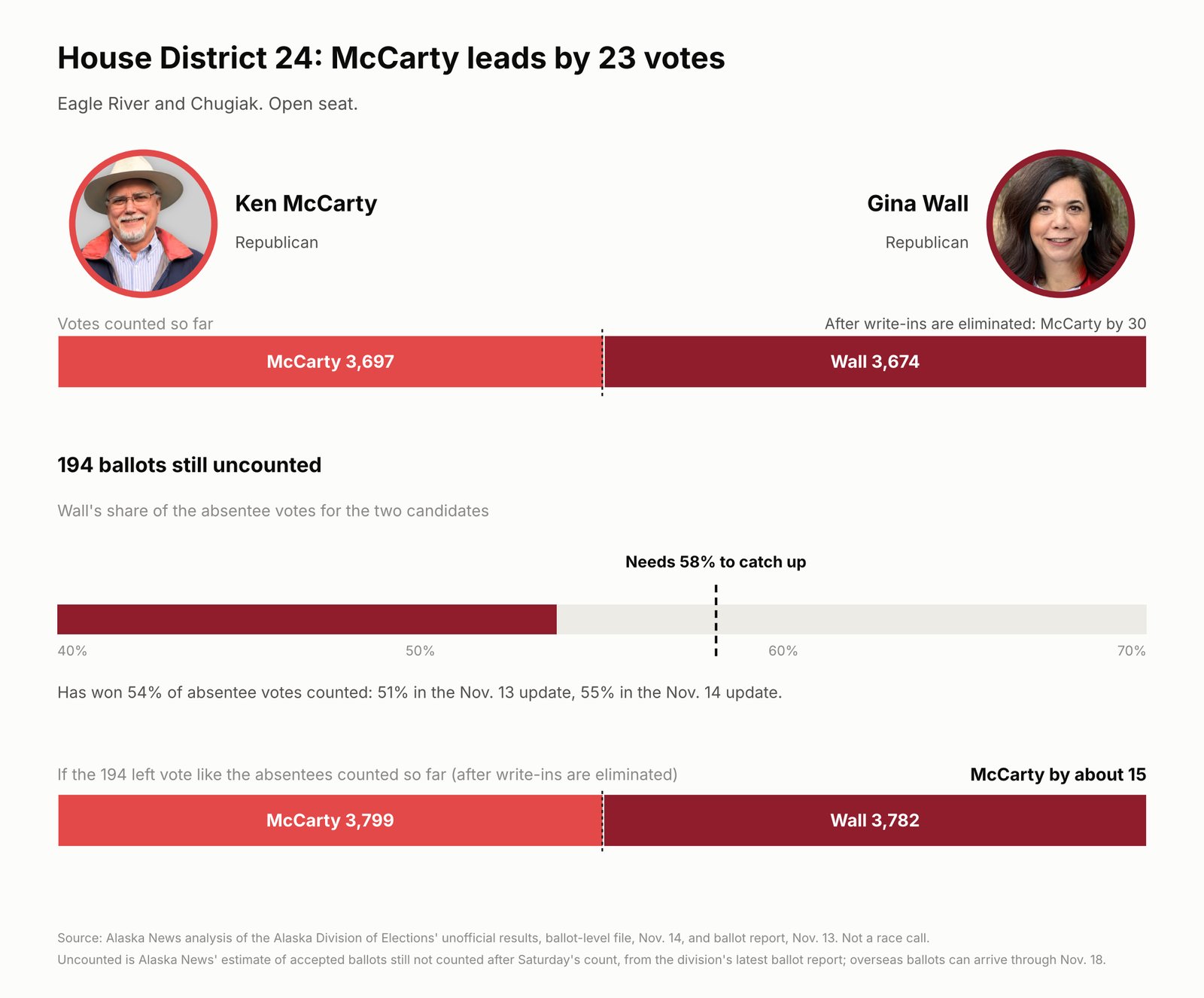
In House District 24, in Eagle River and Chugiak, Republicans Ken McCarty and Gina Wall are 23 votes apart for an open seat after Wall won Saturday's ballots there 147 to 127. McCarty would lead by 30 after write-ins are eliminated. About 190 ballots there are left to count, and Wall would need about 58% of the votes on them. She has won 54% of the district's absentee votes counted so far. If the rest vote like those, McCarty would win by about 15, by Alaska News' math.
Party counts don't decide who runs the House; coalitions do, and they cross party lines.
The current House is run by a 21-member bipartisan coalition of all 14 Democrats, all five independent or nonpartisan members and two Republicans, including Majority Leader Chuck Kopp of Anchorage. It's led by Speaker Bryce Edgmon, who is registered undeclared and is running for the Senate. The incoming coalition has picked Rep. Calvin Schrage, a nonpartisan Anchorage lawmaker, for speaker and Kopp again for majority leader.
If every current leader holds on, the House would have 17 Democrats and six nonpartisan or undeclared members, 23 in all, up from 19 now, based on the Legislature's member list and the parties listed on the ballot. Republicans would drop from 21 seats to 17, or 16 if Johnson wins. Those 23 would be more than the 21 votes it takes to pass a bill in the House, but the coalition hasn't said how many members it will have, and Republicans like Kopp have been part of it.
The coalition's size matters beyond that. Its members chair the committees, including the Finance committees that write the budget and the Rules committees that decide which bills reach the floor, and a bigger majority has more room when members break ranks.

The shift in party numbers comes from five seats, none of them among the races still too close to call. Democrats lead for seats held by Republican Reps. Mia Costello and David Nelson. Nonpartisan candidates lead for the seats Republican Reps. Louise Stutes and Frank Tomaszewski are leaving to run for the Senate. And Democrat Evelynn Trefon leads for Edgmon's seat.
Two House races that were unsettled after the election have firmed up. Democratic Rep. Neal Foster of Nome, the coalition's pick as a Finance co-chair, would win his three-way race by about 640 votes after ranked choices. And in the Fairbanks area, nonpartisan Joy Beth Cottle's lead over Republican Harmony Tomaszewski grew from 43 votes the day after the election to 245.
In the Senate, where 10 of the 20 seats were on the ballot, the party balance would barely move. Republicans lead for all six of the seats they hold among those 10, which would keep them at 11, and Edgmon leads for the Senate District S seat held by Democratic Sen. Lyman Hoffman, which would leave Democrats with eight.
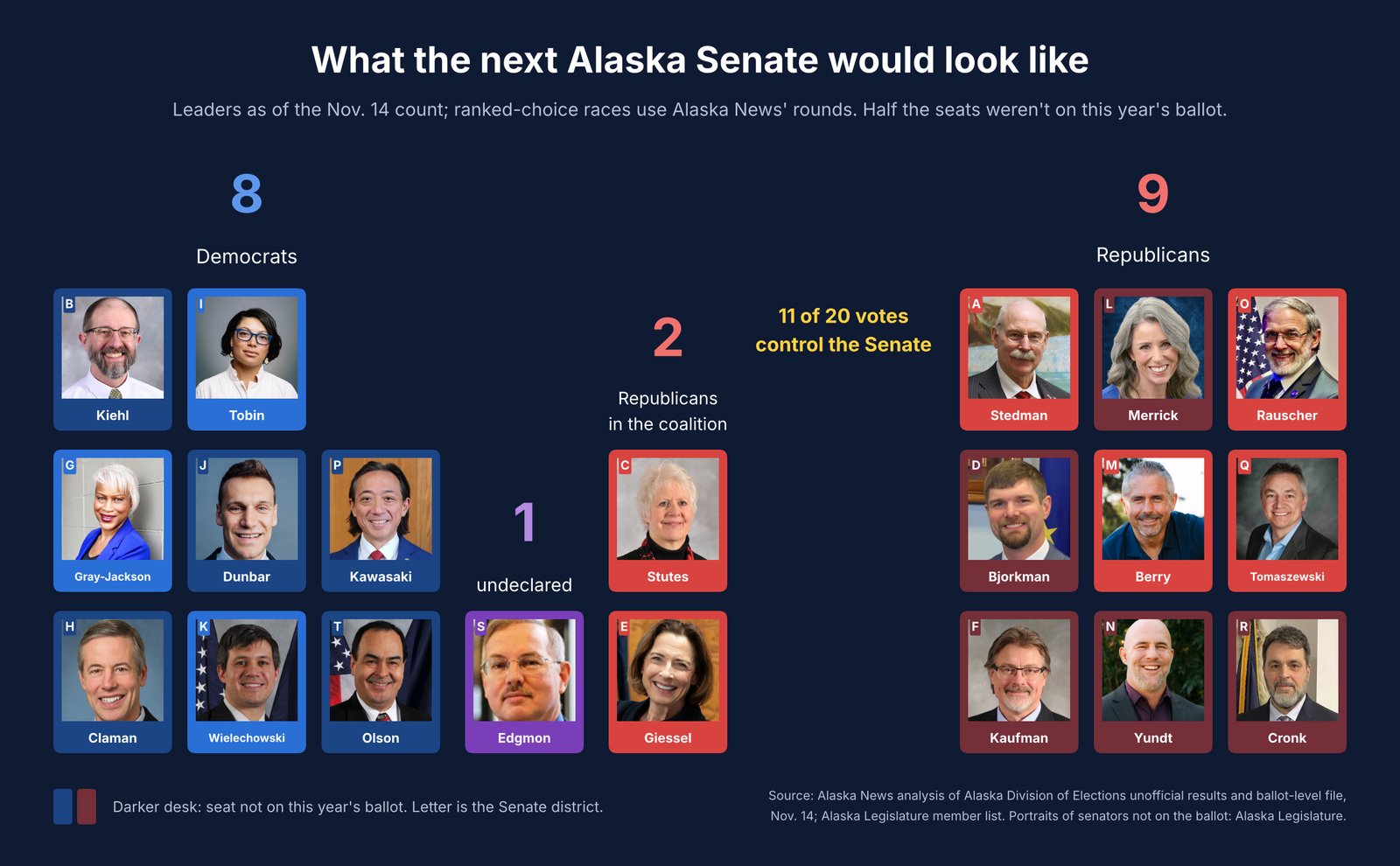
But the Senate's bipartisan coalition is shrinking. It has 14 members now, nine Democrats and five Republicans, down from 17 when it formed after the 2022 election. Three of those Republicans, Sens. Jesse Bjorkman of Nikiski, Kelly Merrick of Eagle River and Bert Stedman of Sitka, have left for a nine-member, all-Republican minority that Bjorkman will lead, the Alaska Beacon reported Saturday. Senate President Gary Stevens, another coalition Republican, and Hoffman won't be in the next Senate.
For now, that leaves the coalition, which has picked Republican Sen. Cathy Giessel of Anchorage for Senate president, at 11 members, the bare minimum to control the 20-member chamber; eight of them would be Democrats. That would make it, like the House coalition, mostly Democratic, which could make for an easier working relationship with Democrat Jonathan Kreiss-Tomkins, whom CNN projected Nov. 12 as the winner of the governor's race. With 11, it can't lose a single vote, or be missing a single member, and still pass a bill on its own. Berry, who would replace Tilton, plans to join the minority, the Beacon reported, so that race doesn't change the coalition's math.
The coalition is counting on two candidates whose races are headed to ranked-choice rounds, and both would win comfortably on the ballots counted so far. Stutes, its pick for majority leader, has 49.6% of first choices in Senate District C and would beat Republican Heath Smith by about 1,600 votes after Republican Carrie Harris is eliminated. Edgmon would beat Republican Darren Deacon in Senate District S by about 900 to 1,000 votes, depending on how ballots missing from the state's file are handled, and by more than 800 even under Alaska News' worst-case check.
Most other races are settled or close to it. Eight candidates had no opponent, and Alaska News rates 27 races not close. On Anchorage's Hillside, Republican Rep. Julie Coulombe leads Democrat Danni Hall by 164 votes, and with only about 180 ballots left there, Hall would need nearly all of them.
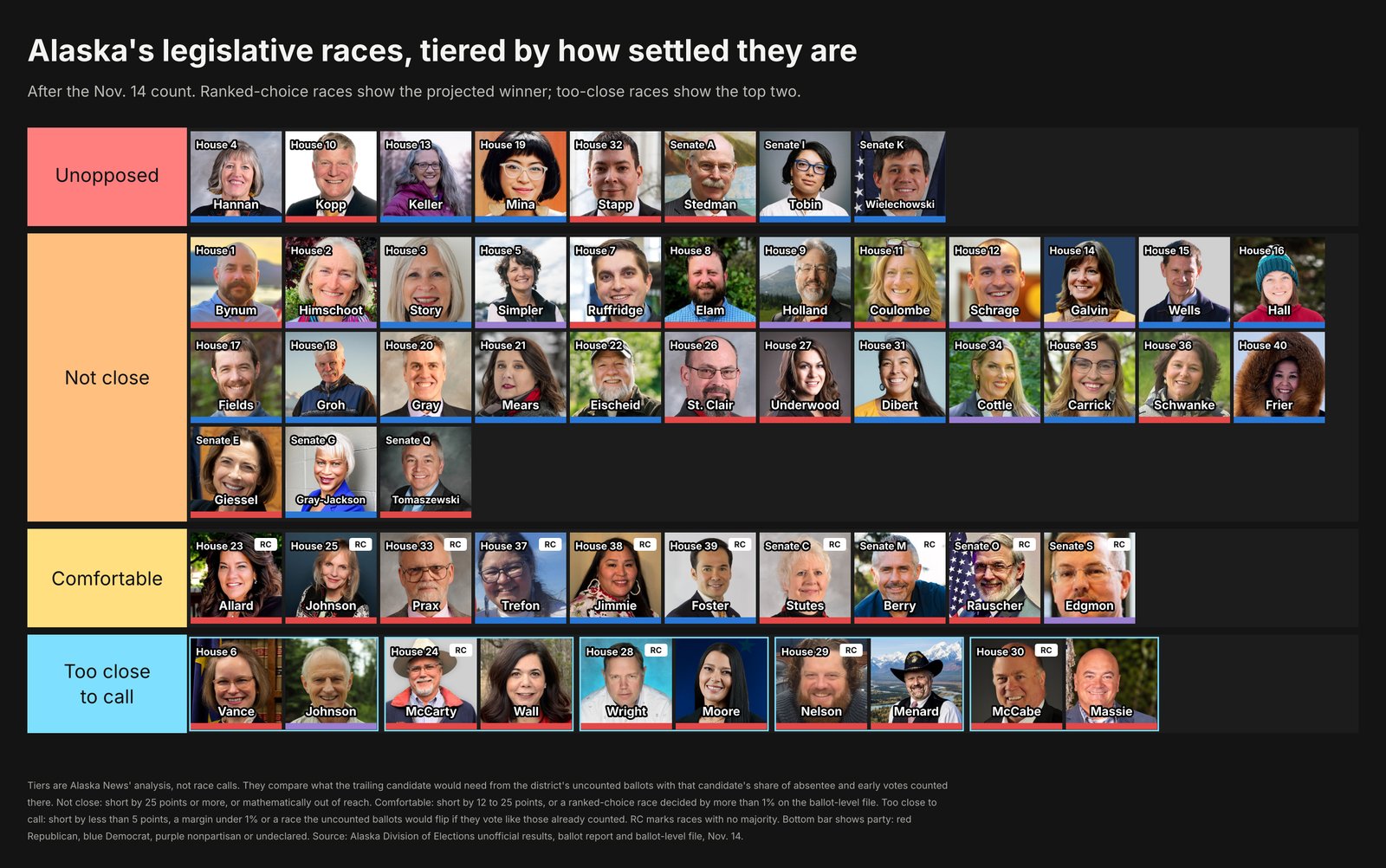
Saturday's ballot-level file also filled in many rural ballots that earlier versions didn't include. The file still leaves out ballots counted only by hand, so for rural races Alaska News also applied the file's rankings to the official first-choice totals.
Even under Alaska News' worst-case check, in which every ballot still missing from the file for an eliminated candidate ranks the runner-up next, the leaders in House Districts 37, 38 and 39 and Senate District S would all win. The full tiers and the rules behind them are in the chart.
The state aims to certify results Nov. 25.
What did you make of this story? (no account needed)
Get Alaska News in your inbox
Create your free account and get the day’s top stories around 6 each morning, in a few minutes’ read.
Top stories, around 6 each morning.
Stories on what you follow, on Sundays.






Comments
Sign in to leave a comment.
No comments yet. Be the first to share your thoughts.