AI Generated Image
Analysis: Ranked-choice repeal trails, with less crossover voting than in 2024
Alaska's second attempt in two years to repeal ranked-choice voting is losing so far, with tens of thousands of ballots still to be counted.
On Ballot Measure 2, "No" leads "Yes" 51.9% to 48.1%, a gap of about 7,600 votes, in the Division of Elections' latest results, posted at 1:09 pm Wednesday. A "Yes" vote is for the repeal, and a "No" vote is to keep ranked-choice voting.
If "No" holds, Alaska would keep the open primaries and ranked-choice general elections voters adopted in 2020.
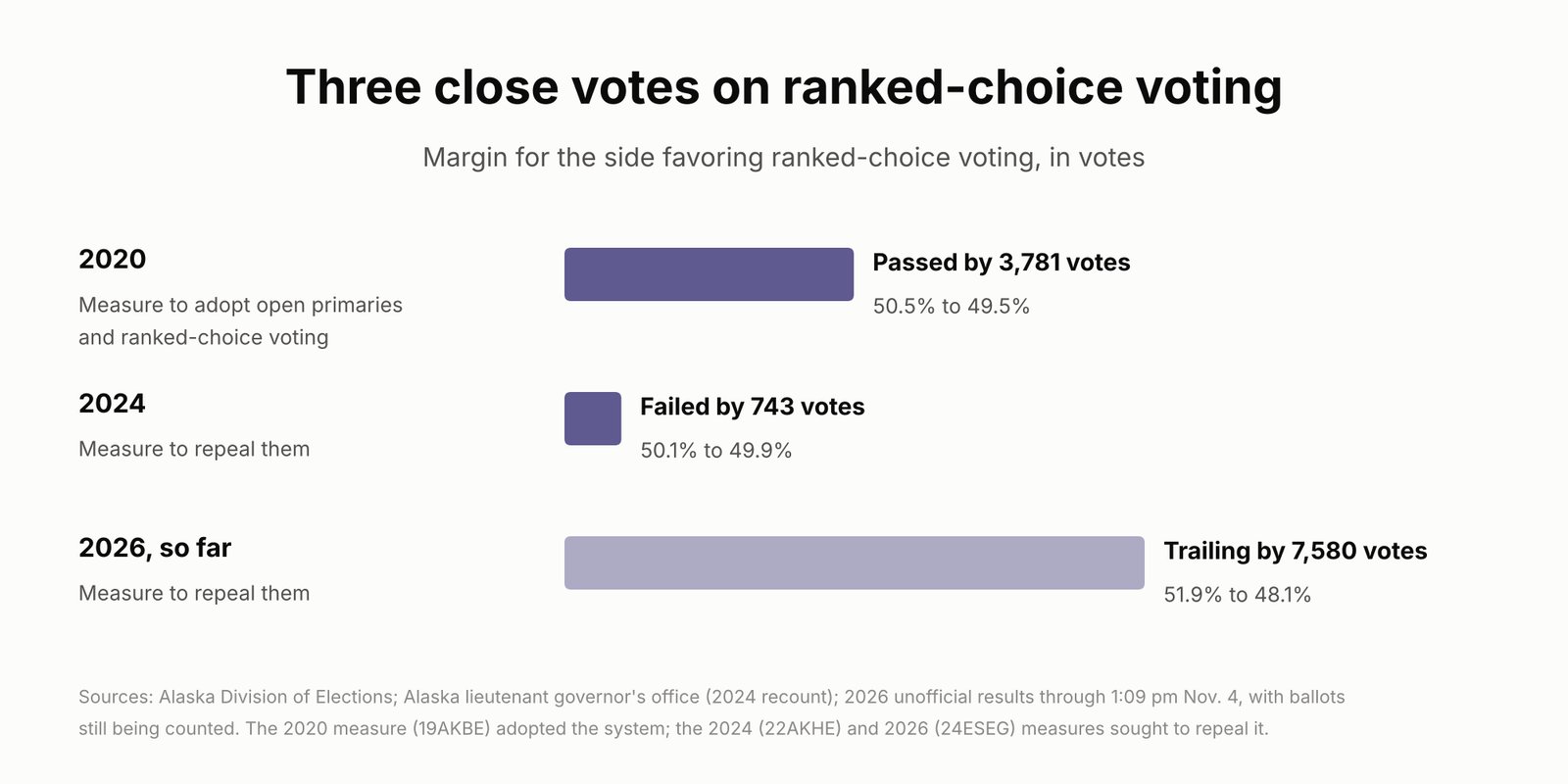
The Associated Press estimated Wednesday that about 74% of the expected vote had been counted, which would leave roughly 75,000 ballots. About 51,000 of those were early and absentee ballots already in the division's hands as of Wednesday morning, by Alaska News' count from its ballot report. If 50,000 to 75,000 votes on the measure remain, "Yes" would need about 55% to 58% of them to pass.
So far, "Yes" has done better on Election Day than in early and absentee voting. It won about 51% of Election Day votes, compared with about 42% of the early votes and 41% of the absentee votes counted so far.
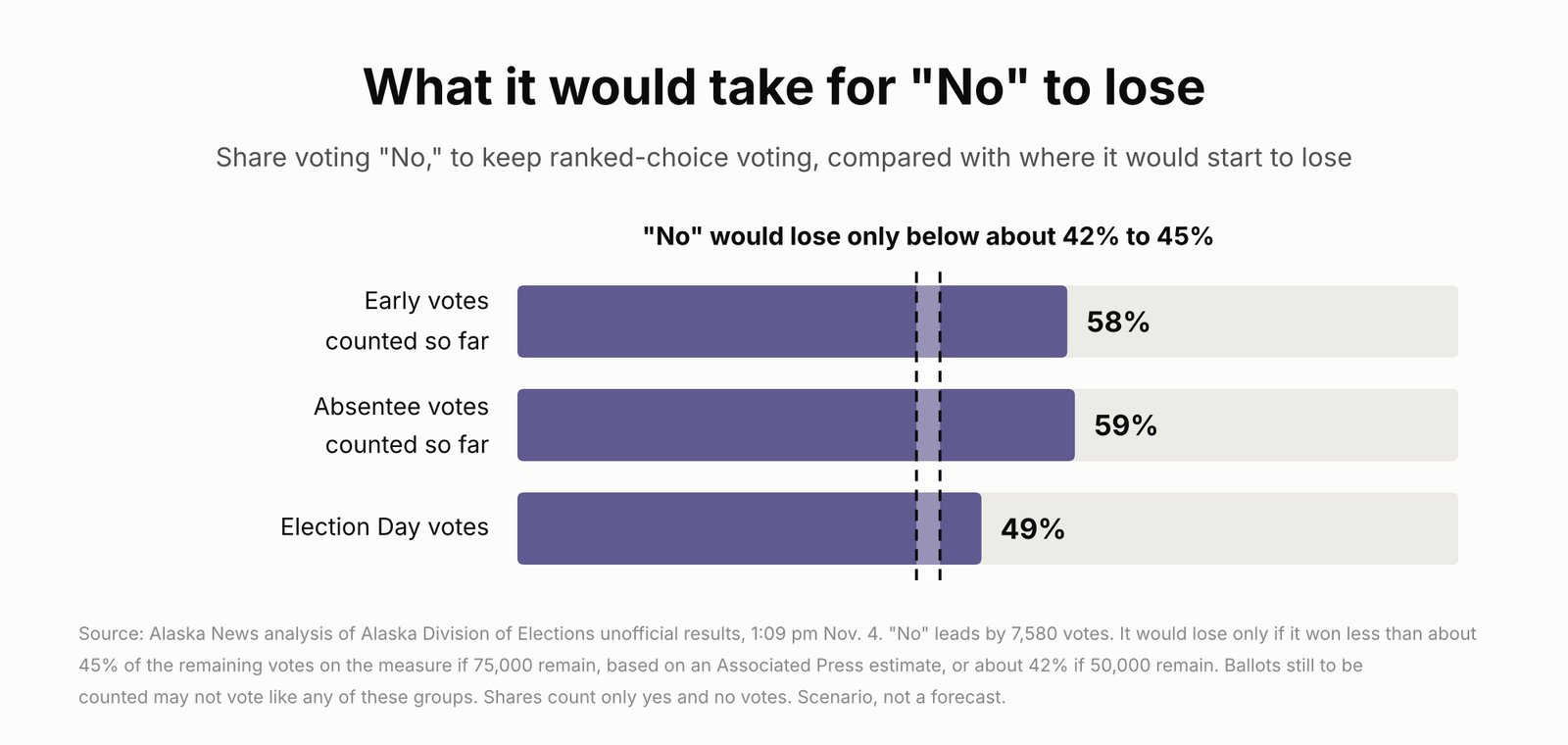
Voters adopted the system in 2020 with about 50.5% of the vote, and a 2024 repeal failed by 743 votes after a recount.
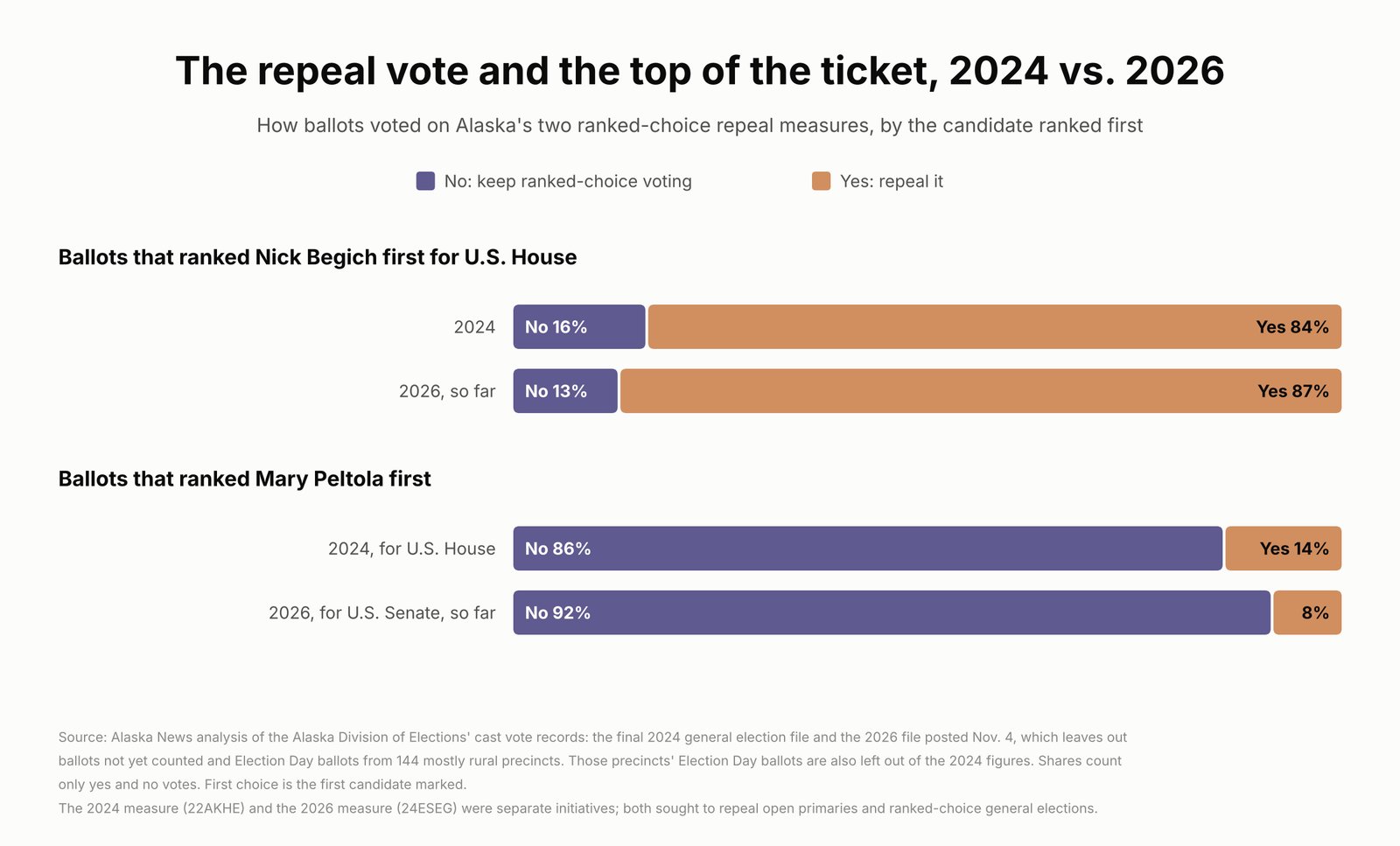
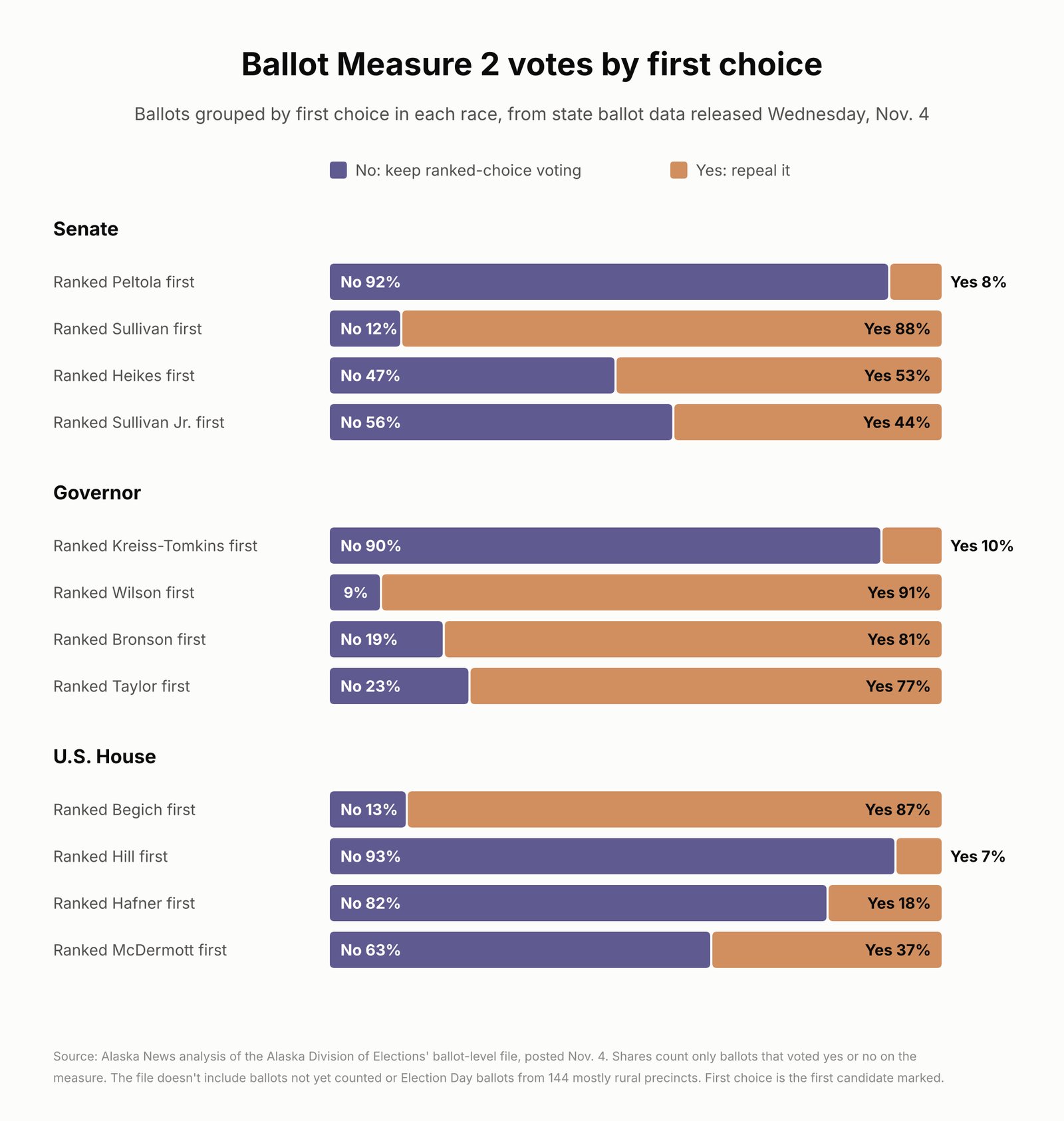
Counting only ballots that voted on the measure, about 1 in 8 that ranked Republican Sen. Dan Sullivan first voted "No," to keep ranked-choice voting, and about 1 in 12 that ranked Democrat Mary Peltola first voted "Yes," to repeal it, an Alaska News analysis of state ballot data shows.
For ballots that ranked the leading candidates first, crossover voting on the measure was more common in 2024. That year, about 1 in 6 ballots that ranked Republican Nick Begich first for U.S. House voted "No." This year, with Begich running for reelection, it's about 1 in 8.
About 1 in 7 ballots that ranked Peltola first for the House in 2024 voted "Yes," compared with 1 in 12 that ranked her first for Senate this year. The ballots that ranked her first in 2024 included a crossover group: about 1 in 11 also picked Donald Trump for president.
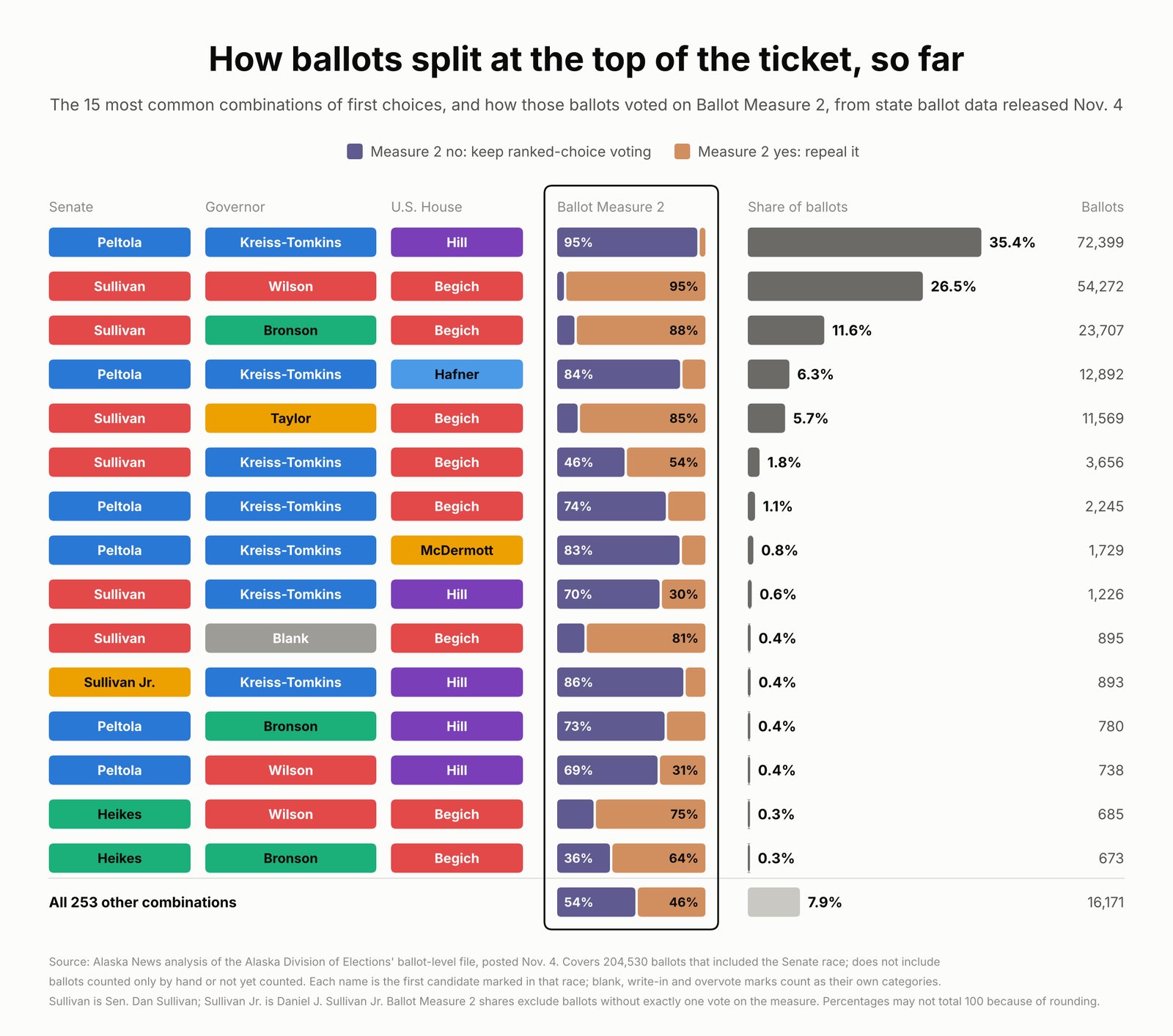
The same pattern shows up in the most common pairings at the top of the ballot. Ballots that ranked Sullivan and Begich first voted "Yes" 90% to 10%. Two years ago, ballots that picked Trump and Begich voted "Yes" 85% to 15%.
Ballots that ranked Peltola first for Senate and nonpartisan Bill Hill first for the House voted "No" 95% to 5%. In 2024, ballots that picked Kamala Harris and Peltola voted "No" 89% to 11%.
Split tickets were more divided. In 2024, ballots that picked Trump for president and Peltola for the House, about 4% of the 2024 ballots compared, voted "No" 56% to 44%. This year, ballots that ranked Sullivan, Democrat Jonathan Kreiss-Tomkins for governor and Begich first voted "Yes" 54% to 46%.
The governor's race shows differences among the Republican tickets. About 9% of ballots that ranked Bernadette Wilson first voted "No," compared with 19% of those that ranked Dave Bronson first and 23% of those that ranked Treg Taylor first. About 10% of the ballots that ranked Kreiss-Tomkins first voted "Yes."
In the House race, about 7% of ballots that ranked Hill first voted "Yes." Ballots that ranked Libertarian Jim McDermott first voted "No" 63% to 37%, and those that ranked Democrat Eric Hafner first voted "No" 82% to 18%.
The shift from 2024 shows up among Election Day, early and absentee ballots alike, so it isn't only a result of counting more Election Day ballots so far.
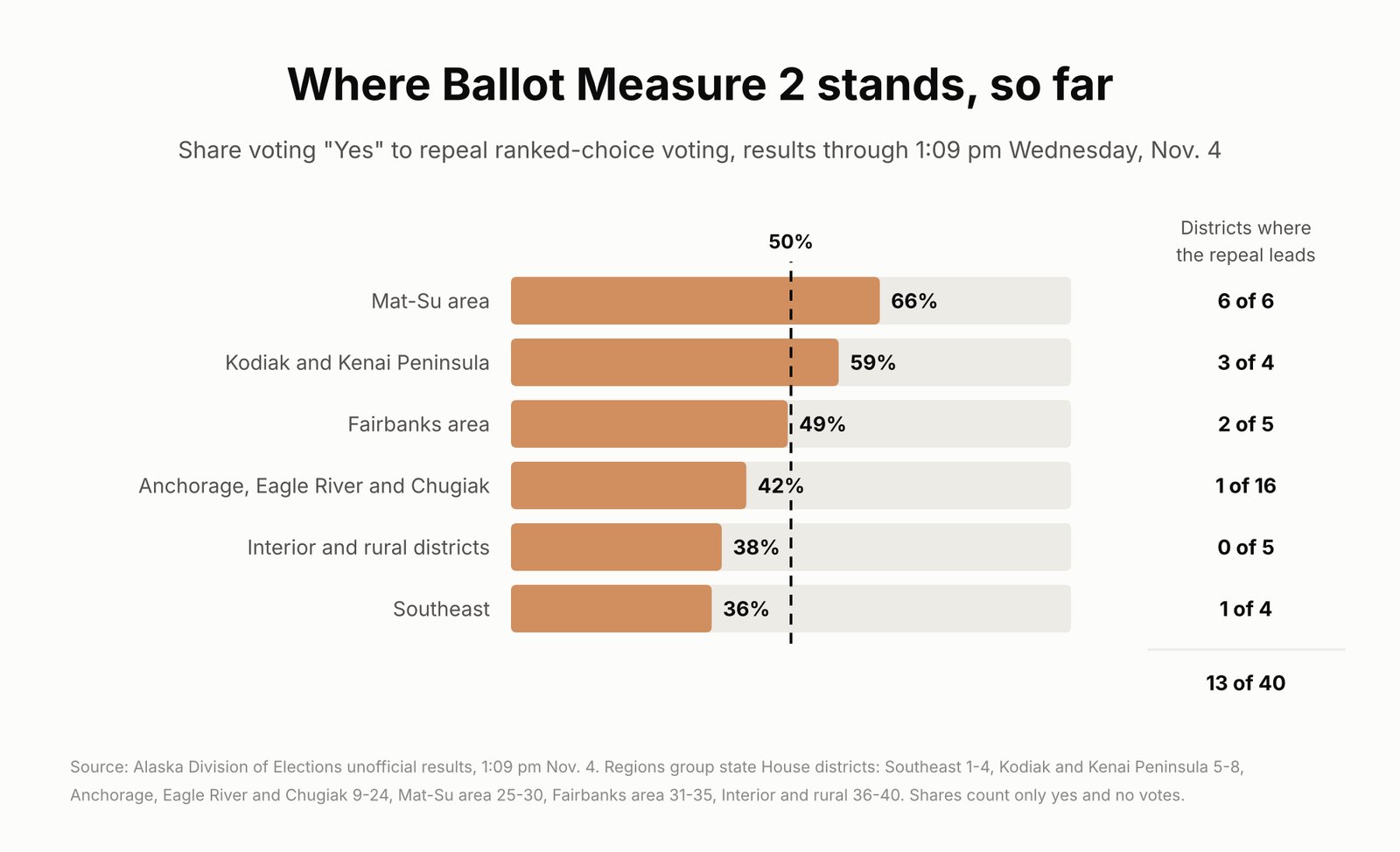
"Yes" leads in 13 of the 40 state House districts: all six Mat-Su-area districts, where it has about 66% of the vote, three on the Kenai Peninsula, two in the Fairbanks area and one each in Ketchikan and the Chugiak-Eagle River area. It trails at 42% in Anchorage, Eagle River and Chugiak as a whole, 38% in the Interior and rural districts and 36% in Southeast. The Fairbanks area as a whole is close to even.
Alaska News compared the state's ballot-level files from 2024 and this year, which show how each ballot was marked without identifying voters. This year's file doesn't include ballots still to be counted or Election Day ballots from 144 mostly rural precincts that are in the official totals but not in the file. To make the comparison closer, Alaska News left those precincts' Election Day ballots out of the 2024 figures. The comparison describes the two files. It doesn't follow the same voters from one election to the next, and the two elections had different candidates and turnout. Percentages by candidate count only ballots that voted "Yes" or "No" on the measure.
The figures by vote type and region come from the division's precinct results, which include every ballot counted so far. The regions group state House districts: 1 to 4 for Southeast; 5 to 8 for Kodiak and the Kenai Peninsula; 9 to 24 for Anchorage, Eagle River and Chugiak; 25 to 30 for the Mat-Su-area districts; 31 to 35 for the Fairbanks area; and 36 to 40 for the Interior and rural districts.
The division plans to count early votes cast from Oct. 30 on, along with questioned ballots, starting Nov. 10. Absentee ballots postmarked by Election Day can arrive through Nov. 13 from inside the U.S. and through Nov. 18 from overseas. The state aims to certify the results Nov. 25.
What did you make of this story? (no account needed)
Get Alaska News in your inbox
Create your free account and get the day’s top stories around 6 each morning, in a few minutes’ read.
Top stories, around 6 each morning.
Stories on what you follow, on Sundays.















Comments
Sign in to leave a comment.
No comments yet. Be the first to share your thoughts.