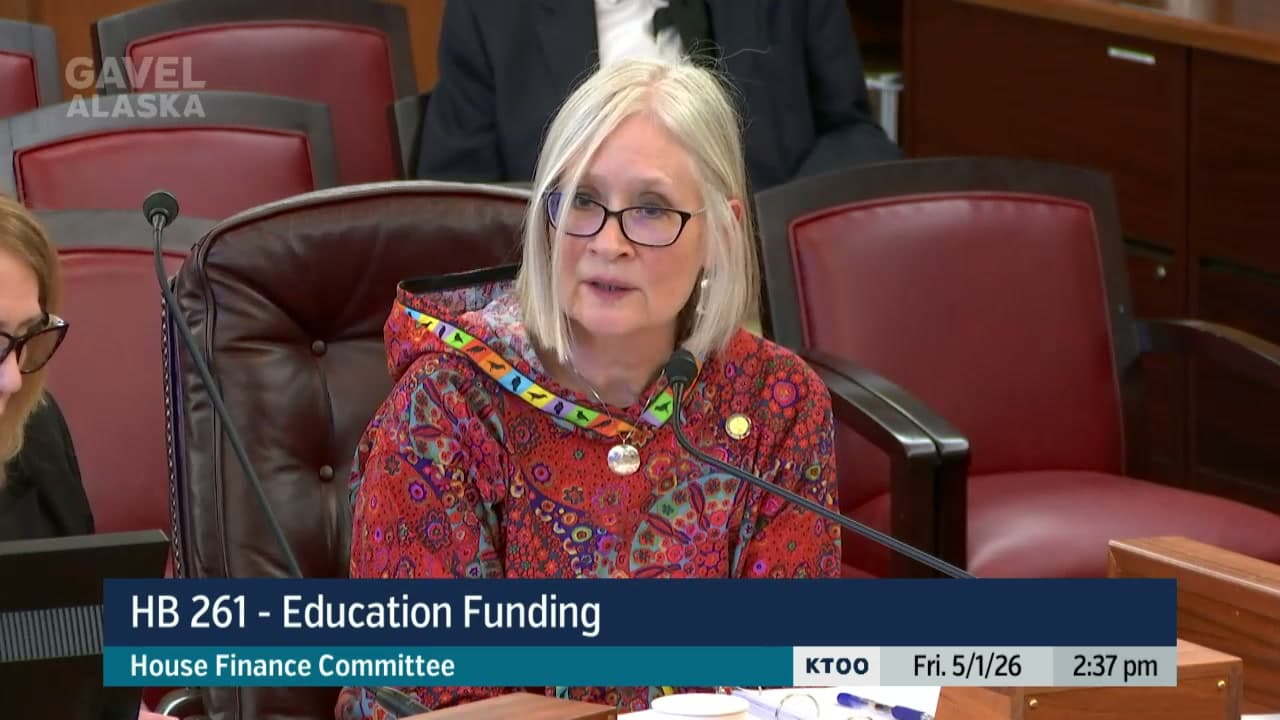
Alaska House Weighs $113M Education Funding Overhaul
The Alaska House Finance Committee heard testimony Friday on a bill that would use three-year student enrollment averaging to give school districts earlier budget certainty. The measure faces scrutiny over its $113 million annual cost and lack of detailed financial modeling.
House Bill 261 would let districts know their funding by July 1 using either a three-year enrollment average or the previous year's count, whichever is higher. The goal is to reduce teacher pink slips by providing budget numbers before contracts go out in March and April.
"It seeks to give our districts more stability and more confidence in the public education that we provide," said Representative Andi Story of Juneau, the bill's sponsor. "Our districts would start the year in July knowing their funding number."
The Department of Education told the committee it cannot model the bill's long-term fiscal impacts. The fiscal note shows $113 million for fiscal year 2027, but officials said the cost could vary significantly in future years as enrollment patterns shift.
"We have not done any projection modeling," said Heather Heineken, director of finance and support services for the Department of Education. "Our fiscal note is based on the FY27 projections, and we are confident in the accuracy for FY27."
Committee members questioned whether the averaging system would create what Representative Allard called "phantom students" counted in multiple districts. The bill would allow a student who moves from one district to another to be partially counted in both places through the three-year average.
Representative Bynum questioned whether districts would ever use the three-year average rather than taking the previous year's count, which would typically be higher in declining enrollment. "My assumption would be that I don't think you would ever use the three-year averaging at all," he said.
Representative Allard pressed on whether the $113 million fiscal note is accurate. "Respectfully, $113 million is a significant amount of money," she said. "I don't know if it's going to go from $115 million to $155 million in two or three fiscal years, or $175 million."
Under current law, districts conduct student counts in October but do not get final numbers from the state until March or April. This forces them to issue teacher contracts without knowing their funding.
The bill also lets districts true up intensive special education student counts in February rather than waiting until the following October. Story said this responds to district requests for mid-year adjustments when high-need students arrive after the fall count.
The committee did not take action Friday. Co-Chair Neal Foster said the committee would bring the bill back Monday afternoon.
The House Finance Committee meets Monday at 9 a.m. to hear the capital budget and public testimony on a fisheries tax credit bill.
This article is based on a public meeting — Alaska Legislature: House Finance, 5/1/26, 1:30pm ().
AI-assisted. How we use AI Transcript byLucas Brown
Stay informed. Support what matters.
Free, permanent access to local news you can verify. Subscribe to support Alaska News and go ad-free.
Related Coverage
House panel debates $113M education funding formula shift
Alaska News · 5mo ago
House Finance considers multi-year school funding averaging bill
Alaska News · 5mo ago
Senate panel advances bill to stabilize Alaska school funding with enrollment averaging
Alaska News · 4mo ago
Alaska House panel hears bill to overhaul school funding timelines
Alaska News · 5mo ago
House Finance Advances Education Funding Bill Despite Fiscal Concerns
Alaska News · 4mo ago
Comments
Sign in to leave a comment.
No comments yet. Be the first to share your thoughts.