Video Clips
Quoted moments from Alaska public meetings, hearings, and press conferences.
Adam Prestidge
“On June 11th, uh, Glenn Fahren signed, executed, and announced a binding memorandum of understanding with the building trades councils from Fairbanks and Anchorage. And so, uh, what did that do? It set up a framework for future project labor agreements.”Alaska Legislature: Joint Conference on HB381, 6/27/26, 2PM · Jun 27, 2026
Adam Prestidge
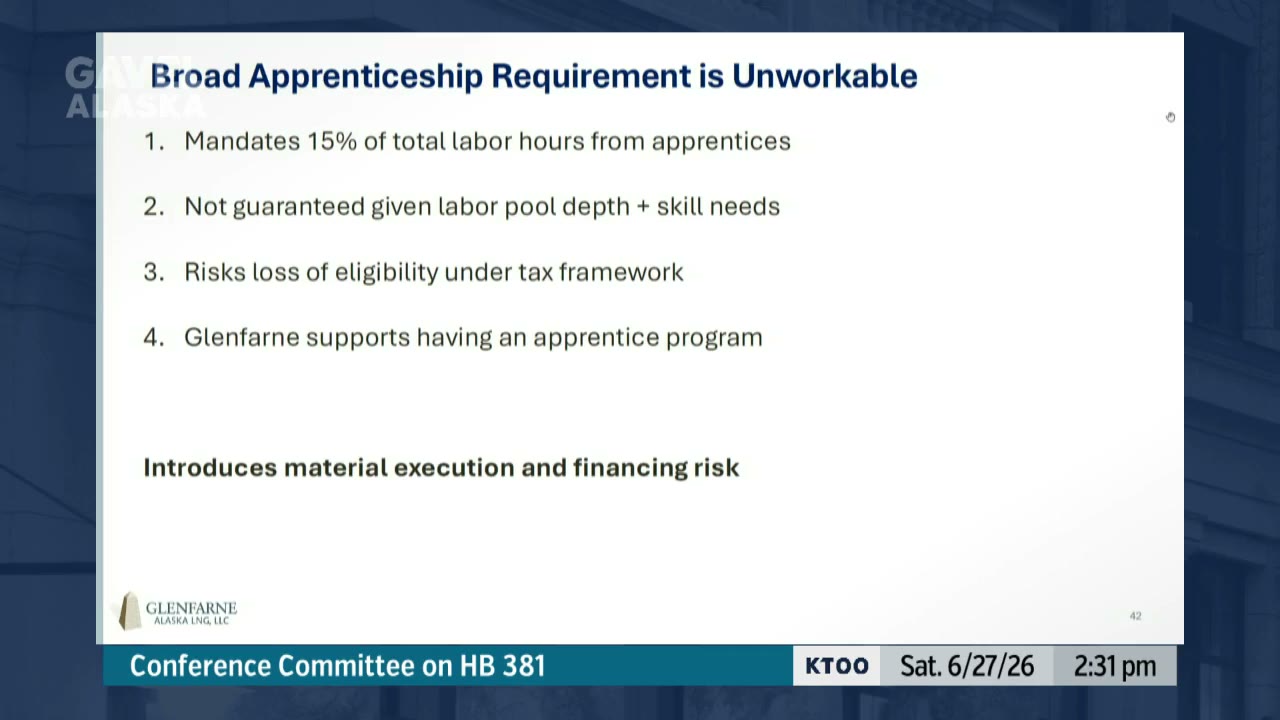
“having a bright line 15% requirement creates a lot— creates unworkable challenges for the project. First of all, there's no consideration in the amendment if there weren't available enough personnel to perform 15% of the hours as apprentices. It's just a flat requirement, 15% of the hours must be done by apprentices. And so the question would immediately come up, Well, if there weren't enough apprentices available to perform that much work, would we lose our tax eligibility?”Alaska Legislature: Joint Conference on HB381, 6/27/26, 2PM · Jun 27, 2026
Dan Stickel
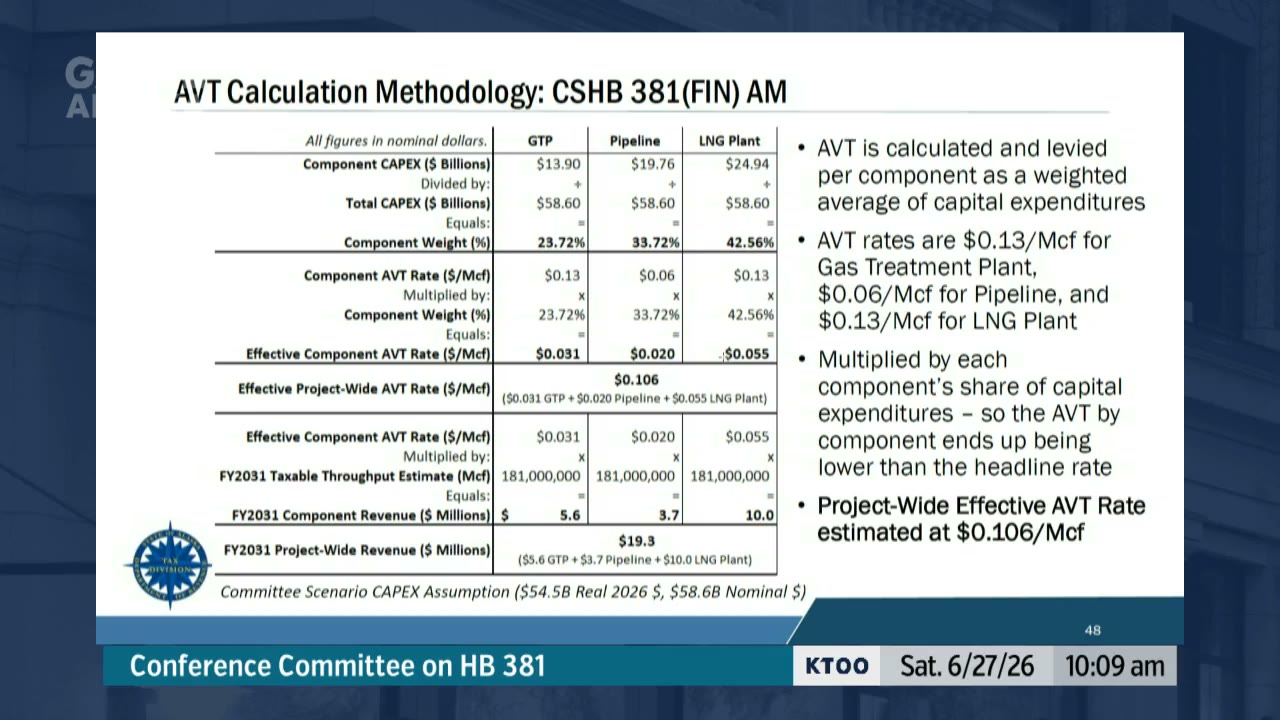
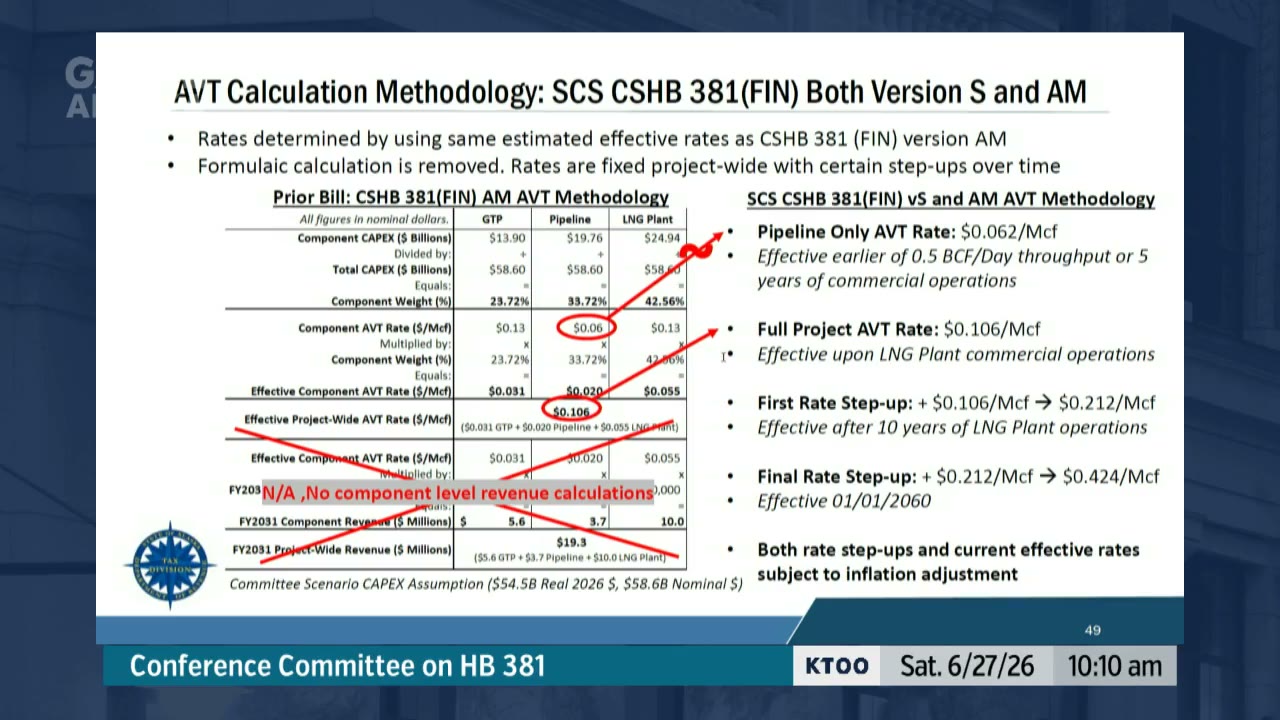
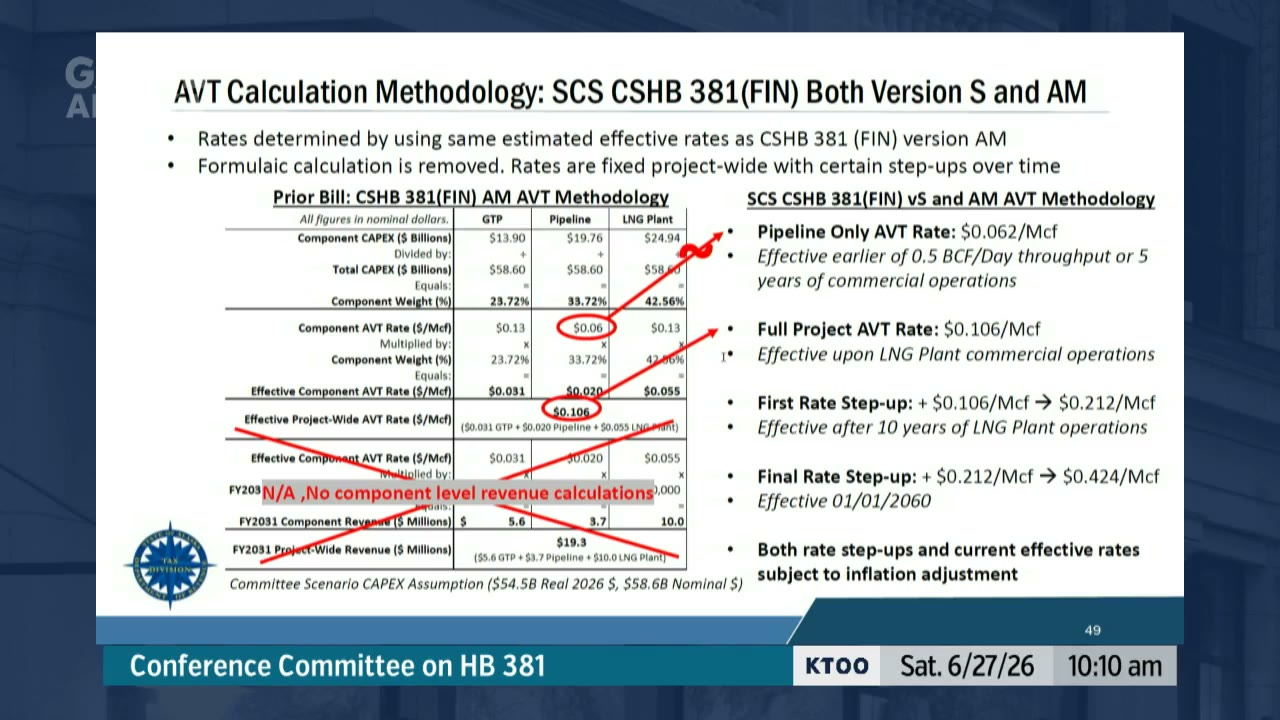
“they moved away from this weighted average approach and instead just put in the flat rates for each component of the project. So they took that about 6 cents per MCF rate on the pipeline component and made that a 6.2 cents per 1,000 cubic feet tax rate for phase 1 of the project. And then they took that 10.6 cents per thousand cubic feet weighted average with the capital expenditures weighting and just made that the tax rate once LNG exports began.”Alaska Legislature: Joint Conference on HB381, 6/27/26, 10am · Jun 27, 2026
Dan Stickel
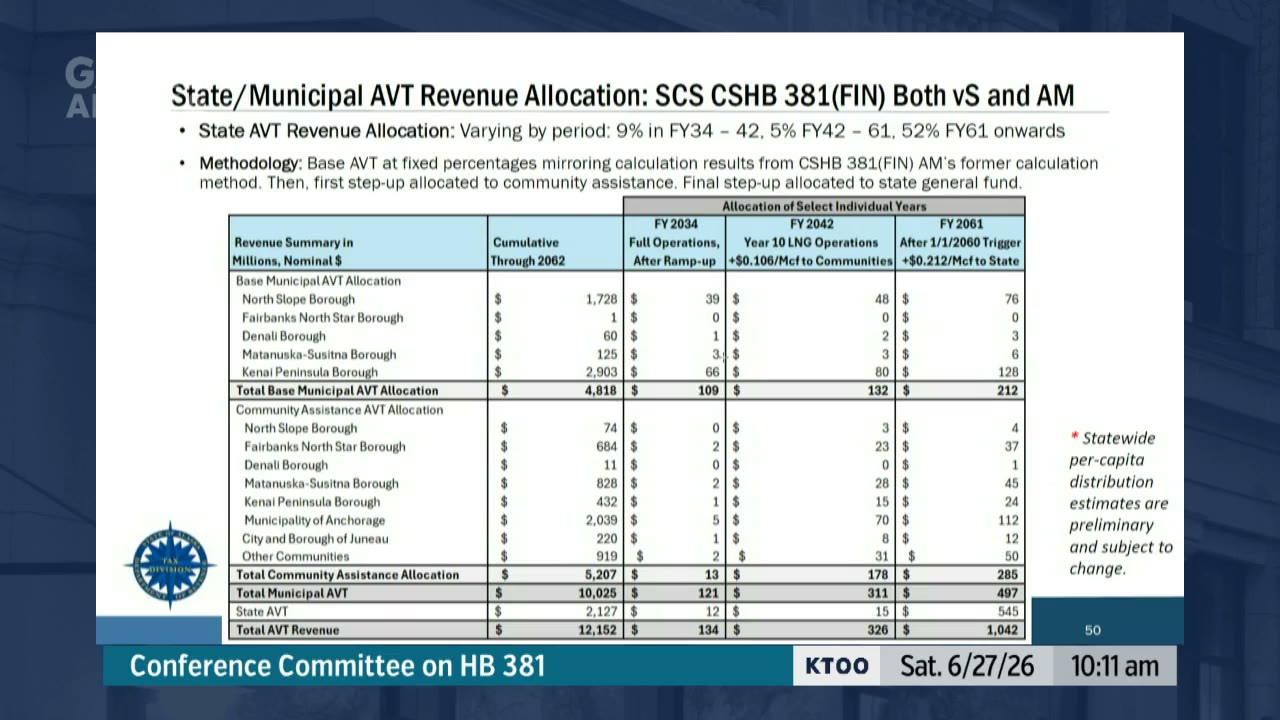
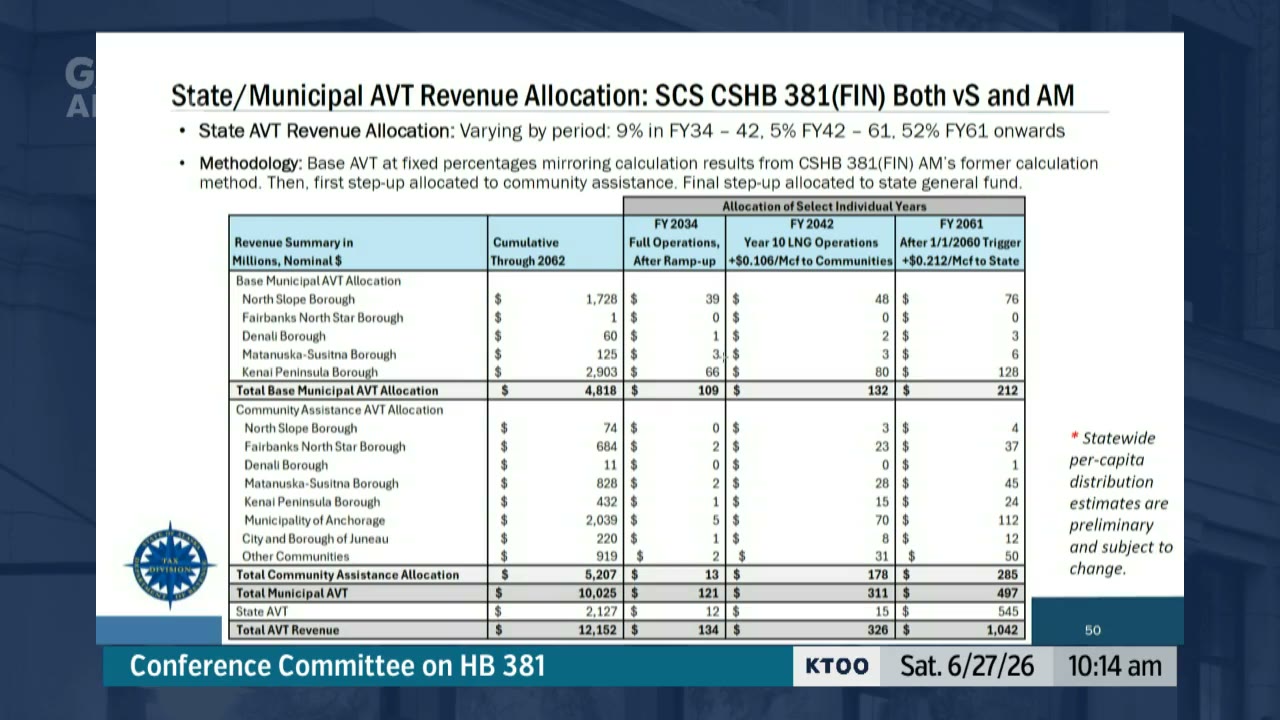
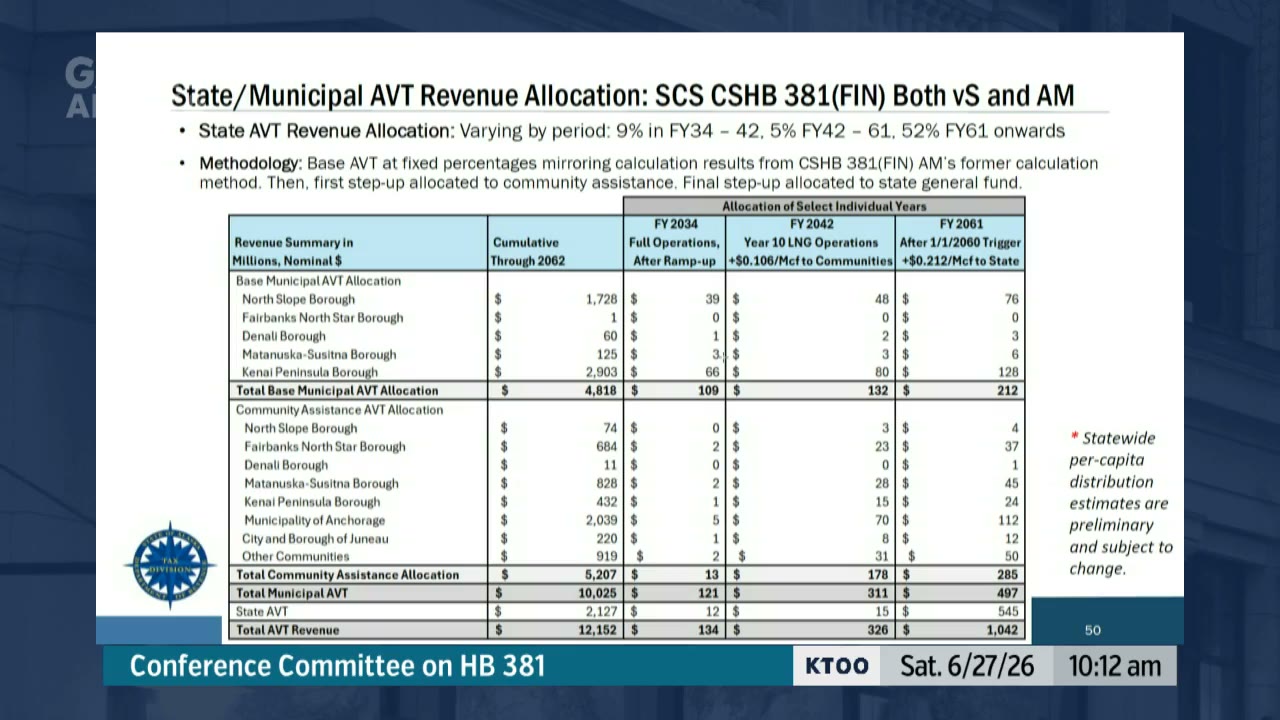
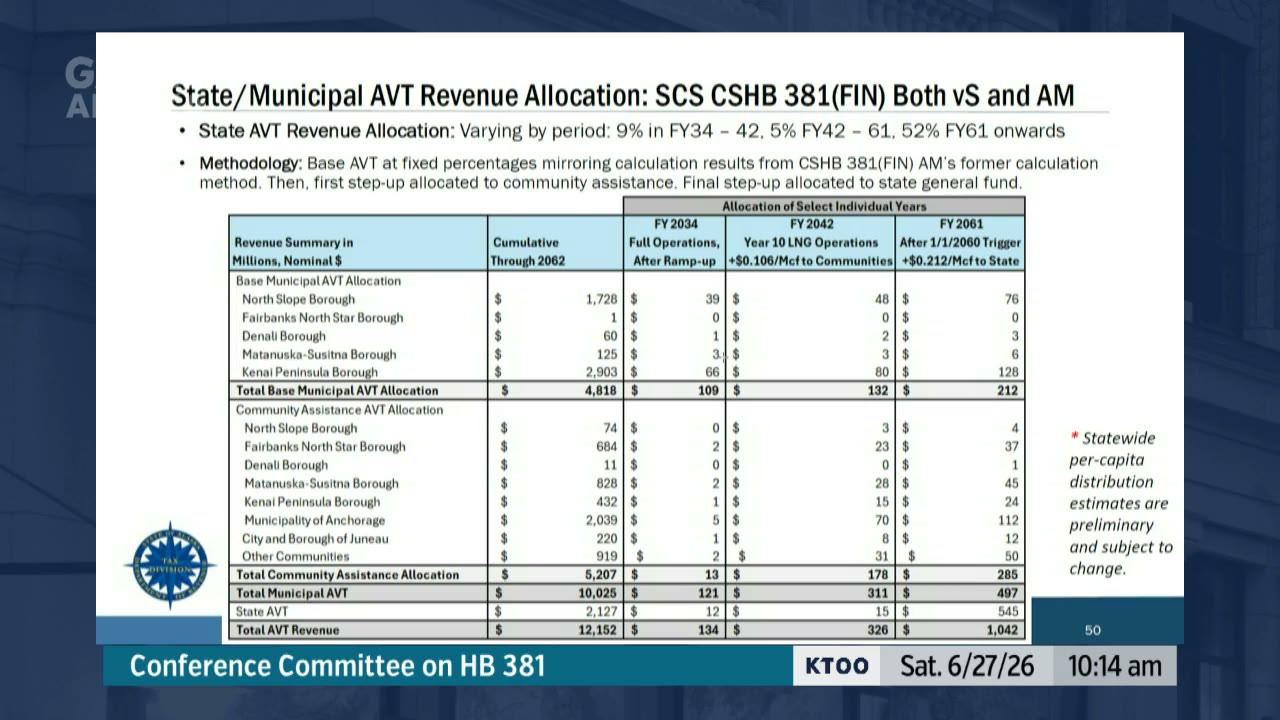
“in those early years, the vast majority of the revenue is allocated to the communities that the project is directly in. So $109 million of the AVT in 2034 would go to those 5 municipalities, with an additional $13 million spread statewide to community revenue sharing and $12 million to the state. And then the second column shows after the first step up in the alternative volumetric tax, and that additional step up goes entirely to community revenue sharing.”Alaska Legislature: Joint Conference on HB381, 6/27/26, 10am · Jun 27, 2026
Mike Cronk
“if we do nothing, these numbers go away, we have nothing here. There's zero revenue brought to this state. There's zero revenue brought to many communities.”Alaska Legislature: Joint Conference on HB381, 6/27/26, 10am · Jun 27, 2026

Dan Stickel
“for a pipeline-only portion of the project, you'd have a 6-cent per MCF tax rate, and then once the full project was in operations, we would estimate that the tax rate on a weighted average basis would be about 10.6 cents per 1,000 cubic feet.”Alaska Legislature: Joint Conference on HB381, 6/27/26, 10am · Jun 27, 2026
Adam Prestidge
“our practical expectation is that we will complete the project ahead of these timelines, and so the deadline or the timeline that you said The end of the year for FID maintains— continues to be our target. And we would— if we were to follow a target construction schedule, even with some delays, we would complete the project before December 31st, well before December 31st, 2032.”Alaska Legislature: Joint Conference on HB381, 6/27/26, 10am · Jun 27, 2026
Dan Stickel
“fixing the percentages does increase some of the certainty and makes it easier to calculate and plan. Removes one item of potential contention going forward.”Alaska Legislature: Joint Conference on HB381, 6/27/26, 10am · Jun 27, 2026
Adam Prestidge
“The deadline of 2037 is well within— well beyond the project completion deadline, even if we put a couple years of contingency on that. And so a 2037 deadline doesn't have that same risk profile to the FID investors. And so for that reason, we suggest deleting the 2032 deadline.”Alaska Legislature: Joint Conference on HB381, 6/27/26, 10am · Jun 27, 2026
Adam Prestidge
“The 2032 completion of construction is more about managing theoretical risk that lenders and investors will look at when they make an investment decision on the project. And so regardless of how we all want to move fast, Regardless of the timing around the energy availability out of the Cook Inlet, lenders and investors will just see this numerically and assign it a hypothetical risk that will make the project more expensive. And so we don't see it adding any additional incentive that isn't there already. It just adds risk to the project that will be priced into the financing.”Alaska Legislature: Joint Conference on HB381, 6/27/26, 10am · Jun 27, 2026
Dan Stickel
“the capital expenditure weighting and the project component weighting, that applied both for calculating the initial tax rates, but then also applied for calculating the sharing out to municipalities. And that sharing out to municipalities has also been fixed in statute. In the Senate version of the bill. So removing some of that complexity. The other addition that the Senate made is the two step-ups.”Alaska Legislature: Joint Conference on HB381, 6/27/26, 10am · Jun 27, 2026
Dan Stickel
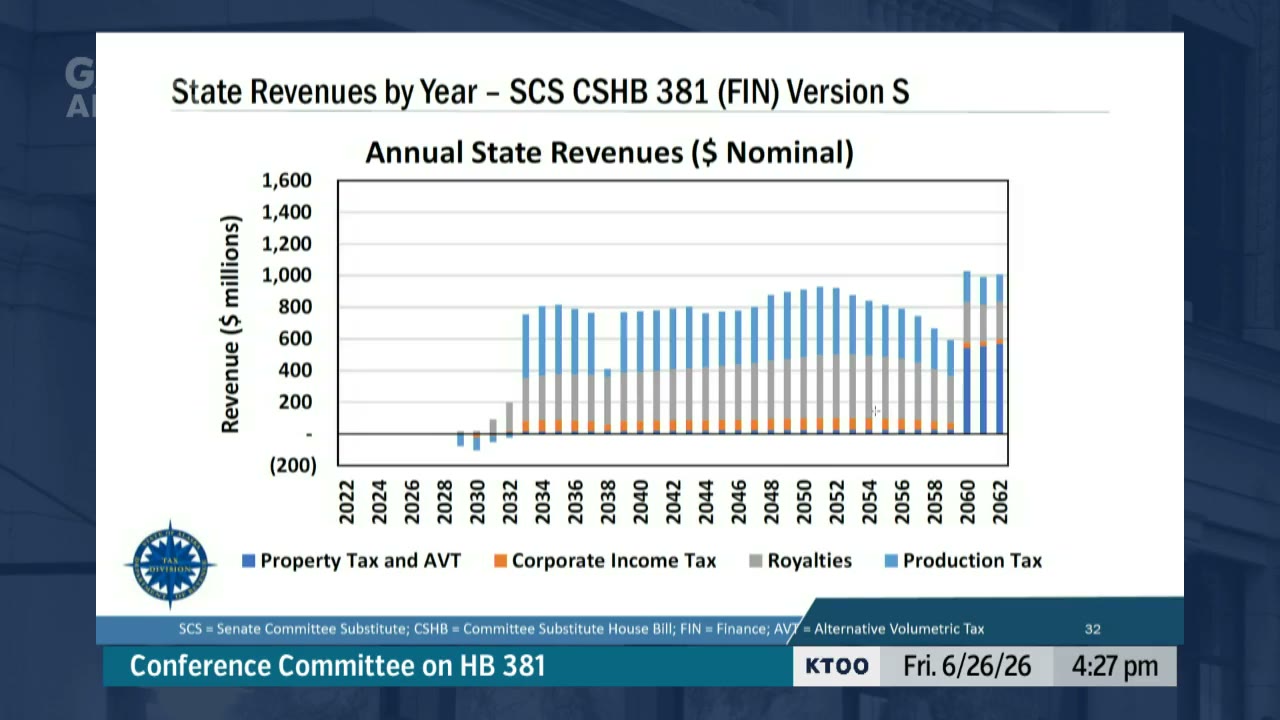
“through 2062, which is the to the extent of our modeling, $32.2 billion to the state. And those are cumulative nominal under our baseline modeling assumptions.”Alaska Legislature: Joint Conference on HB381, 6/27/26, 10am · Jun 27, 2026
Adam Prestidge
“we as the project developer at 8 Star have no objection to the 2028 FID deadline. We're only raising concerns around the 2032 completion of construction deadline.”Alaska Legislature: Joint Conference on HB381, 6/27/26, 10am · Jun 27, 2026
Bryce Edgmon
“the reason why I'm, I guess, at this juncture supportive of keeping in the 2028 timeline, if anything at all, it's just speaking of risk, poring through the Gaffney Klein document that was presented to the legislature in December 2025 that talks about all these sort of jurisdictions around the globe and the need for property tax relief and some sort of relief to get these very expensive front-end projects, gas line infrastructure, into place, is supported by years of analysis and efforts.”Alaska Legislature: Joint Conference on HB381, 6/27/26, 10am · Jun 27, 2026
Dan Stickel
“total state benefits under our baseline model assumptions, which which we talked about yesterday, through 2042 would be $7.5 billion to the state.”Alaska Legislature: Joint Conference on HB381, 6/27/26, 10am · Jun 27, 2026
Dan Stickel
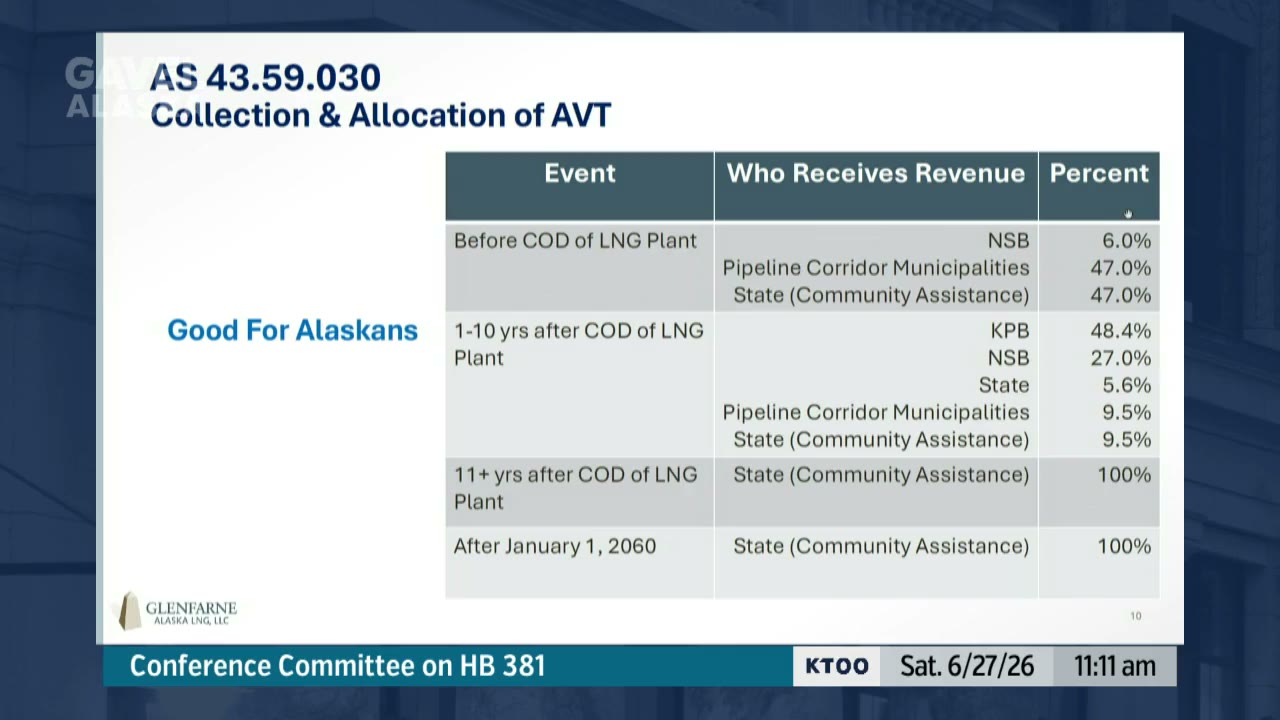
“But then increase to 52% of the total AVT with the second doubling of the tax rate.”Alaska Legislature: Joint Conference on HB381, 6/27/26, 10am · Jun 27, 2026
Dan Stickel
“In the version that passed the House, our break-even price was $8.57 under our baseline scenarios for gas delivered into the global market. Under the version that passed the Senate, it was $8.62 per 1,000 cubic feet. So a 5 cents per 1,000 cubic feet increase from the House version to the Senate version.”Alaska Legislature: Joint Conference on HB381, 6/27/26, 10am · Jun 27, 2026
Dan Stickel
“under the House version of the bill, the alternative volumetric tax was calculated and levied on a per-component basis as a— using a weighted average of capital expenditures. And so once the full project was complete, we would look at the, the total capital expenditures that were spent on each component of the project, being the treatment plant, the pipeline, and the LNG export facility.”Alaska Legislature: Joint Conference on HB381, 6/27/26, 10am · Jun 27, 2026
Bert Stedman
“I think after January 1st, 60, 100% goes to the general fund, not community assistance. Is that right?”Alaska Legislature: Joint Conference on HB381, 6/27/26, 10am · Jun 27, 2026

Dan Stickel
“for the first doubling of the tax rate, 100% of that doubling would go to community assistance, and then for the second doubling of the tax rate, 100% of that that next doubling would go to the state unrestricted general fund.”Alaska Legislature: Joint Conference on HB381, 6/27/26, 10am · Jun 27, 2026
Dan Stickel
“The first effective 10 years, after 10 years of LNG export operations, where the tax rate doubles. And then the second effective in 2060, where the tax rate doubles. Again.”Alaska Legislature: Joint Conference on HB381, 6/27/26, 10am · Jun 27, 2026

Dan Stickel
“It does start with the same effective tax rates as the House version and simply fixes those rates and allocations in, in statute. The Senate version then added in the two doublings of the tax rate that was a major change from the House version.”Alaska Legislature: Joint Conference on HB381, 6/27/26, 10am · Jun 27, 2026
Adam Prestidge
“That penalty is— would be losing the tax— the tax treatment of the project. The result of that would be at the front end, investors would look at this as additional risk, And they would have to price in that risk into how they invest in the project. And so the ultimate outcome of this would be making the project more expensive and require more investment capital.”Alaska Legislature: Joint Conference on HB381, 6/27/26, 10am · Jun 27, 2026
Adam Prestidge
“the 2028 deadline, it puts a bit of a risk on the developer and it puts an incentive on the developer, but it does that at a time before billions of construction dollars have been put at risk on the project. And so essentially putting that 2032 deadline puts additional risk on all the investment dollars that doesn't serve the benefit of actually accelerating anything. And the issue that then comes up is if there were a delay in construction, if there were litigation, if there was COVID, you know, an epidemic, that's just, those are all hypothetical risks that could occur, that have occurred on other projects, that lenders and investors are going to be nervous about.”Alaska Legislature: Joint Conference on HB381, 6/27/26, 10am · Jun 27, 2026
Bryce Edgmon
“I feel like I think if FID isn't, for Phase 1, arrived at by 2028, there's justification for this issue to come back before the legislature to have a longer runway to engage in this discussion. I would submit to you or anyone else that we should not have gotten this bill on March 20th. We should have gotten this a lot earlier so we could, to pour over this in a way that complies with all the sort of what-if scenarios that are out there and also to be maybe a better partner to you as a developer overall to get our work done in a longer frame of time. So I guess at this point I'm not convinced that removing that 2028 FID deadline— and remember, it's just for Phase 1, it's not for Phase 2. You know, I don't know that it serves our best interests”Alaska Legislature: Joint Conference on HB381, 6/27/26, 10am · Jun 27, 2026
Dan Stickel
“in fiscal year 2061, which would be the first full fiscal year after the the second step up of the alternative volumetric tax. At that point in time, after adjusting for the inflation, there would be $212 million shared directly with the communities that the project resides in, an additional $285 million shared across the state based on population for community revenue sharing, and then the state at that point in time would get a little over $500 million.”Alaska Legislature: Joint Conference on HB381, 6/27/26, 10am · Jun 27, 2026
Dan Stickel
“the state starts out receiving about 9% of the AVT revenue. That will drop to 5% with the first doubling of the tax rate.”Alaska Legislature: Joint Conference on HB381, 6/27/26, 10am · Jun 27, 2026
Dan Stickel
“the Senate version of the bill removes some of the complexity in the calculation that was in the prior version of the bill.”Alaska Legislature: Joint Conference on HB381, 6/27/26, 10am · Jun 27, 2026
Lyman Hoffman
“On the first bullet point where the Senate version removes the calculation complexities, does the department have an opinion on that? Especially since it has the same effective rate as the House version simplification, does that reduce the amount of work to the department.”Alaska Legislature: Joint Conference on HB381, 6/27/26, 10am · Jun 27, 2026
Dan Stickel
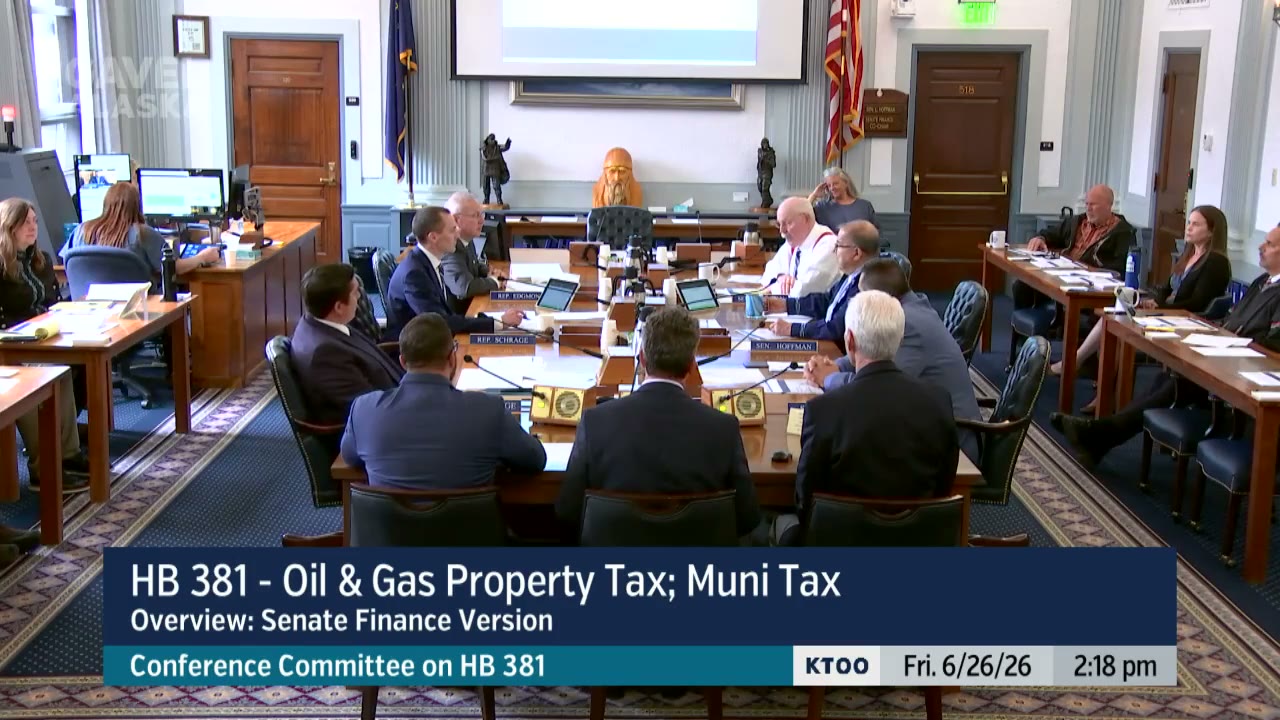
“Representative Ruffridge to the Chair, correct, yes. So the assumption is that there is significant capital expenditure for the Phase 2 and then kind of a steady-state operations beyond that. If the developer were to do a significant expansion, yes, that would reduce their corporate income tax liability.”Alaska Legislature: MSC2-20260626-1410
Matt Kissinger
“Representative Fields asked about these clawback mechanisms at that meeting, and what I said was, I said there, I said, and just to address this clearly, This is my words. And just to address this clearly, because I've heard many questions that dance around this, the clawback would be a paid clawback. And there's real important reason for that.”Alaska Legislature: MSC2-20260626-1410
Matt Kissinger
“Senator Steadman, through the chair, if you would be willing to provide us with a copy of that document, then we can consider redacting it and reviewing it. But as of now, we've only been able to look at that document. We don't have, uh, we don't have our own copy of that.”Alaska Legislature: MSC2-20260626-1410
Dan Stickel
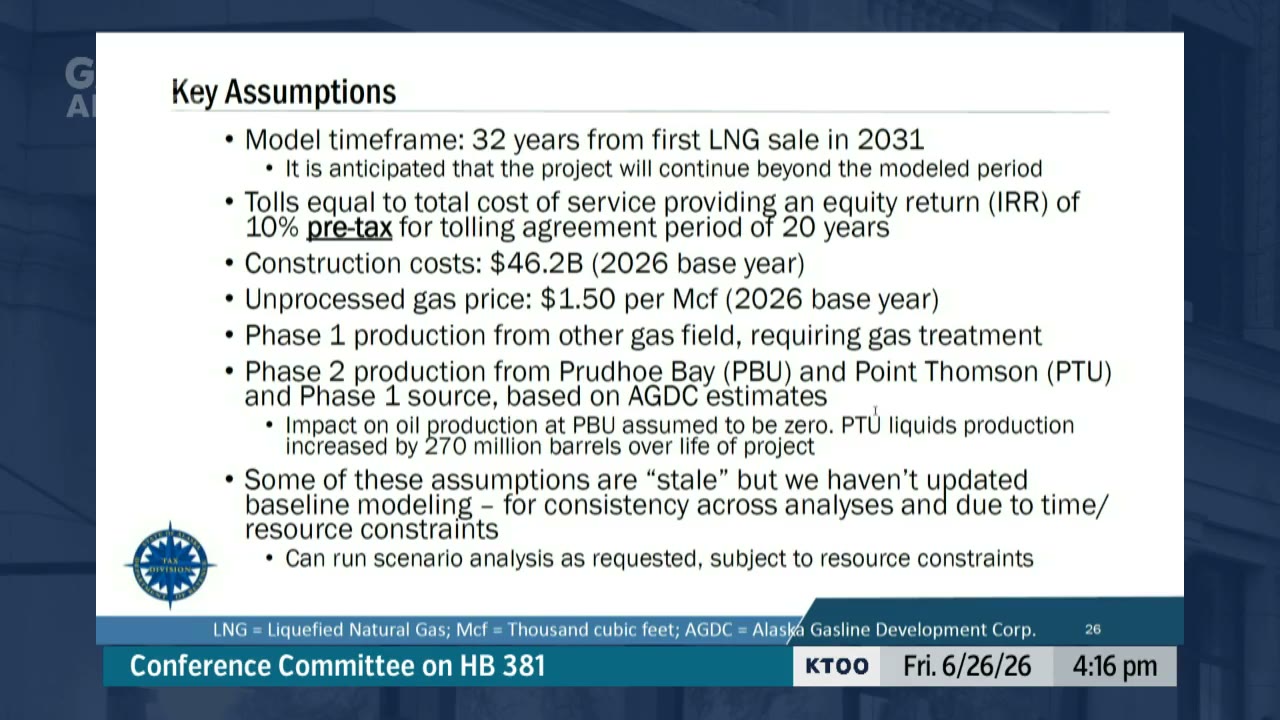
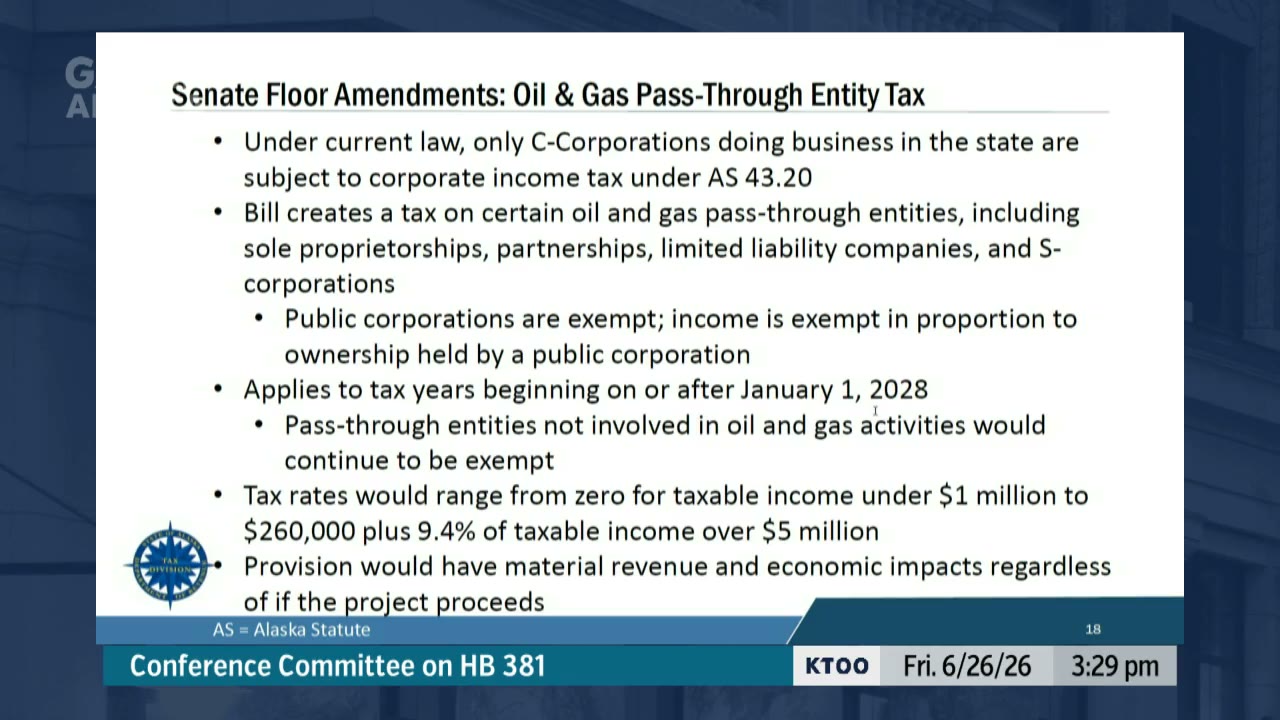
“The material impact between S and S as amended from a modeling standpoint is the inclusion of the pass-through entity tax.”Alaska Legislature: MSC2-20260626-1410
Bert Stedman
“I think the buyback is one of them. There's mechanics if you take a literal interpretation of that document, it may not be as accurate as looking at it in the entirety.”Alaska Legislature: MSC2-20260626-1410
Adam Prestidge
“this is a mechanism that is only exercisable at the state's option. In terms of Glenfarn's ability to seek recourse or any kind of compensation, we don't have that mechanism. We can't ask the state to exercise this option. If Glenfarn decides to abandon the project, we do so with no recourse.”Alaska Legislature: MSC2-20260626-1410
Bert Stedman
“they can draw erroneous conclusions from just reading that in isolation. And we've tried to ferret some of that out in our questions.”Alaska Legislature: MSC2-20260626-1410
Matt Kissinger
“If you're moving towards milestones and you're going to penalize your developer and they miss a milestone and you can just take everything away from them and they can lose everything, they will put nothing into it. And this is a $44 billion project that we're building. We need to put the very best work going into it. And that's why we're— there were these paid clawbacks with respect to our ability to push the developer out.”Alaska Legislature: MSC2-20260626-1410
Dan Stickel
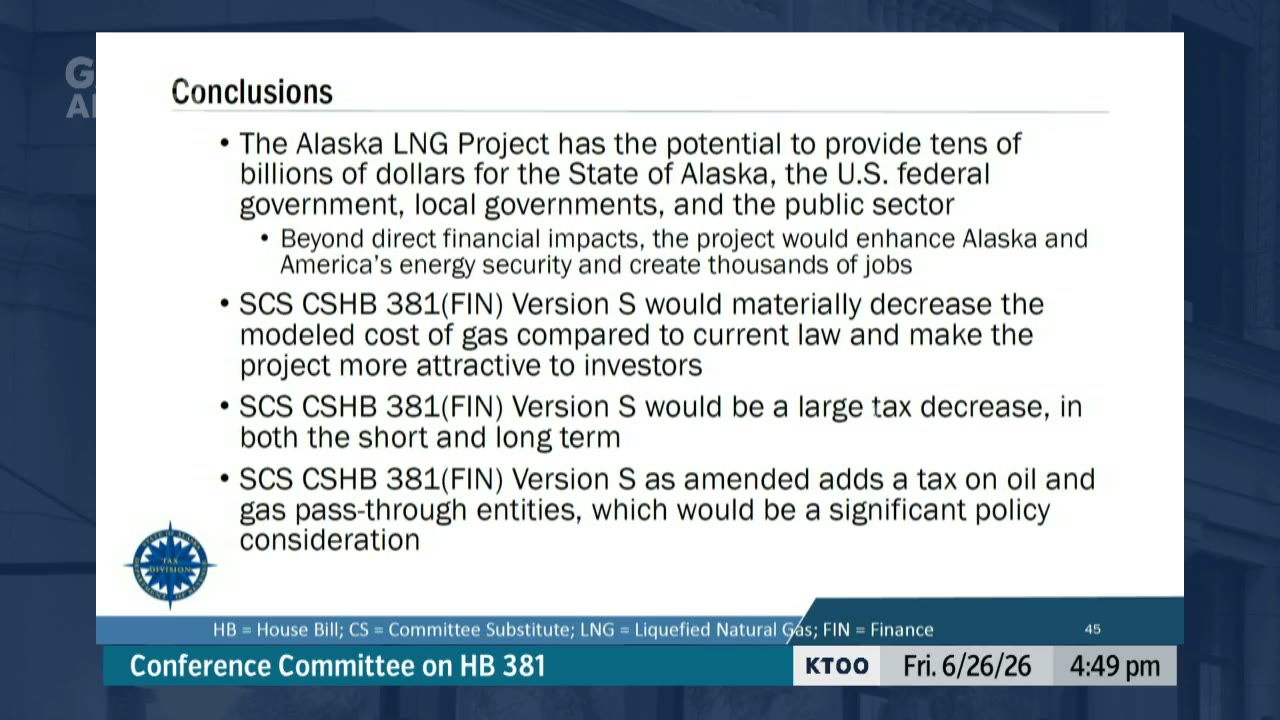
“broadly speaking, the various, you know, the various versions of the bill have kind of targeted that 50 cents or so reduction to that break-even cost of supply plus or minus 5 or 10 cents.”Alaska Legislature: MSC2-20260626-1410
Dan Stickel
“We note the significant policy difference between the two versions of the bill is that pass-through entity tax that is in the version that came out of the Senate floor. That does create— that does add a level of uncertainty uncertainty and is a significant policy decision for the committee to consider.”Alaska Legislature: MSC2-20260626-1410
Adam Prestidge
“we do have the view that if there were ever a cash consideration or a cash repurchase, we would not ask for the monetary value of any tax arrangement to be reflected in any repurchase. So Glenfarm's position is that you would not claim credit for any value added through tax abatement or other relief from the legislature? Representative Sharkey, essentially yes.”Alaska Legislature: MSC2-20260626-1410
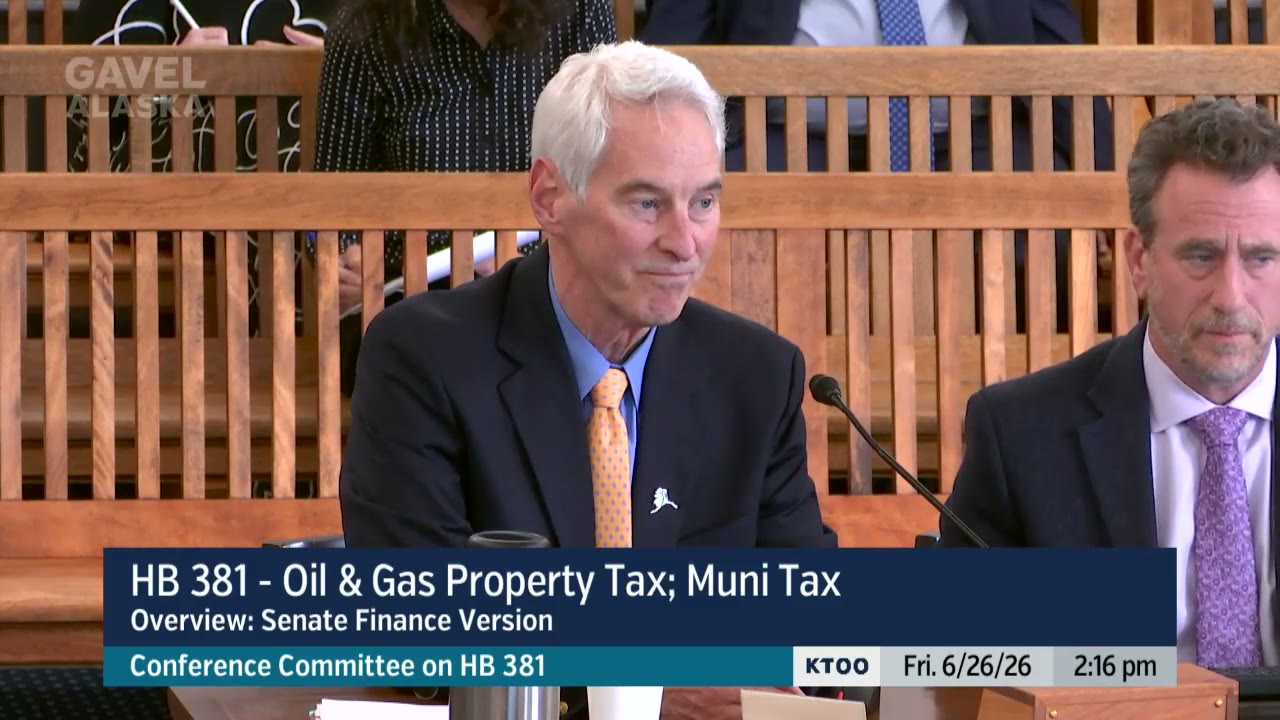
Calvin Schrage
“One question that I would have, which has not been addressed as of yet, is who is able to claim value for any tax abatement that's provided by the legislature. I think I've not heard that issue addressed yet and would appreciate hearing from you on that.”Alaska Legislature: MSC2-20260626-1410