Dan Stickel
16:00 - 17:08
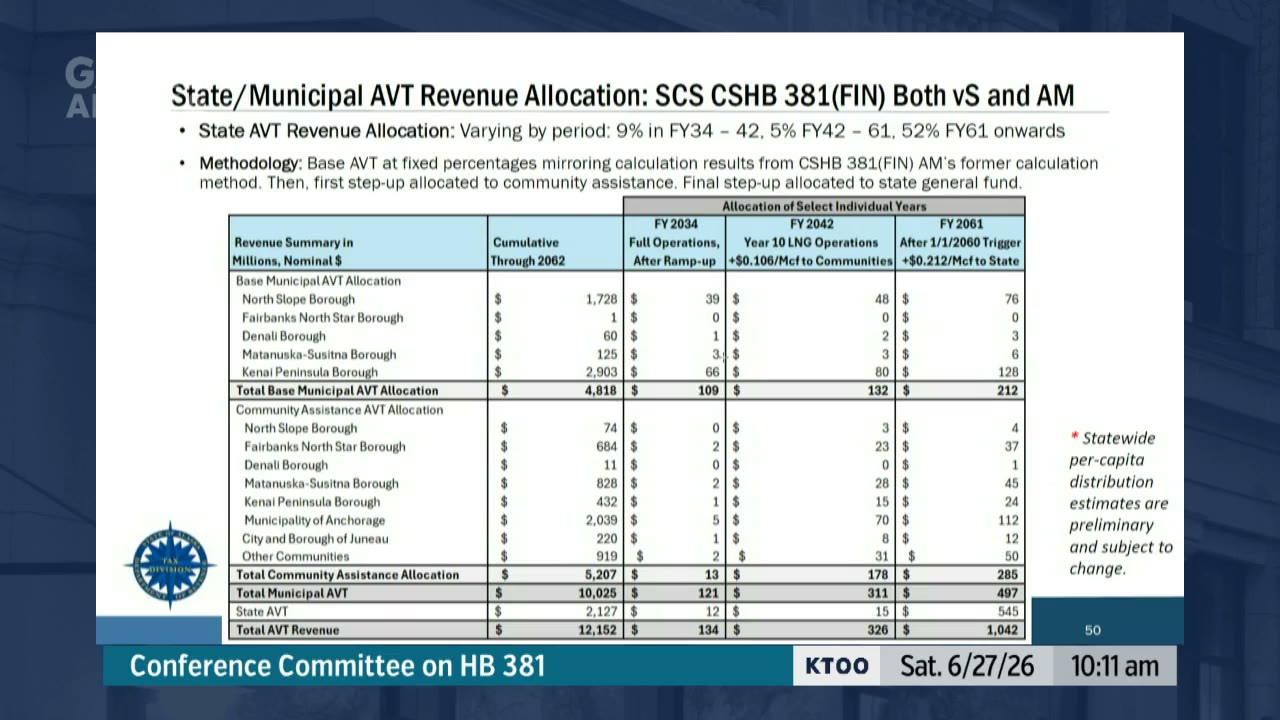
"in those early years, the vast majority of the revenue is allocated to the communities that the project is directly in. So $109 million of the AVT in 2034 would go to those 5 municipalities, with an additional $13 million spread statewide to community revenue sharing and $12 million to the state. And then the second column shows after the first step up in the alternative volumetric tax, and that additional step up goes entirely to community revenue sharing."
“in those early years, the vast majority of the revenue is allocated to the communities that the project is directly in. So $109 million of the AVT in 2034 would go to those 5 municipalities, with an additional $13 million spread statewide to community revenue sharing and $12 million to the state. And then the second column shows after the first step up in the alternative volumetric tax, and that additional step up goes entirely to community revenue sharing.”
- Speaker
- Dan Stickel
- Timestamp
- 16:00 – 17:08
- Community
- Alaska News
- Location
- Alaska
- Captured at
- June 27, 2026
From the transcript
So the FY 34, we show what the allocation to different municipalities would be after— that's the first full year of full operations. And so we have in those early years, the vast majority of the revenue is allocated to the communities that the project is directly in. So $109 million of the AVT in 2034 would go to those 5 municipalities, with an additional $13 million spread statewide to community revenue sharing and $12 million to the state. And then the second column shows after the first step up in the alternative volumetric tax, and that additional step up goes entirely to community revenue sharing. And so come 2042, in our baseline modeling, we'd be looking at $132 million directly to the impact— the communities that the project is in, an additional $178 million to community revenue sharing, Now, those communities that the project is in, they do get a share of that community revenue sharing as well.