AlaskaNews
My Feed

Content discovery

Topics

Issues and interests

Locations

News by place

Organizations

Agencies, boards, and groups

Elections

Elections and time-bounded civic events

Calendar

Upcoming meetings and civic events

Source material

People

People quoted on the platform

Transcripts

Search every public meeting (subscribers)

Video Clips

Quoted moments on video

Photos

Community gallery

Podcasts

Articles read aloud

How It WorksLog inSign up
AlaskaNewsAlaska News

Local news, from the source.

Public meetings deserve coverage.
Every claim links to the original source.

Browse

  • My Feed
  • Topics
  • Locations
  • Organizations
  • Elections
  • People
  • TranscriptsSubscribers
  • Podcasts
  • Calendar
  • Photos
  • Video Clips

Get involved

  • Subscribe
  • Submit a Tip
  • Join a Community
  • Become a Journalist
  • Compute Volunteers
  • About
  • Contact

Resources

  • RSS
  • How It Works
  • API
  • Privacy
  • Terms

© 2026 Communities News LLC. All rights reserved.

Part of the Communities News platform

Video Clips

Quoted moments from Alaska public meetings, hearings, and press conferences.
Clips from Alaska State LegislatureClear
0:22

Speaker A

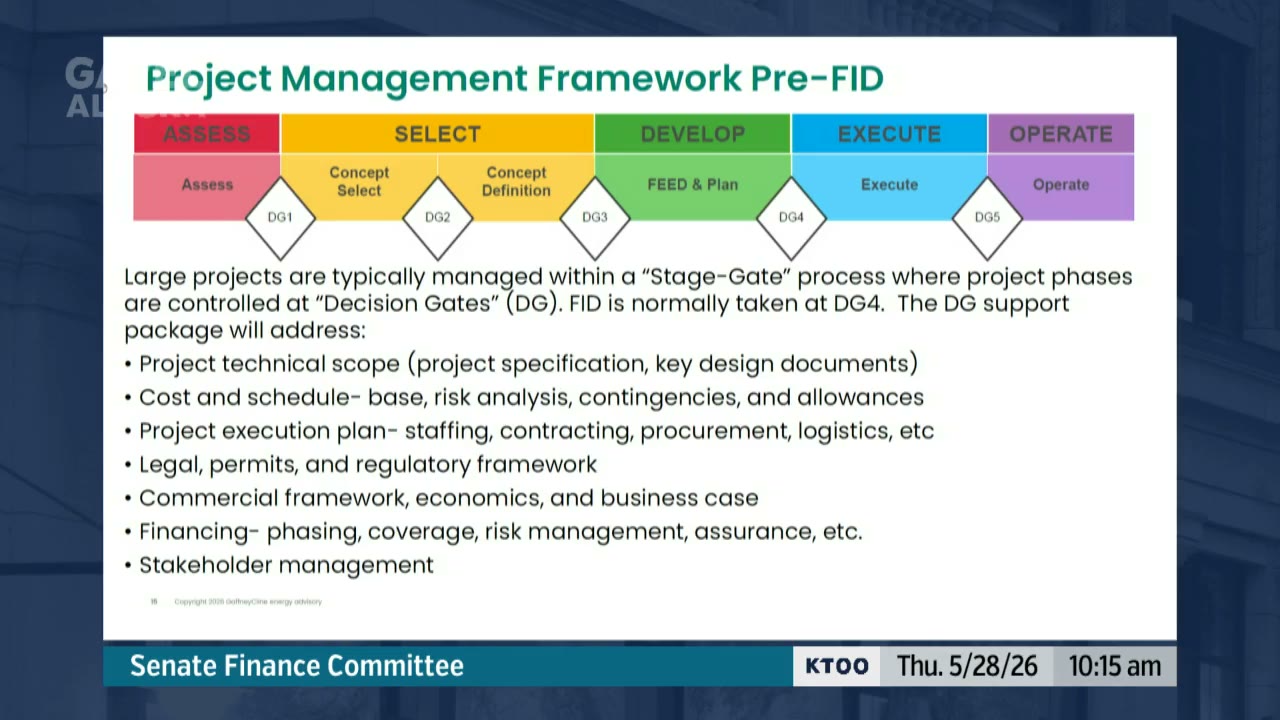
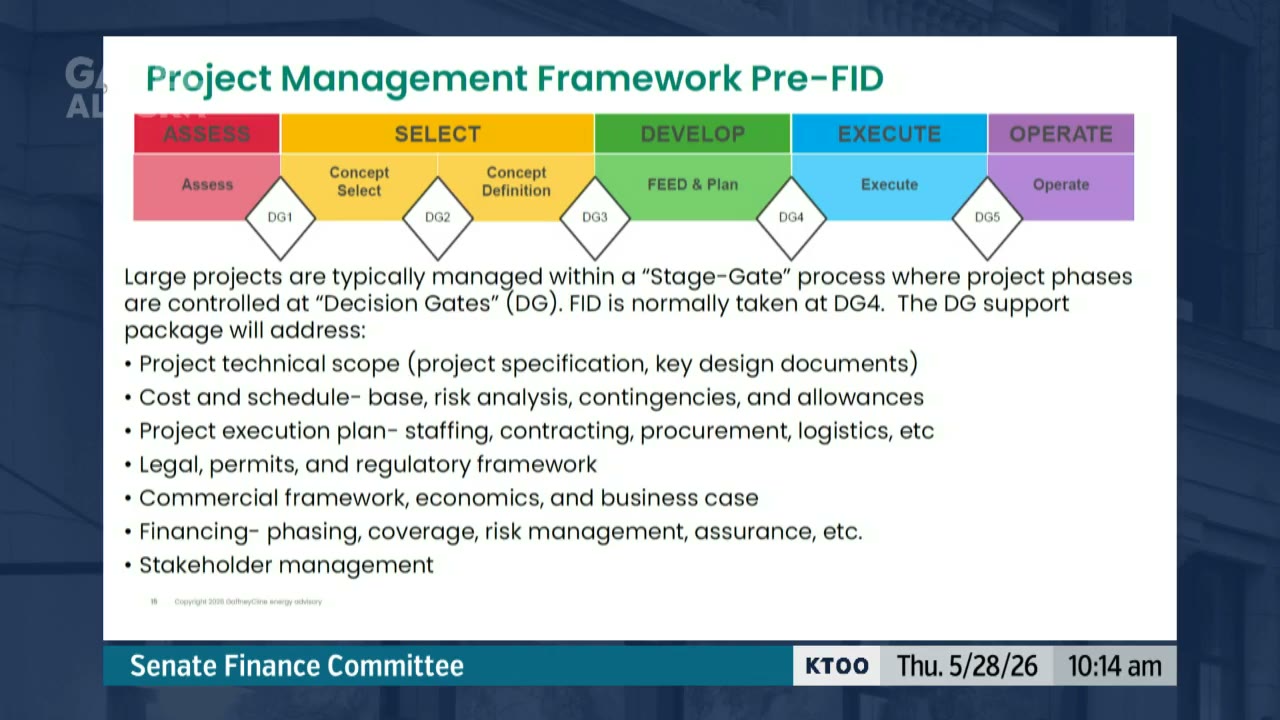
“the pre FID status including gas sales precedent agreements, downstream letters of intent, pipe supply, preliminary agreements and engagement with EPCM and EPC contractors”

Senate Finance, 6/2/26, 9am · Jun 2, 2026

0:38

Speaker A

“a Black Swan event is just something that is unplanned for as low probability, but high impact when it does occur. COVID 19 was a great example of a Black Swan event.”

Senate Finance, 6/2/26, 9am · Jun 2, 2026

0:29

Speaker A

“We were recently involved with reviewing the Vogel nuclear power plant down in Georgia. Units 3 and 4 that were completed a few years ago. That project, I believe, ended up at roughly $36 billion and took, I believe it was seven years longer than planned to complete.”

Senate Finance, 6/2/26, 9am · Jun 2, 2026

0:29

Speaker A

“Bent Flyberg is recognized as one of, if not the preeminent researcher of megaprojects. Through his research of Thousands of projects. He's found 92% of megaprojects are over budget, over schedule or both, which he has dubbed the Iron Law megaprojects.”

Senate Finance, 6/2/26, 9am · Jun 2, 2026

0:25

Bert Stedman

“As I recall that from those classes that we had years ago on a mega project, if, if you were only 20% or less overrun, that was a successful project.”

Senate Finance, 6/2/26, 9am · Jun 2, 2026

0:13

Speaker A

“the most recent information I've heard is that it's imminent. I understand it's pushed from what was previously forecasted, but I believe it's still expected the first half of this year.”

Senate Finance, 6/2/26, 9am · Jun 2, 2026

0:48

Frank Richards

“the original legislation that created AGDC gave AGDC essentially tax-exempt status should we have ownership in the project during construction. And then it was going to fall to the tax structure under 4356 for oil and gas property taxes. Now, the, the concept that is now in front of us with House Bill 381, this alternative volumetric tax, would— is really going to be based on the volumes of gas flowing out of the project.”

HFIN-260527-1330 · May 27, 2026

0:30

Will Stapp

“I think it probably would have been helpful to give some sort of structure. What we have before us is a volumetric structure. I think it's totally fine because it helps de-risk the project to capital cost overruns. But I still don't see— I mean, it probably would have been helpful, I think, for members of the committee, for you guys, even though I know you were out doing other things, because I remember those discussions very well, to perhaps at least bring a little bit of a framework to us.”

HFIN-260527-1330 · May 27, 2026

0:21

Matt Kissinger

“we have as AGDC, even prior to Glenfarm coming into the project, we've put out there this assumption of $1.50 and I think we are still confidently within that assumption range.”

HFIN-260527-1330 · May 27, 2026

0:33

Bert Stedman

“I think some of the other committees have used a number of about $12 billion for the in-state gas line, not $10 billion. So that's, you know, a significant increase right there. And then 20-year government bonds plus 3/8 is roughly 5.5 for your interest rate.”

SFIN-260528-0900 · May 28, 2026

0:43

Jesse Kiehl

“there's an ultimate cap on on what that tariff can be and it's imported LNG. Because the RCA is only ever gonna approve what's reasonable and necessary. And if, you know, the cost overrun example on slide 4 today were to hit an in-state 42-inch pipe with only in-state consumers, I worry that we have a half-built project and no chance of an approved tariff that could pay for the cost overruns.”

SFIN-260528-0900 · May 28, 2026

0:46

Bert Stedman

“what's not straightforward is 70% of 45, which is about $30 billion in debt, And a more realistic number, just dealing with some of the cost escalations, uh, is in the neighborhood of $60 billion, maybe over, because from what we understand, that, uh, construction and pipeline construction costs have escalated a little faster than inflation. So it's probably somewhere north of $60, but just using $60, that's a debt increase of $12 billion. $12 Billion is a big cash flow payment to meet in and of itself.”

SFIN-260528-0900 · May 28, 2026

1:02

Nicholas Fulford

“given the scale of the project, is debt funding. As we've discussed, in a project of this sort, probably be 60, 70% maybe even more, financed on what they call a non-recourse basis. So this would be off balance sheet, so companies would contract with a consortium of banks that would lend the money and would take some degree of risk themselves.”

SFIN-260528-0900 · May 28, 2026

1:06

Nicholas Fulford

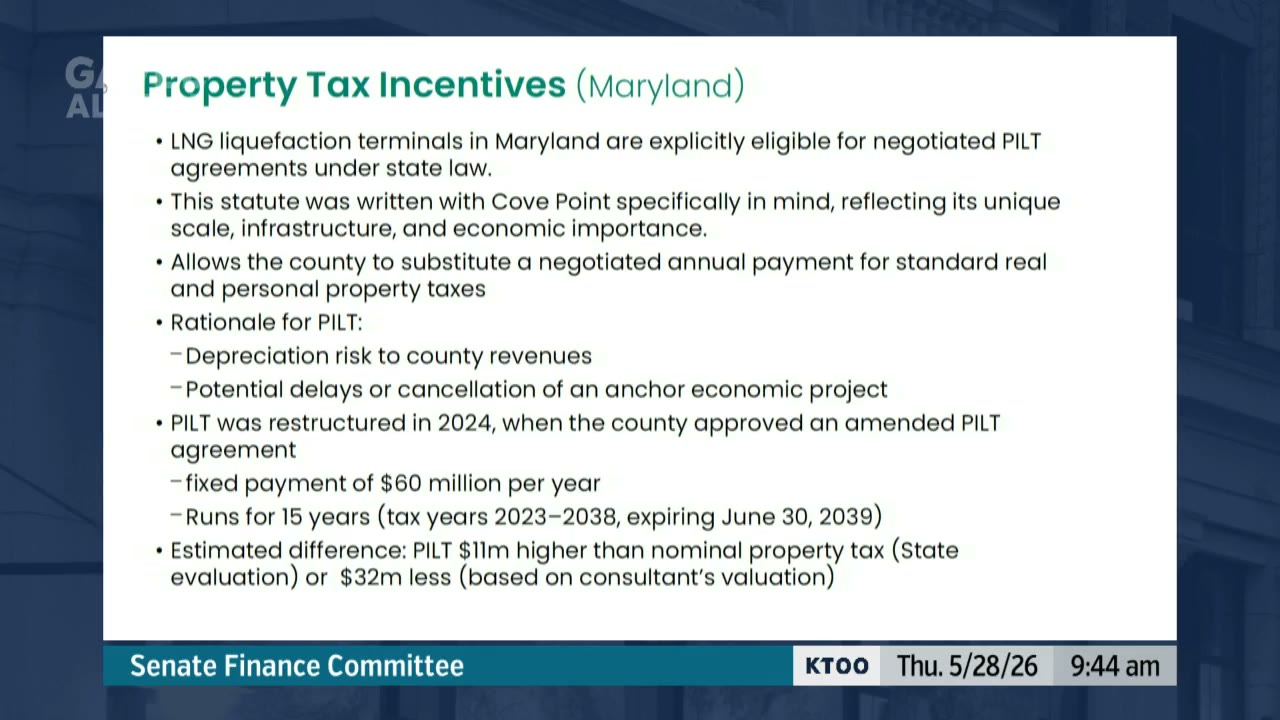
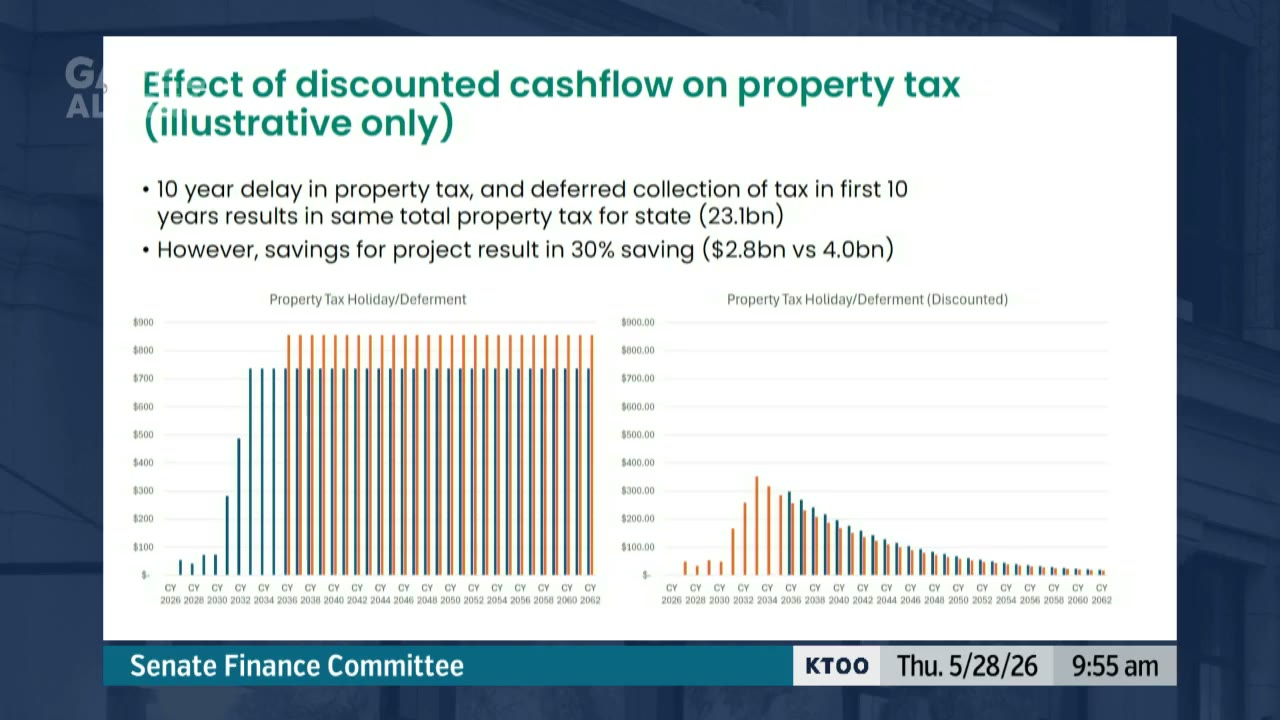
“the current property tax projection up until 2062 would amount to just over $23 billion of revenue, of which about a third would go to the state and about two-thirds goes to local communities along the line and affected host communities. The volumetric tax in— certainly in the original bill set at 6 cents comes to about $2.6 billion.”

SFIN-260528-0900 · May 28, 2026

0:45

Lyman Hoffman

“these people are out, you know, are getting some breaks, yet we're sitting here arguing, should we give breaks to building our pipeline in the harshest conditions and, you know, maybe very limited building seasons of time when they have to put that pipeline in the ground.”

SFIN-260528-0900 · May 28, 2026

0:47

Nicholas Fulford

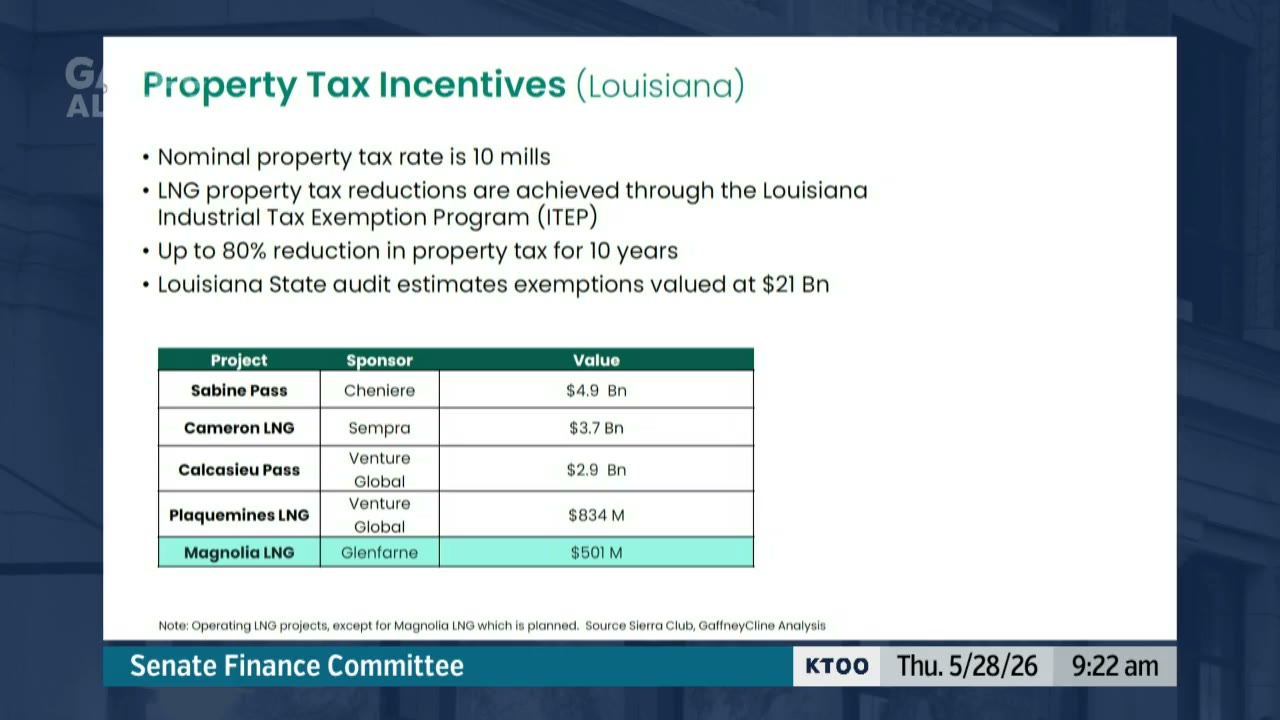
“That's a good summary. What I would say is that that remaining 2 mils, from what I understand, And I don't have detailed numbers on this, but from what I understand, through various other tax exemptions and local arrangements, I think most of the rest of that 2 mils disappears as well. So I think you could almost regard Louisiana as being a full property tax holiday for 10 years”

SFIN-260528-0900 · May 28, 2026

0:21

Bert Stedman

“Louisiana, so they basically go from 10 mils down to 2 mils for 10 years roughly, and then there's some fluctuations around there? Is that kind of their basic structure?”

SFIN-260528-0900 · May 28, 2026

1:14

Nicholas Fulford

“the property tax rate is 10 mils rather than 20, and there are differences in the way in which the taxable value of the facility is calculated. But you can see there, um, you know, Sabine, which is being expanded, Cameron, Calcasieu, and Plaquemine, they're all existing LNG projects. And you can see there on the chart the value of the property tax concession for those companies is, is quite substantial.”

SFIN-260528-0900 · May 28, 2026

0:44

Bert Stedman

“the issue I think that we'll be faced with at some point is a discussion on the state's position being diluted. And the only way you can keep it from being diluted is pony up your portion of the cash, generally speaking.”

SFIN-260528-0900 · May 28, 2026

0:37

Bert Stedman

“just assume it's $60 billion, and at 70/30, that's $18 billion in equity. Somebody's got to put down $18 billion in cash. I would expect the guy that comes to the table with $18 billion, the guy with the gold makes the golden rules, is going to want a significant majority of the equity position or he won't put his $18 billion on the table, he'll go somewhere else. Therein lies a dilution problem or a challenge.”

SFIN-260528-0900 · May 28, 2026

0:25

Nicholas Fulford

“one of the interesting things that we began to talk about yesterday was capital cost. Obviously it's been a very significant element of the debate over the last few weeks, both within the Senate and the other committees.”

SFIN-260528-0900 · May 28, 2026

0:41

Bert Stedman

“we've talked about that 40, mid-40 range cost factor, and some of us believe it's complete nonsense, right? It's an old number that's not relevant, and we'll get into that when we get into our modeling in a couple of days. But if they do the, you know, 70% debt level, there is the government loan guarantees and backing that we need to to get an understanding for over the next several days what that entails. But my understanding from the federal folks that I've talked to, it's if you do 20 years, it's 20 years plus 3/8 on the government bond. If you do 30-year financing, it's 30-year government bonds plus 3/8.”

SFIN-260528-0900 · May 28, 2026

0:50

Nicholas Fulford

“one of the key challenges for this project when you're probably looking at $30 billion or so of debt, is between now and FID, the people providing that $30 billion have to go through this project with a fine-tooth comb and consider every kind of scenario to make sure their money is safe. So in some ways, if the project can secure $30 billion of debt, then right there, there's a relatively high degree of confidence in the project's ability to go forward.”

SFIN-260528-0900 · May 28, 2026

0:54

Nicholas Fulford

“if you, if you look at it through a DCF lens, the project is actually making a 30% saving. So instead of a discounted cash flow amounting to $4 billion, it's one that amounts to $2.8 billion.”

SFIN-260528-0900 · May 28, 2026

1:18

Nicholas Fulford

“if we were to delay any property tax collection until 2036, but but also ensure that that missing tax, for want of a better term, is collected over time, you know, what would that look like?”

SFIN-260528-0900 · May 28, 2026

0:58

James Kaufman

“one of the huge differences is the source of the gas. And so, I mean, there's things that make it such an apples and oranges comparison where I'm sure most of the gas that's being transported in these lines is not coming from state ownership with any kind of royalty or maybe very little.”

SFIN-260528-0900 · May 28, 2026

0:38

Nicholas Fulford

“most of this gas would be in private ownership, would be developed, you know, in, in under very commercial terms.”

SFIN-260528-0900 · May 28, 2026

0:47

Nicholas Fulford

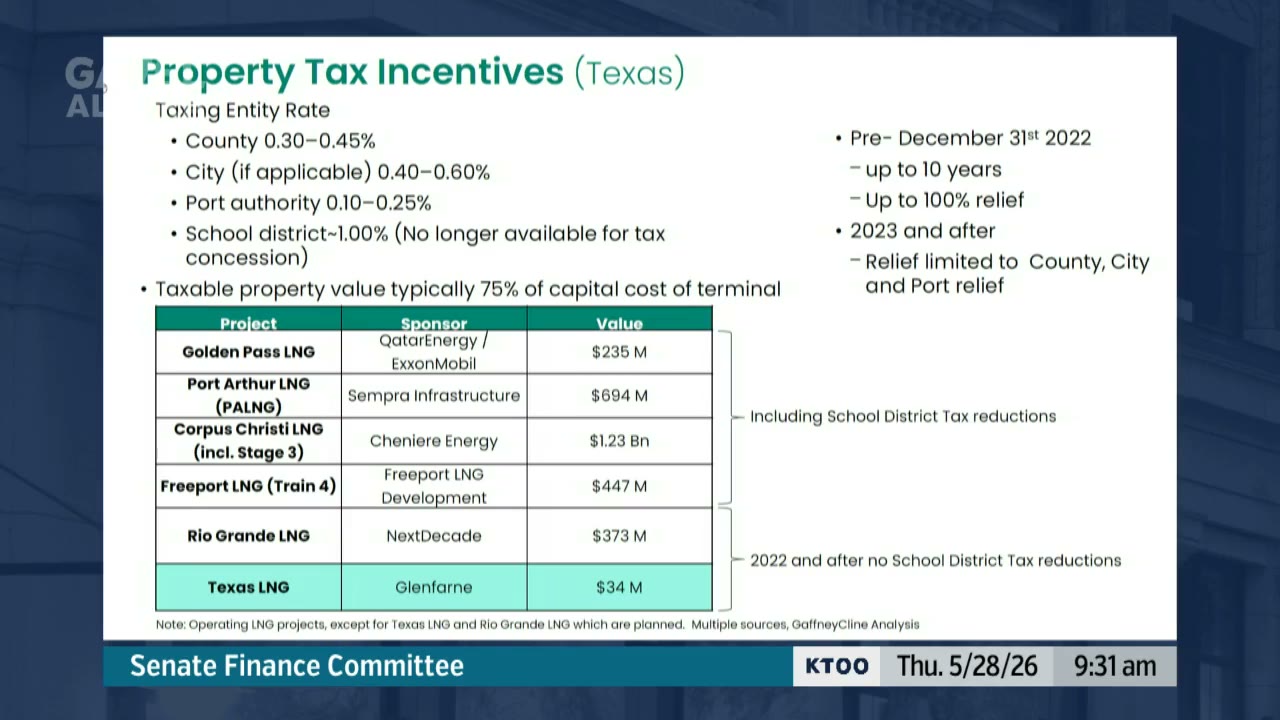
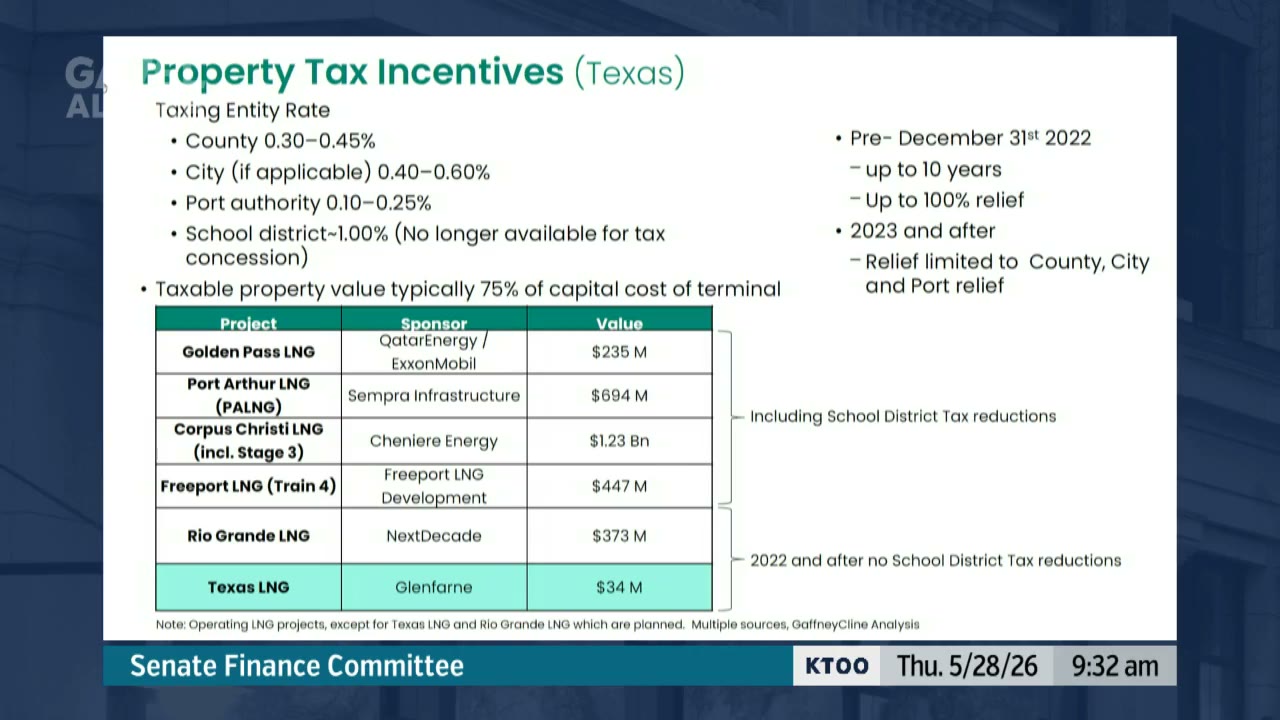
“the property tax concessions, you could say, were, were roughly halved in, in 2023 as a result of this treatment for school districts.”

SFIN-260528-0900 · May 28, 2026

0:45

Nicholas Fulford

“the mechanism in Louisiana is a— well, it's a forgiveness, if you like, of property tax for a period of 10 years, after which the normal rates apply, but there's no there's no recouping of unpaid property tax.”

SFIN-260528-0900 · May 28, 2026

0:42

Nicholas Fulford

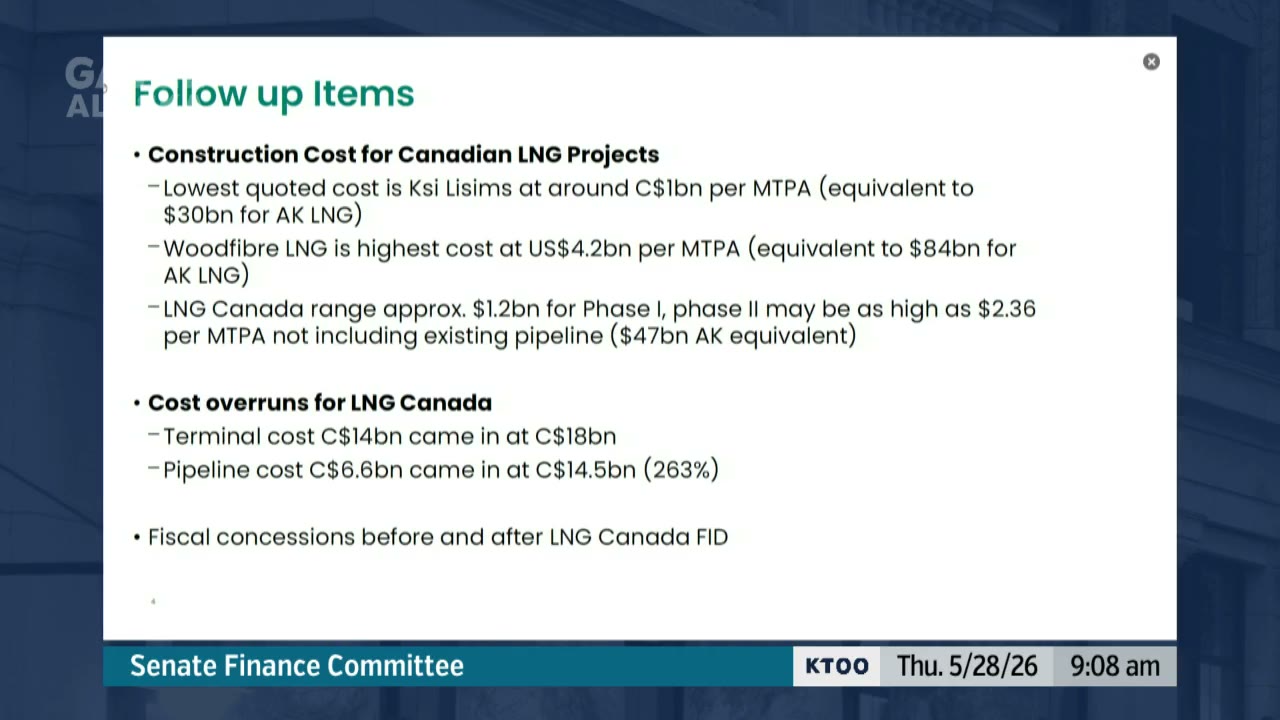
“if they do achieve Phase 2 FID on a cost of $2.36 billion per MTPA, then that suggests that Alaska potentially has a lot more headroom than previously believed, because if they can invest that and sell LNG profitably into Asia, with a $47 billion equivalent just for the LNG, that suggests that the economics of Alaska might be stronger than previously believed.”

SFIN-260528-0900 · May 28, 2026

0:46

Nicholas Fulford

“a fixed revenue such as a volumetric tax or a PILT can work better for local communities because of the planning ability.”

SFIN-260528-0900 · May 28, 2026

0:39

Nicholas Fulford

“it's helpful to look at what some of the other states do, particularly in the lower 48 Gulf Coast states like Texas and Louisiana, where obviously there's been a huge amount of LNG development.”

SFIN-260528-0900 · May 28, 2026

1:16

Nicholas Fulford

“one of the challenges around property tax is that it does not sit happily with this idea of fiscal stability, that, you know, it can be reevaluated, it can be changed, and, you know, it's difficult to plan for.”

SFIN-260528-0900 · May 28, 2026

0:43

Nicholas Fulford

“the most significant learning, which we'll perhaps come on to, is that in offering these tax concessions for 10 years, it's kind of recognizing that with these very high capital projects, it is in that first 10 years that the economic boost given to the project by tax forgiveness is the greatest.”

SFIN-260528-0900 · May 28, 2026

0:31

Matt Kissinger

“We had them come in and compare it with every other jurisdiction, especially around the U.S., Canada, but also some overseas jurisdictions. And what they found was that our property tax in Alaska, the way it's structured, assured would result in property taxes a whole order of magnitude, so kind of 10 times higher than the next highest.”

HFIN-260527-1330 · May 27, 2026

0:36

Will Stapp

“Obviously, kind of begs the question, if you have 3 studies identifying that property taxes were a big issue in the project, the bill to restructure property taxes in Alaska in the project didn't come before the legislature, I want to say, until nearly the end of March. So obviously here we are in special session given the time constraints. And I'm just curious if you guys knew about this for so long, why wasn't at least a skeleton structure presented for us last year or year before or year before that?”

HFIN-260527-1330 · May 27, 2026

0:30

Matt Kissinger

“And you see that aside from capital cost, the property tax is the largest single impact on this project.”

HFIN-260527-1330 · May 27, 2026

0:38

Matt Kissinger

“3 of them really stood out. The first one was what we called state and federal support, such as the loan guarantees, but really it was focused on the loan guarantees. The second one was an even lower gas price, which we have continued to negotiate a lower and lower gas price with the producers. And then finally, even back then, we identified that property taxes were one of the biggest triggers that you could pull.”

HFIN-260527-1330 · May 27, 2026

0:37

Andy Josephson

“when we talked to our consultant, Mr. Fulford, yesterday, he didn't suggest that, that, uh, the contract covered price. That was an imperative feature on his slide deck, I think taken from DOR, showing these heat charts where we had to be in the top left corner to reach or come under that $10.41 cost at delivery.”

HFIN-260527-1330 · May 27, 2026

0:31

Matt Kissinger

“you can also see that the provinces and Canada made necessary concessions to put that over the line, and it benchmarks well with other projects that have moved forward with respect to property tax and corporate tax.”

HFIN-260527-1330 · May 27, 2026

0:26

Matt Kissinger

“I would suspect— I would expect that any contract going in front of the RCA for utility sales in Alaska would look very different with or without the changes to property tax. Simply because it's more than— it's well over $2 impact per MMBTU, which is the unit of measure that is normally sold in. And so I don't believe that they could just simply absorb it.”

HFIN-260527-1330 · May 27, 2026

0:42

Matt Kissinger

“In 2016, they brought in Wood Mackenzie, and they asked Wood Mackenzie to do a competitiveness analysis of the project. And Wood Mackenzie said that the project ranked poorly in terms of competitiveness. And they recommended that we adopt a debt-funded third-party tolling structure rather than what would normally be your IOC, your International Oil Company balance sheet financed project.”

HFIN-260527-1330 · May 27, 2026

0:16

Matt Kissinger

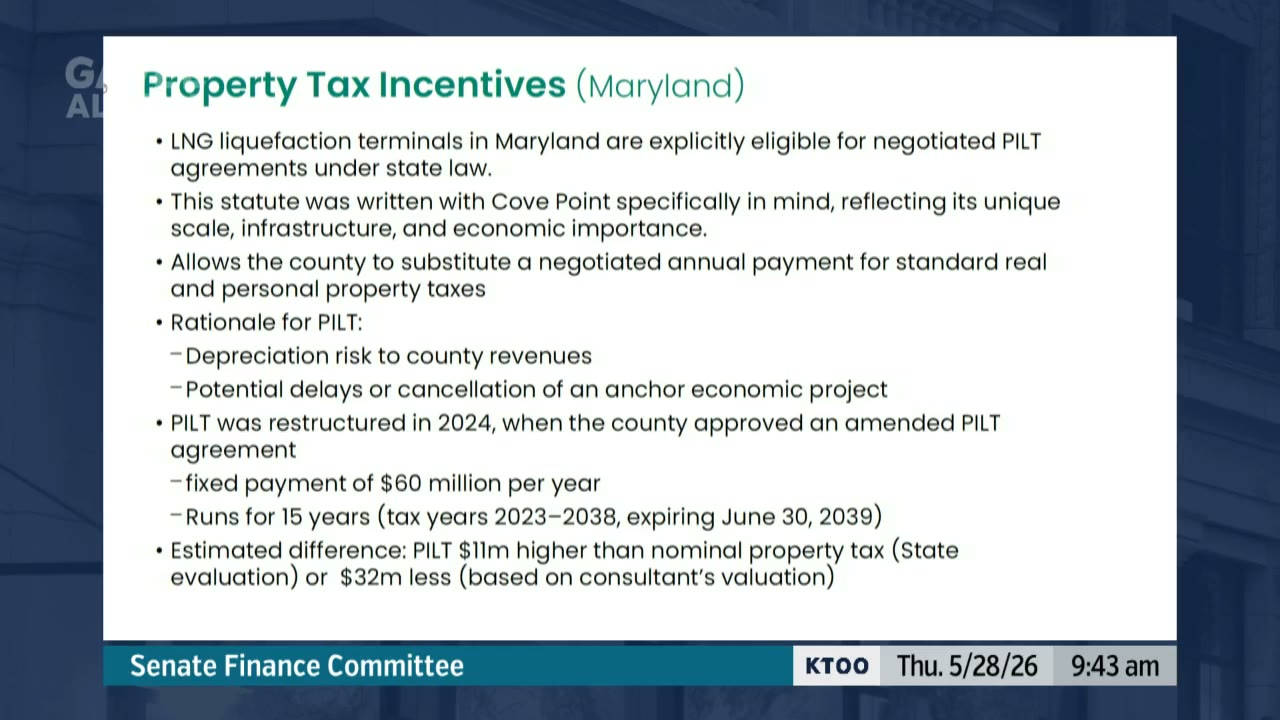
“The next highest that they had identified being Cove Point, Maryland, that had about $50 million a year. I think LNG Canada has around $27 million per year, and if you just go by statute, this project could be well over $800 million a year.”

HFIN-260527-1330 · May 27, 2026

1:19

Frank Richards

“the cost estimate level for the gas treatment plant and the liquefaction are currently a Class 4. And so, as I started off, you know, we were at $44 billion, we reduced it to $38 billion in 2020. And what AGDC did is we had engaged with Fluor as essentially our owner's engineer over the years, and we asked Fluor to keep up with the cost and we would recast that cost estimate”

HFIN-260527-1330 · May 27, 2026

0:27

Frank Richards

“it's really around the property property tax and how we are, you know, far out of our field compared to our competition in other portions of the world. So we wanted to bring this back just to really identify that property tax is an issue within the state of Alaska for this project because, again, it's not an oil project. This is a natural gas project. And so the margins are much smaller than an oil project.”

HFIN-260527-1330 · May 27, 2026

0:27

Matt Kissinger

“If you look at Canada versus Alaska, they have It's a fairly well-known resource, but it's an undeveloped resource that requires drilling and development through the life of those projects. It's the Montney and the Horn Rivers, tight, tight oil and gas up in northern BC and Alberta. They have the pipeline that had to go over the coastal range. We get to avoid the coastal range.”

HFIN-260527-1330 · May 27, 2026

1:15

Nicholas Fulford

“as you consider the tax arrangements for AKLNG, whether it be property tax or something different, a lot of these international investors will be looking at which is the most favorable tax rate, tax environment to operate in”

SFIN-20260527-1330 · May 27, 2026

0:49

Nicholas Fulford

“one of the key features for Alaska is that when you look at that delivered cost to Asia, it's going to have to be roughly the same or slightly less than that U.S. Gulf Coast marginal price”

SFIN-20260527-1330 · May 27, 2026

← NewerOlder →