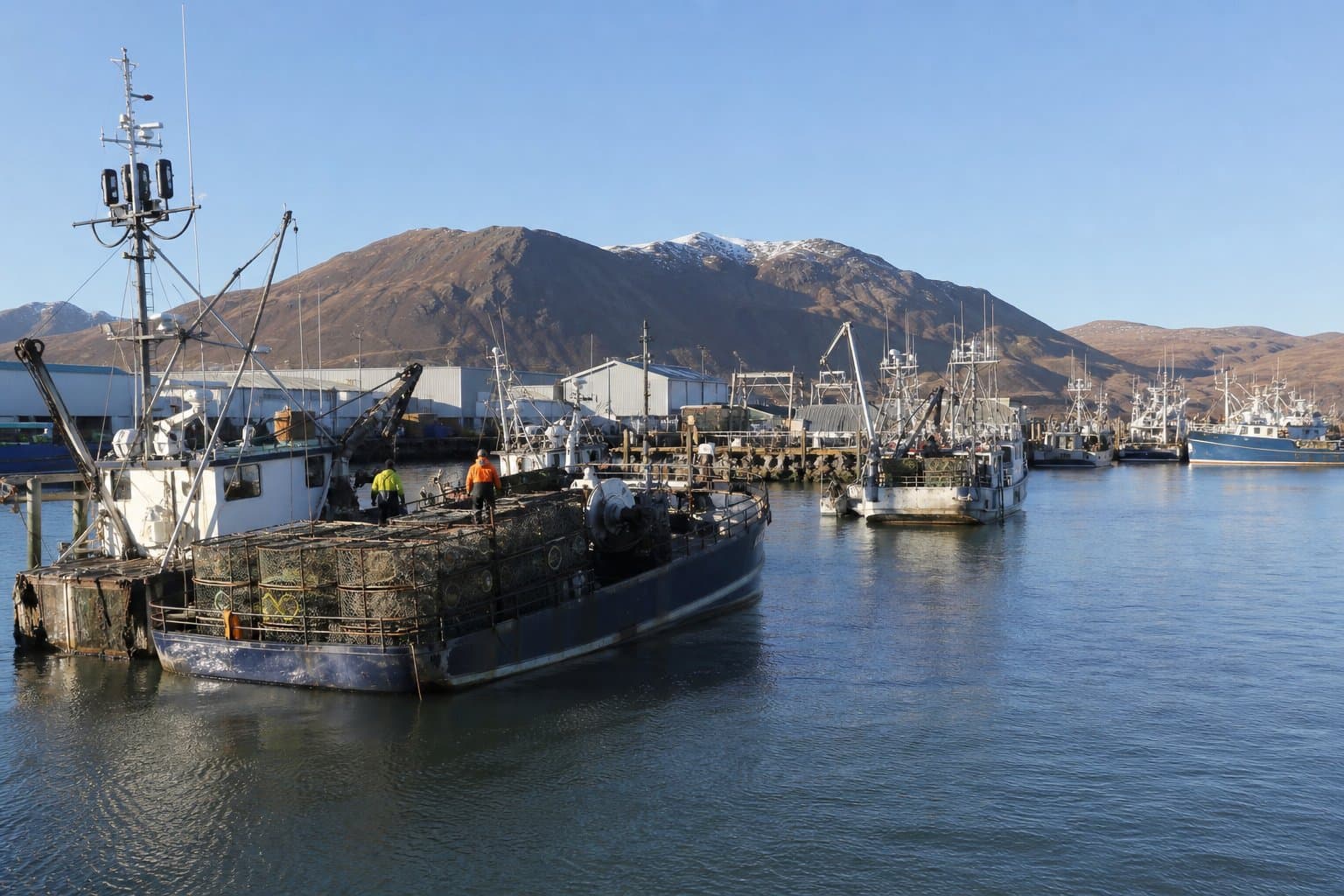
AI image
State reviews Bering Sea crab catch calculations Wednesday
The Alaska Department of Fish and Game will review its 2026/27 total allowable catch calculations for Bristol Bay red king, Bering Sea Tanner and Eastern Bering Sea snow crab at a public meeting Wednesday, Oct. 7. Its preseason registration notice said TACs would be announced in early October.
The state first decides whether each fishery opens under its harvest strategies, then sets a TAC, the annual catch target, for the ones that do. TACs keep removals below the acceptable biological catch, a federal ceiling the North Pacific Fishery Management Council sets each year.
Last season's limits, according to a department update to the Board of Fisheries, were 2.68 million pounds of red king crab, up 16 percent, and 9.3 million pounds of snow crab, up 97 percent and including a 1-million-pound hybrid add-on. Snow crab had reopened in 2024/25 at 4.72 million pounds. Tanner limits were 1.13 million pounds east and 10.12 million pounds west, up 79 percent combined.
NOAA Fisheries rates Bristol Bay red king crab as neither overfished nor subject to overfishing, though the department says mature abundance remains near historic lows. That fishery closed in 2021/22 and 2022/23 for low female abundance. Snow crab has been in a federal rebuilding plan since August 2023, after NOAA Fisheries found the stock overfished. The department has attributed the stock's collapse to a 2018–2019 marine heat wave.
On Sept. 30, the department selected every preregistered catcher vessel in these fisheries for observer coverage, noting that selection "does not imply a fishery will open." Under the partial-coverage system, vessels assigned an observer must carry one for all of their fishing, and the rest get waivers. Operators must give Saltwater Inc., the state-contracted observer provider, at least 10 days' notice before departure, or tell the company if they won't fish. Late notice risks delays or enforcement action.
Source: Alaska Department of Fish and Game.
AI-assisted. Reviewed by Cale Green. How we use AI
Stay informed. Support what matters.
Free, permanent access to local news you can verify. Subscribe to support Bill AlaskaNews and go ad-free.
Related Coverage
Every preregistered Bering Sea crab boat is selected for observer coverage
Alaska News · 1d ago
The panels that shape Alaska's pollock and cod catch limits meet next month
Alaska News · 1mo ago
Southeast king crab registration closes Oct. 2 ahead of a Nov. 1 opening
Alaska News · 3w ago
Aleutian Islands golden king crab quota rises 13% for 2026/27
Alaska News · 3mo ago
Alaska's one-boat state crab fishery reopens as offshore quota rises
Alaska News · 1mo ago
Comments
Sign in to leave a comment.
No comments yet. Be the first to share your thoughts.