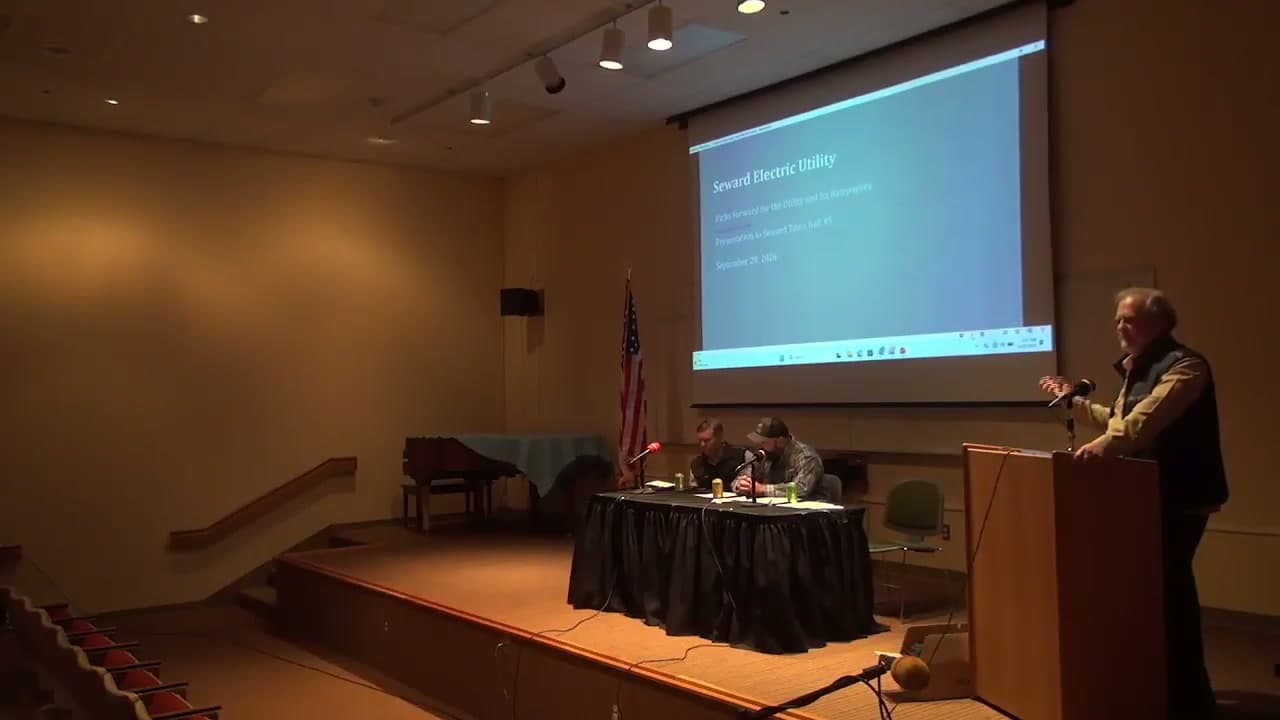
Frame from "Seward Electric Community Town Hall Meeting 9/28/26" · Source
Seward survey respondents favor a local cooperative to run the city's electric utility
Most people who answered Seward's latest survey on the future of its electric utility want a local cooperative to run it while the city keeps ownership, city staff said at a town hall Monday. Sixty-two percent ranked that option first.
A city-owned utility run by a board separate from the City Council drew 22% of first-place votes, and selling the utility to one of the Railbelt's member-owned cooperatives drew 15%. Eighty-eight percent said it is very important that all ratepayers, inside and outside city limits, have a say, and 88% said they support the city pursuing more hydropower. The survey is open to anyone and is not a scientific poll. The results reflect 347 responses between Aug. 25 and Sept. 25, about half from people living outside city limits, and the city is aiming for 400.
The question is back after voters rejected selling the utility in 2023. The city has since paid Matanuska Electric Association to manage it, and a two-year pause on revisiting the issue ended last October. Electric General Manager Brian Hickey said the way the utility has long been run "hasn't worked."
Much of the math depends on a proposed hydroelectric project on Godwin and Fourth of July creeks, across Resurrection Bay. Under Hickey's base-case projections, drawn from the city's own study, a household using 750 kilowatt-hours a month would pay about $174 a month with the hydro project, $212 without it and $195 if the utility were sold.
The biggest factor is a federal clean energy tax credit that public utilities can now receive as a direct payment. Hickey said breaking ground before 2033 could cover 30% to 50% of the project's cost, depending on which requirements the project meets, and his base case assumes the full 50%. He estimates the cost at $190 million to $200 million, or as much as $285 million in a worst case.
The project is still at an early stage. Hickey said there's no guarantee it can be built until crews study the geology, the reservoir's capacity and the fish in Fourth of July Creek. Residents at the town hall asked about sediment and a recent landslide in the canyon.
Seward isn't the only one interested in the site. Chugach Electric applied to federal regulators in February for a preliminary permit on Godwin Creek, which would give it first claim to study the site and seek a license to build there. The city applied in April for both creeks, and Hickey said the city believes federal law requires regulators to give a local municipality preference. A decision is expected late this year or early 2027, and the city is keeping its study of the project private until then.
Hickey said a City Council work session could come before the end of the year or in early 2027. The city has also applied for a $2 million state grant for drilling, reservoir mapping and fish studies at the site, which would begin next summer if awarded.
This article is based on a public meeting of City of Seward — Seward Electric Community Town Hall Meeting 9/28/26 ().
AI-assisted. Reviewed by Cale Green. How we use AI Transcript byWalter AlaskaNews
Stay informed. Support what matters.
Free, permanent access to local news you can verify. Subscribe to support Melinda Communities.News and go ad-free.
Related Coverage
Alaska Energy Survey Shows Strong Support for Renewables, Mixed Views on Nuclear
Alaska News · 5mo ago
Cordova's co-op wants a data center to soak up unsold hydropower
Alaska News · 2mo ago
Seward council approves $11.8 million in shore power contracts for cruise dock
Alaska News · 1h ago
Railbelt ratepayers will repay up to $100M for a Bradley Lake expansion built around federal tax credits
Alaska News · 1mo ago
A $400 million expansion of Bradley Lake hydro would power about 30,000 homes and cut Southcentral's gas use
Alaska News · 1mo ago
Comments
Sign in to leave a comment.
No comments yet. Be the first to share your thoughts.