Alaska Energy Survey Shows Strong Support for Renewables, Mixed Views on Nuclear
Alaska Energy Survey Shows Strong Support for Renewables, Mixed Views on Nuclear
The Alaska Center for Energy and Power and the Institute of Social and Economic Research presented survey results Friday showing Alaskans favor expanding hydroelectric, solar and wind power while opinions on nuclear energy remain divided.
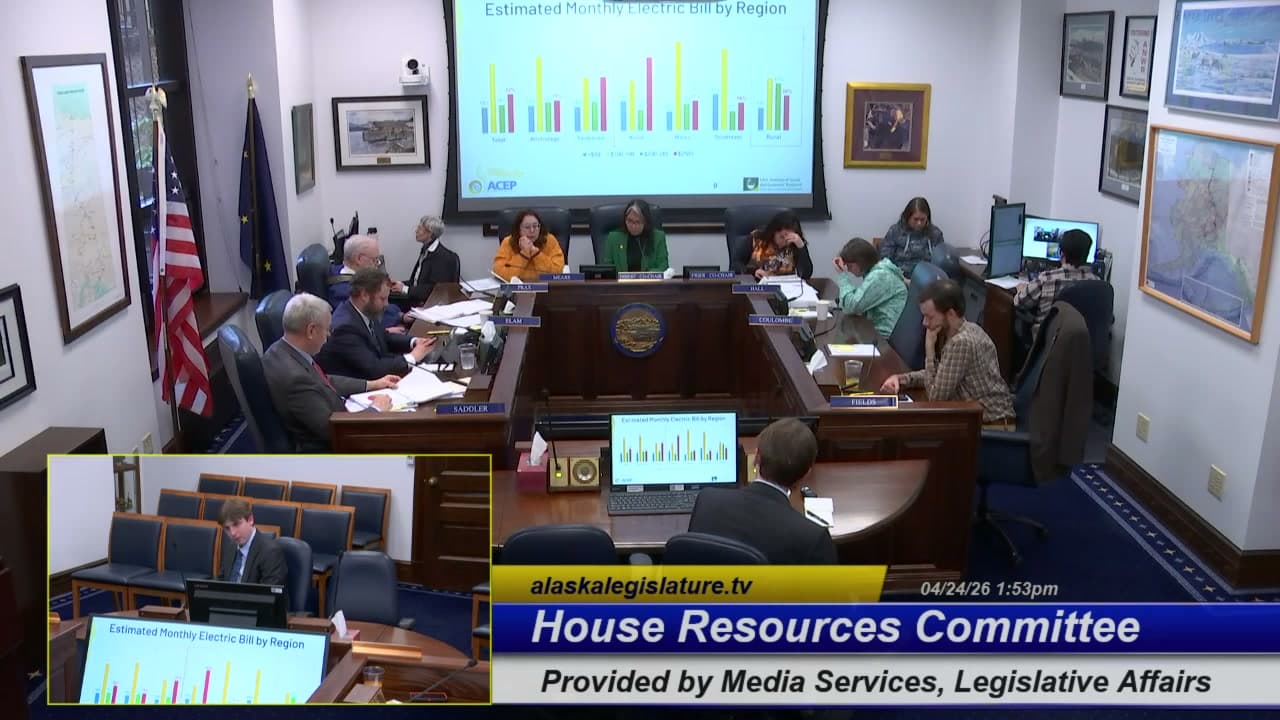
Gwen Holdman, chief scientist at the Alaska Center for Energy and Power, and Diane Hirshberg, director of the Institute of Social and Economic Research, told the House Resources Committee that three years of polling data reveal consistent support for renewable energy development across the state. The surveys, conducted between 2023 and 2025, sampled between 500 and 600 Alaskans each year.
Hydroelectric power drew the strongest support, with 80% of Southeast Alaska respondents calling their electric bills affordable. Juneau residents pay about 13.7 cents per kilowatt hour. By contrast, 40% of Fairbanks and Kenai Peninsula residents said their bills were unaffordable. Fairbanks residential electricity rates average about 32 cents per kilowatt hour.
Fairbanks and other peripheral rail belt customers face high energy burden, which measures how much of a household's income goes to energy costs, Holdman said. The average Fairbanks resident spends 10% of household income on energy costs. That is more than three times the 3% threshold considered high burden in the United States.
The surveys found 70% of Alaskans support building a natural gas pipeline, with strongest backing in the Mat-Su region and weakest in Southeast Alaska. But support dropped 27% when respondents were told the project might require additional state investment. Support fell further if energy costs would increase compared to current rates.
A lot of the support is tied to the idea that this is going to result in lower cost or stable cost energy for Alaskans, Holdman said.
On nuclear energy, awareness of advanced reactor technology increased from 25% in 2023 to 40% in 2025. Support for using nuclear power in Alaska rose about 10% over the same period. When given information about microreactors, small reactors that could fit in an oversized shipping container, support increased significantly during the survey itself.
Fairbanks showed the highest awareness of advanced nuclear technology, likely because of the proposed microreactor at Eielson Air Force Base. That project would be the first commercial microreactor deployed in the United States if it stays on schedule for 2027 or 2028.
The presentation highlighted energy cost challenges facing rural Alaska. Hub communities pay unsubsidized electric rates well above the U.S. average, while communities under 1,000 residents face even higher costs. The Power Cost Equalization Program subsidizes residential customers, but covers only about one-third of kilowatt hours sold in rural Alaska.
Holdman warned that diesel price increases will hit rural communities hard. The researchers estimate a $5 per gallon increase in liquid fuel costs would create a $450 million impact across rural Alaska.
Rep. Donna Mears noted that fuel supply disruptions compound the problem. She said a supplier who delivers fuel by barge to western and northern Alaska recently lost access to South Korean sources because fuel from the Middle East through the Strait of Hormuz became unavailable. The company now competes with California buyers for Canadian refinery fuel and is considering sourcing from the Gulf of Mexico.
Once prices rise, she called it sticky, they tend to stay stuck high for a little while, Mears said. Because when we are looking at fuel in rural Alaska, in communities that get seasonal deliveries, you get one or two deliveries in a lot of communities and whatever price you buy at, you are stuck with. But it also is, it kind of lasts over a period of years.
Fairbanks faces its own crisis. Golden Valley Electric Association burned 250,000 gallons of diesel per day during winter 2025 because natural gas-generated power from Southcentral Alaska was unavailable. All of rural Alaska together burns about 70,000 gallons of diesel daily for power generation.
There is simply not any extra gas to be contracted, Holdman said when asked why natural gas power to Fairbanks dropped to essentially zero in 2025.
The researchers cautioned that regional breakdowns in the survey have larger margins of error due to smaller sample sizes. The 2023 survey included an oversample of 100 Fairbanks residents, while the 2025 survey oversampled Nome and Kotzebue with about 50 residents from each community.
Hirshberg said the surveys provide directional information rather than definitive answers for specific regions. Both researchers expressed interest in conducting more rigorous surveys with larger sample sizes to better understand regional differences in energy perspectives.
The Alaska Center for Energy and Power is organizing a tour of Idaho National Laboratory for utility managers next week, with a tentative second tour for legislators planned for late June.
The House Resources Committee received the presentation as informational. No action was taken.
This article is based on a public meeting — Alaska Legislature: House Resources, 4/24/26, 1pm ().
AI-assisted. How we use AI Transcript byLucas Brown
Stay informed. Support what matters.
Free, permanent access to local news you can verify. Subscribe to support Alaska News and go ad-free.
Related Coverage
Seward survey respondents favor a local cooperative to run the city's electric utility
Alaska News · 22h ago
Alaska Sustainable Energy Conference explores future of statewide energy systems
Alaska News · 4mo ago
Alaska Energy Conference Highlights Gas Pipeline Progress Amid Legislative Tax Debate
Alaska News · 4mo ago
House Finance begins review of Alaska LNG tax bill with competing rate proposals
Alaska News · 4mo ago
Alaska Senate panel hears gas line bill with $900M annual tax break
Alaska News · 4mo ago
Comments
Sign in to leave a comment.
No comments yet. Be the first to share your thoughts.