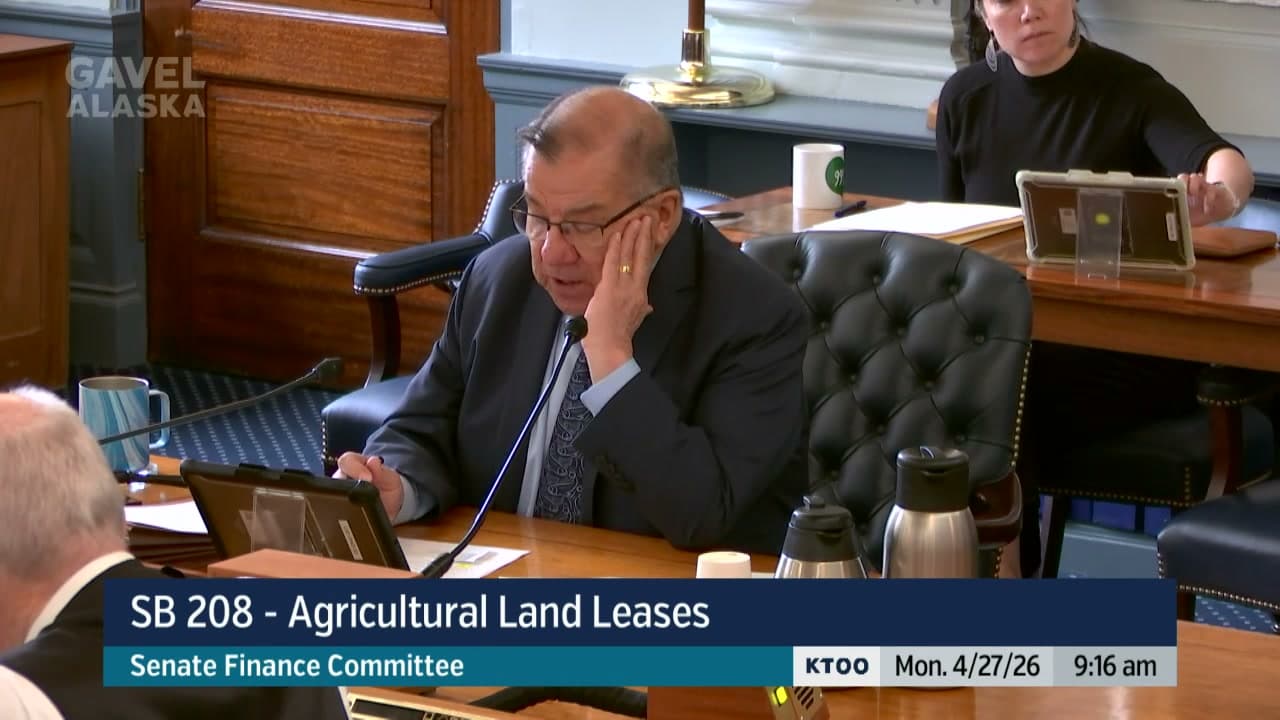
Senate Finance Advances Agricultural Leasing Reform After Farmer Cites $9,000 Annual Fee
The Alaska Senate Finance Committee moved forward Monday with legislation to overhaul how the state leases farmland, responding to testimony that current appraisal requirements price farmers out of productive land.
Senate Bill 208, sponsored by Senator Jesse Bjorkman, creates a new leasing program that allows farmers to select state parcels and rent them at below-market agricultural rates rather than development values. The bill also gives the Department of Natural Resources the option to award agricultural land sales based on merit rather than solely to the highest bidder.
The committee set the bill aside without a vote after a first hearing, standard practice before advancing legislation. No timeline was set for final action. The bill previously received hearings in the Senate Resources Committee and is now moving through the Finance Committee as part of the standard legislative process.
Emily Garrity, who operates Twitter Creek Gardens near Homer, told the committee her lease application for 4.5 acres of state land ballooned from an estimated $1,000 per year to $9,000 after an appraisal valued the parcel at $117,000. That works out to more than $2,000 per acre annually. The state's four other active crop production leases charge less than $1 to $90 per acre.
"Charging over $2,000 per acre per year for the land they are growing on is not going to get us there," Garrity said. "I urge you to consider Senate Bill 208 to allow for the leasing of state lands to be accessible for agricultural production."
The parcel Garrity applied for in April 2023 sits inside a ski trail loop on land classified for recreational use. It has been unused for more than 20 years but contains the same deep, well-drained soil that has yielded 40,000 pounds of vegetables from her existing two-acre operation. The local ski club provided unanimous support for her application.
Margaret Adsit, lands coordinator for the Alaska Farmland Trust, said the organization's FarmLink program currently has 90 individuals actively looking for land. She described a growing mismatch between available farmland and development pressure, particularly in the Matanuska-Susitna Borough.
"We have lost more than 3,000 acres of farmland over the past decade, while development has increased by over 23,000 acres," Adsit said. "That is an 11 percent loss of farmland alongside a 14 percent increase in development."
Current Mat-Su property prices range from $45,000 to $75,000 per acre for undeveloped agricultural land, she said. That price point pushes most new farmers toward leasing as their only viable entry into agriculture.
The bill addresses three areas. First, it streamlines the leasing process by making costly appraisals and surveys optional unless the commissioner deems them necessary. Under the new program, agricultural leases would run for an initial 10-year term with five-year renewal options. Lessees would become eligible to purchase the land after seven years of agricultural use. Second, it allows DNR to use a regulation-based scoring system to evaluate applicants on qualifications and business plans rather than awarding parcels solely to the highest bidder. Third, it gives DNR authority to assess civil penalties for agricultural covenant violations rather than only having the option to repossess land.
Amy Seitz, policy director for the Alaska Farm Bureau, said the state owns much of Alaska's suitable agricultural land, but access remains difficult. Only about 1 percent of Alaska land is privately owned, and much of that has already been developed or is too small for agricultural use.
"While the number of farms in Alaska is increasing, we have less land in farms than we had even in the early 2000s," Seitz said.
Senator Bert Stedman asked DNR about renewal provisions in existing leases. Rachel Longacre, chief of operations for DNR's Division of Mining, Land and Water, said the department has three active agricultural leases established in the 1960s. Current leases remain active under their existing terms, but at renewal they could adopt the new program's market rates.
Longacre said the bill would allow DNR to set regional market rates that conform to agricultural values rather than development potential. New applications would be subject to the new rates. Existing leases are assignable to other farmers or to children of current leaseholders.
Senator Click Bishop asked whether the bill changes title restrictions on land sold after being leased. Longacre confirmed that any land sold as agricultural land would carry covenants on the deed restricting its use.
The bill does not change how or when the state identifies land for agricultural disposal, according to Laura Asche, staff to Senator Bjorkman. The new leasing and merit-based sale programs would operate alongside existing programs without altering them.
Robert Gibson, a Homer-area farmer and rancher, testified about subdivision restrictions that prevent parcels from being divided unless each resulting piece is at least 40 acres. He described a 61-acre parcel that cannot legally be subdivided because subtracting 40 acres leaves 21 acres, below the minimum.
"A change in that law would really help people to get into agriculture more," Gibson said.
The bill carries a zero fiscal note from DNR, though the department noted it will need to change regulations to implement the new programs.
The committee set the bill aside for further consideration. The committee plans to meet Tuesday morning at 9 a.m.
This article is based on a public meeting — Alaska Legislature: Senate Finance, 4/27/26, 9am ().
AI-assisted. How we use AI Transcript byLucas Brown
Stay informed. Support what matters.
Free, permanent access to local news you can verify. Subscribe to support Alaska News and go ad-free.
Related Coverage
House panel hears bill to ease farmland leasing, lower costs for Alaska growers
Alaska News · 4mo ago
House Resources passes agricultural land lease bill unanimously
Alaska News · 4mo ago
Alaska House panel expands farm tax breaks to flowers, hay
Alaska News · 4mo ago
Senate advances farm tax bill, carves out Anchorage exemption
Alaska News · 4mo ago
Alaska lawmakers debate farm tax break for horses, flowers
Alaska News · 4mo ago
Comments
Sign in to leave a comment.
No comments yet. Be the first to share your thoughts.