Psychologist who lost son to fentanyl urges Alaska lawmakers to support prevention
A clinical psychologist who lost her son to fentanyl poisoning told Alaska lawmakers Thursday that demand reduction through education is the only way to stop the drug from killing more young people.
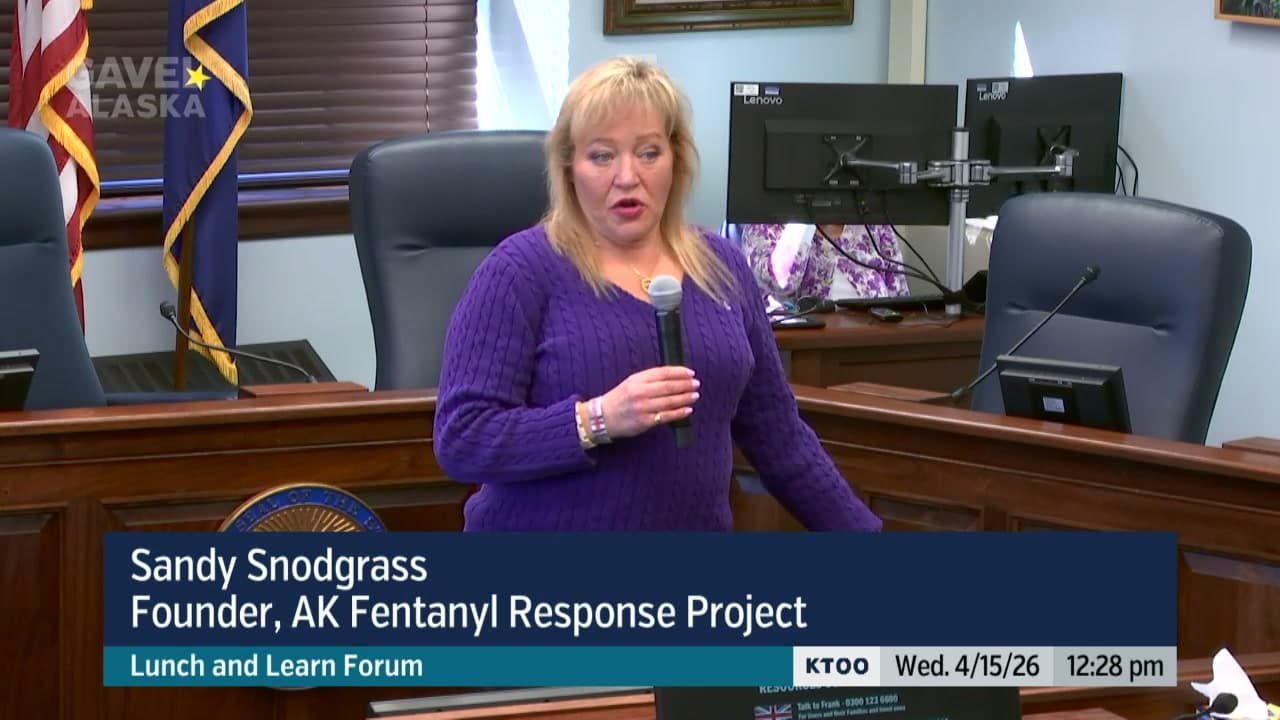
Sandy Snodgrass, founder of the Alaska Fentanyl Response Project, presented at a legislative Lunch and Learn session in Juneau. She has traveled to Alaska schools teaching students about fentanyl dangers since her 22-year-old son Bruce died from fentanyl poisoning in October 2021.
"You can never die from an illicit drug if you never try an illicit drug," Snodgrass said. "That is a very difficult message to get through to people and young people."
Snodgrass stood in the Oval Office in December when the president signed Bruce's Law, federal legislation that provides new tools for organizations to address the fentanyl crisis. The law passed as one of only 35 bills approved by Congress that year.
Bruce Snodgrass was found dead behind a Wells Fargo drive-through in Anchorage, less than a mile from his family's home. He had left the house on his mountain bike on a Thursday afternoon. His body was recovered two days later by a dog walker.
"He was not able to call out for help," Snodgrass said. "I found out later that it was 100 percent fentanyl that he received that day. Somehow dropped dead where he stood and could not call out for help."
The presentation included a 13-minute documentary called "Poisoning in Alaska" created with law enforcement support. The film shows Anchorage police responding to overdose calls and interviews with officers, victims' family members and people affected by the crisis.
According to statistics presented in the documentary, Alaska recorded almost 2,000 overdoses statewide in 2023, with about 1,200 in Anchorage alone. Of those, approximately 340 were fatal statewide and 220 in Anchorage. The Alaska Department of Health reported that overdose deaths decreased from 357 in 2023 to 339 in 2024. Fentanyl was involved in 73 percent of Alaska's overdose deaths in 2024, with Anchorage having the highest regional rate.
Snodgrass said the crisis has worsened with the introduction of carfentanil, a synthetic opioid even more potent than fentanyl. While a lethal dose of fentanyl is about 10 grains of table salt, carfentanil can kill with just two to three grains. She said five Anchorage families have lost loved ones to carfentanil since October.
Rural Alaska communities face particular danger because of high drug prices that attract traffickers. Snodgrass compared the economics to food costs, noting that an egg that costs a dollar in Anchorage sells for $10 in Chevak. The same pricing applies to illicit drugs.
The DEA has seized thousands of pills at a time in backpacks on planes headed to rural communities. In Togiak, a village of 800 people, agents intercepted 3,000 pills in a single seizure. Bush pilots have become a first line of defense by reporting suspicious passengers to state troopers.
Snodgrass said she visited Bagget Middle School in Anchorage the day before the presentation, teaching eighth-grade health classes throughout the day. The DEA supervisor and U.S. attorney attended to support the effort.
"They cannot arrest, they cannot prosecute, they cannot treat their way out of this," Snodgrass said. "The way out of this is demand reduction."
The documentary featured interviews with law enforcement officers who described responding to multiple overdose calls every shift. One officer said he responds to overdoses "every day, unfortunately."
Fentanyl and counterfeit pills have become increasingly difficult to identify. Officers described fake Xanax bars and M30 pills stamped to look identical to legitimate prescriptions. One detective said he seized 5,000 pills that all said Xanax on them, but not a single one contained the actual drug.
"You can buy them from China and China will ship you over fentanyl in whatever substance or form you want," the detective said in the film.
Snodgrass said the president declared fentanyl a weapon of mass destruction two weeks after she raised the issue during the Bruce's Law signing. She had been urged by another parent who lost a son and believes fentanyl could be weaponized.
Nationwide, approximately 281 Americans die from fentanyl poisoning every day, according to DEA figures Snodgrass cited. Among high school students aged 14 to 18, the death toll is 22 per week.
"If it was yogurt, no one would ever eat yogurt again," Snodgrass said. "But, you know, because it is an illicit drug, somehow we are allowing this."
Snodgrass, a psychologist by training, said she can see students' reactions change when she speaks to them face to face about the dangers. She has presented to thousands of Alaska students and said rural communities remain particularly vulnerable because many young people do not understand the risks.
She urged anyone interested in hosting a presentation or supporting prevention efforts to contact her through the Alaska Fentanyl Response Project website at akfentanylresponse.com.
"I need help," Snodgrass said. "I cannot do this alone. I need legislators to help. I need schools to help. I need law enforcement to help. I need parents to help."
This article is based on a public meeting — Alaska Legislature: Lunch & Learn: Alaska Fentanyl Response Project, 4/15/26, 12pm ().
AI-assisted. How we use AI Transcript byLucas Brown
Stay informed. Support what matters.
Free, permanent access to local news you can verify. Subscribe to support Alaska News and go ad-free.
Related Coverage
Dunleavy names a fentanyl awareness day; Alaska recorded 339 overdose deaths last year
Alaska News · 1mo ago
Toksook Bay documentary on suicide prevention screened for Alaska lawmakers
Alaska News · 5mo ago
Senate panel considers tougher penalties for fatal hit-and-run crashes
Alaska News · 5mo ago
Alaska Senate Panel Advances Youth Suicide Prevention Bill
Alaska News · 5mo ago
Alaska House passes mental health education bill after emotional debate
Alaska News · 4mo ago
Comments
Sign in to leave a comment.
No comments yet. Be the first to share your thoughts.