Oil industry opposes tax provisions in Alaska gas pipeline bill
The Alaska Oil and Gas Association raised antitrust concerns and opposed multiple tax provisions in a gas pipeline bill Thursday. The industry group argued the legislation has expanded beyond its original purpose.
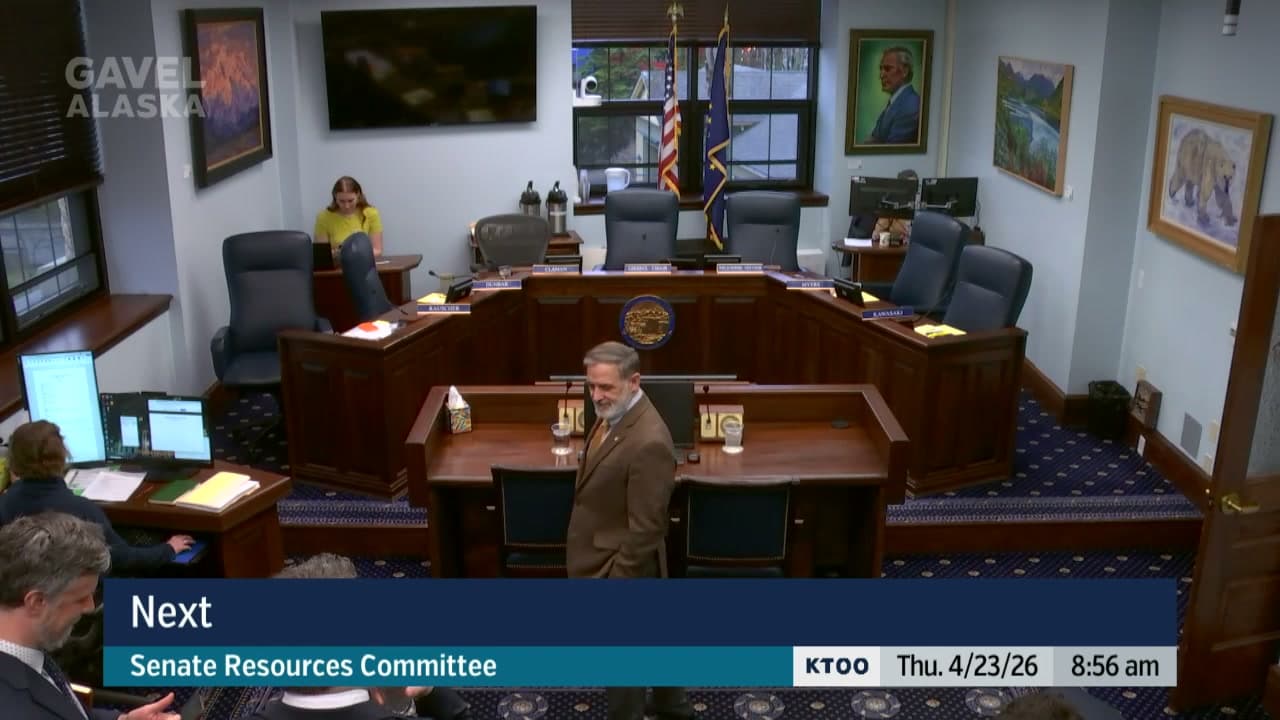
Steve Wackowski, president and CEO of the association, told the Senate Resources Committee that SB 280 version G now includes provisions that would immediately affect current oil and gas operations. This would happen regardless of whether a future gas line project moves forward. The governor introduced the bill to resolve property tax structure challenges for gas pipeline economics. The industry paid nearly $720 million in property taxes to the state in fiscal year 2025. Of that, $576 million went to local communities.
"This committee substitute has expanded beyond the purpose of resolving a long-standing challenge to gas line project economics posed by current oil and gas property tax structure," Wackowski said.
The association opposes sections 20 through 33 of the bill. These include provisions decoupling oil and gas lease expenditures, taxpayer confidentiality changes, prevailing value sections, and an income tax on pass-through entities.
Marie Evans, vice chair of the association's tax committee, warned that sections requiring the Department of Revenue to publish oil and gas prices raised antitrust concerns. "The ambiguity of what Department of Revenue is going to have to do to comply with this gives me a lot of concern," Evans said. "If data is derived from reports of current sales and marketing, we have a concern that the participation and the reporting could be associated with conduct that could lead to antitrust inquiries."
The bill's provisions on decoupling oil and gas lease expenditures could make some wells uneconomic, Wackowski testified. He used a BTU equivalency ratio of 6 MCF of gas to 1 barrel of oil at Prudhoe Bay as an example. The field currently produces around 245,000 barrels of oil per day and injects approximately 7.7 BCF of gas daily. Under the bill's formula, 84 percent of barrel-of-oil-equivalent would be attributed to gas that is being reinjected.
"Using this BTU equivalency could unintentionally disallow reasonable costs associated with oil production from being deducted against production tax liability and could ultimately jeopardize future oil recovery," Wackowski said.
Senator Forrest Dunbar said his intent with the committee substitute was that typical gas extraction and reinjection would not be caught up in the provisions. The target was larger-scale investments that drive revenue negative through 2032. Evans said it was possible to interpret the sections that way. But statutory ambiguity would rely on Department of Revenue regulations to clarify the legislature's intent.
The association also opposes sections 23 through 25. These propose a new income tax on privately held oil and gas pass-through entities with taxable income greater than $1 million. The tax would affect producers, processors, and oil and gas transporters by pipeline and maritime transportation.
"This proposal represents a significant policy shift that has not received adequate vetting or independent modeling and continues to raise serious concerns regarding its structure, its potential impacts, and its targeted and retroactive nature," Wackowski said.
Depending on interpretation, the pass-through entity tax could affect Cook Inlet producers, private explorers, gas line developers, carbon sequestration companies, and private maritime fuel shippers. The provision assumes parity between pass-through entities and C corporations that does not exist in practice, Wackowski said.
Senator Bill Wielechowski pressed the association to provide data on rates of return at Prudhoe Bay and how the S-corp provision would affect profitability. "The law is that when producers take out a lease in the state of Alaska, just like Texas, just like Louisiana, just like North Dakota, just like any other state in the country, they have a legal obligation to produce, develop, explore, market the gas or oil when they can make a reasonable profit," Wielechowski said.
Wielechowski said rates of return at Prudhoe Bay during the ACES debate in 2006-07 were over 100 percent. That is well above what courts and the Department of Natural Resources have testified is a reasonable rate of return of 10 to 25 percent. He asked the association to provide specific data showing whether the S-corp provision would make any fields or developments uneconomic.
Senator Cathy Giessel, chair of the Senate Resources Committee, noted that Alaska has no personal income tax. S corporations and LLCs would be paying taxes if the state had one. She said the tax brackets starting at $1 million in net income were not unreasonable. Other states where the same companies operate have personal income taxes.
Dunbar said Glenfarn, the developer of the pipeline project, told legislators directly that an S-corp tax like the one in the bill would not impact whether they construct the pipeline. Glenfarn is not a member of the Alaska Oil and Gas Association.
The association recommended keeping the bill focused on the gas project framework and property tax structure. Broader tax changes should be evaluated separately with adequate time and analysis. "Alaska has a real opportunity here, but large projects depend on certainty," Wackowski said. "The state's role should be to reduce risk, not introduce new layers of it."
The Senate Resources Committee will continue hearings on SB 280 Friday at 3:30 p.m. The hearing is open to the public.
This article is based on a public meeting — Alaska Legislature: Senate Resources - April 23, 2026 9:00am ().
AI-assisted. How we use AI Transcript byLucas Brown
Stay informed. Support what matters.
Free, permanent access to local news you can verify. Subscribe to support Alaska News and go ad-free.
Related Coverage
Oil industry opposes gas pipeline tax bill over bundled oil tax increases
Alaska News · 4mo ago
Gas pipeline bill adds oil tax increase, industry calls process rushed
Alaska News · 4mo ago
Mayors Oppose Alaska LNG Tax Bill, Cite Revenue Concerns
Alaska News · 6mo ago
Hilcorp says opposing the tax isn't opposing the gas line
Alaska News · 1mo ago
Senate panel examines regulatory questions on gas pipeline tax plan
Alaska News · 5mo ago
Comments
Sign in to leave a comment.
No comments yet. Be the first to share your thoughts.