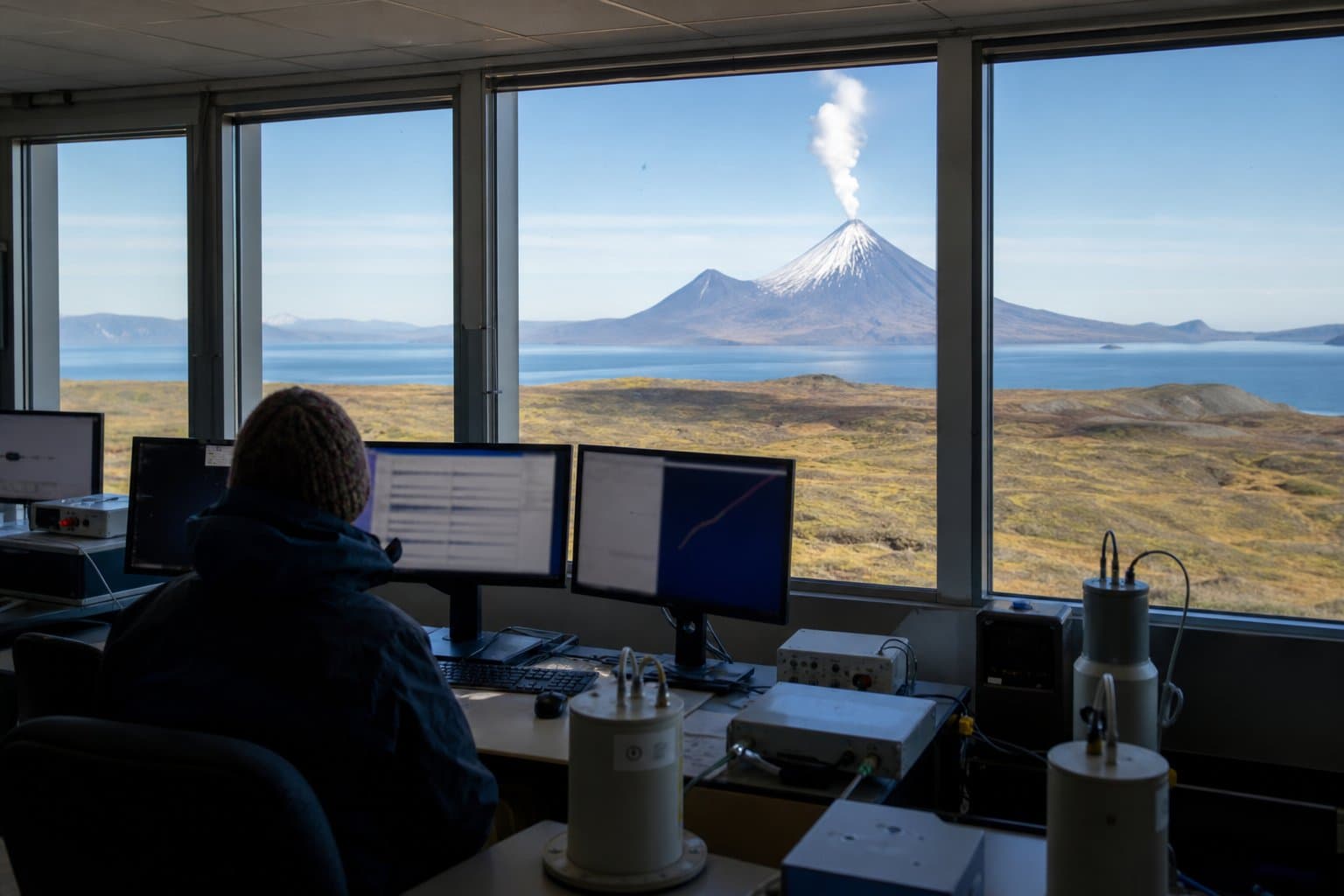
NSF awards UAF $360,443 to study Shishaldin eruption signals
How the Study Works
Volcano monitoring in the Aleutians relies heavily on two indirect signals: ground shaking recorded by seismometers, and infrasound, low-frequency sound below the range of human hearing. A new federal grant funds work on whether those signals can be converted into a quantitative measure of what an eruption is actually doing. The National Science Foundation awarded the University of Alaska Fairbanks $360,443 on Monday for a three-year study of eruption source processes at explosive basaltic stratovolcanoes, running from Jan. 1, 2027, through Dec. 31, 2029.
The principal investigator is David Fee, coordinating scientist for Shishaldin monitoring at the Alaska Volcano Observatory. The award comes through the Directorate for Geosciences; the program officer is Jennifer Wade.
The project compares Shishaldin Volcano on Unimak Island with Mount Etna in Sicily, and includes a targeted field experiment at Etna to supplement Italy's existing monitoring network. According to the award abstract, the team hypothesizes that gas discharge regimes primarily control both signal characteristics and eruption style, and will build models estimating eruption source parameters such as volcanic gas flow rate from seismoacoustic observations. To get there, the researchers plan to compile systematic seismoacoustic catalogs of recent eruptions, determine the locations of the seismic and infrasound sources, and relate those observations to documented eruptive phenomena.
Why It Matters for Aviation
The stated motivation is hazard assessment in real time. The Geophysical Institute's volcanology program describes the aviation stake on its research page: faculty and students work to locate and track ash plumes and clouds "which may threaten the 70,000 airline passengers and millions of pounds of cargo that fly over the North Pacific region every day." Past eruptions of Aleutian volcanoes have produced ash plumes that disrupted air traffic and dusted nearby communities with fine ash, according to USGS records. Shishaldin remains at alert level ADVISORY and aviation color code YELLOW, monitored by local seismic and infrasound sensors, web cameras and a geodetic network.
The award funds research, not an operational change; whether the resulting models enter the observatory's real-time workflow is not addressed in the abstract. The grant also funds a social media video series for middle and high school students.
AI-assisted, reviewed by editors. Spot an error?
Related Coverage
NSF awards UAF $1.77 million to build AI geohazard forecasting tools
Alaska News · 2w ago · 80% match
NSF awards UAF $877,501 for mass spectrometer to support fisheries and minerals research
Alaska News · 1w ago · 78% match
How bubbles can throw off the sound Alaska uses to count its fish
Alaska News · 2w ago · 76% match
UAF scientist leads $36K Antarctic sea ice study amid record lows
Alaska News · 2mo ago · 74% match
UAF scientist gets $300K to unlock permafrost's carbon time bomb
Alaska News · 2mo ago · 74% match
Comments
Sign in to leave a comment.
No comments yet. Be the first to share your thoughts.