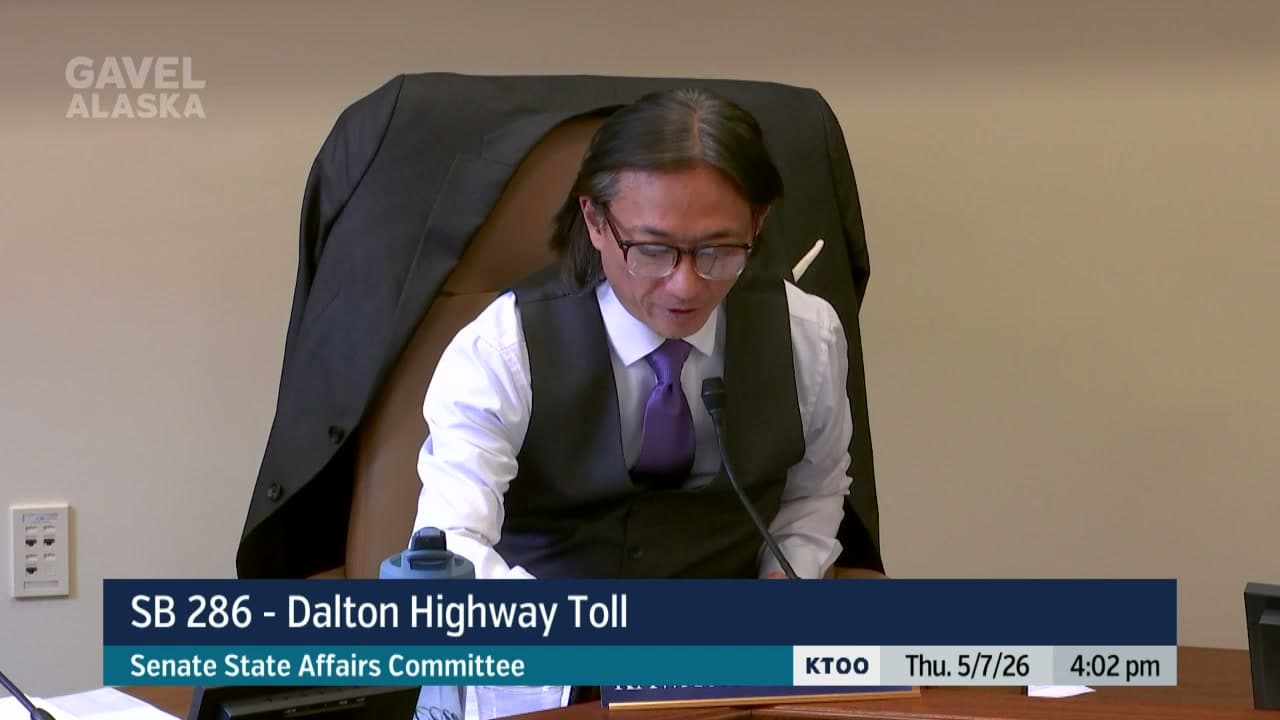
Industry groups oppose Dalton Highway toll targeting oil and gas traffic
Industry groups testified in opposition Thursday to a late-session bill that would impose tolls on a two-mile stretch of the Dalton Highway near Deadhorse. They warned the measure could cost Alaska millions in federal highway funding and single out the oil and gas industry.
The Senate State Affairs Committee heard invited and public testimony on Senate Bill 286, which would establish tolls on miles 413 to 415 of the Dalton Highway. Testifiers said the bill targets vehicles transporting people or goods for oil and gas developers while exempting other users. Chair Scott Kawasaki, who sponsored the measure on behalf of the committee, said the state invests approximately $17 million annually in Dalton Highway maintenance and operations. That includes $10.5 million from state funds and $6 million from federal sources. The proposal responds to heavy wear from industrial traffic on the highway, which drives high maintenance costs the state currently shoulders.
DOT counsel testified that federal authorization and a corridor feasibility study would likely be needed before the toll could be implemented. The testimony grounded industry concerns about federal funding in agency analysis.
Greg Miller, incoming president of the Alaska Support Industry Alliance, told the committee the toll could trigger the loss of federal funding that currently covers up to 90 percent of highway maintenance costs. Under federal law, states generally cannot convert existing toll-free highways into toll roads without adding new capacity across the entire route, he said.
"Right now, the funding can cover up to 90 percent of the cost," Miller said. "Losing that would mean the state of Alaska is suddenly on the hook for 100 percent of maintenance, operations, and repairs on one of the most expensive roads we have."
Steve Wakowski, president and CEO of the Alaska Oil and Gas Association, said the industry already pays substantial taxes to Alaska. According to the Revenue Sources Book, the oil and gas industry was expected to pay roughly $858 million in corporate income tax, severance taxes, and state property tax in fiscal year 2026. That figure does not include approximately $988 million in royalties and another $460 million in royalty payments to the Permanent Fund.
"This bill would require oil producers to effectively pay twice, once through existing taxes that fund transportation and roads statewide, and again through a toll specific to the Dalton Highway," Wakowski said.
Jamie Benson, president of the Alaska Trucking Association, said the bill would force trucking companies to front toll payments and potentially pursue legal action to recover reimbursement. The association represents 135 member companies with over 10,000 employees statewide.
"The reimbursement process places trucking companies in the middle, forcing them to front payments and potentially pursue legal action, adding unnecessary risk and burden," Benson said.
Cody Heiss, vice president for Specialized Transport and Rigging, called the reimbursement system chaotic and impractical. "It suggests that if an operator pays the toll, they can seek reimbursement from the oil entity. If that fails, they can pursue legal action to recoup the cost," Heiss said. "This is not an effective policy. It is a lawsuit waiting to happen."
Senator Robert Myers, who represents the North Slope, raised additional concerns about the bill's structure. He noted that the two-mile toll zone runs from the airport to the end of the road in Deadhorse. That creates potential competitive disadvantages for contractors with facilities just outside the toll zone.
"Every single time that one of their vehicles needs to go out on the field, they are going to get hit going through that toll section, which is going to put them at a competitive disadvantage to every other contractor who is already inside and on the spine road there," Myers said.
Myers also questioned whether the bill violates equal protection principles by exempting Alyeska Pipeline Service Company while targeting other oil and gas operations. He said the bill could face legal challenges on multiple fronts.
Zach Seabolt, representing Papakeetn, Alaska, said the bill creates a dangerous precedent by designating only a two-mile stretch as a toll road and specifically exempting all users except those supporting oil and gas developers. "Public infrastructure, especially the critical haul roads, should be maintained through a fair, broad-based approach not by picking winners and losers among its users," Seabolt said.
Rob Christianson, who works for Sourdough Express and serves on the Alaska Alliance board, said the bill moves away from the principle that public roads serve a public purpose. "If we begin carving out small sections of public infrastructure and charging only certain users based on industry, where does it stop?" Christianson said.
The committee took no action on the bill Thursday. Kawasaki said public testimony will remain open, and the bill will be held for a further hearing. The toll proposal arrives as lawmakers weigh alternative funding mechanisms for Dalton maintenance, including Senate Bill 280's proposed 30-cent-per-barrel oil surcharge. That measure would generate roughly $50 million annually but fall short of the estimated $80 million needed.
This article is based on a public meeting — SSTA-260507-1530 ().
AI-assisted. How we use AI Transcript byLucas Brown
Stay informed. Support what matters.
Free, permanent access to local news you can verify. Subscribe to support Alaska News and go ad-free.
Related Coverage
Oil industry opposes gas pipeline tax bill over bundled oil tax increases
Alaska News · 4mo ago
Oil industry opposes tax provisions in Alaska gas pipeline bill
Alaska News · 5mo ago
Senate panel doubles oil surcharge for Dalton Highway maintenance in gas pipeline bill
Alaska News · 4mo ago
Senate panel proposes doubling Dalton Highway surcharge in gas line bill
Alaska News · 4mo ago
Gas pipeline bill adds oil tax increase, industry calls process rushed
Alaska News · 4mo ago
Comments
Sign in to leave a comment.
No comments yet. Be the first to share your thoughts.