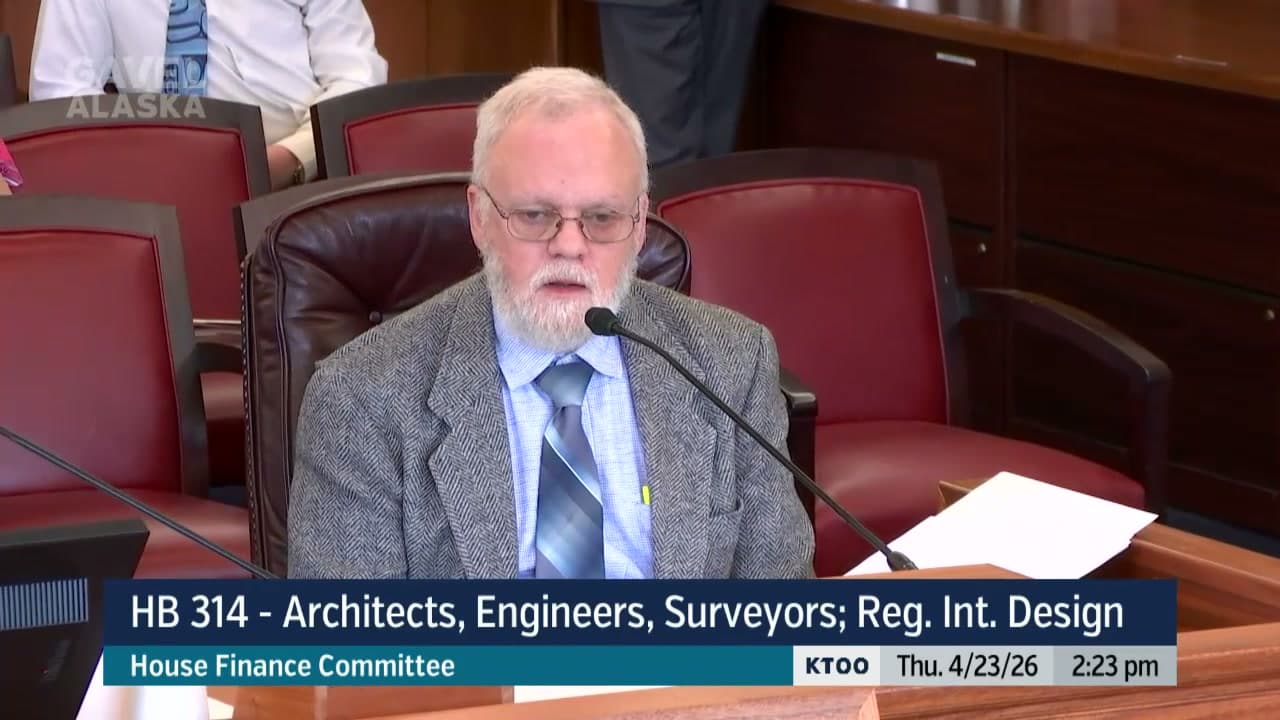
House Finance advances bill extending professional licensing board
The Alaska House Finance Committee voted Thursday to advance a bill extending the state's Board of Registration for Architects, Engineers, and Land Surveyors and adding registered interior designers to the professions it regulates.
House Bill 314 passed out of committee with individual recommendations after a hearing that included discussion of changes made to address concerns that led to a gubernatorial veto of similar legislation last year. The board's current authorization expired June 30, 2025, putting it in a one-year wind-down period.
Rep. Mike Prox, a North Pole Republican who sponsors the bill, said the measure addresses three issues raised with Senate Bill 54, which the legislature passed in 2025. The earlier bill would have repealed a statute the administration believed prevented the Department of Transportation from issuing design-build contracts. House Bill 314 leaves that section in place.
The new version also narrows language about wastewater system installers. Where Senate Bill 54 would have allowed Department of Environmental Conservation-certified installers to install wastewater systems up to 1,500 gallons for both commercial and residential properties, House Bill 314 limits that authority to residential systems only.
The bill keeps the board at 11 members rather than expanding it to 13 as the earlier version proposed. It removes one civil engineer position and adds a registered interior designer. It eliminates requirements that specific engineering disciplines be represented, giving the governor flexibility to appoint any discipline the board regulates.
"The challenge with the board, especially one this large with many professions, is getting the right person if you are designating professions," Prox said. "Finding somebody to serve on the board becomes a problem."
Chris Curtis, the state's legislative auditor, testified that her office conducted a sunset audit of the board in 2024 and found no issues requiring recommendations. The audit supported an eight-year extension, the maximum allowed, which would move the board's termination date to June 30, 2033.
Curtis warned that if the board is not extended, licensing duties would transfer to the Division of Corporations, Business and Professional Licensing. While licenses would not disappear, the state would lose volunteer experts who help draft regulations and assist with investigations.
"My concern is that you would be losing some expertise in helping draft your regulations," Curtis said. "You would also be losing those volunteer experts to help with the investigative process."
The bill creates a pathway for interior designers to register with the board under what is known as a title act rather than a practice act. A title act provides voluntary registration for interior designers who meet competency standards through education, experience, and examination. Unregistered interior designers could continue practicing but could not use the title "registered interior designer" or sign and stamp certain documents. A practice act, by contrast, would require mandatory licensure of anyone practicing in the scope of practice.
Charles Bettisworth, a Fairbanks architect and fellow of the American Institute of Architects, testified that qualified interior designers bring critical expertise to projects involving safety and infection control. He cited work on facilities for foster children, medical clinics, and co-working spaces during the COVID-19 pandemic.
"The skills, expertise, training, and qualifications of interior designers who are part of our team were critical in addressing the design of spaces which mitigated the safety concerns of both staff and patrons," Bettisworth said.
Matthew Baruch, director of government affairs for the Council for Interior Design Qualification, explained that the title act would allow qualified interior designers to register with the board for a protected title and stamping and permitting privileges if they wish to practice independently. Those working under other design professionals would not be required to register.
Rep. Alyse Galvin, an Anchorage independent, said she learned during the hearing that only one or two designers in Alaska currently meet the parameters to apply for Department of Defense contract opportunities, and both obtained their credentials in other states.
"I think it is really important that Alaskans are able to get to these opportunities such as the Department of Defense," Galvin said.
The Division of Corporations, Business and Professional Licensing submitted a fiscal note requesting $175,600 in new appropriations for fiscal year 2027, plus $67,300 already included in the governor's budget. Director Sylvan Robb said the costs would fund one new licensing examiner position, board meeting travel, advertising, and training. The division would cover expenses through professional licensing fees.
Rep. Zack Fields, an Anchorage Democrat and licensed professional engineer, raised concerns about board composition. He noted that engineers make up 84 percent of the more than 6,500 people the board regulates but would hold only 36 percent of board seats under the bill.
"When we look at the actual people being covered by the board, the vast majority of those out there of over 6,500 people registered, 84 percent fall under the engineering category," Fields said. "There is a large representation of a very small section of the professions."
Prox acknowledged the concern but said addressing board composition would require extensive input and could delay passage beyond the sunset deadline.
"Your point is well taken," Prox told Fields. "I think that needs to be looked at, but it probably needs to be debated in the changes, recommended changes coming from the board."
The bill also updates exemptions at the board's request. It would allow certain certified wastewater installers to design conventional on-site systems handling less than 1,500 gallons per day without a professional license. It would require professional licenses for employees or officers of companies operating in Alaska if they design natural gas pipelines under specified conditions.
Gene McCabe, director of the Division of Water, submitted a zero fiscal note, saying the wastewater provisions align with current regulations and would not change division procedures.
The bill also adds a Range 23 salary for the board's executive administrator into statute.
The bill includes a retroactive effective date of June 30, 2025, for the board extension, with other provisions taking effect March 31, 2026. A grace period would give the board time to establish regulations for interior designer registration.
Sen. Clayman carries companion legislation in the Senate, where it has had an initial hearing in Senate Finance. Rep. Andrew Gray, an Anchorage Democrat, outlined the expected path forward: a House floor vote, followed by the bill moving to the Senate to meet its companion, then returning to the House for a concurrence vote after Senate passage.
The committee advanced version 34-LS1490/A with attached fiscal notes.
This article is based on a public meeting — Alaska Legislature: House Finance, 4/23/26, 1:30pm ().
AI-assisted. How we use AI Transcript byLucas Brown
Stay informed. Support what matters.
Free, permanent access to local news you can verify. Subscribe to support Alaska News and go ad-free.
Related Coverage
House advances bills on autonomous vehicles, nurse training, interior design
Alaska News · 5mo ago
House Finance approves pharmacist prescription bill after rejecting nurse compact
Alaska News · 4mo ago
Senate Committee Advances Healthcare Licensing Compact Bill
Alaska News · 4mo ago
House Finance hears respiratory therapist licensing bill, Alaska's last-state gap
Alaska News · 5mo ago
House Finance Advances Education Funding Bill Despite Fiscal Concerns
Alaska News · 4mo ago
Comments
Sign in to leave a comment.
No comments yet. Be the first to share your thoughts.