House Finance hears respiratory therapist licensing bill, Alaska's last-state gap
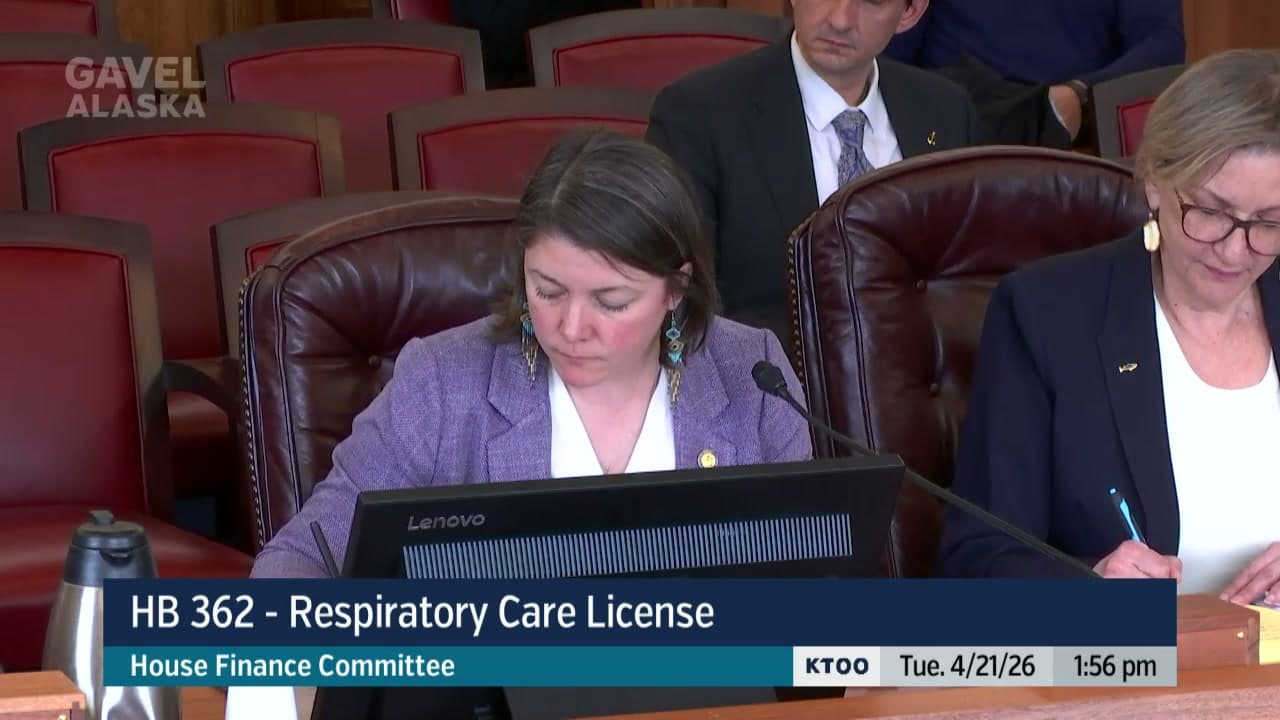
The House Finance Committee heard testimony Tuesday on a bill that would make Alaska the last state in the nation to license respiratory therapists, a gap sponsors say leaves patients vulnerable and health facilities struggling to recruit qualified staff.
Alaska is the only U.S. state without professional licensure for respiratory therapists, who provide critical care for patients from premature infants in neonatal units to trauma victims requiring mechanical ventilation. The lack of oversight means anyone claiming to be a respiratory therapist needs only a college certificate, not a state license, and there is no agency to enforce quality standards or continuing education requirements.
Representative Carolyn Hall, who sponsored HB 362 as a House Labor and Commerce Committee bill, told the Finance Committee that the state's outlier status creates disadvantages. "Alaska has RTs, but we are the only state in the United States that does not license respiratory therapists," Hall said.
Without licensure, Hall explained, health care facilities must depend on voluntary certification that lacks the administrative oversight backed by law. "Anyone claiming to be an RT in Alaska only needs a college program certificate, not a license," she said. "Health care facilities must depend on voluntary certification, which lacks the administrative oversight structure backed by the force of law that a statutory licensure program provides."
Hall said the current system exposes patients to risk. "In contrast, Alaska's current system lacks a formal license, leaving patient care vulnerable to unqualified providers such as those who have lost their licenses in other states," she said.
The bill would establish a non-boarded licensing program through the Division of Corporations, Business and Professional Licensing, with all administrative costs covered by licensing fees paid by respiratory therapists themselves. The fiscal note projects startup costs of $46,100 in fiscal year 2027 and $41,600 in subsequent years, with no impact on the state's general fund.
Angela Euler, a registered respiratory therapist and president of the Alaska Society for Respiratory Care, testified that between 200 and 250 respiratory therapists currently practice in Alaska. She described the profession's role across the full spectrum of care, from newborns to critically ill adults.
"Currently, Alaska is the only state that does not require professional licensure for respiratory therapists," Euler said. "House Bill 362 is an important step toward ensuring consistent standards for education, competency, accountability, and professional oversight."
The bill includes a grandfather clause allowing current certified practitioners to continue working for up to one year while obtaining licensure. Sylvan Robb, director of the Division of Corporations, Business and Professional Licensing, told the committee that licensing fees would likely range between $100 and $325 for a two-year period, based on similar professions the division regulates.
Robb explained that the division would reclassify an existing vacant office assistant position into a licensing examiner role to handle the new program. She said 24 other professions, including several healthcare fields like naturopaths and audiologists, are already regulated directly by the division without a separate board.
Representative Jeremy Bynum questioned the bill's reliance on the department to set standards rather than establishing an oversight board. The bill directs the department to adopt regulations referencing "a nationally recognized organization for respiratory therapists," language Bynum called "pretty vague" compared to statutes that establish professional boards.
"In the bill, we are specifically relying on the department to set the standards and criteria, and we just, I do not want to use the word vaguely, but we just say nationally recognized organization, and to me that is pretty vague," Bynum said.
Euler clarified that the National Board for Respiratory Care provides national testing and credentialing, and that "respiratory care practitioner" and "respiratory therapist" are used interchangeably in the profession. She said the bill was drafted using scope-of-practice language from other states and aligned with national best practices.
The licensure proposal has moved through the Legislature before. In March, the Senate Labor and Commerce Committee reviewed similar licensure language in a committee substitute for HB 110, hearing from Hall, respiratory therapist Angela Oiler, and Robb, though the committee set that version aside without a vote.
Hall told the committee that both the Alaska Hospital and Healthcare Association and the Alaska State Medical Association have written letters of support for the bill, though those letters were not yet in the committee packet. No opposition has emerged, she said.
The committee took no action Tuesday, setting the bill aside after the introductory hearing. Hall said she hopes the committee will move forward with a bill that closes "this really significant gap that we have in our healthcare industry."
The next House Finance Committee meeting is scheduled for Wednesday morning, when the committee will hear an education funding bill.
This article is based on a public meeting — Alaska Legislature: House Finance, 4/21/26, 9am ().
AI-assisted. How we use AI Transcript byLucas Brown
Stay informed. Support what matters.
Free, permanent access to local news you can verify. Subscribe to support Alaska News and go ad-free.
Related Coverage
Senate Committee Advances Healthcare Licensing Compact Bill
Alaska News · 4mo ago
Senate panel advances health care compacts bill despite sovereignty concerns
Alaska News · 5mo ago
Senate Committee Hears Testimony on Nurse Licensure Compact Bill
Alaska News · 6mo ago
House Finance approves pharmacist prescription bill after rejecting nurse compact
Alaska News · 4mo ago
Alaska House passes five healthcare licensure compacts in single bill
Alaska News · 4mo ago
Comments
Sign in to leave a comment.
No comments yet. Be the first to share your thoughts.