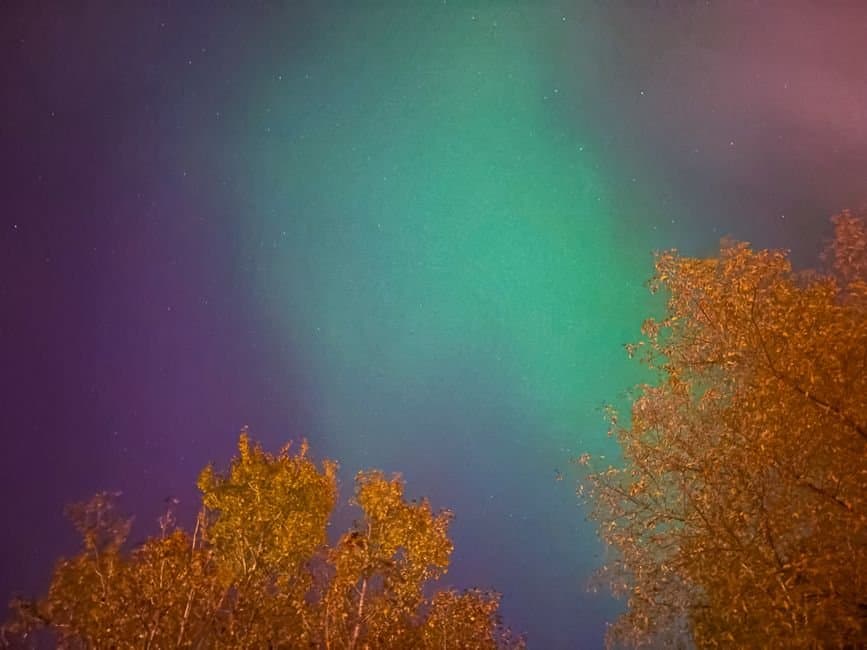
An eclipsed Moon rises over Alaska Wednesday, with aurora possible after
Alaska gets a narrow window Wednesday night, Aug. 26, for two things at once: a deep partial lunar eclipse and a possible aurora, on the first dark nights of the season.
The Moon rises over Anchorage around 8:10 pm already inside Earth's shadow, with 96% of its disk in the darkest part, dim and coppery against bright twilight. After sunset around 9:23 pm the shadow slides off. The partial eclipse ends at 9:52 pm, and the last faint penumbral shading clears by 11:01 pm. Best viewing runs roughly from 9:30 to 10 pm.
No equipment is needed. Unlike a solar eclipse, a lunar eclipse is safe to view directly. A clear view of the southeastern horizon helps, since the Moon will be low as it rises already in shadow. In Fairbanks, deeper into aurora territory, moonrise comes around the same time.
The aurora part
Separately, NOAA has issued a geomagnetic storm watch for Aug. 27 and 28. A coronal mass ejection from a solar flare earlier this week is arriving, and forecasters expect a Kp index of 3 to 4 on the 0-to-9 geomagnetic scale, with a chance of reaching Kp 5, minor storm level.
At Kp 3 to 4, aurora is possible across northern Alaska and a maybe for Anchorage. At Kp 5, it would be visible across much of the state. Fairbanks re-entered aurora season around Aug. 21, when nights finally got dark enough again after the summer's midnight sun.
The weather
The National Weather Service expects increasing clouds over Anchorage Wednesday night, with rain developing mainly after 1 am Thursday. That leaves the critical 9:30 to 11 pm window partly to mostly cloudy. Fairbanks looks similar, with showers likely after 4 am. In both cities, the weather worsens after the eclipse window closes.
What to know
The eclipse is certain geometry, visible whether the clouds cooperate or not. The aurora is only a forecast. A spectacular display usually needs Kp 5 or higher, possible but not likely.
Photographers may want a 200mm or longer lens on a tripod, pointed southeast at moonrise, to catch the eclipsed Moon low on the horizon with a foreground. If aurora appears to the north while the Moon sits to the south, that is the shot.
The Geophysical Institute at the University of Alaska Fairbanks runs a real-time aurora forecast at gi.alaska.edu/monitors/aurora-forecast.
Source: Wednesday night's sky could put on a double show, if the clouds cooperate.
Made by our human newsroom with AI. How humans and AI work here · Grow with our newsroom
From prior coverage
Stay informed. Support what matters.
Free, permanent access to local news you can verify. Subscribe to support Walter AlaskaNews and go ad-free.
Related Coverage
Fairbanks has best chance for northern lights early Friday as G2 storm nears
Alaska News · 2d ago
Northern lights outshine a nearly full moon over Fairbanks as solar wind keeps the aurora active
Alaska News · 1w ago
Northern lights draw crowds to Fairbanks and Kodiak viewing spots
Alaska News · 5mo ago
Fairbanks and Kodiak Residents Capture Last Aurora Displays Before Midnight Sun
Alaska News · 5mo ago
Aurora Borealis Lights Up Kodiak and Interior Alaska Skies
Alaska News · 5mo ago
Comments
Sign in to leave a comment.
No comments yet. Be the first to share your thoughts.