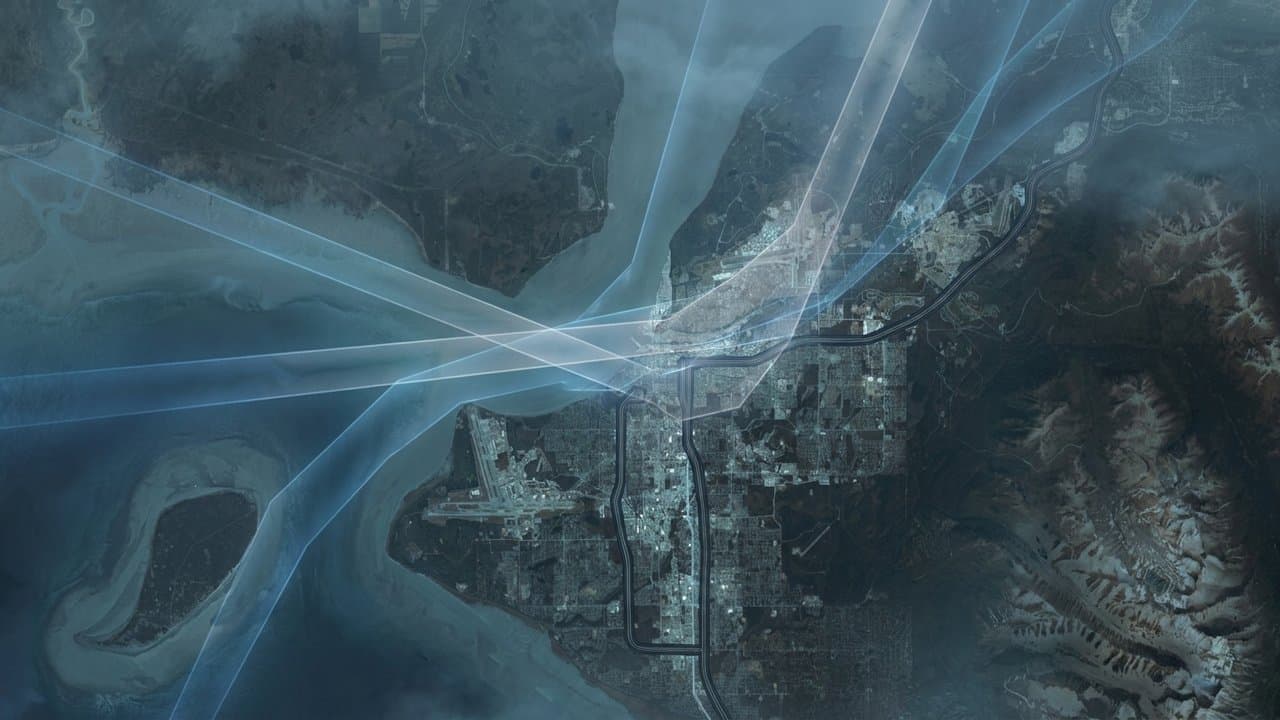
Editorial map (Gemini + Google Maps)
FAA proposes redrawing Anchorage basin airspace and flight paths for JBER's extended runway
The Federal Aviation Administration is proposing to redraw airspace and flight paths over the Anchorage basin so Joint Base Elmendorf-Richardson can use an instrument landing system on its extended Runway 17. The redesign also touches Ted Stevens Anchorage International, Bryant Army Airfield, Lake Hood and Merrill Field. The agency is taking public comment on the draft environmental assessment through Nov. 9.
Why the change
The Air Force decided in 2018 to extend the runway north to 10,000 feet for F-22 launch and recovery, and construction began in 2023. Elmendorf's controlled airspace ends less than one nautical mile from the runway's departure end, so instrument arrivals would conflict with Merrill Field and Anchorage airport traffic. Merrill Field's tower warned the change would hurt local aircraft using its Runway 7/25.
The FAA's notice, signed by Byron G.Y. Chew, group manager of the agency's Operations Support Group, says JBER "is currently restricted from operating at its intended capacity" until the surrounding airspace is modified.
What would change for pilots
Sections of the basin's special air traffic rules airspace would be modified, removed or redefined, and some would become Class C or Class D airspace. Visual flight paths would shift to fit the new procedures. The plan includes 29 procedures, among them 12 new or amended RNAV departures, which use satellite-based area navigation. En route transitions would rise from 53 to 69 and runway transitions from 17 to 42. The FAA says the plan adds no flights, does not change the aircraft mix and requires no construction.
Noise
The draft finds no significant noise impacts requiring mitigation for residents. It projects reportable noise increases for 364 residents by 2032, south of the Anchorage airport and in and southwest of Tyonek, but none in 2027. Of those residents, 271 would see increases of 3 decibels or more and 93 would see 5 decibels or more. The Anchorage increases stem from a redesigned Runway 15 departure and Runway 33 arrivals. Tyonek's stem from a proposed arrival route.
Every significant noise increase falls on JBER land or over Cook Inlet. Protected sites with reportable increases would rise from 11 in 2027 to 20 in 2032, including Cook Inlet beluga critical habitat, a bald eagle nesting site and trails near Sand Lake Road and Diamond Boulevard. "None of the resources are managed for a quiet setting," the draft says.
What's next
The tribal consultation letter is listed as pending in an appendix that names 29 recipients from 26 tribes, including the Native Village of Tyonek. Consultation with NOAA, the National Park Service, the Fish and Wildlife Service and the Interior Department is also pending, and the FAA has made no final decision. The FAA plans virtual public workshops Oct. 27 and 28.
Source: Federal Aviation Administration, FAA proposes redrawing Anchorage's airspace and flight paths so JBER can open an instrument runway; its draft finds no significant impact, and comments are due Nov. 9.
Made by our human newsroom with AI. Reviewed by Cale Green. How humans and AI work here · Grow with our newsroom
Stay informed. Support what matters.
Free, permanent access to local news you can verify. Subscribe to support Walter AlaskaNews and go ad-free.
Related Coverage
Anchorage will take public comment on Merrill Field's next 20 years Oct. 15
Alaska News · 2w ago
FAA scales back plan to expand controlled airspace over Alaska after pilot groups object
Alaska News · 1w ago
Anchorage airport noise study weighs which measures to recommend; public comment Aug. 25
Alaska News · 1mo ago
FAA plan would give a Cook Inlet oil-field airstrip its first instrument approaches
Alaska News · 1mo ago
Merrill Field gets nearly $954,000, mostly federal, to plan its future
Alaska News · 1mo ago
Comments
Sign in to leave a comment.
No comments yet. Be the first to share your thoughts.