AI Generated Image
Analysis: Most Alaska ballots so far went one of two ways at the top of the ticket
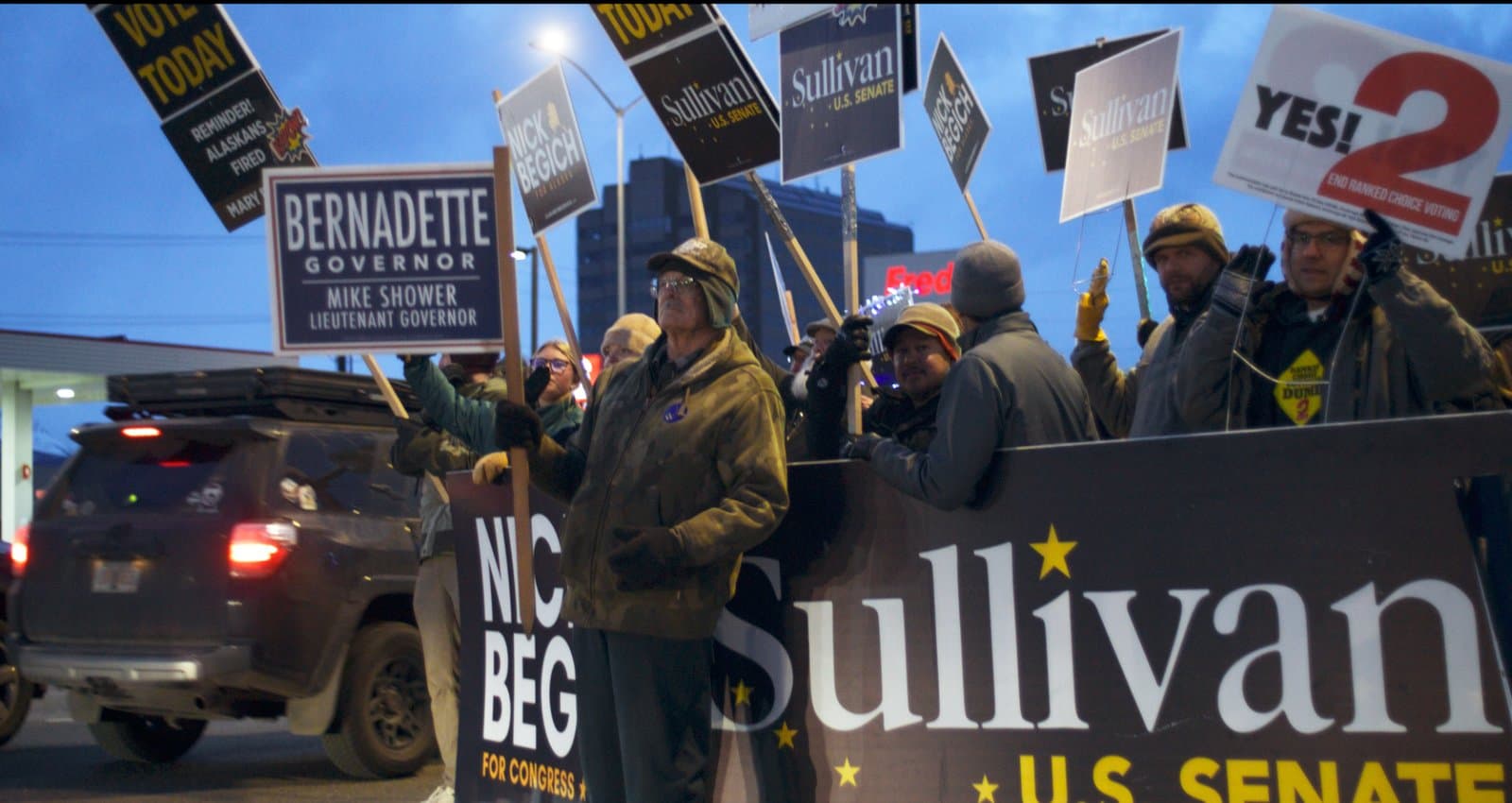
More than 60% of the Alaska ballots in state data released so far went one of two ways in the races for U.S. Senate, governor and U.S. House, an Alaska News analysis shows.
About 35% of the ballots ranked Democrats Mary Peltola first for Senate and Jonathan Kreiss-Tomkins first for governor, along with nonpartisan Bill Hill for the House. About 27% ranked Republicans Dan Sullivan, Bernadette Wilson and Nick Begich first.
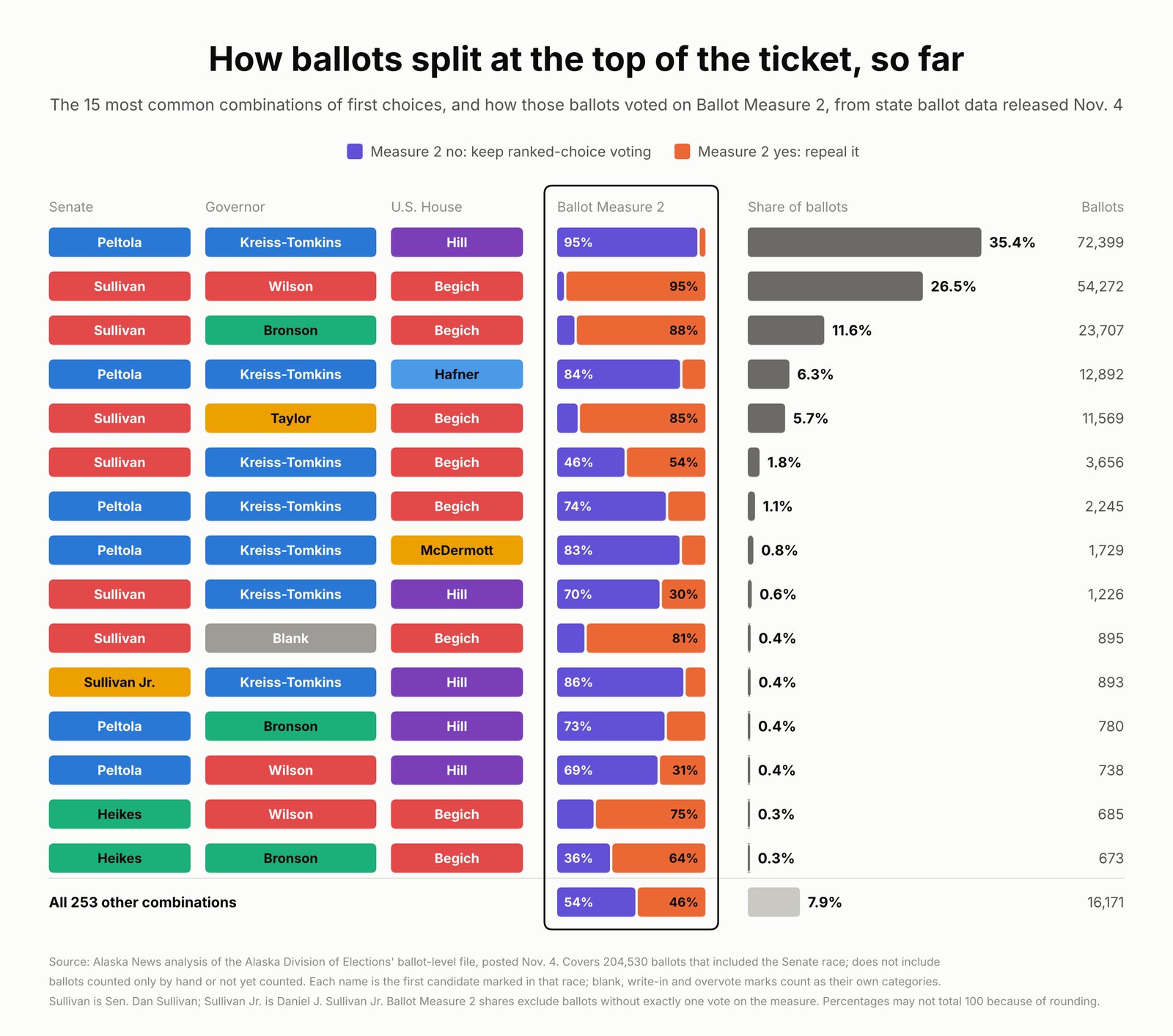
The next most common combinations paired Sullivan and Begich with Republican Dave Bronson for governor, on about 12% of ballots, or with Republican Treg Taylor, on about 6%. Another 6% paired Peltola and Kreiss-Tomkins with Democrat Eric Hafner in the House race.
About 7% of the ballots picked at least one Republican and at least one Democrat among their three first choices. The most common of those, Sullivan for Senate, Kreiss-Tomkins for governor and Begich for the House, appeared on about 1.8% of ballots.
The Division of Elections posted the ballot-level file early Wednesday. It records how each ballot was marked, without identifying voters, and covers 204,530 of the 215,906 ballots cast in the Senate race in the latest results. The rest are Election Day ballots from 144 mostly rural precincts, most of which count ballots by hand. The file doesn't include ballots counted only by hand, the division says.
It also doesn't include the roughly 75,000 ballots the Associated Press estimates are still to be counted, about 51,000 of which were already in the division's hands Wednesday morning, by Alaska News' count from its ballot report. Alaska News used the same file in its analyses of the Senate and governor's races, treating the first candidate marked on each ballot as its first choice.
The file also shows how ballots that ranked Daniel J. Sullivan Jr. first for Senate were marked in the other races. Sullivan Jr., a retired teacher from Petersburg who shares the senator's name, has 3,600 first-choice votes, or 1.7%, in the latest results.
Ballots that ranked him first spread more broadly across the rest of the ticket than those that ranked either front-runner first. Of the 3,384 ballots in the file that ranked him first, about 42% ranked Kreiss-Tomkins first for governor and 55% ranked one of the three Republican tickets first. In the House race, 43% ranked Begich first, 37% Hill and 12% Libertarian Jim McDermott.
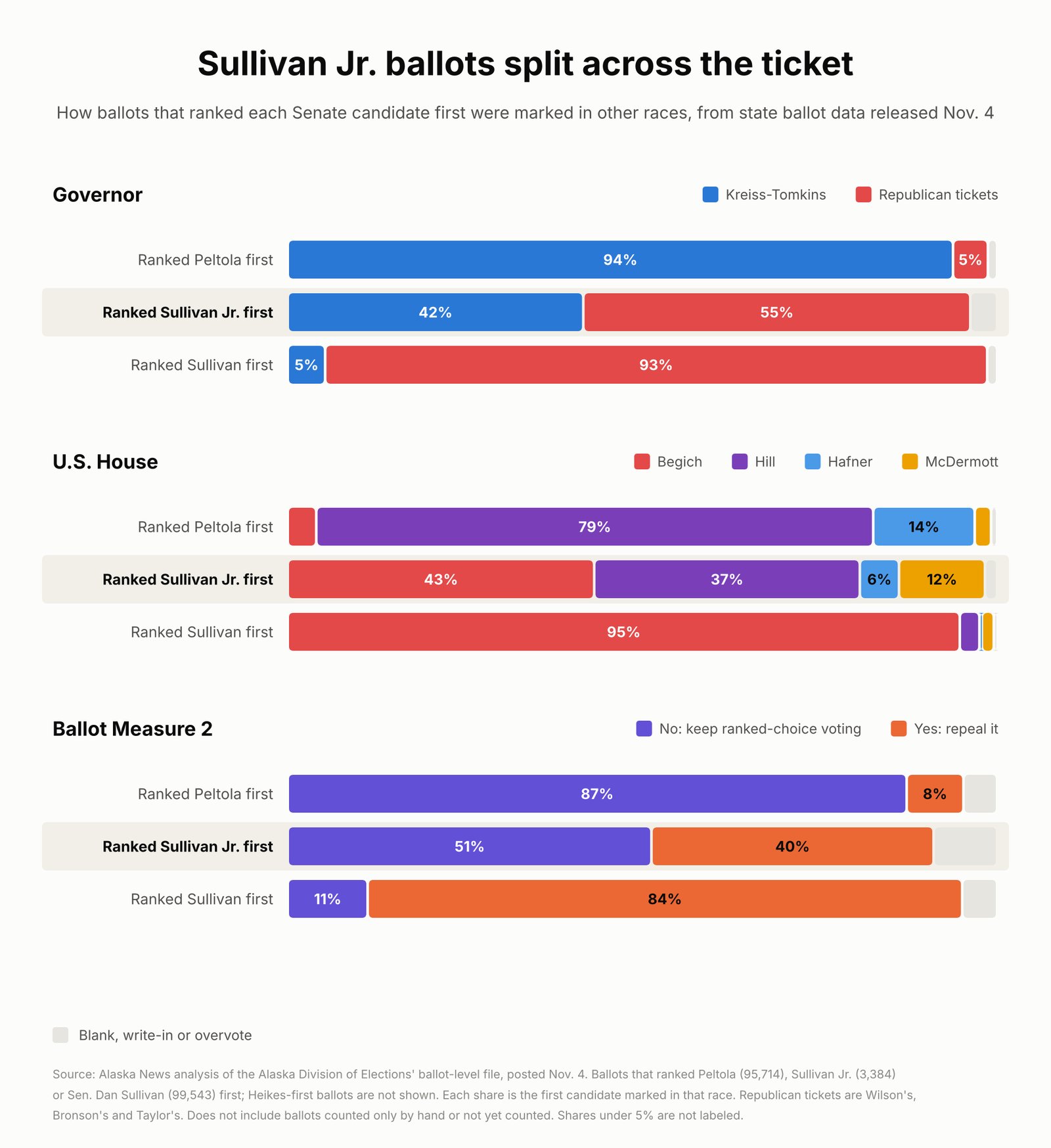
By comparison, about 94% of the ballots that ranked Peltola first also ranked Kreiss-Tomkins first, and about 93% of Sullivan-first ballots ranked a Republican ticket first.
On Ballot Measure 2, which would end open primaries and ranked-choice general elections, 51% of the ballots that ranked Sullivan Jr. first voted no and 40% voted yes, compared with 48% no and 47% yes across the file. In a final round between Peltola and the senator, about 33% of those ballots would count for Peltola and 23% for the senator under the rankings in the file, and the rest would stop counting.
Separately, 70 ballots in the file marked both Sullivans, and no other candidate, as their first choice for Senate. Marking two candidates at the same ranking is an overvote, so those ballots count for no one in the race. The file can't show why they were marked that way.
Many ballots used no backup choices at all. In each of the three races, more than half of the ballots in the file marked just one candidate, which is sometimes called bullet voting. A ballot like that counts fully for its one candidate as long as that candidate is still in the count.
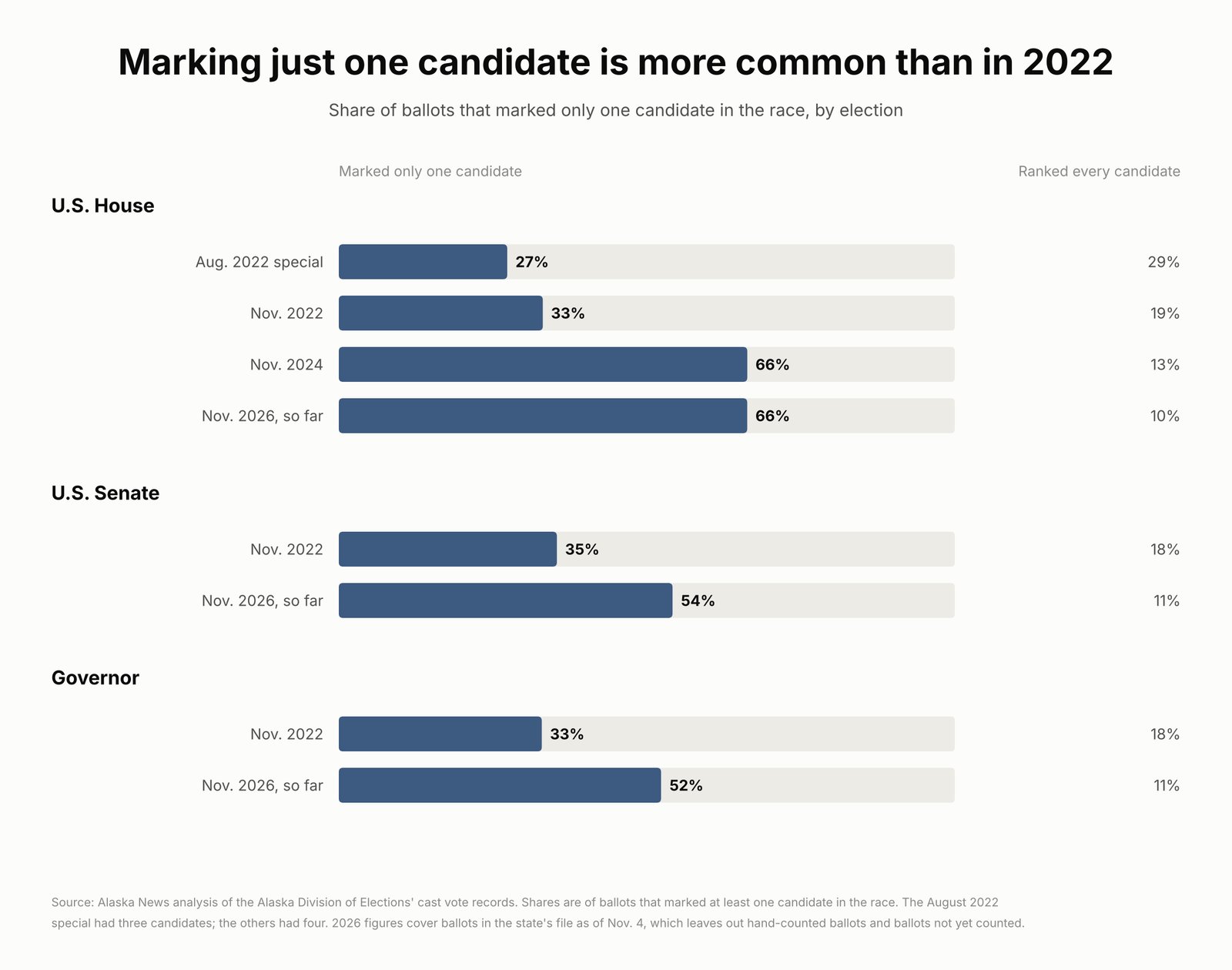
How often that happened depended on the race. In the governor's race, about 30% of the ballots that ranked Wilson first marked no other ticket, along with about a third of those that ranked Bronson or Taylor first. That compares with 74% of the ballots that ranked Kreiss-Tomkins first. Kreiss-Tomkins was the only Democrat running for governor, against three Republican tickets.
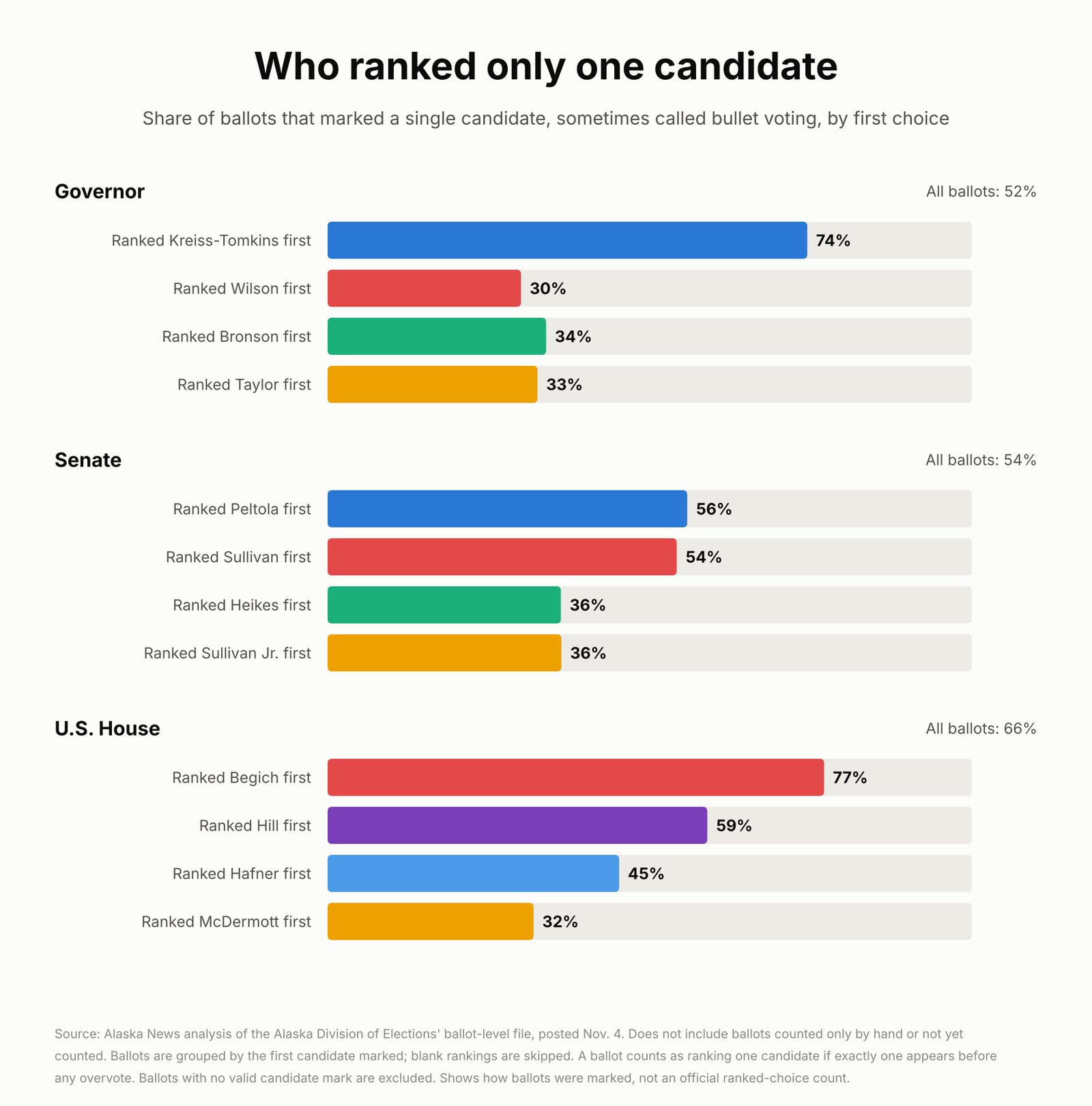
The House race went the other way. About 77% of the ballots that ranked Begich first marked no one else, compared with 59% of Hill-first ballots. Begich was the only Republican in the race. In the Senate race, Peltola-first and Sullivan-first ballots marked just one candidate at about the same rate, 56% and 54%.
It also differed by how ballots were marked on Ballot Measure 2. In the governor's race, 70% of the ballots that voted no on the repeal marked only one ticket, compared with 33% of the ballots that voted yes. In the House race, it reversed: 76% of yes ballots marked only one candidate, compared with 56% of no ballots. The Senate race was about even.
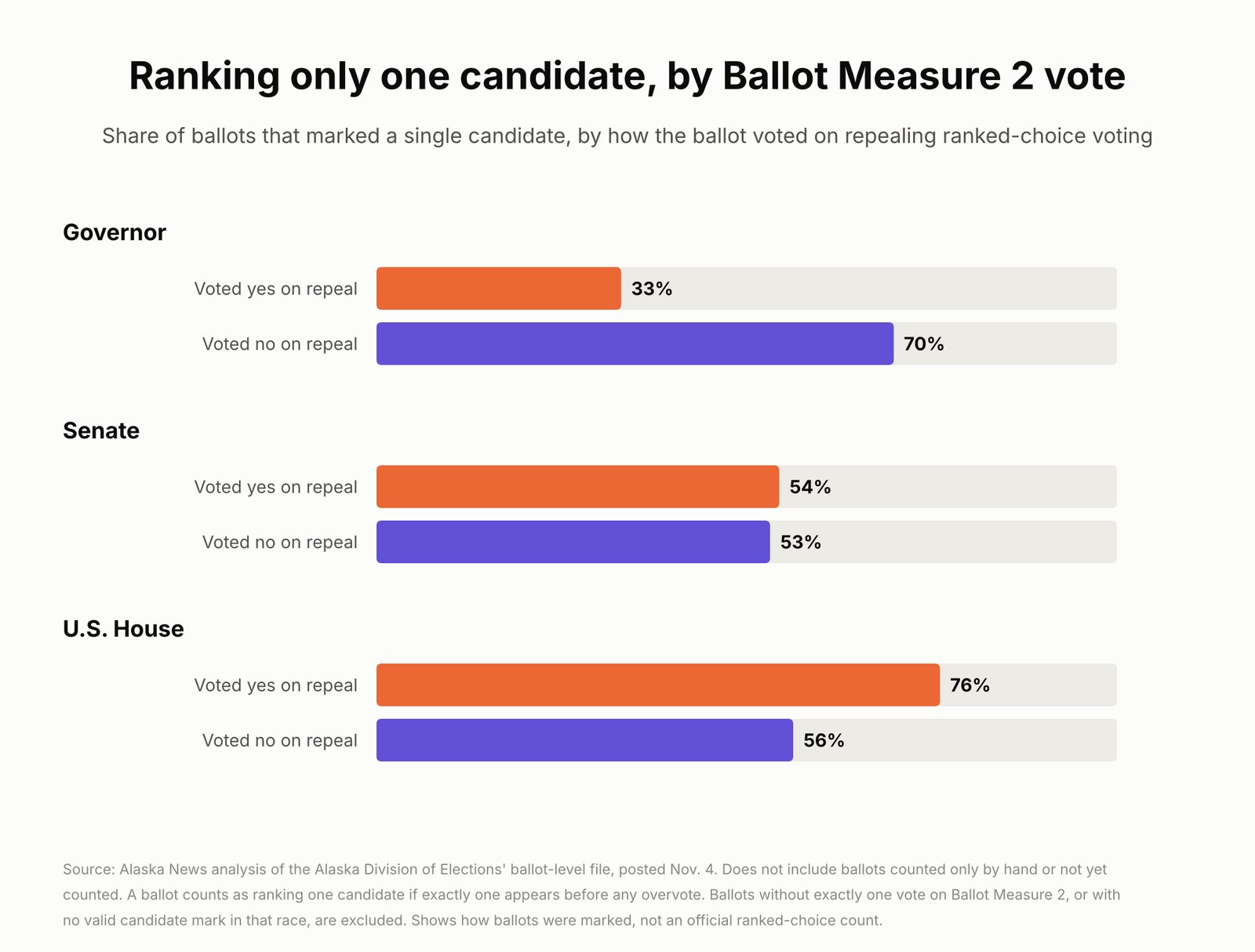
Ballots that voted no on the repeal were also more likely to rank every candidate. In each of the three races, about 14% of no ballots ranked all four, compared with 7% to 8% of yes ballots.
The file reflects only the ballots counted, and included in the Division. of elections 'Cast Vote Record' file. The division plans to count more ballots starting Nov. 10, and its ranked-choice count for races without a majority is scheduled for Nov. 18.
What did you make of this story? (no account needed)
Get Alaska News in your inbox
Create your free account and get the day’s top stories around 6 each morning, in a few minutes’ read.
Top stories, around 6 each morning.
Stories on what you follow, on Sundays.










Comments
Sign in to leave a comment.
No comments yet. Be the first to share your thoughts.