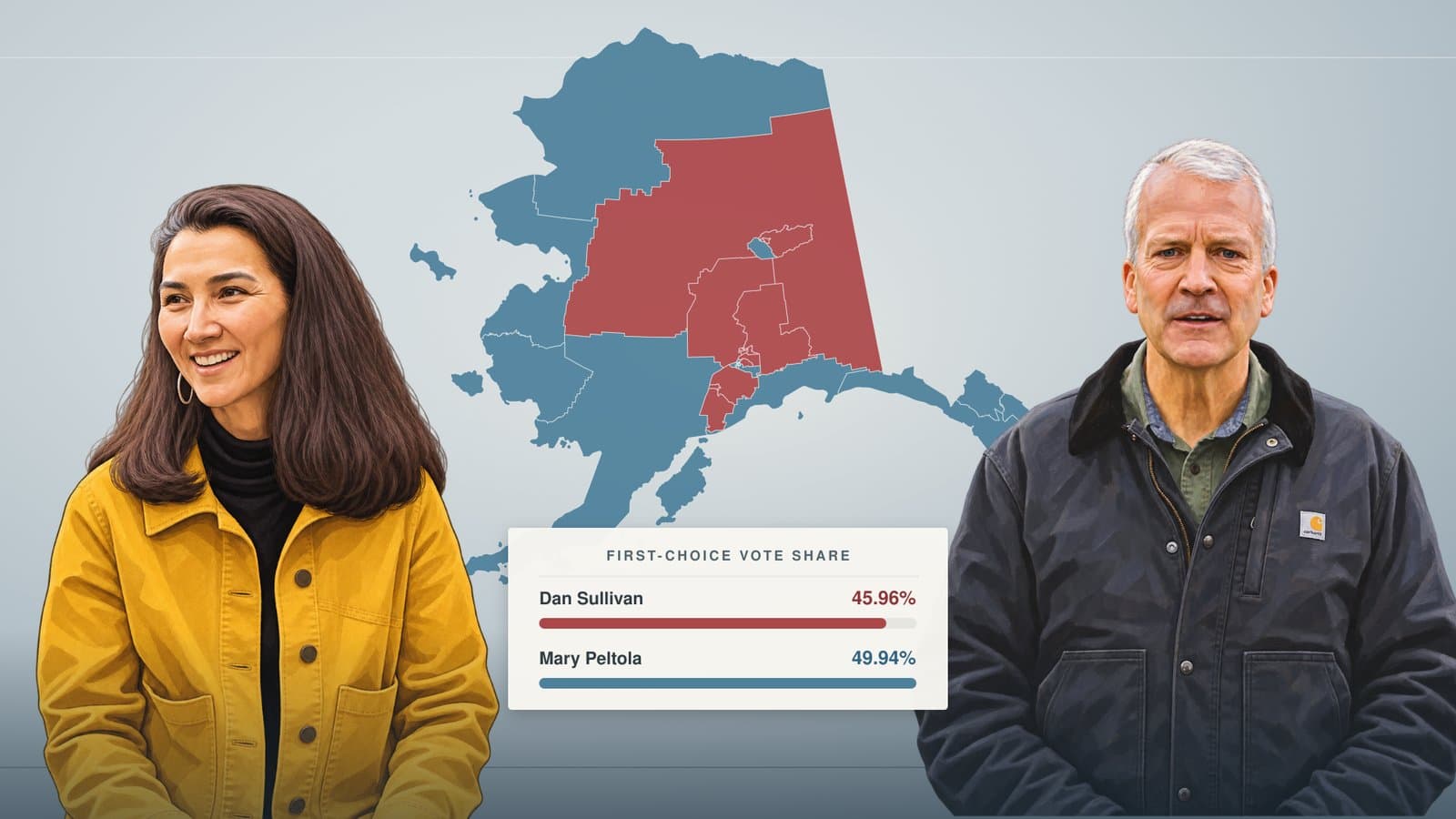
AI Generated Image
Analysis: Peltola's Senate lead passes 11,000 as she nears an outright majority
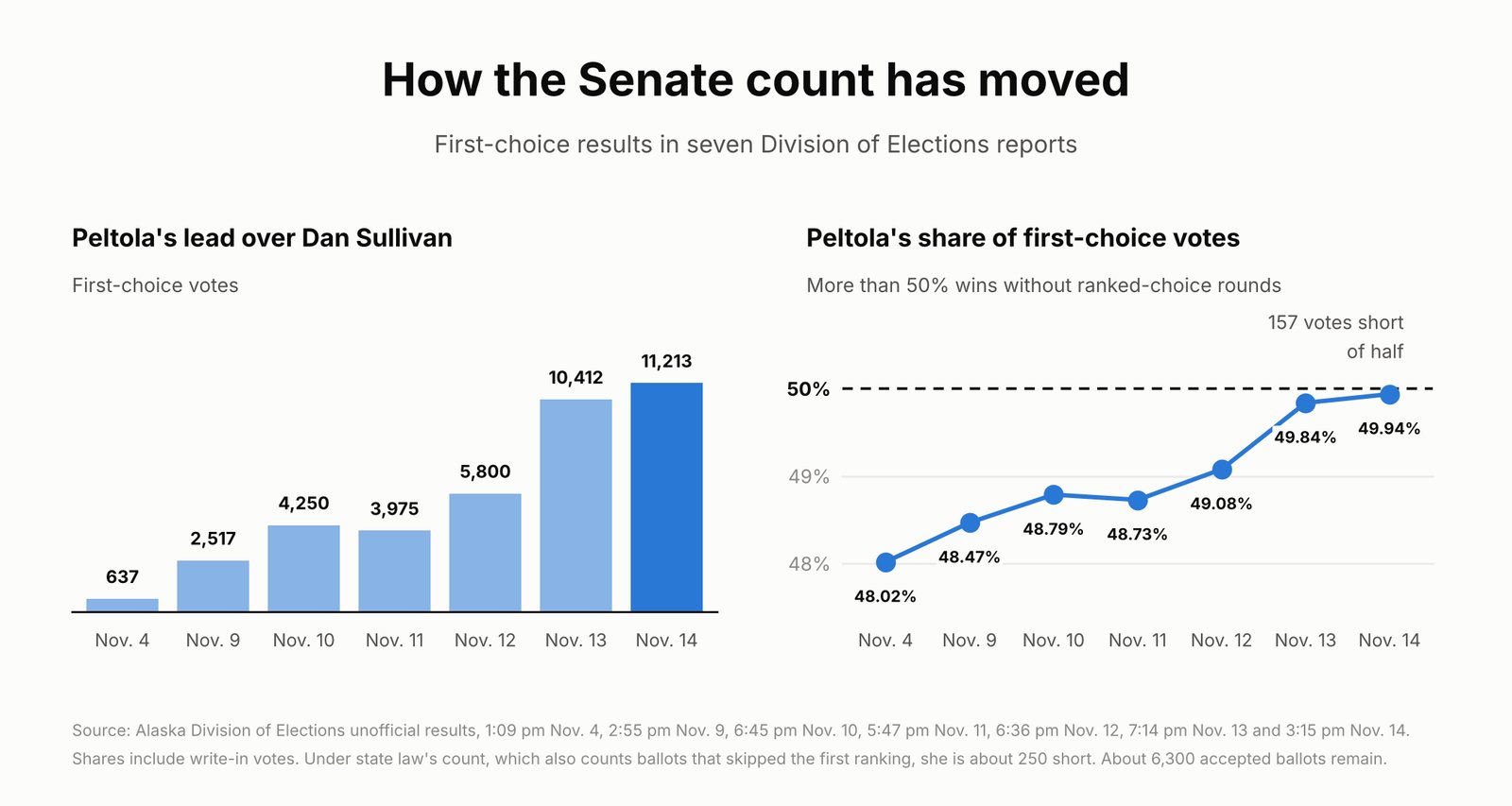
Democrat Mary Peltola's lead over Republican Sen. Dan Sullivan grew to 11,213 votes in the state's latest count Saturday, Nov. 14, and her share of the vote rose above 50% on the state's live results page.
That doesn't settle the race yet. Counting the ballots the way state law does, Peltola is about 250 votes short of the majority that would let her win without ranked-choice rounds, an Alaska News analysis of state election data shows. If the rounds are needed, the state's ballot-level file shows she would win them by about 10,400 votes on the ballots counted so far.
Peltola has 140,637 first-choice votes, or 49.94%, to Sullivan's 129,424, or 45.96%, in the Division of Elections' latest results. Republican Gerald Heikes has 2.1%, Daniel J. Sullivan Jr. of Petersburg, who appears on the ballot without a party label, has 1.7%, and write-ins have 0.3%.
The division's live results page shows Peltola at 50.1% because it leaves write-in votes out of the total; leaving them out, she is about 280 votes over half. The division's full results report counts the 872 write-ins and puts her 157 votes short of half.
Under state law, a candidate who is the top choice on more than half of the active ballots wins without ranked-choice rounds. That count also includes ballots that skipped the first ranking, counted for the voter's next choice, which the division's first-choice totals leave out. About 350 Senate ballots in the ballot-level file did that, and only about a quarter of them went to Peltola. Counting write-ins and those ballots, she is about 250 votes short, by Alaska News' math. If no one has a majority when counting ends, the division plans to run ranked-choice rounds Nov. 18, after its final count of absentee and questioned ballots.
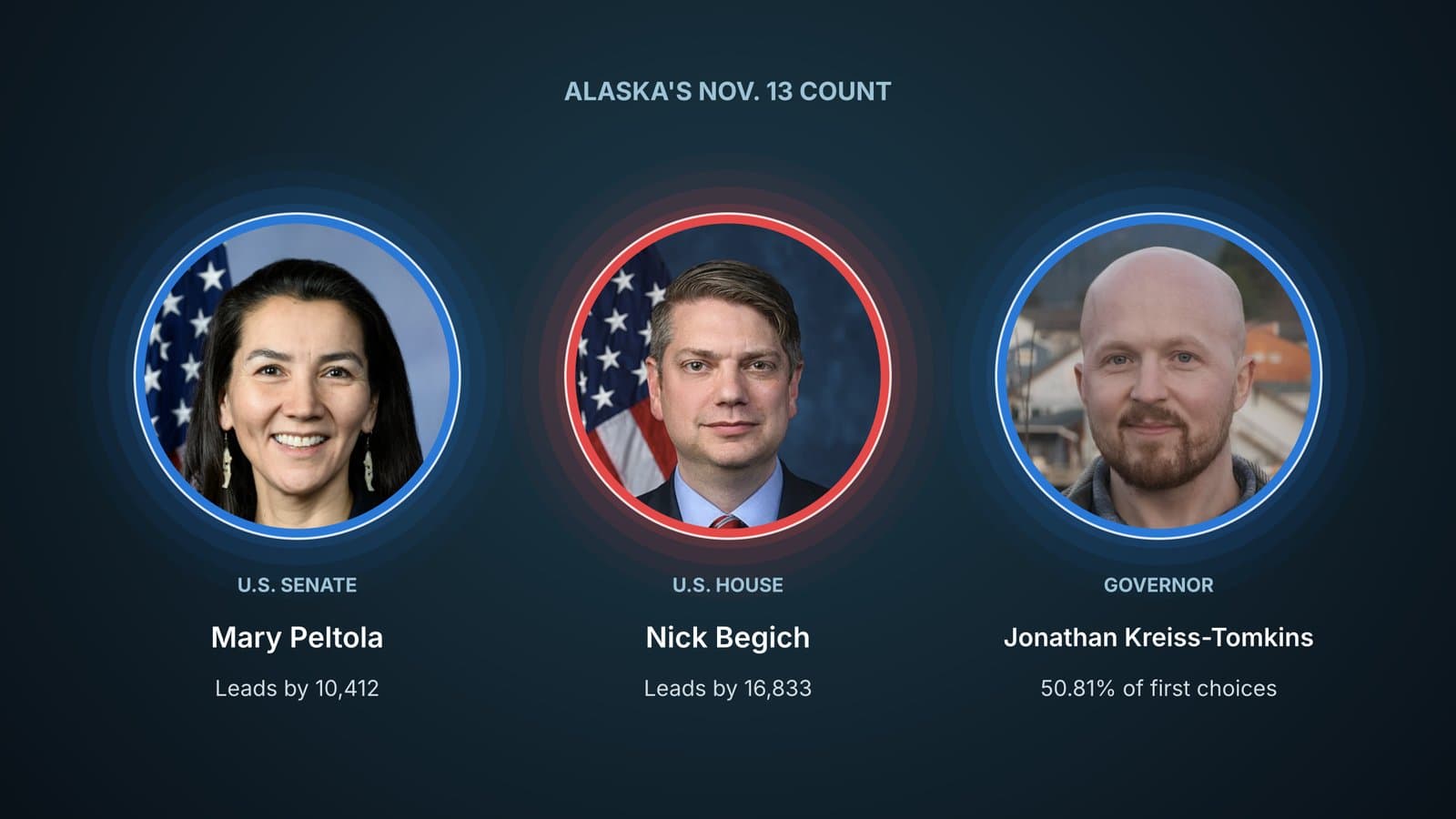
Peltola's lead was 10,412 after Friday's update and 637 in the division's results the day after the election. It has grown in five of the division's six updates since, shrinking only on Nov. 11, when most of the new ballots were absentees from the Mat-Su area.
Saturday's update added 4,290 ballots, all but a few dozen of them from Anchorage, Eagle River and Chugiak. They included the area's 2,625 questioned ballots, which voters cast when election workers can't confirm their eligibility at the polls, and about 1,400 absentee ballots. Peltola won 57% of the new Senate votes to Sullivan's 38%, adding 801 votes to her lead.
The questioned ballots had been the biggest unknown left in the count. They went 54% for Peltola and 40% for Sullivan, better for her than the area's Election Day ballots, which went 50% for her, and the questioned ballots counted elsewhere in the state, which went 45% for her. She won about 61% of the area's other new ballots, most of them absentees.
About 6,300 accepted ballots still weren't in the results after Saturday's count, by Alaska News' count from the division's latest ballot report. Nearly all are absentee ballots: about 2,500 from Anchorage, Eagle River and Chugiak, about 2,100 from Southeast Alaska, about 900 from the House district that includes Kodiak, Cordova and Seward, and about 550 from the Kenai Peninsula, most of them from the House district that includes Homer. Ballots from overseas can still arrive through Nov. 18.
To get past half under state law's count, Peltola would need about 54% of the Senate votes on the ballots left, or about 52.5% if as many as 10,000 are left. On ballots like the ones left, she has mostly done better than that. She won 60% of the Anchorage-area absentee votes counted Saturday, and in Friday's update she won 61% of Southeast's absentee votes and 59% in the Kodiak-area district. The exception is the Homer-area district, where she won 52% of Friday's absentee votes.
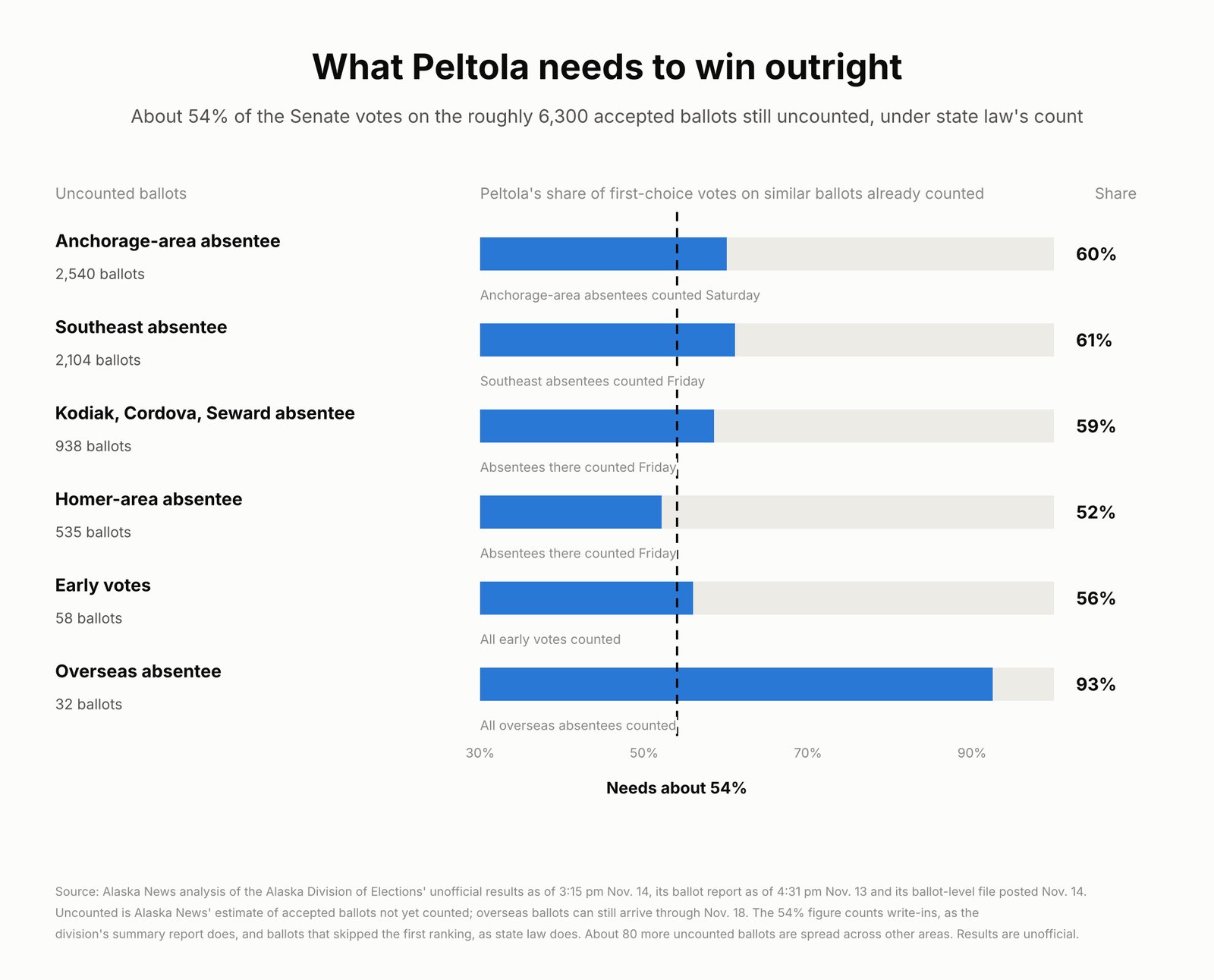
If each district's remaining absentee and early ballots vote like the same kinds of ballots already counted there, Peltola would finish with about 50.2%, about 560 votes more than half under state law's count, by Alaska News' math. That's a scenario, not a forecast, and it rests on the ballots left voting much like the ones already counted.
If she falls short, the ranked-choice rounds would favor her, according to the ballot-level file the state posted Saturday, which records how each ballot was marked without identifying voters. The file covers 282,698 ballots, all but about 900 of those counted. The division says ballots counted only by hand aren't in it.
In those rounds, the division would eliminate the last-place candidates one at a time and move their ballots to each voter's next choice: write-ins first, then Sullivan Jr., then Heikes. Sullivan Jr.'s ballots lean toward Peltola: 34% rank her next, 23% rank Sullivan and 43% rank neither. Heikes' ballots lean the other way: about 41% rank Sullivan next, 18% rank Peltola and 41% rank neither. Together, those ballots and the write-ins would cut Peltola's lead by about 850 votes.
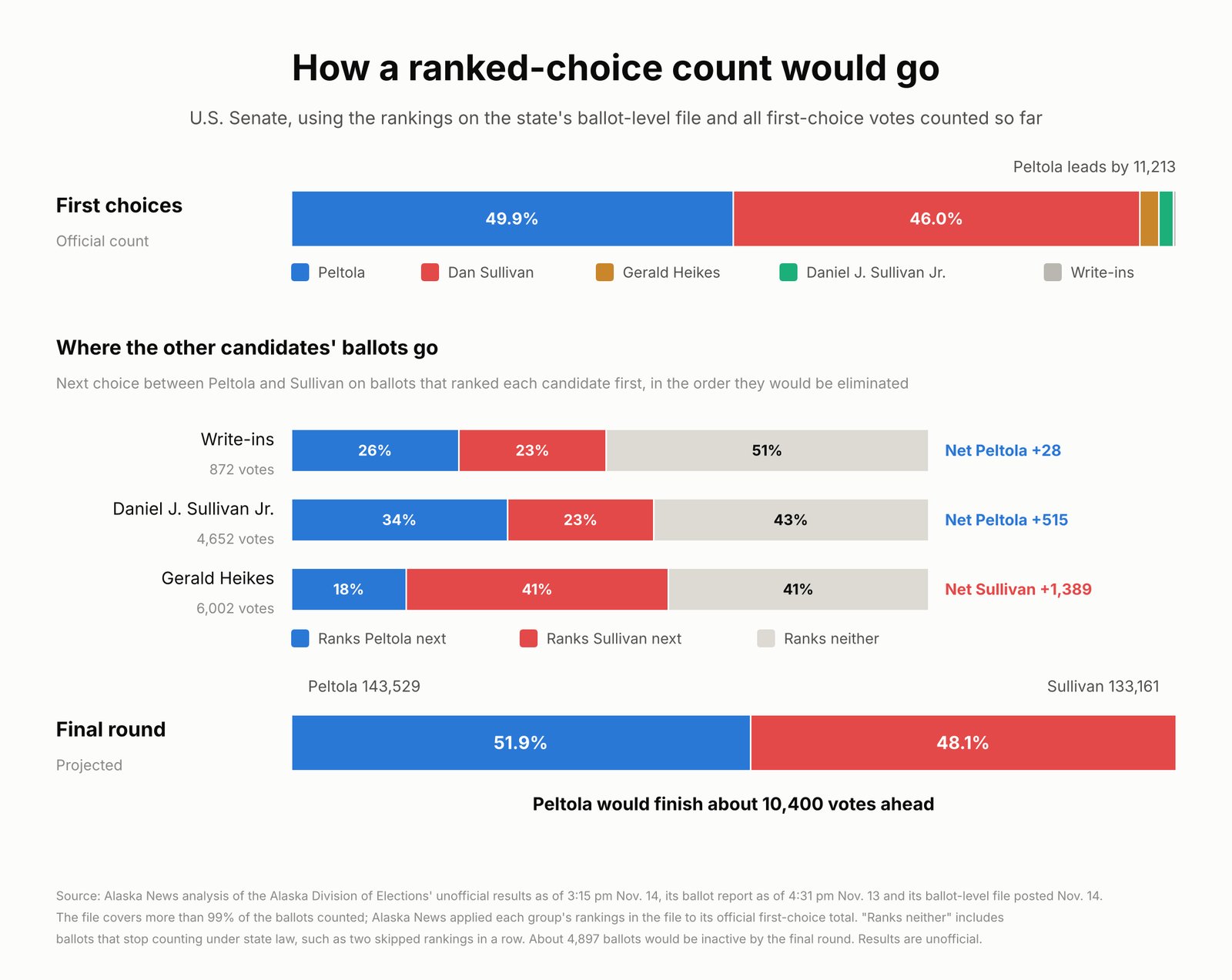
Applying the file's rankings to all the first-choice votes counted so far, Peltola would finish with about 51.9% in a final round against Sullivan, about 10,400 votes ahead. That's up from about 9,500 on Friday's file, using the same method as Alaska News' earlier analysis.
Counting only the actual rankings on the file's ballots for Heikes, Sullivan Jr. and write-ins, Peltola would also lead by about 10,400 after those candidates are eliminated. About 100 ballots for those candidates aren't in the file. Even if every one of them ranked Sullivan next, Peltola would still lead by about 10,300.
That leaves Sullivan no path in a final round on the ballots counted so far. He couldn't overtake her even if every one of the roughly 6,300 ballots left ranked him over her, and even if 15,000 were left, he would need about 85% of the ones that rank either candidate. He won 38% of Saturday's Senate votes.
Most Senate ballots didn't use the extra rankings. About 55% of the Senate ballots in the file ranked only one candidate, including 56% of those that ranked Peltola first and 55% of those that ranked Sullivan first.
When Sullivan-first ballots ranked anyone else, the next choice was usually Heikes, who was next on 39% of all Sullivan-first ballots. On Peltola-first ballots, the most common next choice was Sullivan Jr., at 31%, followed by Heikes at 6.7% and Dan Sullivan at 5.2%.
The file also shows how the rest of each ballot was marked. About 93% of Peltola-first ballots ranked Democrat Jonathan Kreiss-Tomkins first for governor, and 92% ranked nonpartisan Bill Hill or Democrat Eric Hafner first for the U.S. House. About 94% of Sullivan-first ballots ranked Republican Rep. Nick Begich first for the House.
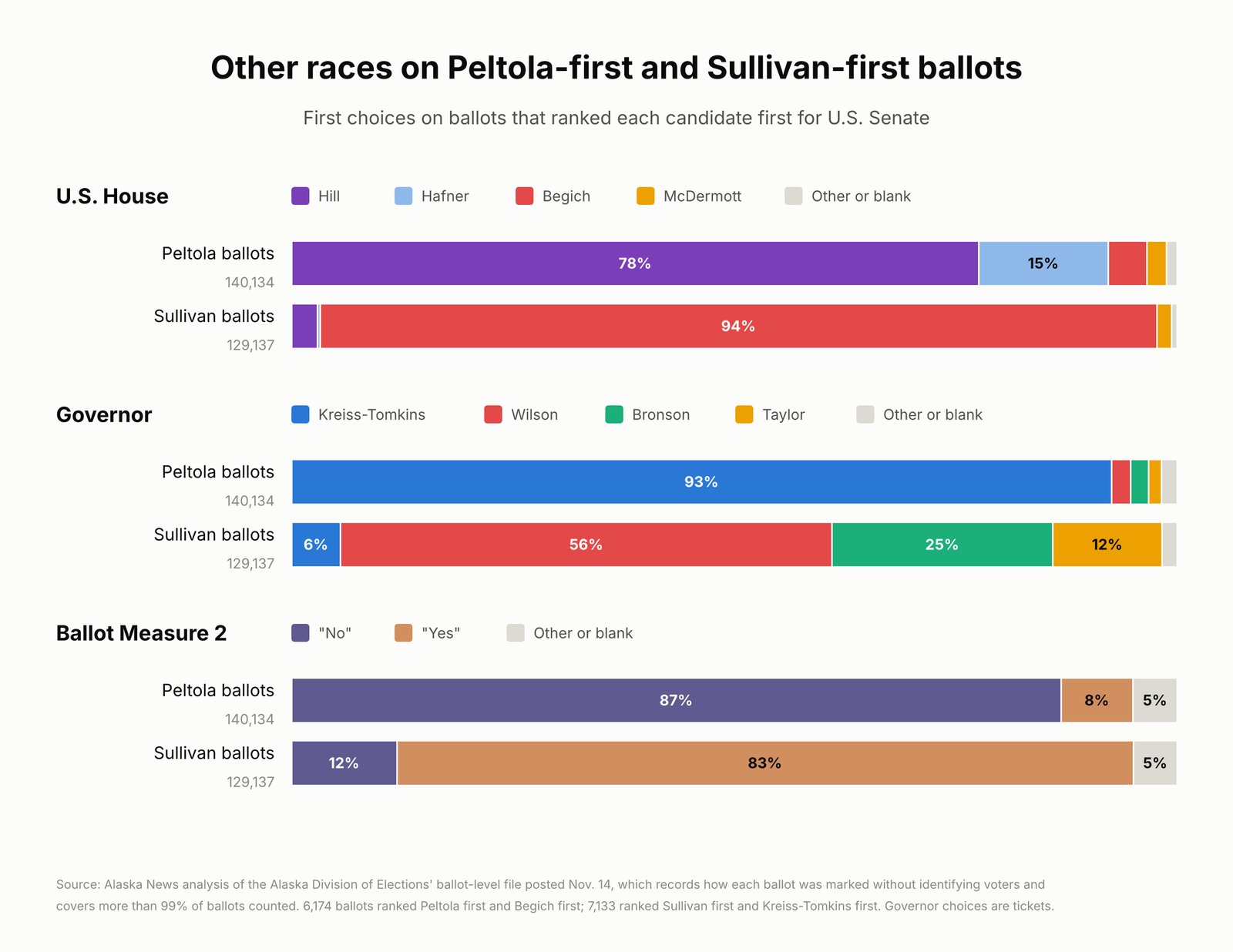
Ticket-splitting ran both ways. About 7,100 ballots ranked Sullivan first and Kreiss-Tomkins first for governor, and about 6,200 ranked Peltola first and Begich first. On Sullivan-first ballots, first choices for governor split among Republicans Bernadette Wilson, 56%, Dave Bronson, 25%, and Treg Taylor, 12%.
On Ballot Measure 2, which would repeal Alaska's open primaries and ranked-choice general elections, 87% of Peltola-first ballots voted "No," to keep them, and 83% of Sullivan-first ballots voted "Yes." About 12% of Sullivan-first ballots voted "No," and 8% of Peltola-first ballots voted "Yes."
The projections reflect only the ballots counted so far and aren’t race calls. The division plans to release its ranked-choice tabulations Nov. 18, after its final count, and the state aims to certify results Nov. 25.
What did you make of this story? (no account needed)
Made by our human newsroom with AI. Reviewed by Cale Green. How humans and AI work here · Grow with our newsroom ·
Get Alaska News in your inbox
Create your free account and get the day’s top stories around 6 each morning, in a few minutes’ read.
Top stories, around 6 each morning.
Stories on what you follow, on Sundays.
Source: Alaska Social: Community Signal roundup.














Comments
Sign in to leave a comment.
No comments yet. Be the first to share your thoughts.