Alaska LNG project could tap Defense Production Act for federal support
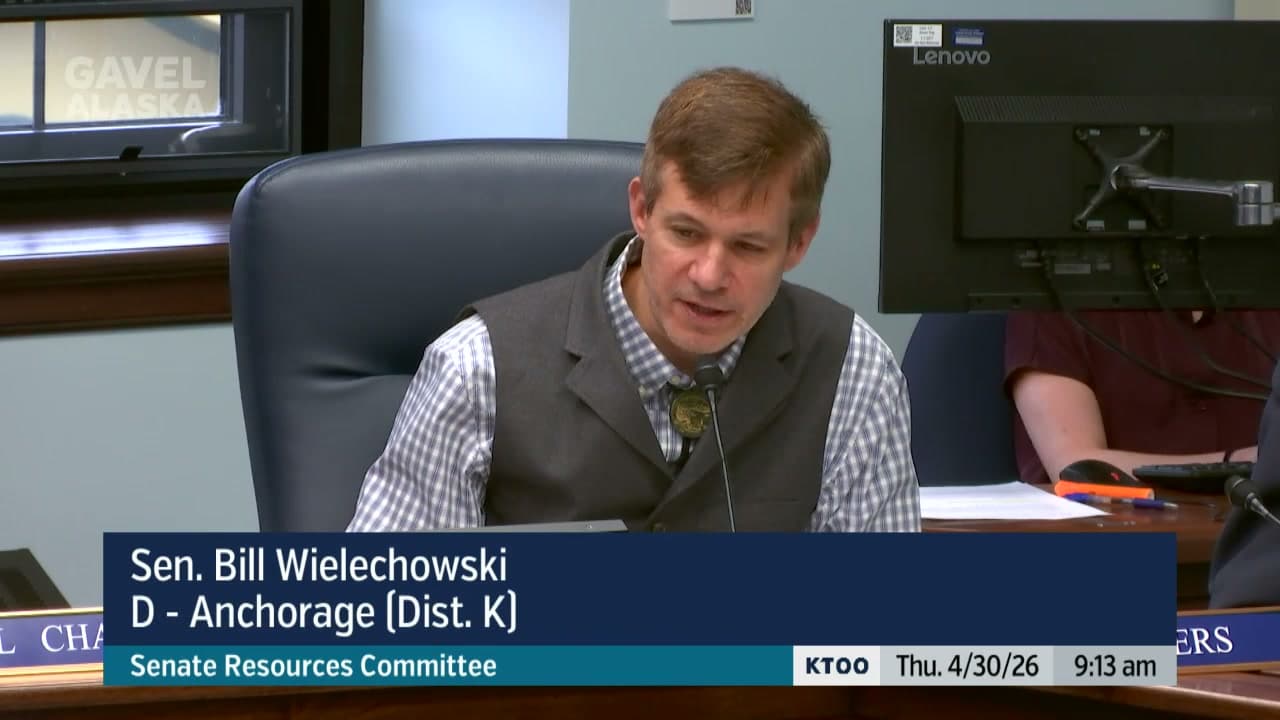
The Alaska Senate Resources Committee heard testimony Thursday on how the Defense Production Act could provide federal support for the proposed $47 billion Alaska LNG project, marking what an expert called uncharted territory for the Korean War-era law.
President Trump invoked the Defense Production Act on April 20, 2026, declaring a national emergency and delegating authority to the Secretary of Energy to support natural gas and LNG capacity expansion. The move opened the door for federal grants, loan guarantees, or offtake agreements for projects like Alaska LNG, which would include a gas treatment facility, an 800-mile pipeline, and an LNG export terminal.
Philip Rossetti, a senior fellow at the R Street Institute who testified before the committee, said the scale of potential federal involvement would be unprecedented. Traditional Defense Production Act projects receive tens of millions of dollars in aid and rarely exceed $100 million.
"Traditionally, these projects are in the tens of millions of dollars in terms of receiving DPA aid and rarely exceeds $100 million," Rossetti said. "So for these sort of large-scale projects, I think we are starting to enter into some uncharted territory of how the DPA can be utilized."
The Defense Production Act was first adopted in 1950 during the Korean War to give the president authority to prioritize contracts and activities in the private sector for national defense. The law has evolved over decades, with recent administrations expanding its use beyond traditional defense procurement.
Rossetti warned that using the act for a project of this magnitude could set a precedent for future presidents to deploy it for massive infrastructure projects unrelated to traditional national defense.
"When you look at the recent applications during the Trump administration of the DPA, that is actually what we are really seeing is the Biden administration and their expansion of the use of the DPA is essentially what leads the current administration to conclude that they can use it in a similar and perhaps even larger fashion," Rossetti said.
Senator Forrest Dunbar asked whether federal support at this scale would create a new tool for future administrations to fund projects like massive wind farms.
"If the federal government did come in and somehow infused a tremendous amount of capital, would you see that, and it was not challenged, would you see that as an expansion of the DPA's current understanding?" Dunbar said. "The next president and the president after that, would they have a new tool on their hand to say, I do not know, build a mega gigantic wind farm or anything else?"
Rossetti said yes. He said if Congress does not limit the authority and continues to fund the Defense Production Act fund, the next president will be able to use it in similar or larger ways.
The committee also discussed transparency concerns related to the project. The committee chairwoman noted that the state legislature is being asked to eliminate all property tax for the duration of construction and for 10 years after production begins, yet information from Alaska LNG Project LLC, the private developer, remains extremely limited. Alaska LNG Project LLC has held long-term federal authorization since 2014 to export 20 million tons per year of LNG from Alaska sources for 30 years.
"The proposal before us is to completely eliminate all property tax for the duration of the construction and for 10 years after production begins," the chairwoman said. "It is a private sector company, but government is being asked to pony up a whole lot of money to make this private sector endeavor go forward."
Rossetti cautioned that government interventions in markets carry opportunity costs, since every dollar the government spends must be paid for by taxing someone else or by borrowing money that future taxpayers will repay with interest.
"Every dollar that the government spends either must be paid for by taxing someone else or by taxing someone in the future because the money is borrowed now, which is typically what is happening, which means they are paying for it plus interest," Rossetti said.
Governor Dunleavy introduced legislation in 2024 to replace the project's property tax structure with a volumetric tax projected to generate $26 billion over 30 years. The Alaska Gasline Development Corporation, the state entity involved in project development, sought Authorization for Expenditure funds in its fiscal year 2025 budget to support regulatory defense, FERC Section 3 construction authorization, and project advancement.
The committee set an amendment deadline for the related tax legislation, Senate Bill 280, for Monday, May 4 at 5 p.m. The committee will hold its next meeting Friday afternoon to hear from the Department of Natural Resources and open public testimony.
This article is based on a public meeting — Alaska Legislature: Senate Resources - April 30, 2026 9:00am ().
AI-assisted. How we use AI Transcript byLucas Brown
Stay informed. Support what matters.
Free, permanent access to local news you can verify. Subscribe to support Alaska News and go ad-free.
Related Coverage
Senate panel examines price controls, federal authority on gas pipeline
Alaska News · 5mo ago
Consultant warns Senate Finance that Alaska LNG faces megaproject risks
Alaska News · 3mo ago
Alaska LNG Pipeline Gains Momentum with Federal Support, Asian Demand
Alaska News · 4mo ago
Senate panel examines LNG project economics, megaproject risks
Alaska News · 5mo ago
Senate panel debates $1B tax break for Alaska LNG amid cost secrecy
Alaska News · 4mo ago
Comments
Sign in to leave a comment.
No comments yet. Be the first to share your thoughts.