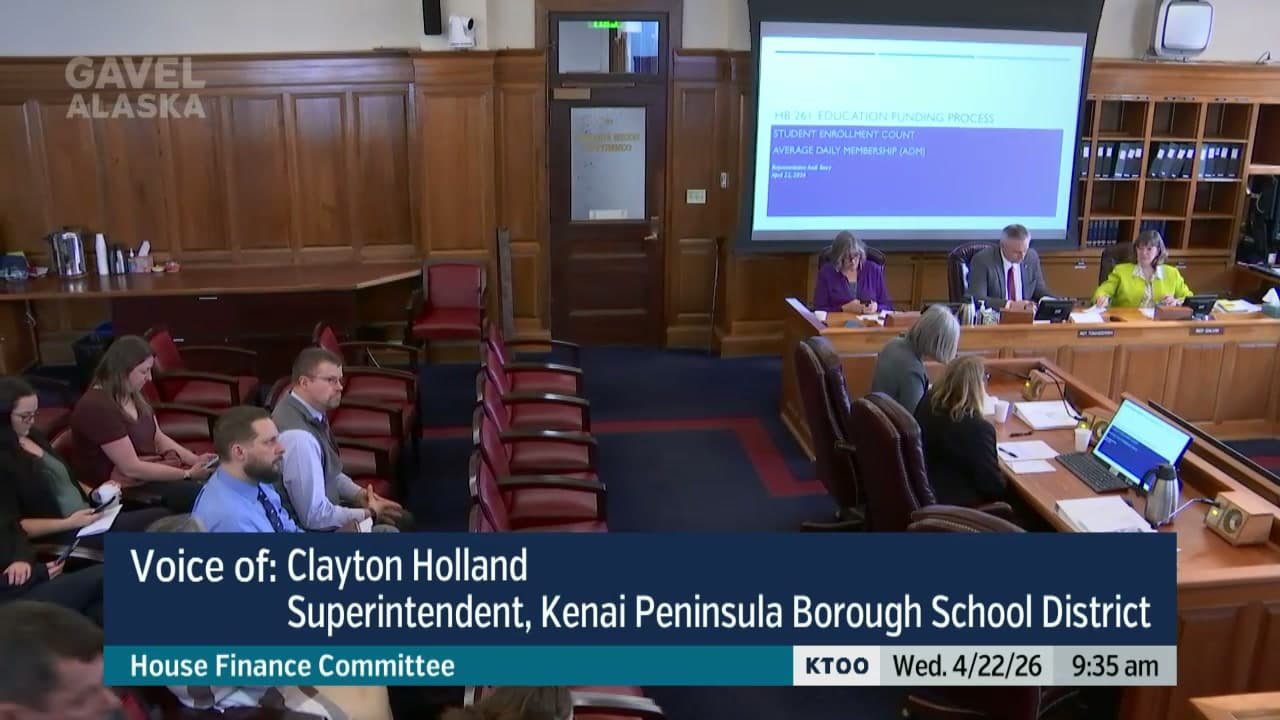
Alaska House panel hears bill to overhaul school funding timelines
The Alaska House Finance Committee heard testimony Wednesday on legislation that would fundamentally change how school districts budget by giving them enrollment numbers months earlier than the current system allows.
House Bill 261, introduced by Representative Andi Story, would let districts use either a three-year average of prior student counts or the previous year's count to set their budgets by July 1. That is well before the current October count that determines funding. The change would allow districts to offer teacher contracts in March or April instead of waiting until late spring or summer, when many qualified candidates have already accepted positions elsewhere.
"It is the norm that communities do not know their funding levels until after critical staffing program decisions have been made and local municipalities have finalized their budgets," Story said. "Last year, communities and districts did not know their current budgets until right before school started."
The bill draws on recommendations from a 2015 legislative study that found 26 other states use student count averaging. Story said the current system forces districts into an annual cycle of building budgets, revising them, and rebuilding them again as new information becomes available.
"This bill, by having a student count number July 1st and not dependent on the current year October student count, allows districts to then offer teacher and staff contracts earlier in the spring, enabling districts to retain experienced, beloved teachers, and hire new teachers when recruitment is in full swing, rather than waiting until late spring or right before school starts when talented candidates are limited," Story said.
Clayton Holland, superintendent of the Kenai Peninsula Borough School District, told the committee his district must submit a balanced budget to the borough by May 1 without knowing actual state revenue.
"In districts with the borough, we are required to submit a balanced budget in the spring," Holland said. "This creates a situation where we are making major financial decisions about staffing, programs, and in some cases even school closures without knowing what our actual revenue will be."
"It becomes a cycle of building a budget, revising it, and rebuilding it yet again as new information becomes available," Holland said. "This is not a stable or effective way to run a school system."
Holland said the Kenai district has not yet offered contracts to non-tenured teachers and has not begun hiring for positions that will likely open once funding levels are known.
The bill includes several other changes to the funding formula. It would allow districts to adjust intensive needs student counts in February to account for high-needs students who arrive after the October count. Story noted that intensive students receive 13 times the funding of regular students and have complex needs that typically require additional staff.
The legislation would also change how alternative schools with fewer than 175 students are counted. Currently, they are grouped with the largest school in the district for funding purposes. The bill would count them as separate schools, which supporters say better reflects the intensive services those programs provide.
Districts could use the current year count if enrollment increases by more than 5 percent. The bill removes the existing hold harmless provision that protects districts from enrollment drops exceeding 5 percent, though districts already receiving that protection would be grandfathered in.
Fiscal notes prepared by the Department of Education and Early Development for HB 261 indicated a zero fiscal impact, though Representative Jeremy Bynum questioned how the formula changes would affect individual districts given declining enrollment statewide. Bynum requested detailed modeling for every school district in the state showing how the formula changes would affect funding levels.
Michael Robbins, superintendent of Bristol Bay Borough School District, said the bill's hold harmless transition language is important for small rural districts already relying on those protections. The bill would prevent a sudden funding cliff by allowing those districts to continue under existing formulas until they no longer qualify.
Katie Parrott, president of the Alaska Association of School Business Officials and senior director for the Office of Management and Budget for the Anchorage School District, testified that the current system requires districts to make budgets based on enrollment projections that are not verified until months into the fiscal year. She said removing uncertainty from the annual budgeting process would reduce administrative burden and allow districts to focus more on student outcomes.
The committee heard the bill and held it for further consideration. The Finance Committee scheduled additional hearings for April 24, April 27, and May 1.
HB 261 is one of several education funding measures moving through the legislature this session. Lawmakers have also considered House Bill 374, which would increase the base student allocation by $630 per student, and a Senate committee advanced a revised House Bill 28 with $82 million in one-time funding for energy, transportation, reading, and vocational training. Earlier in the session, House Bill 69 proposed permanent base student allocation increases to combat inflation, adding over $330 million initially.
The House Education Committee approved a committee substitute version of the bill on April 1 with a 4-1 vote and two no recommendation votes. Representatives Dibert, Eischeid, Himschoot, and Story voted in favor. Representative Schwanke voted against it. Representatives Elam and Underwood gave no recommendation.
This article is based on a public meeting — Alaska Legislature: House Finance, 4/22/26, 9am ().
AI-assisted. How we use AI Transcript byLucas Brown
Stay informed. Support what matters.
Free, permanent access to local news you can verify. Subscribe to support Alaska News and go ad-free.
Related Coverage
House Finance considers multi-year school funding averaging bill
Alaska News · 5mo ago
House panel debates $113M education funding formula shift
Alaska News · 5mo ago
Senate panel advances bill to stabilize Alaska school funding with enrollment averaging
Alaska News · 4mo ago
Alaska House Weighs $113M Education Funding Overhaul
Alaska News · 5mo ago
House Finance Advances Education Funding Bill Despite Fiscal Concerns
Alaska News · 4mo ago
Comments
Sign in to leave a comment.
No comments yet. Be the first to share your thoughts.