Alaska governor candidates agree on Permanent Fund, split on taxes
Three candidates for Alaska governor agreed Thursday that the Permanent Fund needs stronger constitutional protection and that the next governor should submit a balanced budget. The larger disagreement was what should carry the cost.
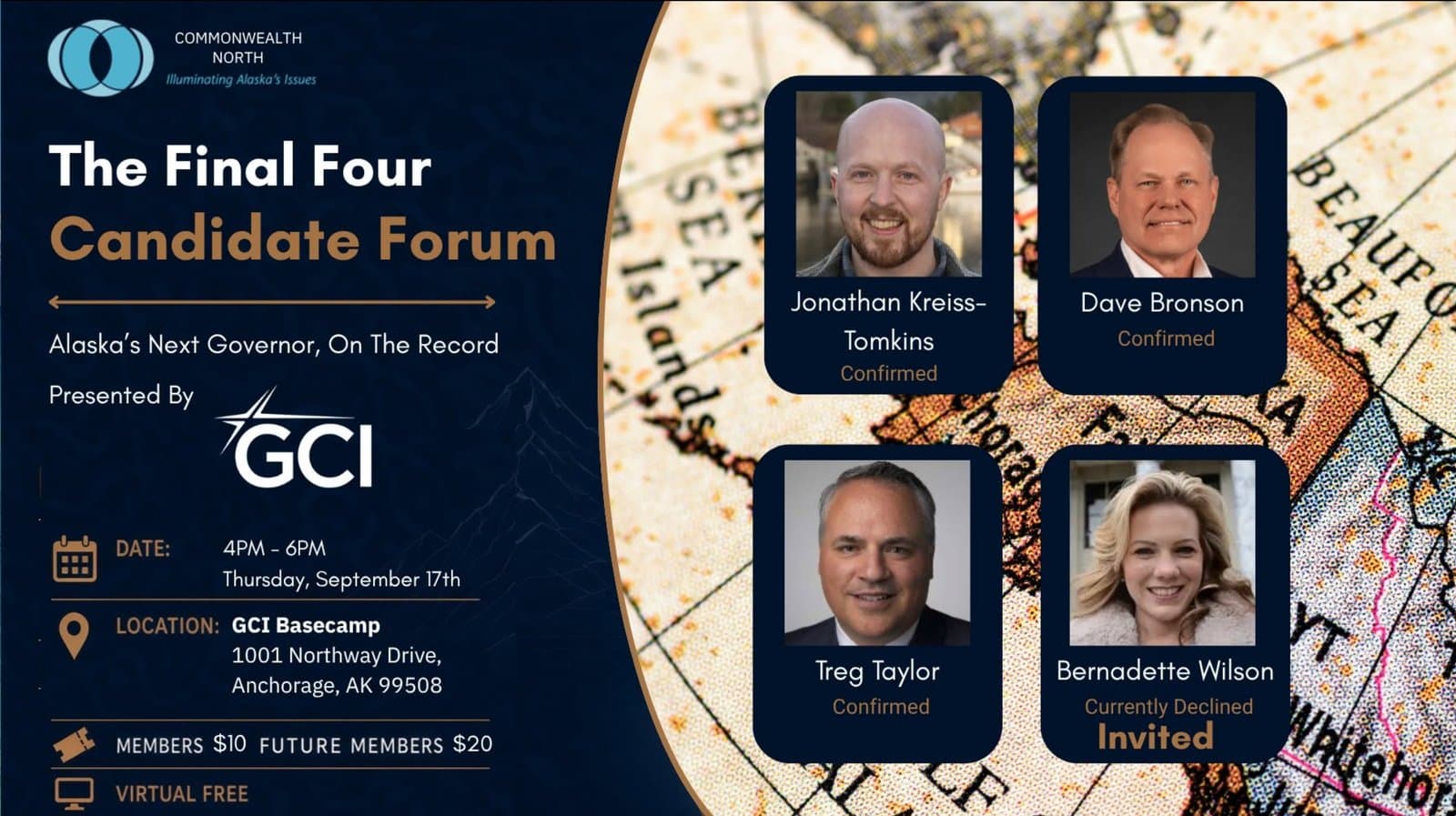
At a Commonwealth North forum in Anchorage, Treg Taylor and Dave Bronson argued that Alaska should close its fiscal gap through spending restraint, resource development and economic growth rather than broad new taxes. Jonathan Kreiss-Tomkins also called for operating-budget reductions, but paired them with targeted new revenue and a broader discussion about diversifying the state's tax base.
The format gave Taylor, Bronson and Kreiss-Tomkins 12 minutes each to answer the same three advance questions on fiscal policy, energy and out-migration. A moderated question period followed. Taylor and Bronson are registered Republicans; Kreiss-Tomkins is a registered Democrat. Bernadette Wilson, the fourth candidate on the general-election ballot and a Republican, did not participate. Commonwealth North's full transcript does not give a reason for her absence.
All three participants said their first budget would balance, though Bronson cautioned that a new governor could not rapidly restructure state government during the eight days between taking office and the budget deadline.
Taylor said the state should live within existing revenue and focus on public safety, infrastructure, education and services for vulnerable Alaskans. Asked whether Alaska's lack of a broad-based tax was a feature or a flaw, he called it a feature and said growth, not taxes, should expand the state's economy.
Bronson used an inflation-adjusted spending trend line to argue that Alaska appropriated roughly $25 billion more than it should have over nearly two decades. He rejected broad taxes and said resource royalties and Permanent Fund earnings should finance government. Bronson called the lack of a connection between private-sector growth and state revenue a flaw, but said the answer was to focus less on the treasury and more on jobs and private investment.
Kreiss-Tomkins proposed applying the corporate income tax consistently across major oil producers, collecting tax from online sales and discussing broader-based revenue with the Legislature. He also called for structural reviews and downward pressure on agency budgets, arguing that spending reductions and revenue should be part of the same fiscal settlement.
The Permanent Fund produced the night's strongest agreement. Bronson and Kreiss-Tomkins supported converting it to a constitutionally protected single-fund endowment. Taylor said the fund's principal should be locked away from future legislative raids. Bronson also said the state no longer has enough money to pay a full statutory dividend every year, while Kreiss-Tomkins called for a sustainable dividend that does not require overdrawing the fund.
Energy produced overlap on the problem and different emphases on the response. Taylor and Bronson placed a North Slope gas pipeline at the center of their plans. Taylor coupled it with permitting reform and access to state and federal land. Bronson argued that stable taxes and a more welcoming business climate would attract investment.
Kreiss-Tomkins focused on state investment in new generation and transmission, including the Railbelt intertie, an integrated regional grid and economic dispatch. He also supported targeted royalty reductions and continued state pressure on Cook Inlet leaseholders to produce more gas.
Their out-migration answers reflected the same divide. Taylor treated economic development and better-performing state services as the foundation for keeping families in Alaska. Bronson focused on forward-funding schools and improving academic results, describing education as a barrier to recruiting workers. Kreiss-Tomkins combined education and energy with more housing, modular-construction reform and public investments intended to improve quality of life.
The moderated questions also showed areas where campaign categories blurred. All three supported forward-funding public education. On persistent state vacancies, Kreiss-Tomkins emphasized retirement benefits, pay and workplace culture; Taylor emphasized leadership and described using both management changes and raises at the Department of Law; Bronson warned that some long-vacant positions remain essential and said agencies cannot fill them when government wages trail competing employers.
The candidates differed again when asked what they would seek first from Washington. Bronson called for greater state control over federal land. Kreiss-Tomkins prioritized predictable federal permitting for North Slope investment. Taylor said the federal government should fulfill land and access commitments Alaska received at statehood.
Commonwealth North called the event an interview rather than a debate, and candidates did not respond directly to one another during their prepared presentations. Even so, the common questions made the central choice clearer: Taylor and Bronson said Alaska can restore fiscal stability primarily through development, restraint and management; Kreiss-Tomkins said those steps should be combined with new revenue and more public investment.
Voters decide the race Nov. 3 using ranked-choice voting. The forum followed a Sept. 8 candidate event where the same three candidates also agreed on many of Alaska's problems while dividing over pensions, school choice, energy and the proper reach of state government.
This article is based on a public meeting of Commonwealth North — The Final Four Candidate Forum: Alaska's Next Governor, On the Record 9/17/2026 ().
Drafted with AI. Edited by Cale Green (2 revisions). Reviewed by Cale Green. Who is accountable. Transcript byLucas Brown
Stay informed. Support what matters.
Free, permanent access to local news you can verify. Subscribe to support Walter AlaskaNews and go ad-free.
Related Coverage
Three Alaska governor candidates agree on the problems, diverge on government's role
Alaska News · 1w ago
One Democrat, three Republicans, and two months to go
Alaska News · 2w ago
Bronson calls for bottom trawling ban in state waters at Kodiak fisheries debate
Alaska News · 1w ago
Gubernatorial candidates split on Board of Fisheries overhaul
Alaska News · 1w ago
Bronson takes the last spot on Alaska's four-way November governor ballot
Alaska News · 3w ago
Comments
Sign in to leave a comment.
No comments yet. Be the first to share your thoughts.