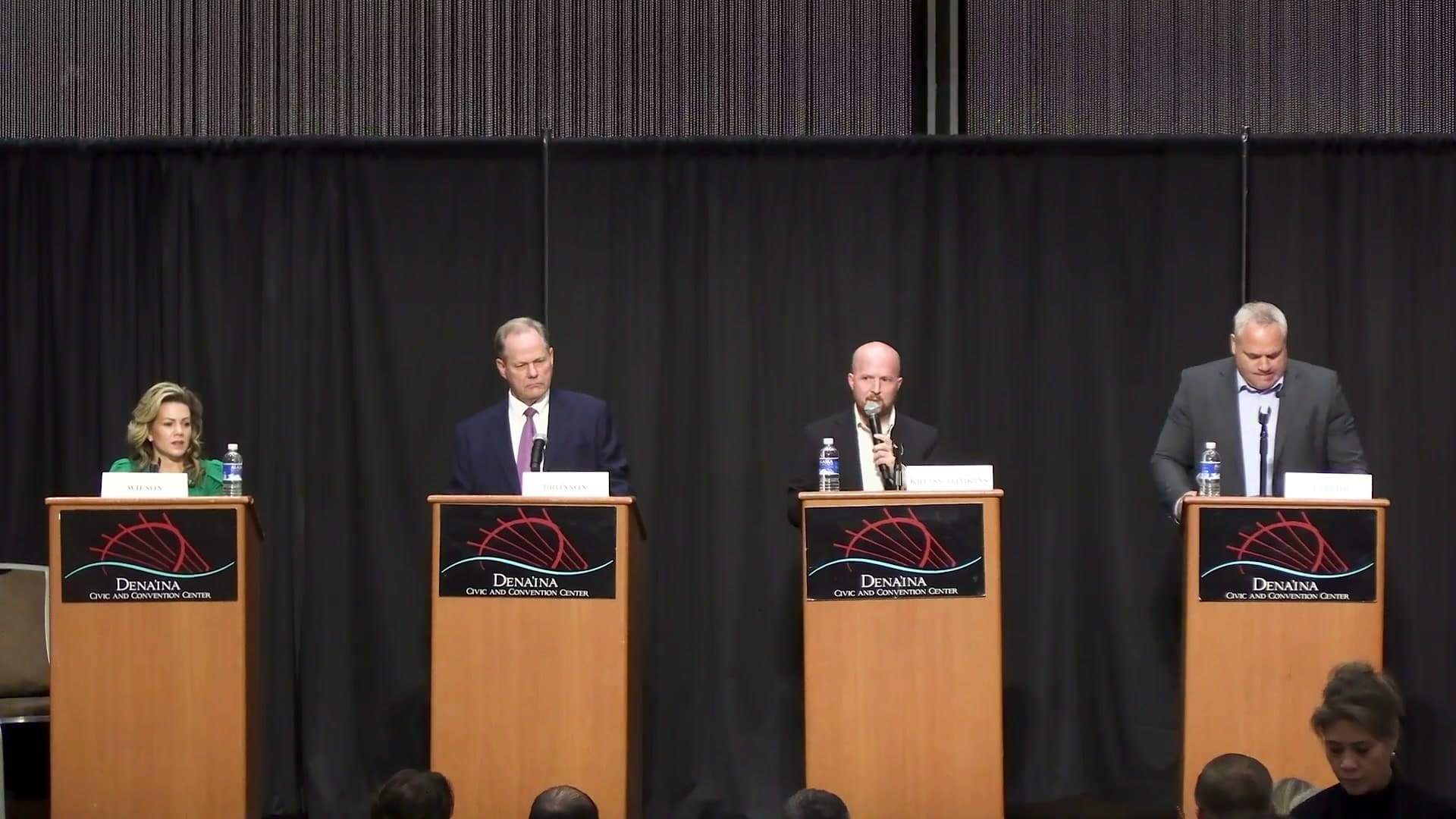
At an industry forum, four candidates for governor made their case on resource development
Alaska's four candidates for governor agreed Monday that the state should produce more oil and build the infrastructure to develop its resources.
They disagreed over the terms, and over how much state money and risk should be involved.
The candidates appeared at the Alaska Resources Gubernatorial Forum, hosted by the Resource Development Council and 11 partner trade associations at Anchorage's Dena'ina Center. Questions covered permitting, taxes, mining access, fisheries, forestry and oil production.
Agreement on producing more
All four candidates said increasing oil production would be an economic priority.
Taylor called for regulations to follow the underlying statutes as narrowly as possible. Kreiss-Tomkins said Alaska should continue North Slope development while also pursuing renewable energy. Wilson proposed a permitting "shot clock" that would establish a decision timetable once an application is filed. Bronson said a statewide hiring freeze had left permitting offices understaffed and argued that essential positions should be exempted.
Wilson criticized Kreiss-Tomkins by name three times, beginning with the first question of the afternoon, when she said he supports raising oil taxes. In the oil production round, she attacked his signature on a 2021 clean-energy letter, describing it as opposition to oil and gas development and saying it had been sent to then-House Speaker Nancy Pelosi.
The letter, signed by state and local officials nationwide including 11 from Alaska, was addressed to the top Democratic and Republican leaders of both the House and Senate. It asked Congress to put the country "on the path to 100% clean energy powering everything from our electricity grid, transportation, and buildings." It called for supporting communities that depend on oil, gas and coal jobs through that transition. It did not address continued oil and gas development.
Asked directly whether increasing oil production would be a priority, Kreiss-Tomkins called the NPR-A lease sale "maybe the most single exciting thing for Alaska in terms of economic growth" and said the state should accelerate development on the North Slope, including Willow and Santos' Pika project. On the letter, he said: "In my mind it's 'and both.' It is renewable energy, wind, solar, plug-in solar, whatever pencils, and it is oil and gas development."
How much risk should the state carry?
The candidates' differences became more concrete when industry panelists asked about roads, ports and access to mineral deposits.
Wilson and Kreiss-Tomkins marked the broadest boundaries of the discussion.
Wilson said Alaska has spent decades debating whether projects would pencil out and has not built a major road in nearly 40 years. The next governor, she said, needs a "robust capital budget" to build infrastructure to resource projects, and needs to be "willing to take the risk and isn't afraid to fail." "Is every project going to turn out exactly the way that we want it to? No, it's not," she said. "Are some of them going to go bust? Probably. But we can sit here and we can worry about the perfection and does everything pencil out, or we can say, you know what, we're going to go, we're going to run hard, we're going to run fast."
Kreiss-Tomkins said he supports projects, including past investments like the Red Dog mine road and the Port of Nome expansion, but warned against spreading limited state money across every megaproject at once. "When it pencils and the state can make those core infrastructure investments and the economics are there and they will recoup and pay for themselves over the lifespan of the project, then I think there's a compelling case to proceed," he said. He also argued that Alaska has forfeited federal transportation money because it has not consistently produced a complete Statewide Transportation Improvement Program.
Kreiss-Tomkins criticized Wilson once. Returning to her earlier remark that people don't think about the state budget every day, he said: "This might be a point of respectful disagreement between me and Bernadette, but I do think a balanced budget and a sustainably balanced budget is important for the state." She responded that he had twisted her words, and raised the letter again.
Bronson supported the Ambler and West Susitna access projects, and said the state's test should be timing. "You need to prioritize the projects that have the greatest and soonest or earliest return on investment," he said.
Taylor described infrastructure as a core responsibility of government and made the case for state resources going into the proposed 211-mile Ambler road. "The gravel has zero value. It is a stranded resource without access to it," he said of state-owned gravel along the route. "So the gravel used for that road along that roadway, the Ambler Road, should be given by the state without charge." Once the road exists, he said, the remaining gravel becomes worth something.
The Ambler road remains contested. The principal federal rights-of-way for the Ambler project were reissued in October 2025, and Alaska adopted a site-specific land-use plan in 2022. Financing, construction decisions and additional project-specific permits would still be required.
None of the four candidates identified a dollar ceiling for state participation, a required rate of return or a specific test for deciding when an uncertain access project should be abandoned.
Whether pass-through producers should pay
Moderator Connor Hajdukovich asked whether the candidates would support a tax on a single industry, beginning with Bronson.
Bronson rejected the proposal. Kreiss-Tomkins disputed the premise, saying he supported "parity in the corporate income tax structure" for oil and gas companies regardless of how they are organized.
Wilson opposed beginning with Hilcorp, arguing that a tax initially directed at one company or industry could later be expanded. Taylor also opposed the proposal, saying Alaska "can't tax your way to prosperity" and warning against returning to an oil-tax structure resembling the former ACES system.
Under current Alaska law, C corporations pay state corporate income tax, while pass-through entities such as S corporations generally do not. Alaska also has no individual income tax through which the owners' distributed income would otherwise be taxed by the state. A 2026 legislative proposal would apply corporate income tax to pass-through entities with more than $25 million in taxable income.
Gov. Mike Dunleavy separately proposed a flat 2% S-corporation tax in August as part of an Alaska LNG compromise bill. That proposal did not become law.
The general election is Nov. 3, six weeks out. The deadline to register to vote is Oct. 4.
This article is based on a public meeting of Vimeo — Vimeo video 1229047123 ().
Drafted with AI. Edited by Cale Green (5 revisions). Reviewed by Cale Green. Who is accountable. Transcript byWalter AlaskaNews
Watch key moments from the source meeting. Click to expand.
Stay informed. Support what matters.
Free, permanent access to local news you can verify. Subscribe to support Alaska News and go ad-free.
Related Coverage
Alaska governor candidates agree on Permanent Fund, split on taxes
Alaska News · 3d ago
Three Alaska governor candidates agree on the problems, diverge on government's role
Alaska News · 1w ago
Sullivan and Peltola clash in a combative first forum, previewing a bitter Senate race
Alaska News · 3w ago
Bronson calls for bottom trawling ban in state waters at Kodiak fisheries debate
Alaska News · 1w ago
Gubernatorial candidates split on Board of Fisheries overhaul
Alaska News · 1w ago
Comments
Sign in to leave a comment.
No comments yet. Be the first to share your thoughts.