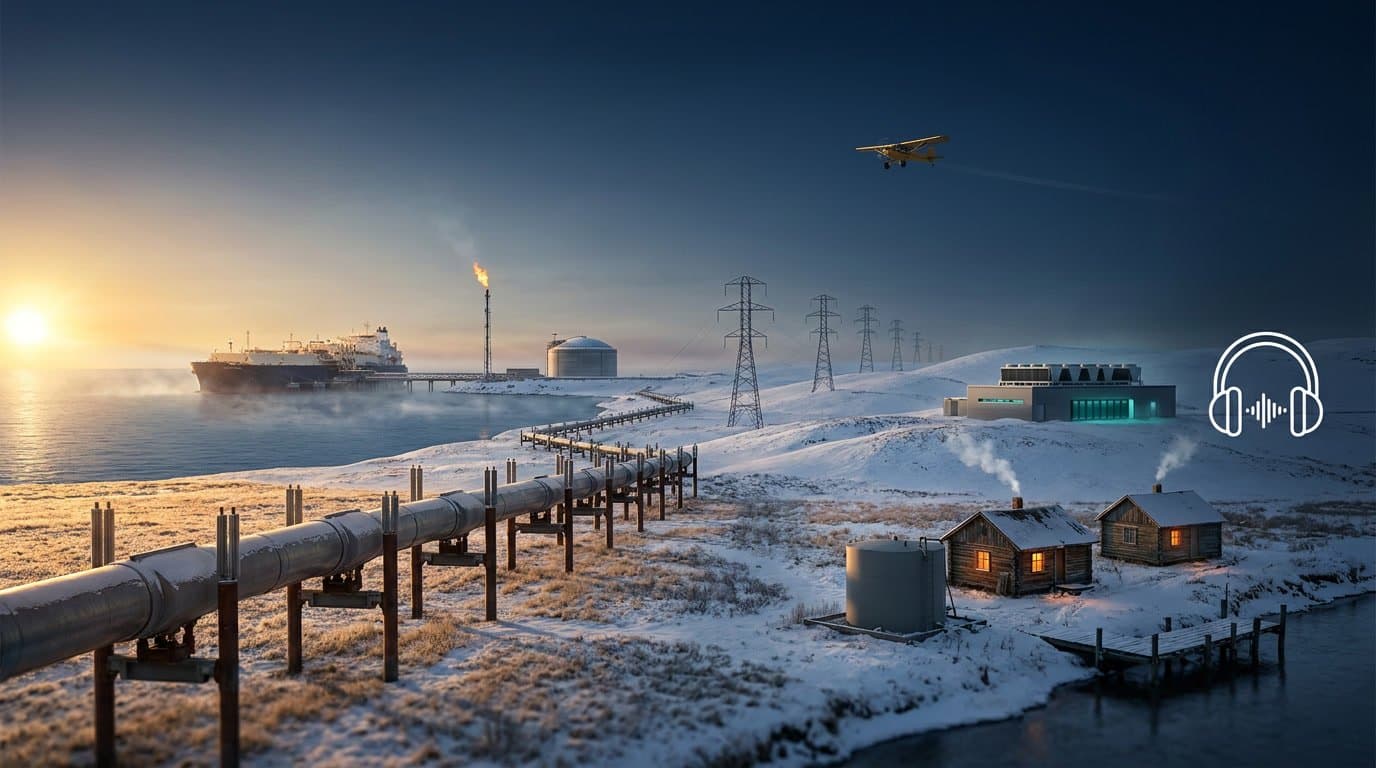
Frame from Alaska Sustainable Energy Conference (May 19, 2026)
Alaska Energy Conference Highlights Gas Pipeline Progress Amid Legislative Tax Debate
This episode of Alaska News is also a podcast, hosted by Maggie and Walter. Press play above to hear them talk through the day's stories — or read the highlights below.
Nearly a thousand energy executives gathered in Anchorage on May 19 for Day One of the Alaska Sustainable Energy Conference. While the conference celebrated signed construction contracts on the Alaska LNG project, lawmakers 800 miles south in Juneau debated competing tax frameworks that will decide who pays for it.
Alaska LNG developer says contracts signed, gas delivery targeted for 2029
Brandon Duvall of the Glenfarne Group told the conference the 807-mile pipeline from Prudhoe Bay to Nikiski is positioned to start delivering gas in 2029. His exact words: "We have let out the bulk of the construction, the equipment supply, the pipe." The project has secured 13 million tonnes in LNG reservations and commitments from international investors in Germany, Italy, Greece, Taiwan, Japan, and Korea. The state owns 25 percent of the project; Glenfarne owns 75.
Interior Secretary Doug Burgum framed the pipeline as a national security priority, noting that LNG shipping from Alaska takes eight days to Tokyo compared to 32 days from the Gulf Coast. Governor Mike Dunleavy called President Trump "the best president for Alaska in history." Lieutenant Governor Nancy Dahlstrom said when Alaska has the energy it needs, both the state and the country are safer places.
Two tax frameworks split the governor and the legislature
The governor's framework, SB 280, is in Senate Finance as of May 19. It would replace standard property taxes on the pipeline with a volumetric tax of six cents per thousand cubic feet for the pipeline itself and 12 cents for treatment and LNG plants. The Department of Revenue projects that structure would generate $800 million annually by year six and $22.8 billion through 2062.
The House has been moving its own version through floor debate this week. Senator Bill Wielechowski called the governor's proposal "roughly a 90 percent tax cut," noting it would drop annual property-tax collections from about $1 billion to roughly $74 million. "This is a tax-break bill rather than a prerequisite for construction," Wielechowski said. Burgum's counter, delivered at the conference: "If it is not built, there will not be property taxes, there will not be royalties."
Consumer-cost concerns: Southcentral could pay $22.96 per Mcf if exports fall through
Representative Zack Fields raised a concern that got less stage time in Anchorage: if export agreements do not materialize and Southcentral utilities become the project's base customer, gas will get expensive. The Department of Revenue's own analysis shows Southcentral consumers could face prices of $22.96 per thousand cubic feet — roughly double what households pay today.
Senator Lyman Hoffman questioned whether the $50 million community impact fund in the legislation is adequate. "Fifty million would not even address the concerns that Fairbanks might have," Hoffman said. The Regulatory Commission has already announced a 10 percent rate hike for the Railbelt region before any pipeline construction begins.
Governor Dunleavy told the conference he wants the tax legislation completed in three weeks. If the legislature does not deliver, he said, "there will be a special session" — "1 hour after" adjournment.
Critical minerals: federal attention meets a permitting reality
Federal officials at the conference said Alaska holds 95 percent of the critical minerals the Department of the Interior has designated as strategic to national security — a state-government talking point that draws on DOI data and that reads more cautiously when paired with the qualifier that Alaska holds large reserves of the minerals on DOI's list, not 95 percent of every category. The state leads in known graphite deposits and is a significant source of zinc, copper, tungsten, and antimony, most of which the United States currently imports from China.
The Department of Energy has allocated over $1 billion in funding opportunities for Alaska projects. Senator Dan Sullivan said the Biden administration imposed approximately 70 executive orders restricting Alaska development and that those restrictions are now gone.
Still, two major hard rock mines have opened in Alaska since the Red Dog zinc mine began production in 1989: Pogo gold mine in 2006 and Kensington gold mine in 2010. Federal officials cited permitting timelines of 15 to 18 years as the primary barrier to new projects. Alaska Attorney General Stephen Cox added a nuance that got less applause: "Many barriers to development are not about policy but about execution."
AI data centers: a new pitch for cold-climate computing
Former Senator Kyrsten Sinema, who co-chairs the AI Infrastructure Coalition, pitched Alaska as a destination for artificial intelligence data centers, citing the state's land, water, power, and cool climate. The Department of the Air Force announced plans in April for advanced AI data centers at three Alaska installations: Joint Base Elmendorf-Richardson, Eielson Air Force Base, and Clear Space Force Station. The Alaska Industrial Development and Export Authority has already approved a $17 million loan to Greensparc for data center infrastructure in Cordova.
Rural Alaska: $6.63 a gallon, 53 villages, no pipeline in sight
All of this — the pipeline, the minerals, the data centers — reads differently when you are paying $6.63 a gallon for gasoline. That was the average price this winter across 99 surveyed rural communities. Alaska Village Electric Cooperative serves 53 villages where the immediate question is whether this winter's fuel-barge prices will break another household budget, not whether a pipeline will arrive in a decade. The conference continues May 20 with panels on rural Alaska energy systems and hybrid solar-battery-biomass infrastructure that does not wait for an 807-mile pipeline.
Governor Dunleavy has set a three-week deadline for the legislature to pass tax legislation for the project.
Articles referenced in this episode
Alaska LNG Project Targets 2029 Gas Delivery as Developer Reports Major Contract Awards
Alaska News · 4mo ago
Interior Secretary urges Alaska to build LNG project quickly amid Asian demand
Alaska News · 4mo ago
Alaska Senate panel hears gas line bill with $900M annual tax break
Alaska News · 4mo ago
Federal Officials Push Permitting Reform to Unlock Alaska's Critical Minerals
Alaska News · 4mo ago
Alaska Officials Hail 'Night and Day' Shift Under Trump Energy Policies
Alaska News · 4mo ago
Former Senator Kyrsten Sinema Identifies Alaska as Prime AI Data Center Location
Alaska News · 4mo ago
Alaska Sustainable Energy Conference explores future of statewide energy systems
Alaska News · 4mo ago
Dunleavy to Call Special Session on Gas Line Property Tax Within Hour of Adjournment
Alaska News · 4mo ago
Stay informed. Support what matters.
Free, permanent access to local news you can verify. Subscribe to support Walter AlaskaNews and go ad-free.
Related Coverage
Alaska LNG developer says financing secured, eyes 2027 start
Alaska News · 4mo ago
Roundup: Alaska energy conference closes with pipeline financing, record lease sale, and economic freedom debate
Alaska News · 4mo ago
Alaska Senate panel hears gas line bill with $900M annual tax break
Alaska News · 4mo ago
Alaska LNG Tax Bill Stalls as Lawmakers Demand Project Cost Data
Alaska News · 4mo ago
Alaska LNG Project Targets 2029 Gas Delivery as Developer Reports Major Contract Awards
Alaska News · 4mo ago
Comments
Sign in to leave a comment.
No comments yet. Be the first to share your thoughts.