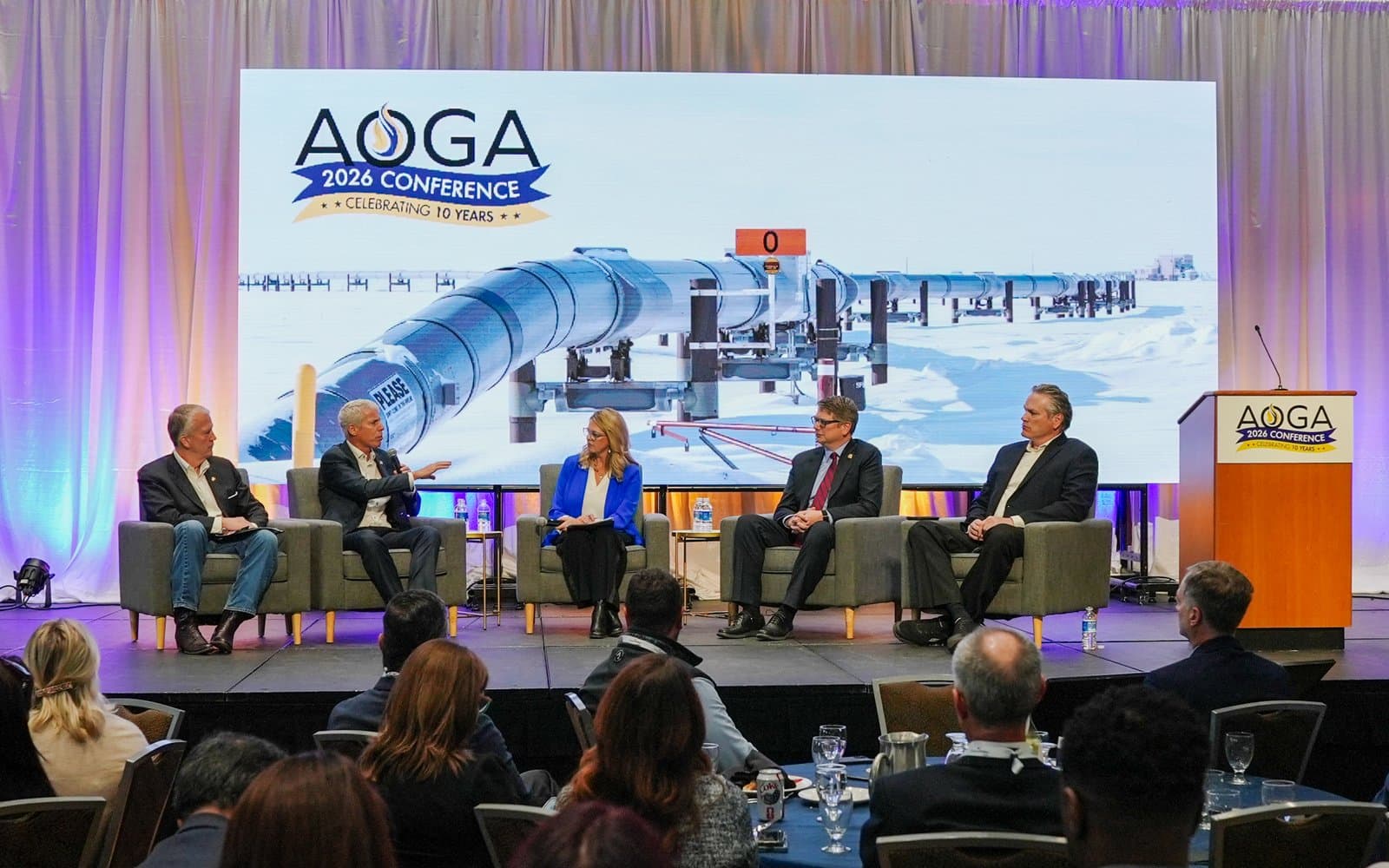
Sen. Dan Sullivan, Energy Secretary Chris Wright, Kara Moriarty, Rep. Nick Begich and Gov. Mike Dunleavy speak during the Alaska Oil and Gas Association conference in Anchorage on Aug. 27, 2026. Photo
A fight over whether North Slope oil money stays local or goes to the whole state
At the Alaska Oil and Gas Association's annual conference in Anchorage last week, U.S. Rep. Nick Begich and U.S. Sen. Dan Sullivan celebrated what they called a historic win for Alaska: a bigger cut of the money the federal government takes in from oil and gas on federal land in the state. Written into last year's federal budget law, the deal lifts Alaska's share of key federal oil-and-gas receipts to 70 percent over time, up from 50 percent, and the delegation cast it as the long-delayed fulfillment of a promise made at statehood. Gov. Mike Dunleavy shared the stage, part of a panel that also included U.S. Energy Secretary Chris Wright.
What the two men did not mention is that this oil money is now the subject of a different fight back home — over whether it keeps flowing first to the Arctic communities nearest the drilling, as it has for decades, or gets spent by the state as a whole. On one side is the state treasury; on the other, the North Slope. And the sum at stake stands to grow for years.
"We were promised when we became a state a certain set of things from the federal government," Begich said. "One of those was an outsized share of those federal royalties and revenues for the people of Alaska." Sullivan tied the bigger share straight to the state budget, telling the room it would give lawmakers more to work with "when they're having the debates on funding for schools and roads and teachers" — money, in his framing, "for all of us."
That argument is about Alaska's share as a state. It is a separate question from where the money goes once it arrives — and that is where the fight is. The system that has sent much of it to the North Slope came decades after statehood: a 1980 federal law opened the National Petroleum Reserve-Alaska, a vast stretch of the western North Slope, to commercial oil leasing, split the money evenly between the state and Washington, and directed that the state "give priority" to the communities "most directly or severely impacted" by the drilling. Alaska built a grant program around that requirement — though what "priority" actually obligated the state to do would not be settled for years.
For the North Slope Borough, that money is real but not everything. The borough already collects around half a billion dollars a year in property taxes, almost all of it from the oil and gas infrastructure inside its borders — a huge tax base for a place of about 10,000 people. The impact grants are a separate, and much smaller, stream on top of that.
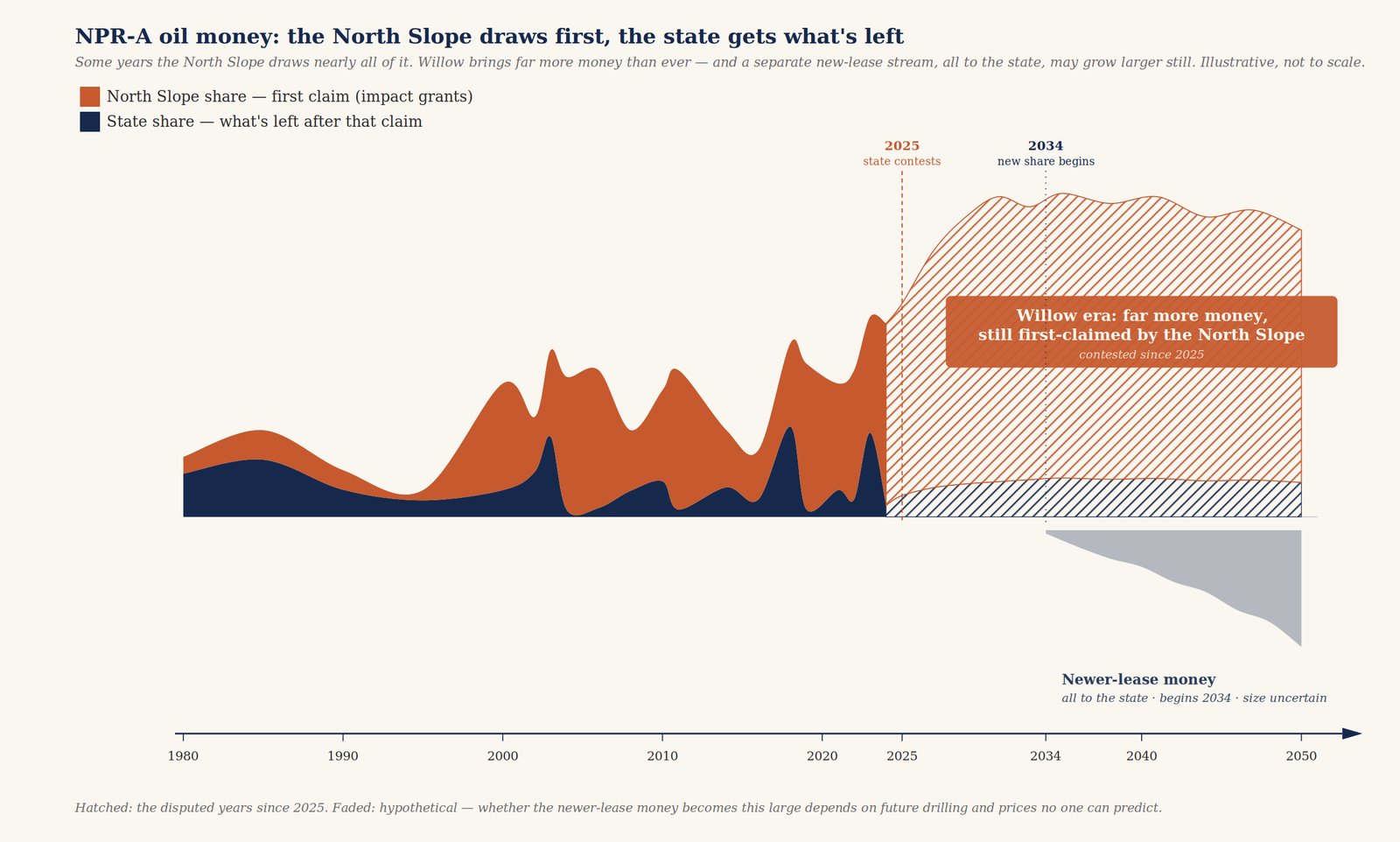
The Willow project — ConocoPhillips' big new oil development inside the reserve — is expected to send roughly $3.1 billion to the impacted communities over the next few decades. The state's own forecasts count that as Willow revenue, generated under the older leases — the money the North Slope's priority has always covered. The new, bigger share the delegation was celebrating applies only to leases issued after July 4, 2025, and does not begin until 2034; it does not touch Willow. What is in dispute is the money already coming.
And the state has quietly moved to change where it goes. In its latest revenue forecasts, the Dunleavy administration's Department of Revenue began treating the reserve's money as unrestricted — free to spend anywhere — rather than as money that flows first to the North Slope grant program. A year earlier, the same forecast had called it restricted to that federal purpose. That change reflects the administration's position that most of the receipts are available for statewide spending before the North Slope's traditional first claim is applied. It is a position legislative analysts reject, and it is the whole fight.
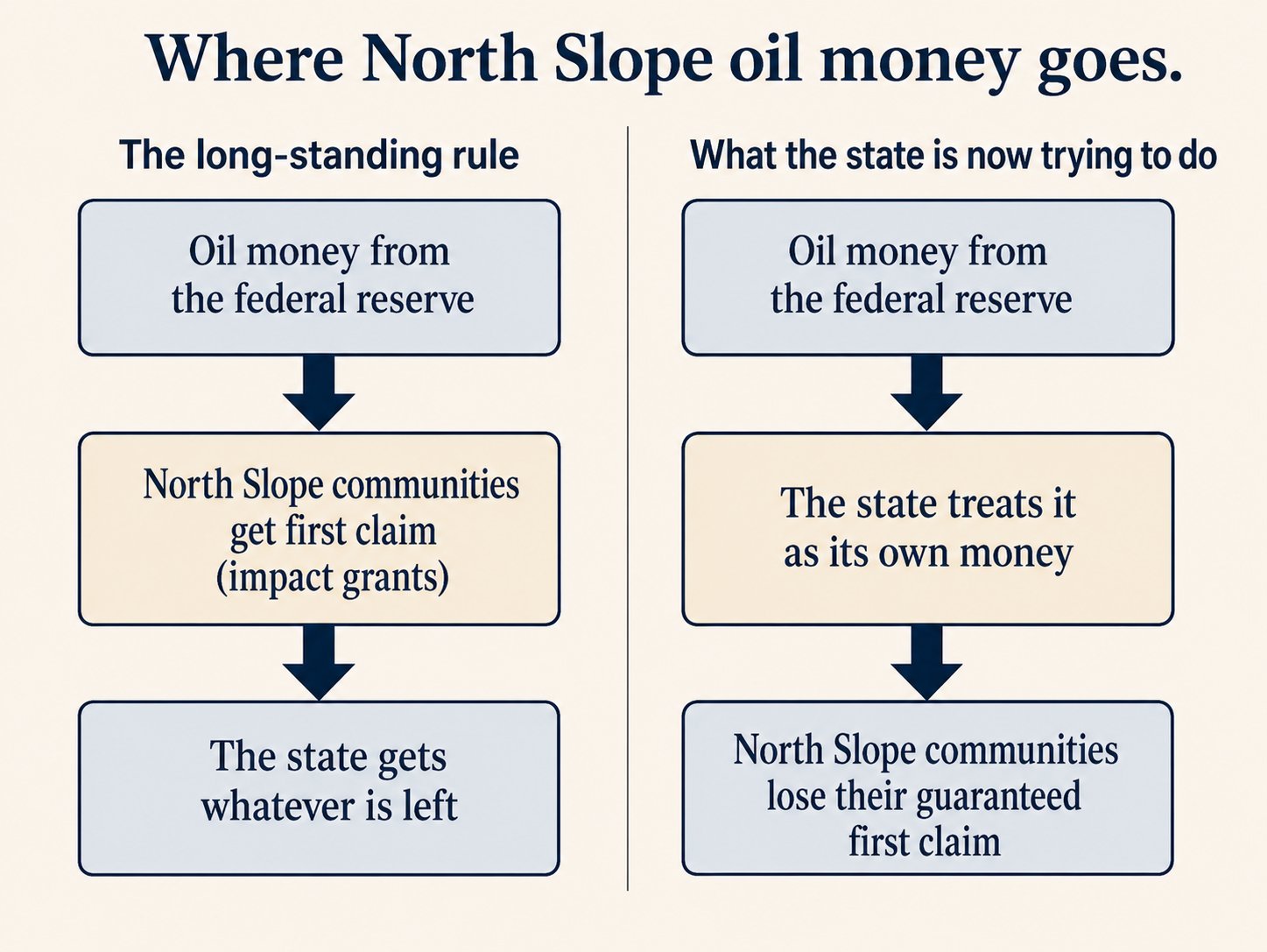
Dunleavy has championed the revenue at both ends. He shared the stage with the delegation touting the bigger state share, and he has called the reserve's record oil lease sale "a major win" for Alaska. His administration is also the one now arguing that a growing share of that money can be spent statewide instead of on the North Slope. The two stances flow from a single view — that the money is Alaska's and should serve all Alaskans — but they put the administration at odds with a program the region has leaned on for decades.
The Legislature is not going along, at least not yet. The Legislature's own attorneys concluded last fall that the federal law did not actually change the sharing requirement, and its finance analysts have kept treating the money as restricted. Lawmakers left the North Slope fund in place and, in this year's budget, appropriated about $18 million from it to the grant program. The result is a live standoff in Juneau over whether the administration can reclassify the money the way it wants.
A closely related question was answered in court, and the answer is the reason the North Slope's claim is as strong as it is. In the program's early years, Alaska kept most of the NPR-A money for statewide purposes — much the way the Dunleavy administration now proposes — sending it to the Permanent Fund and the general treasury rather than the impacted communities. The North Slope Borough and the cities of Barrow and Wainwright sued. In 1986 an Alaska judge ruled the state could not divert the money to statewide accounts before first identifying and meeting legitimate impact claims.The state did not appeal, and the Legislature wrote that principle into its own law — the grant program the administration is now reinterpreting. No court has ruled on whether that reinterpretation is allowed.
The legal fight sits on top of a policy one, and both sides have a real case. The state's begins where Sullivan did on the stage: Alaska runs chronic deficits and constant pressure on the dividend, and a large and growing stream of oil money could ease the strain on schools, troopers and services that serve the whole state, rural communities included. The state also has history on its side: Congress required priority for the communities but never defined how large that claim was — how much of the share the priority actually guaranteed. That the impact grants now consume nearly all of it in some years is a result worked out later, in court and in the Legislature, and it is that result the state says it should be free to revisit.
The other case is the reason the priority exists at all: the communities nearest the drilling absorb its roads, air traffic and industrial footprint, and the provision was written to send a share of the money, on a first priority basis, where those costs land. Both sides have serious backers.
The dispute is over the money, not the drilling — and the drilling has its own, separate opponents. Many of the region's major Iñupiat institutions are firmly pro-development and backed the recent rollback of Biden-era limits in the reserve. But support has never been unconditional: even communities that welcome the development have drawn lines around specific places. The city, tribe and village corporation of Nuiqsut, the community closest to the Willow project, jointly sought to protect the subsistence lands around Teshekpuk Lake from additional oil development — a small corner of a vast reserve, but the corner they hunt.
The drilling, meanwhile, seems to be moving ahead. Federal land managers reopened most of the 23-million-acre reserve to leasing late last year, and Congress threw out the Biden-era plan that had restricted it. A lease sale in the reserve this spring drew a record $163.7 million, more than ten times the last one held in 2019. A new sale on the Arctic refuge's coastal plain in June drew far less — about $3.7 million, and the only bidders were the state's own development authority, AIDEA, and a small Alaska company, Hex Energy, with no major producer taking part. With all this new development, and potentially much more money coming, the question is whether an arrangement that worked with less drilling is the one that should hold.
For now, the fight in Juneau is over money already flowing under the old rules — Willow money that could keep coming for decades. But the quieter change is in the new law's fine print. The 1980 command — that the state "give priority" to the communities "most directly or severely impacted" — was not carried into the new 70 percent share, the money from leases issued after last July that begins flowing in 2034. Older leases and newer ones will produce side by side for years, so nothing switches off on that date. What changes is the starting point: the new share arrives without the community priority written in, and how its money will ultimately be split inside Alaska is not settled. Congress raised the state's cut. It did not decide where that money goes when it gets here.
This article is based on a public meeting — AOGA 2026.08.27 Panel Sullivan, Secretary of Energy, Nick Begich, Mike Dunleavy ().
Made by our human newsroom with AI. How humans and AI work here · Grow with our newsroom Transcript byLucas Brown
Stay informed. Support what matters.
Free, permanent access to local news you can verify. Subscribe to support Walter AlaskaNews and go ad-free.
Related Coverage
The number that quietly sets the state budget: a barrel of oil
Alaska News · 3mo ago
ConocoPhillips' Disclosed Alaska Royalties Fell 58% in Two Years
Alaska News · 4w ago
A pass-through tax, not the pipeline, is the real fight in Juneau
Alaska News · 3mo ago
The $100 million question inside Alaska's gas-line bill
Alaska News · 3mo ago
North Slope oil is running below the state's forecast so far, and the price is running above it
Alaska News · 1mo ago
Comments
Sign in to leave a comment.
No comments yet. Be the first to share your thoughts.