AI image
A $1.5 billion Seward Highway plan pits safety against the Turnagain Arm viewshed
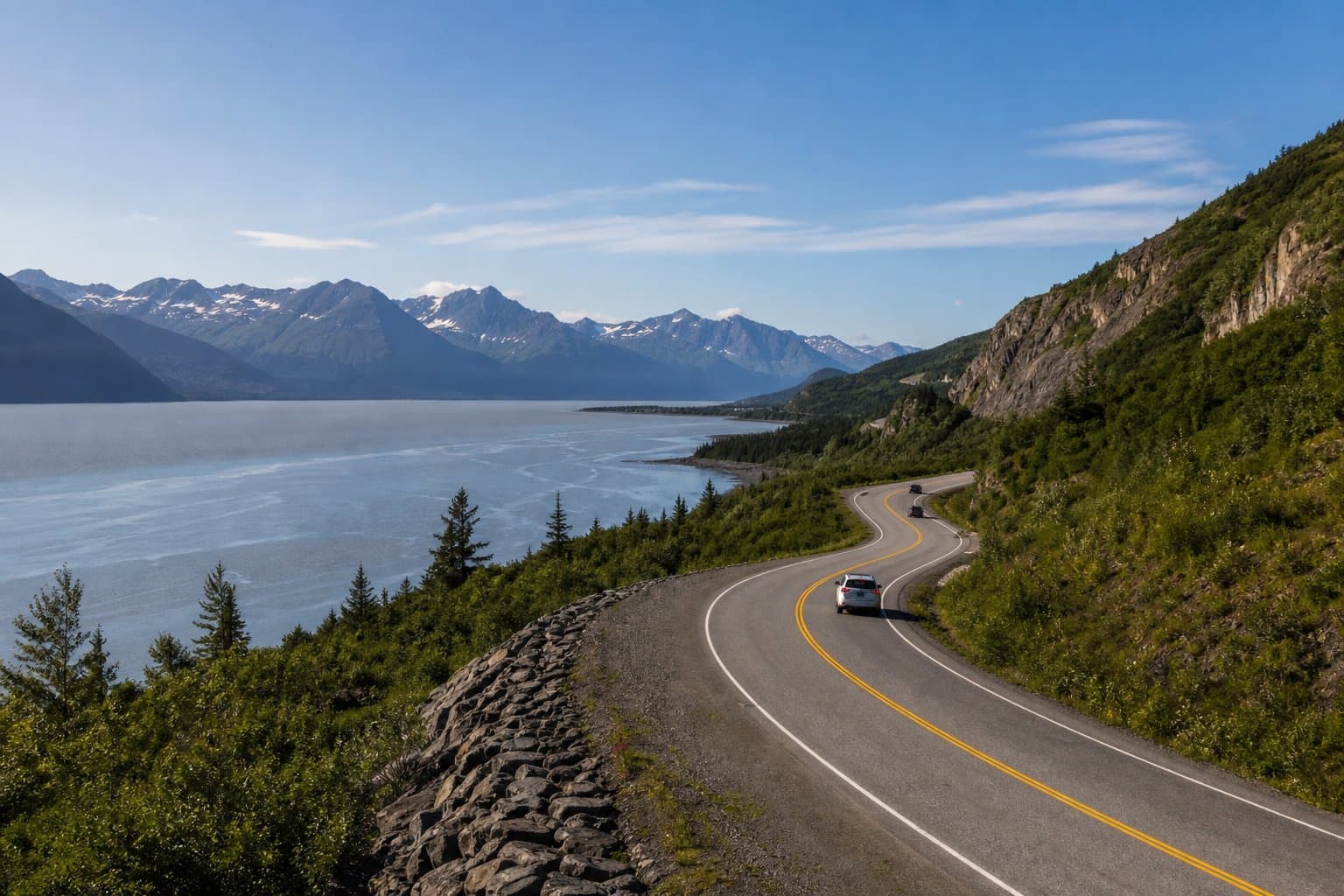
Is a $1.5 billion rebuild of the Seward Highway a safety project or a highway-widening project wearing safety as a disguise? That question has split Anchorage's transportation planners from a widening coalition of critics — and this week the fight escalated.
The citizen committee that advises Anchorage's metropolitan planning body asked it, in a July 28 letter, to reverse course and pull the Safer Seward Highway project from the region's long-range transportation plan. The advisory committee wants the state to answer a checklist of concerns before the project can be written back in.
The Alaska Department of Transportation and Public Facilities proposes a four-lane divided highway with a separated pathway along nearly 20 miles from Bird Flats to Rabbit Creek — a stretch the state has designated a safety corridor. The department says the project would cut crash rates and severity and improve reliability, and that it would be funded federally through the National Highway System, not from Anchorage's own transportation budget.
Critics see something else. "DOT&PF has addressed none of those concerns nor modified its design," wrote advisory committee chair Matt Cruickshank, whose letter argues the design "endorses an unnecessarily large physical footprint with a median as wide as 250 feet and cliff excavation as high as 400 vertical feet" — a scale it says would degrade the setting of Turnagain Arm and Chugach State Park.
The committee says it supports Seward Highway safety work that is "data-driven, cost-effective, low impact, and fiscally sensible," pointing to guardrails, speed cameras and centerline barriers as alternatives.
The objections run beyond the committee. Bike Anchorage, which sat on the project's stakeholder group, told the Planning and Zoning Commission that "this is not a safety project. It is a highway widening project with a false veneer of safety." Ann Rappoport, representing the Rabbit Creek Community Council, testified that the council backed more compact alternatives and warned the design "will instead encourage speeding and create highly dangerous turning across multiple traffic lanes."
There is also a data fight underneath the design fight. The advisory committee has opposed the current plan since February, calling its traffic data misleading and its safety predictions unrealistic; AMATS staff separately noted the corridor doesn't appear until 55th on the state's high-crash-location list. The estimate tops $1.5 billion even before detailed design of the intersections and the Potter Marsh section, and critics say that cost would pull money from other Anchorage priorities.
DOT&PF offered in mid-July to hold a public meeting to explain the design. The advisory committee called that insufficient. The department has not publicly responded to the July 28 letter.
Assembled from public records the newsroom collected ().
Drafted with AI. Edited by Cale Green (1 revision). No full editor review is on record. Who is accountable.
Stay informed. Support what matters.
Free, permanent access to local news you can verify. Subscribe to support Walter AlaskaNews and go ad-free.
Related Coverage
The state is drilling test holes for a Seward Highway fix, as a bigger $1.5 billion plan draws fire
Alaska News · 1mo ago
A $1.5 billion Seward Highway rebuild goes to public comment Sept. 22
Alaska News · 2w ago
A Seward Highway rebuild that doubled to $1.4 billion is back on Anchorage's plan, over objections
Alaska News · 2mo ago
Anchorage historic panel objects to Seward Highway safety review it says skipped the city
Alaska News · 1mo ago
State confirms narrow lanes, pilot-car delays on Seward Highway through summer
Alaska News · 3mo ago
Comments
Sign in to leave a comment.
No comments yet. Be the first to share your thoughts.