Video Clips
Quoted moments from Alaska public meetings, hearings, and press conferences.

Speaker A
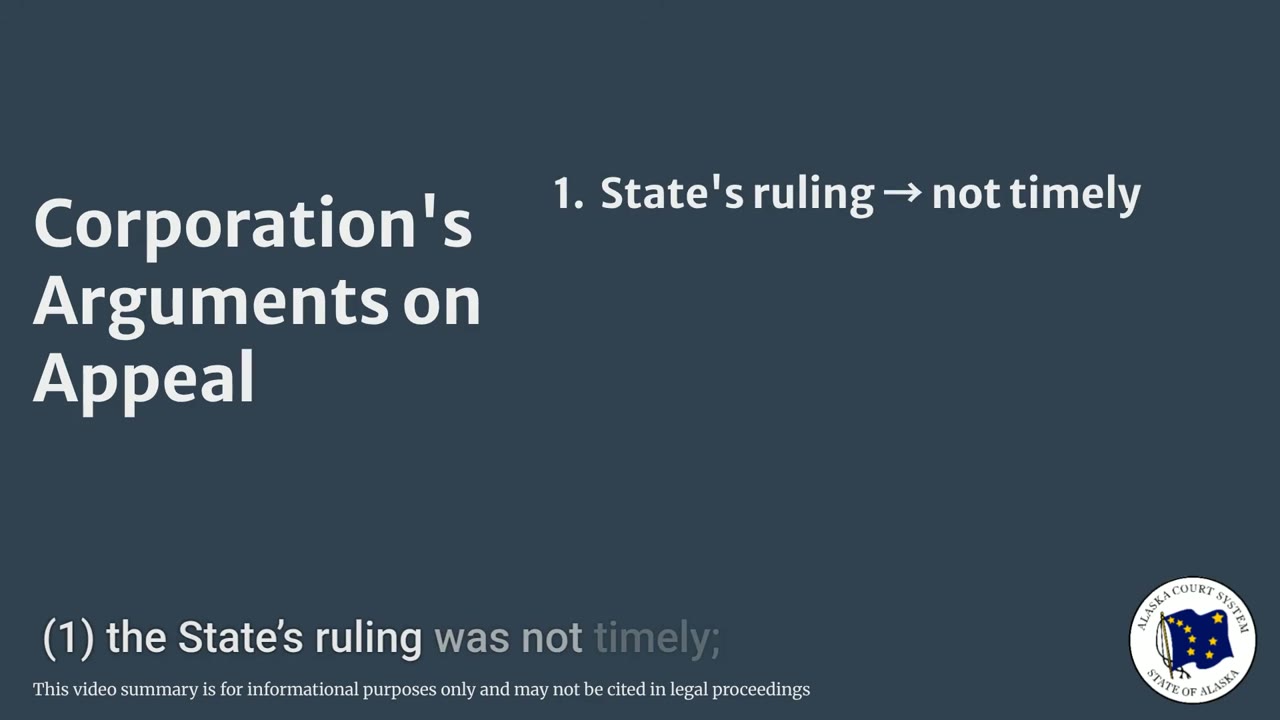
“A corporation that performs sleep studies ordered by doctors filed a tax return that claimed the favorable tax status. The state denied this status, concluding that the corporation performed services in the field of health, and required the corporation to pay more taxes. The Superior Court affirmed the state's decision. The corporation appealed to the Alaska Supreme Court, raising 3 main arguments: 1. The state's ruling was not timely.”Alaska Court System: Alaska Supreme Court Opinion No. 7818, S-18949, Alyeska International, Inc, d/b/a Alaska Sleep Clini · Sep 9, 2026

Speaker A
“Third, the court was not convinced by the private letter ruling the corporation got from the IRS. In a private letter ruling, the IRS offers an opinion about a taxpayer's tax situation based on facts described by the taxpayer. In this case, the IRS's letter did not mention certain facts that were key to the state's decision. And the private letter ruling was issued long after the state's decision, so it is possible the corporation changed the way it operated in the meantime. Therefore, the Alaska Supreme Court ruled that the state was not wrong to deny the corporation favorable tax treatment.”Alaska Court System: Alaska Supreme Court Opinion No. 7818, S-18949, Alyeska International, Inc, d/b/a Alaska Sleep Clini · Sep 9, 2026
Speaker A
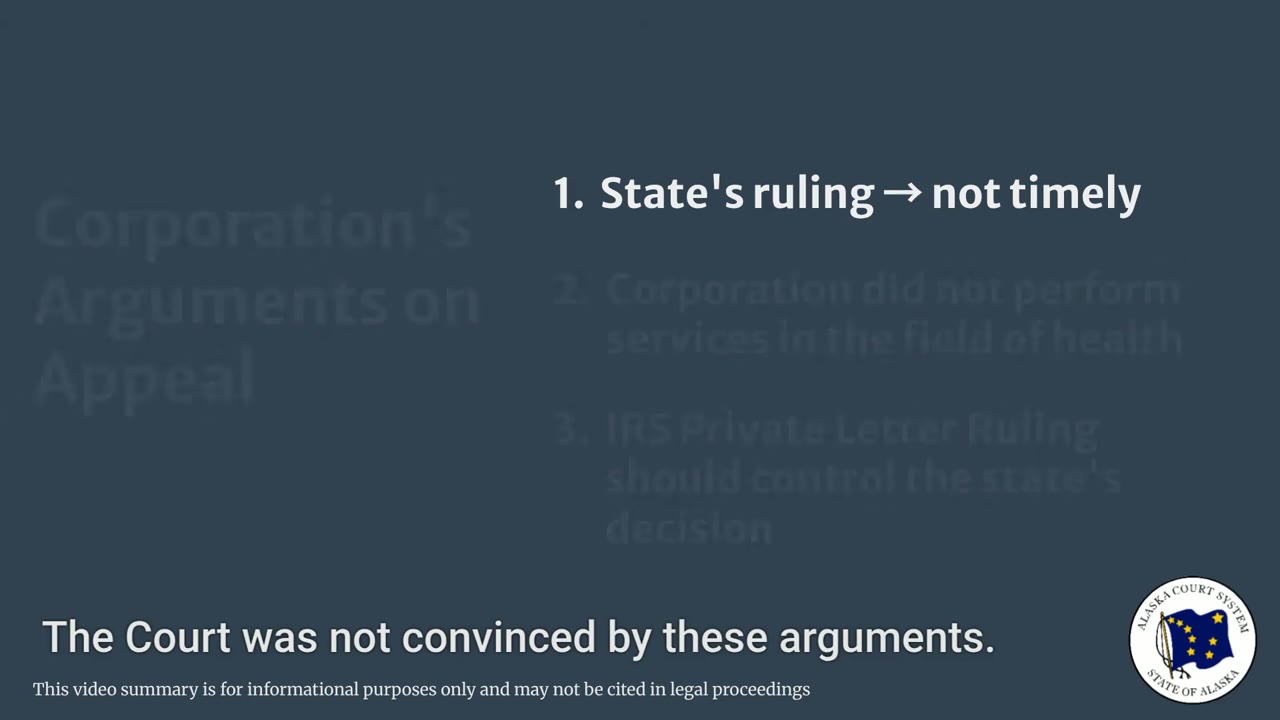
“2. The state was wrong to find that the corporation performed services in the field of health. And 3. The outcome of this case should be controlled by a private letter ruling the corporation later got from the IRS stating that the corporation did not perform services in the field of health. The court was not convinced by these arguments.”Alaska Court System: Alaska Supreme Court Opinion No. 7818, S-18949, Alyeska International, Inc, d/b/a Alaska Sleep Clini · Sep 9, 2026
Speaker A
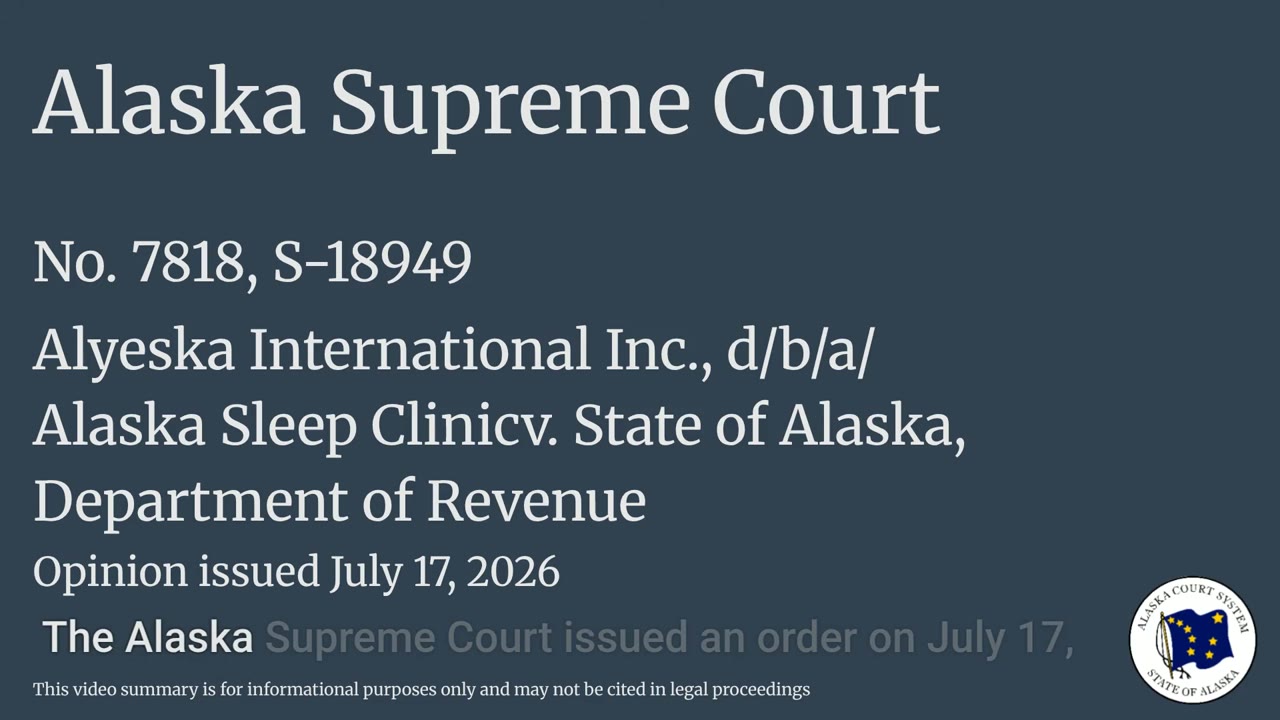
“The Alaska Supreme Court issued an order on July 17, 2026, in a corporate tax case. Alaska law offers a favorable tax status to corporations that meet certain standards described in federal law. This favorable treatment does not apply to businesses that perform services in the field of health.”Alaska Court System: Alaska Supreme Court Opinion No. 7818, S-18949, Alyeska International, Inc, d/b/a Alaska Sleep Clini · Sep 9, 2026
Speaker A
“First, the state's denial of the corporation's tax exemption was timely. The corporation argued that the state must decide whether taxpayers qualify for a tax exemption on the first day of the tax year and then immediately notify taxpayers. But the corporation's reading of the law would be unworkable and is not what the legislature, which passed the law, intended. Second, the state correctly decided that the corporation performs services in the field of health. This ruling was based on evidence about the role of the corporation's highly trained medical director and the corporation's marketing, which emphasized its expertise and skill in testing for sleep disorders.”Alaska Court System: Alaska Supreme Court Opinion No. 7818, S-18949, Alyeska International, Inc, d/b/a Alaska Sleep Clini · Sep 9, 2026
Dan Stickel
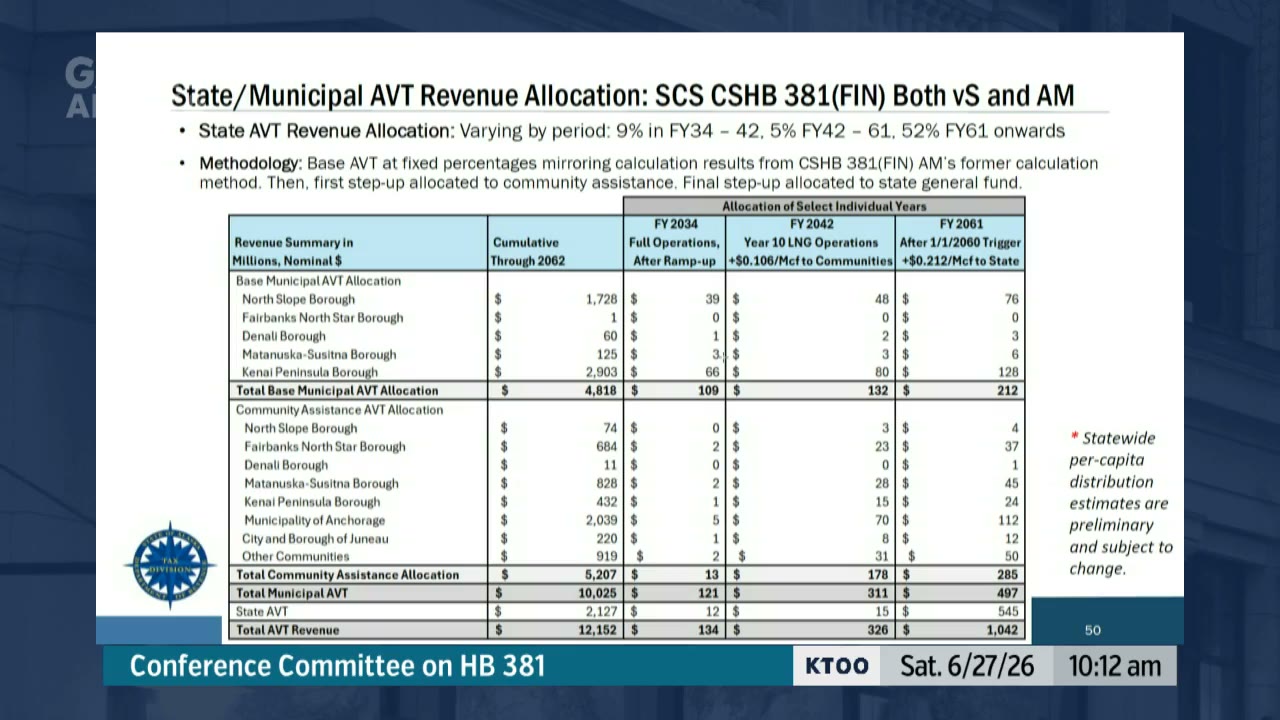
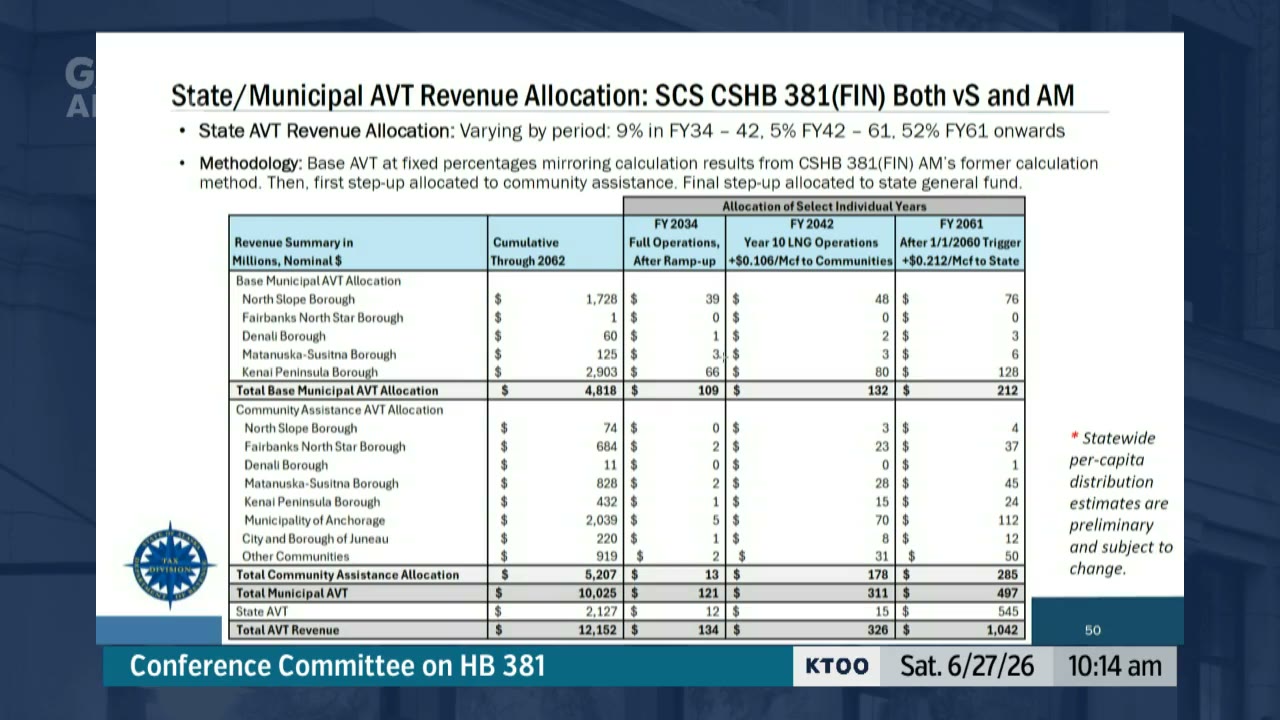
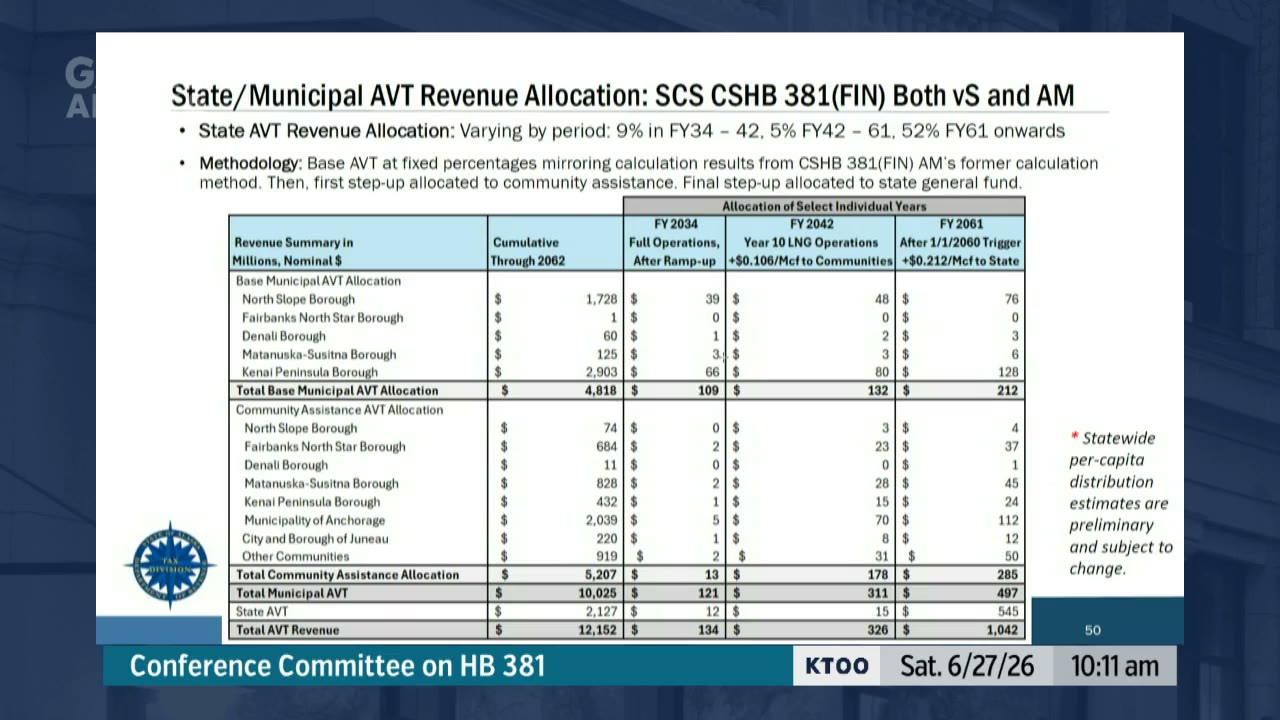
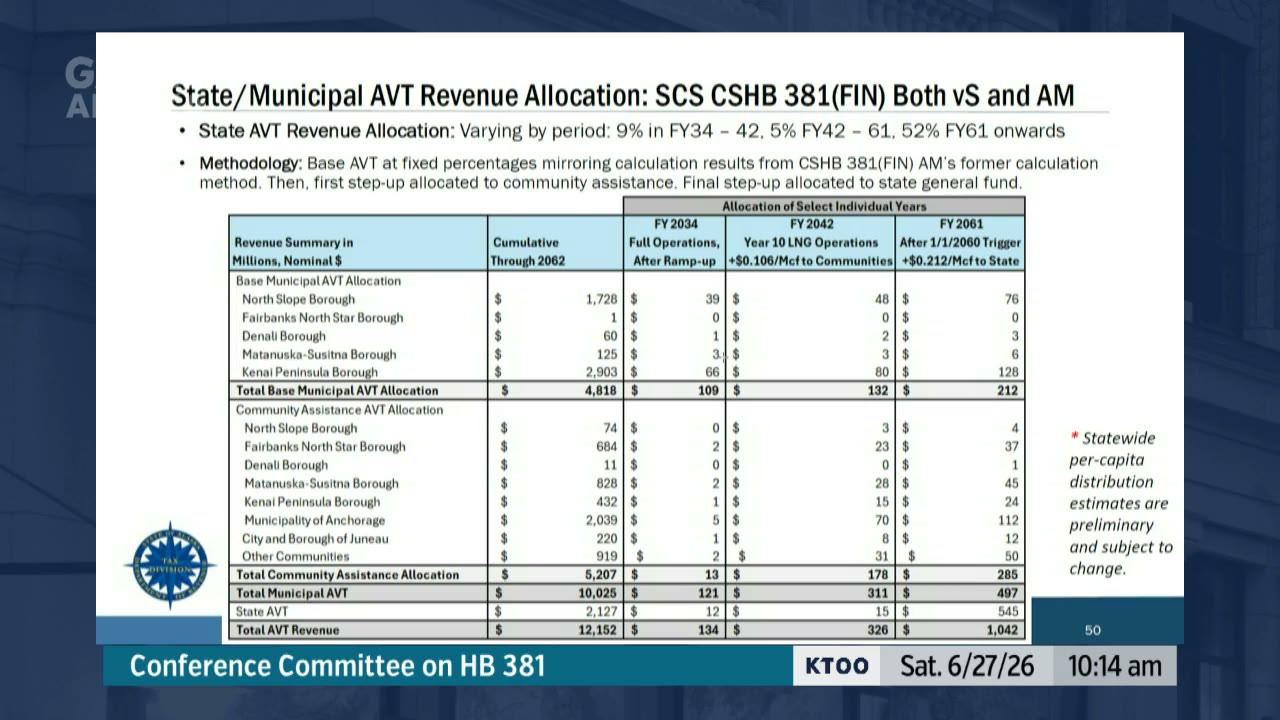
“in fiscal year 2061, which would be the first full fiscal year after the the second step up of the alternative volumetric tax. At that point in time, after adjusting for the inflation, there would be $212 million shared directly with the communities that the project resides in, an additional $285 million shared across the state based on population for community revenue sharing, and then the state at that point in time would get a little over $500 million.”Alaska Legislature: Joint Conference on HB381, 6/27/26, 10am · Jun 27, 2026
Dan Stickel
“But then increase to 52% of the total AVT with the second doubling of the tax rate.”Alaska Legislature: Joint Conference on HB381, 6/27/26, 10am · Jun 27, 2026
Dan Stickel
“the Senate version of the bill removes some of the complexity in the calculation that was in the prior version of the bill.”Alaska Legislature: Joint Conference on HB381, 6/27/26, 10am · Jun 27, 2026
Adam Prestidge
“The deadline of 2037 is well within— well beyond the project completion deadline, even if we put a couple years of contingency on that. And so a 2037 deadline doesn't have that same risk profile to the FID investors. And so for that reason, we suggest deleting the 2032 deadline.”Alaska Legislature: Joint Conference on HB381, 6/27/26, 10am · Jun 27, 2026
Bryce Edgmon
“the reason why I'm, I guess, at this juncture supportive of keeping in the 2028 timeline, if anything at all, it's just speaking of risk, poring through the Gaffney Klein document that was presented to the legislature in December 2025 that talks about all these sort of jurisdictions around the globe and the need for property tax relief and some sort of relief to get these very expensive front-end projects, gas line infrastructure, into place, is supported by years of analysis and efforts.”Alaska Legislature: Joint Conference on HB381, 6/27/26, 10am · Jun 27, 2026
Dan Stickel
“through 2062, which is the to the extent of our modeling, $32.2 billion to the state. And those are cumulative nominal under our baseline modeling assumptions.”Alaska Legislature: Joint Conference on HB381, 6/27/26, 10am · Jun 27, 2026
Dan Stickel
“In the version that passed the House, our break-even price was $8.57 under our baseline scenarios for gas delivered into the global market. Under the version that passed the Senate, it was $8.62 per 1,000 cubic feet. So a 5 cents per 1,000 cubic feet increase from the House version to the Senate version.”Alaska Legislature: Joint Conference on HB381, 6/27/26, 10am · Jun 27, 2026
Dan Stickel
“in those early years, the vast majority of the revenue is allocated to the communities that the project is directly in. So $109 million of the AVT in 2034 would go to those 5 municipalities, with an additional $13 million spread statewide to community revenue sharing and $12 million to the state. And then the second column shows after the first step up in the alternative volumetric tax, and that additional step up goes entirely to community revenue sharing.”Alaska Legislature: Joint Conference on HB381, 6/27/26, 10am · Jun 27, 2026
Dan Stickel
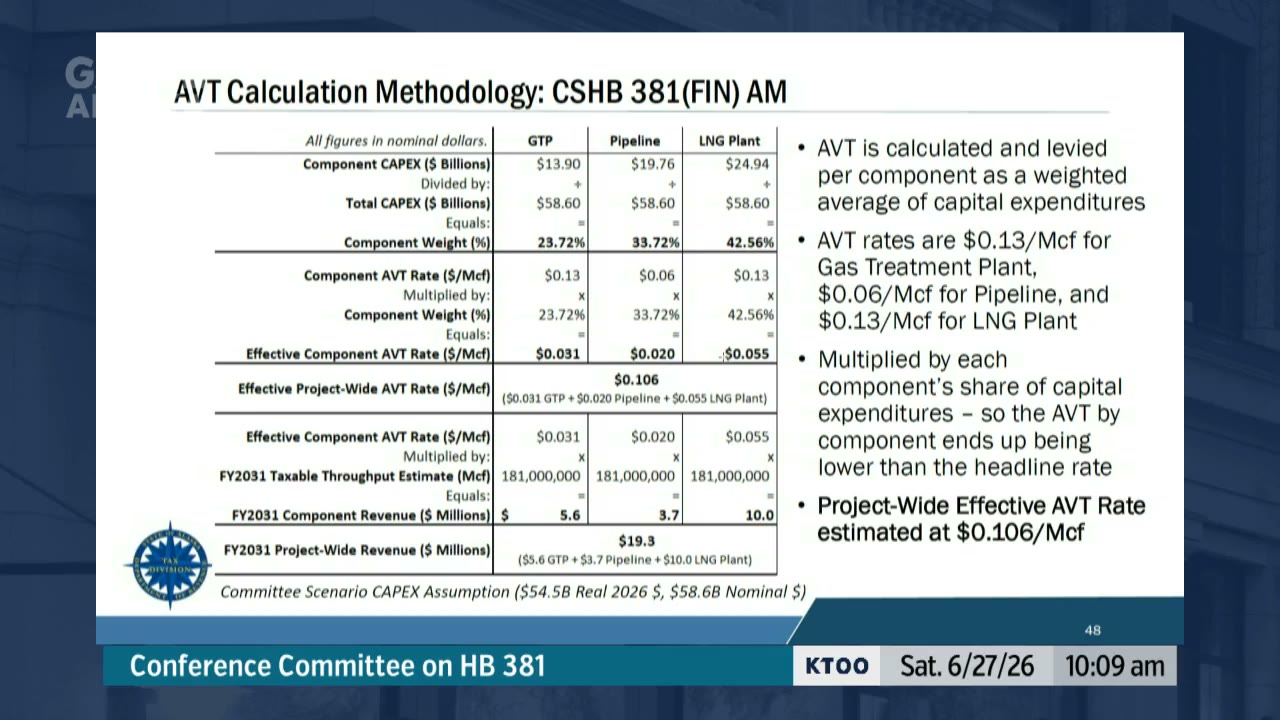
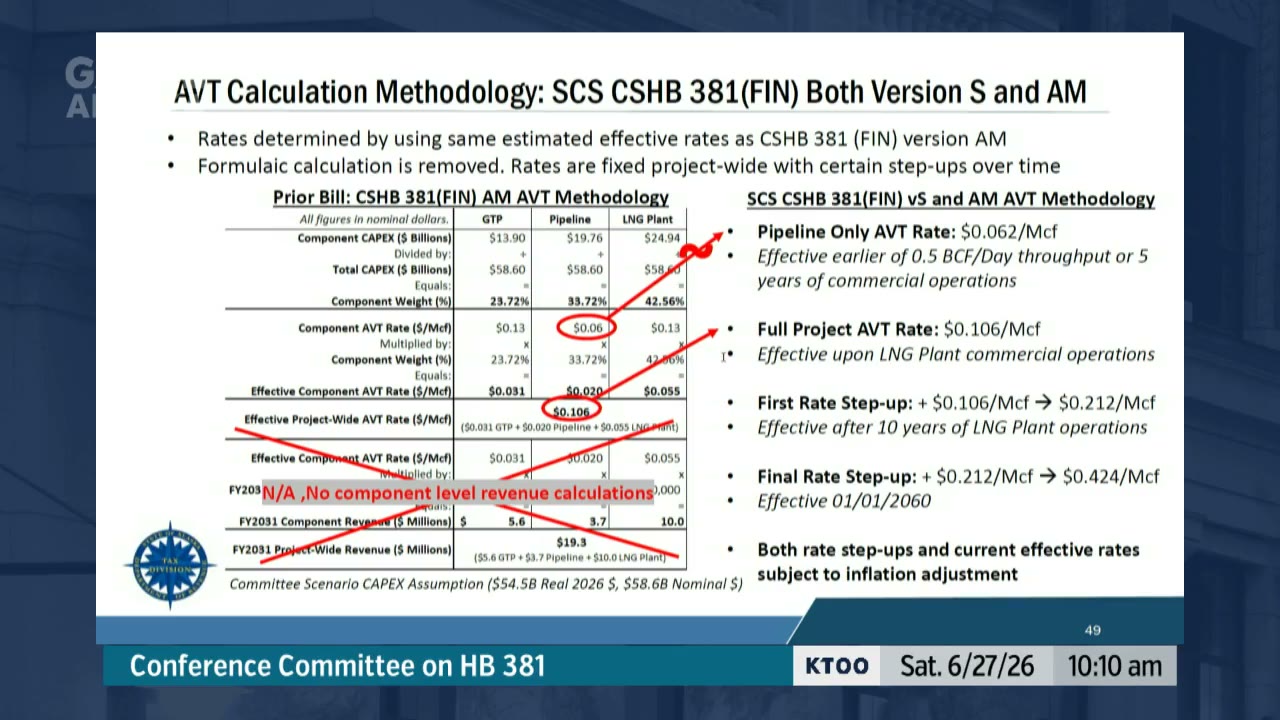
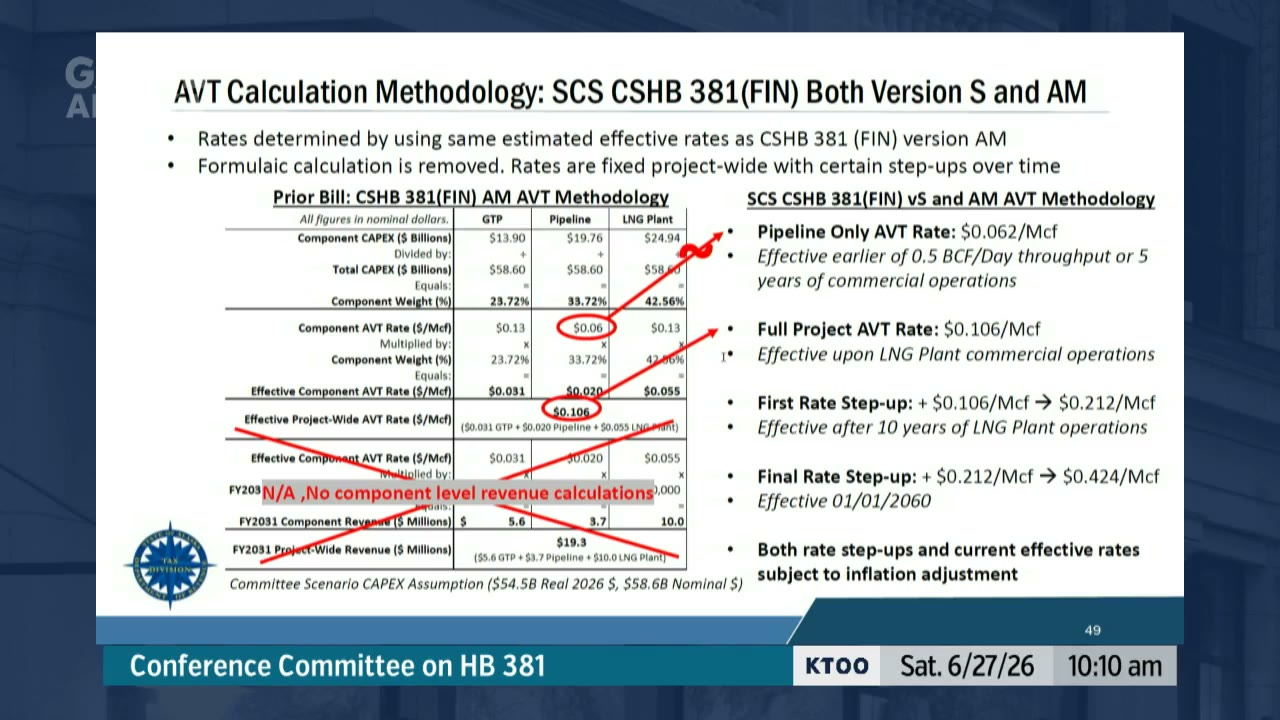
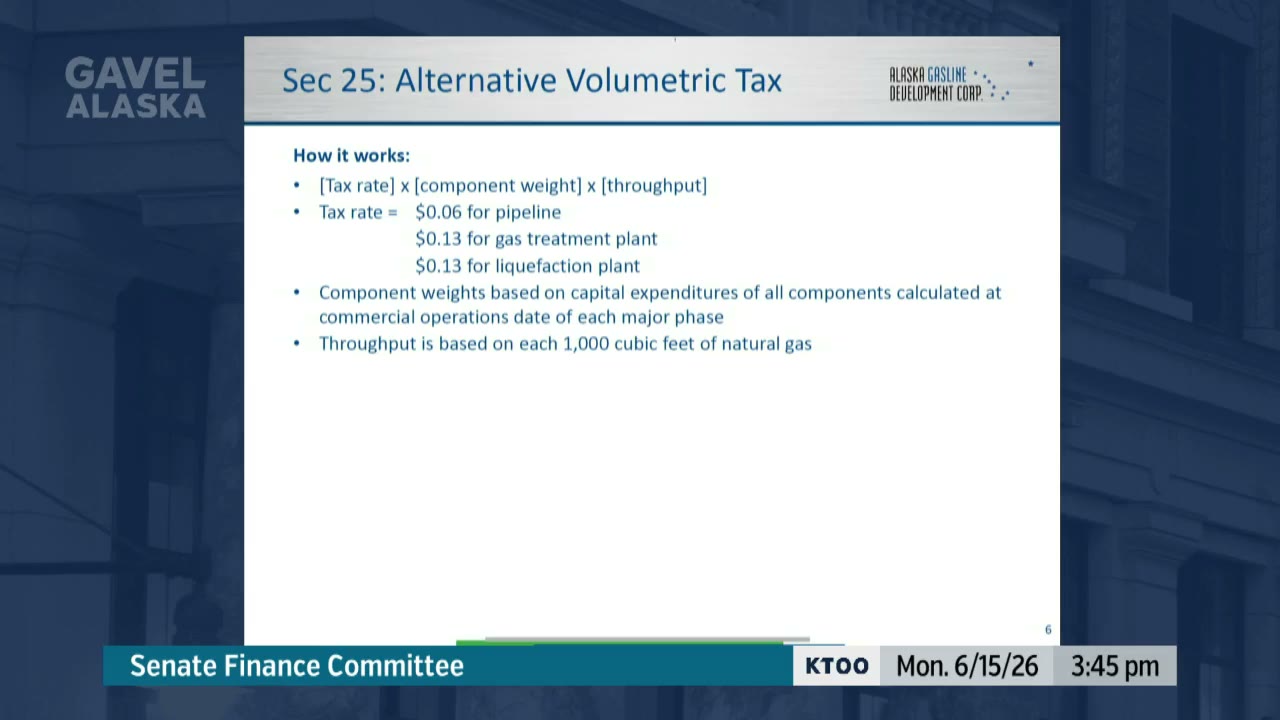
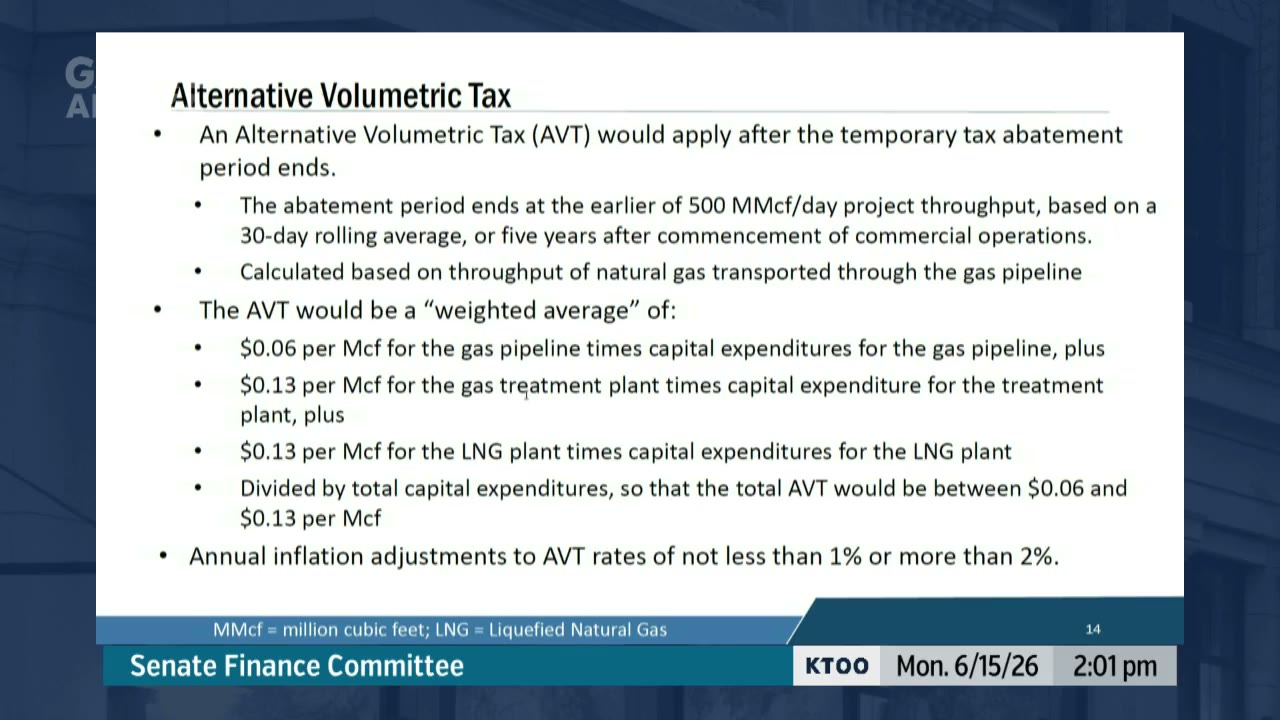
“they moved away from this weighted average approach and instead just put in the flat rates for each component of the project. So they took that about 6 cents per MCF rate on the pipeline component and made that a 6.2 cents per 1,000 cubic feet tax rate for phase 1 of the project. And then they took that 10.6 cents per thousand cubic feet weighted average with the capital expenditures weighting and just made that the tax rate once LNG exports began.”Alaska Legislature: Joint Conference on HB381, 6/27/26, 10am · Jun 27, 2026
Adam Prestidge
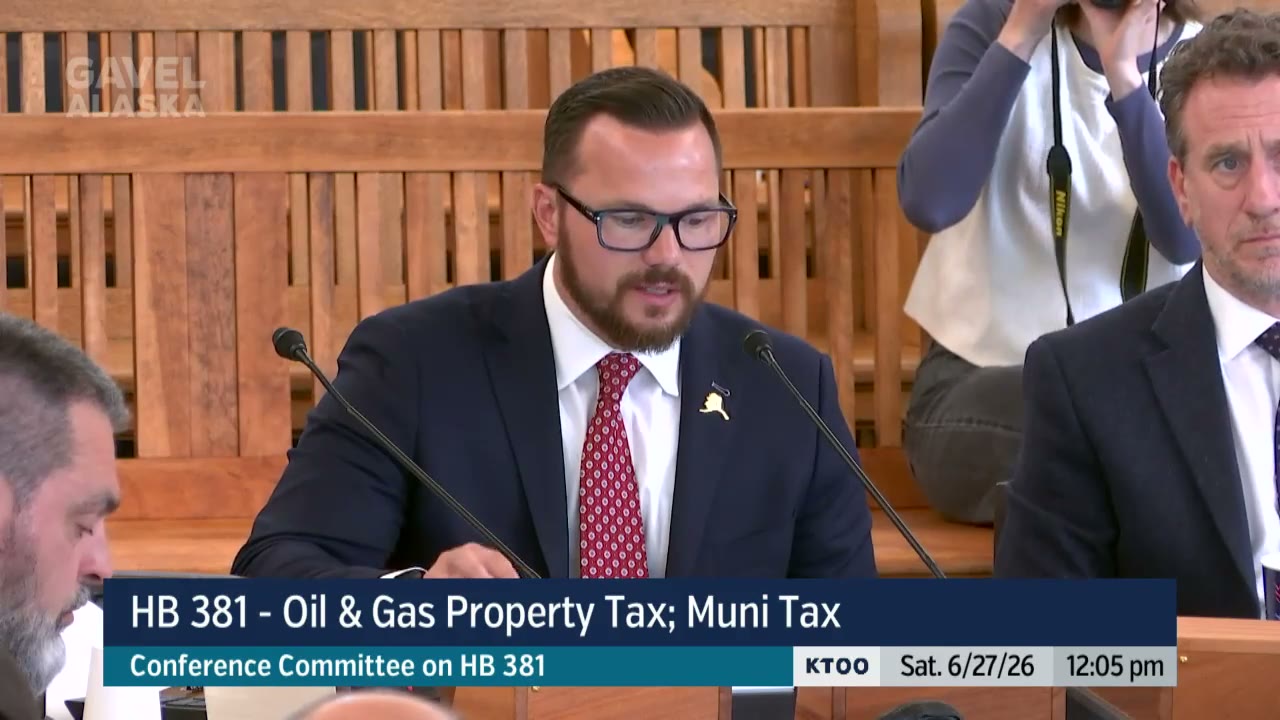
“our practical expectation is that we will complete the project ahead of these timelines, and so the deadline or the timeline that you said The end of the year for FID maintains— continues to be our target. And we would— if we were to follow a target construction schedule, even with some delays, we would complete the project before December 31st, well before December 31st, 2032.”Alaska Legislature: Joint Conference on HB381, 6/27/26, 10am · Jun 27, 2026
Adam Prestidge
“the 2028 deadline, it puts a bit of a risk on the developer and it puts an incentive on the developer, but it does that at a time before billions of construction dollars have been put at risk on the project. And so essentially putting that 2032 deadline puts additional risk on all the investment dollars that doesn't serve the benefit of actually accelerating anything. And the issue that then comes up is if there were a delay in construction, if there were litigation, if there was COVID, you know, an epidemic, that's just, those are all hypothetical risks that could occur, that have occurred on other projects, that lenders and investors are going to be nervous about.”Alaska Legislature: Joint Conference on HB381, 6/27/26, 10am · Jun 27, 2026
Dan Stickel
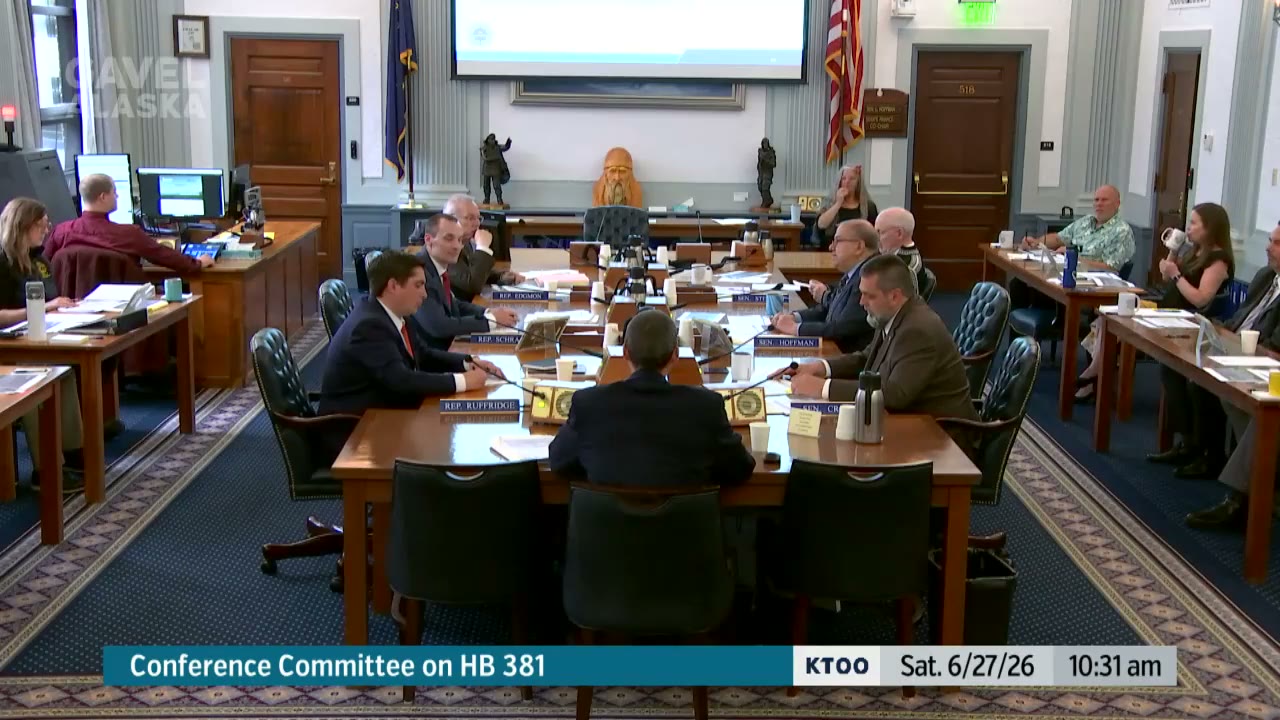
“fixing the percentages does increase some of the certainty and makes it easier to calculate and plan. Removes one item of potential contention going forward.”Alaska Legislature: Joint Conference on HB381, 6/27/26, 10am · Jun 27, 2026
Bryce Edgmon
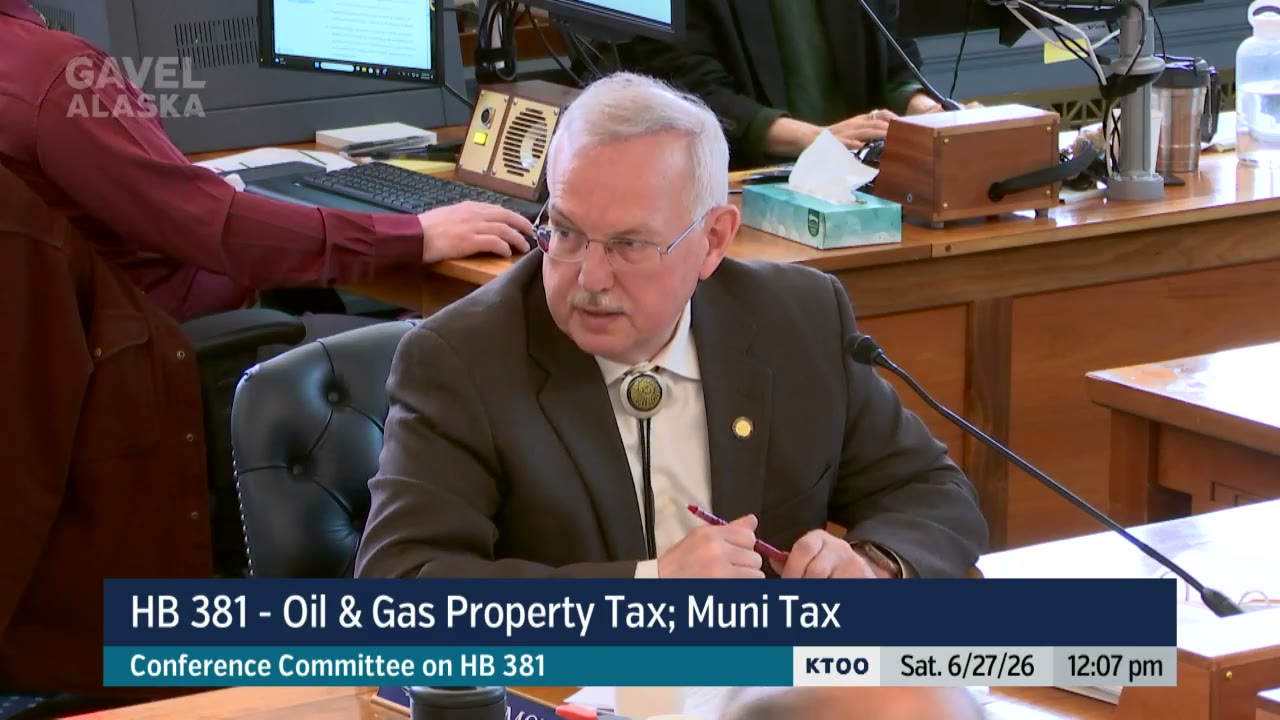
“I feel like I think if FID isn't, for Phase 1, arrived at by 2028, there's justification for this issue to come back before the legislature to have a longer runway to engage in this discussion. I would submit to you or anyone else that we should not have gotten this bill on March 20th. We should have gotten this a lot earlier so we could, to pour over this in a way that complies with all the sort of what-if scenarios that are out there and also to be maybe a better partner to you as a developer overall to get our work done in a longer frame of time. So I guess at this point I'm not convinced that removing that 2028 FID deadline— and remember, it's just for Phase 1, it's not for Phase 2. You know, I don't know that it serves our best interests”Alaska Legislature: Joint Conference on HB381, 6/27/26, 10am · Jun 27, 2026
Lyman Hoffman
“On the first bullet point where the Senate version removes the calculation complexities, does the department have an opinion on that? Especially since it has the same effective rate as the House version simplification, does that reduce the amount of work to the department.”Alaska Legislature: Joint Conference on HB381, 6/27/26, 10am · Jun 27, 2026
Adam Prestidge
“The 2032 completion of construction is more about managing theoretical risk that lenders and investors will look at when they make an investment decision on the project. And so regardless of how we all want to move fast, Regardless of the timing around the energy availability out of the Cook Inlet, lenders and investors will just see this numerically and assign it a hypothetical risk that will make the project more expensive. And so we don't see it adding any additional incentive that isn't there already. It just adds risk to the project that will be priced into the financing.”Alaska Legislature: Joint Conference on HB381, 6/27/26, 10am · Jun 27, 2026

Dan Stickel
“for a pipeline-only portion of the project, you'd have a 6-cent per MCF tax rate, and then once the full project was in operations, we would estimate that the tax rate on a weighted average basis would be about 10.6 cents per 1,000 cubic feet.”Alaska Legislature: Joint Conference on HB381, 6/27/26, 10am · Jun 27, 2026
Bert Stedman
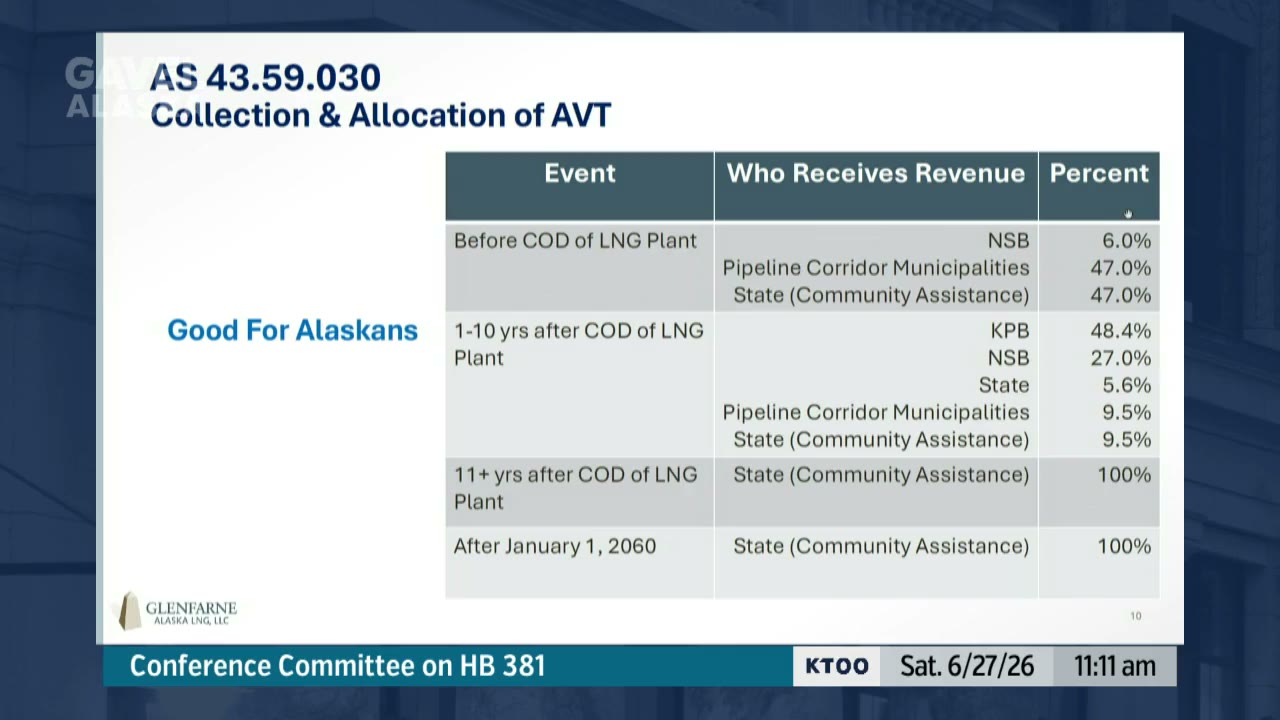
“I think after January 1st, 60, 100% goes to the general fund, not community assistance. Is that right?”Alaska Legislature: Joint Conference on HB381, 6/27/26, 10am · Jun 27, 2026
Dan Stickel
“the state starts out receiving about 9% of the AVT revenue. That will drop to 5% with the first doubling of the tax rate.”Alaska Legislature: Joint Conference on HB381, 6/27/26, 10am · Jun 27, 2026

Dan Stickel
“for the first doubling of the tax rate, 100% of that doubling would go to community assistance, and then for the second doubling of the tax rate, 100% of that that next doubling would go to the state unrestricted general fund.”Alaska Legislature: Joint Conference on HB381, 6/27/26, 10am · Jun 27, 2026

Dan Stickel
“It does start with the same effective tax rates as the House version and simply fixes those rates and allocations in, in statute. The Senate version then added in the two doublings of the tax rate that was a major change from the House version.”Alaska Legislature: Joint Conference on HB381, 6/27/26, 10am · Jun 27, 2026
Dan Stickel
“total state benefits under our baseline model assumptions, which which we talked about yesterday, through 2042 would be $7.5 billion to the state.”Alaska Legislature: Joint Conference on HB381, 6/27/26, 10am · Jun 27, 2026
Dan Stickel
“the capital expenditure weighting and the project component weighting, that applied both for calculating the initial tax rates, but then also applied for calculating the sharing out to municipalities. And that sharing out to municipalities has also been fixed in statute. In the Senate version of the bill. So removing some of that complexity. The other addition that the Senate made is the two step-ups.”Alaska Legislature: Joint Conference on HB381, 6/27/26, 10am · Jun 27, 2026
Dan Stickel
“The first effective 10 years, after 10 years of LNG export operations, where the tax rate doubles. And then the second effective in 2060, where the tax rate doubles. Again.”Alaska Legislature: Joint Conference on HB381, 6/27/26, 10am · Jun 27, 2026
Mike Cronk
“if we do nothing, these numbers go away, we have nothing here. There's zero revenue brought to this state. There's zero revenue brought to many communities.”Alaska Legislature: Joint Conference on HB381, 6/27/26, 10am · Jun 27, 2026
Dan Stickel
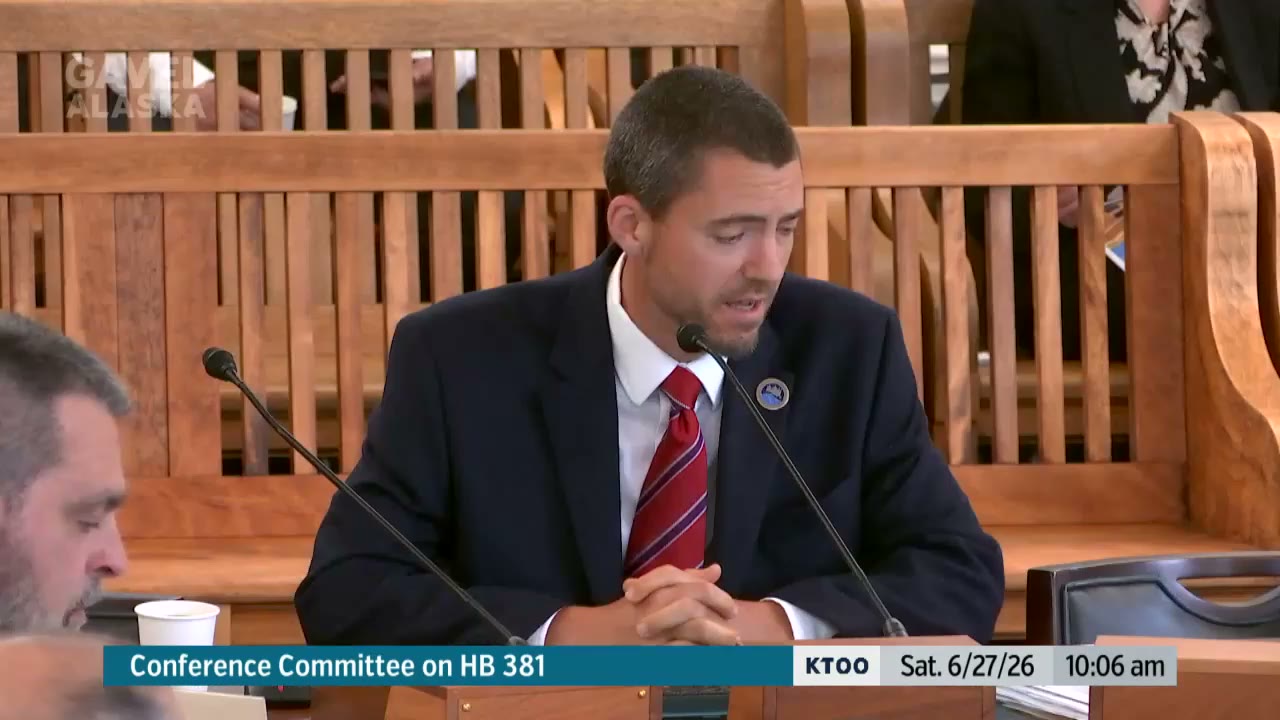
“under the House version of the bill, the alternative volumetric tax was calculated and levied on a per-component basis as a— using a weighted average of capital expenditures. And so once the full project was complete, we would look at the, the total capital expenditures that were spent on each component of the project, being the treatment plant, the pipeline, and the LNG export facility.”Alaska Legislature: Joint Conference on HB381, 6/27/26, 10am · Jun 27, 2026
Adam Prestidge
“we as the project developer at 8 Star have no objection to the 2028 FID deadline. We're only raising concerns around the 2032 completion of construction deadline.”Alaska Legislature: Joint Conference on HB381, 6/27/26, 10am · Jun 27, 2026
Adam Prestidge
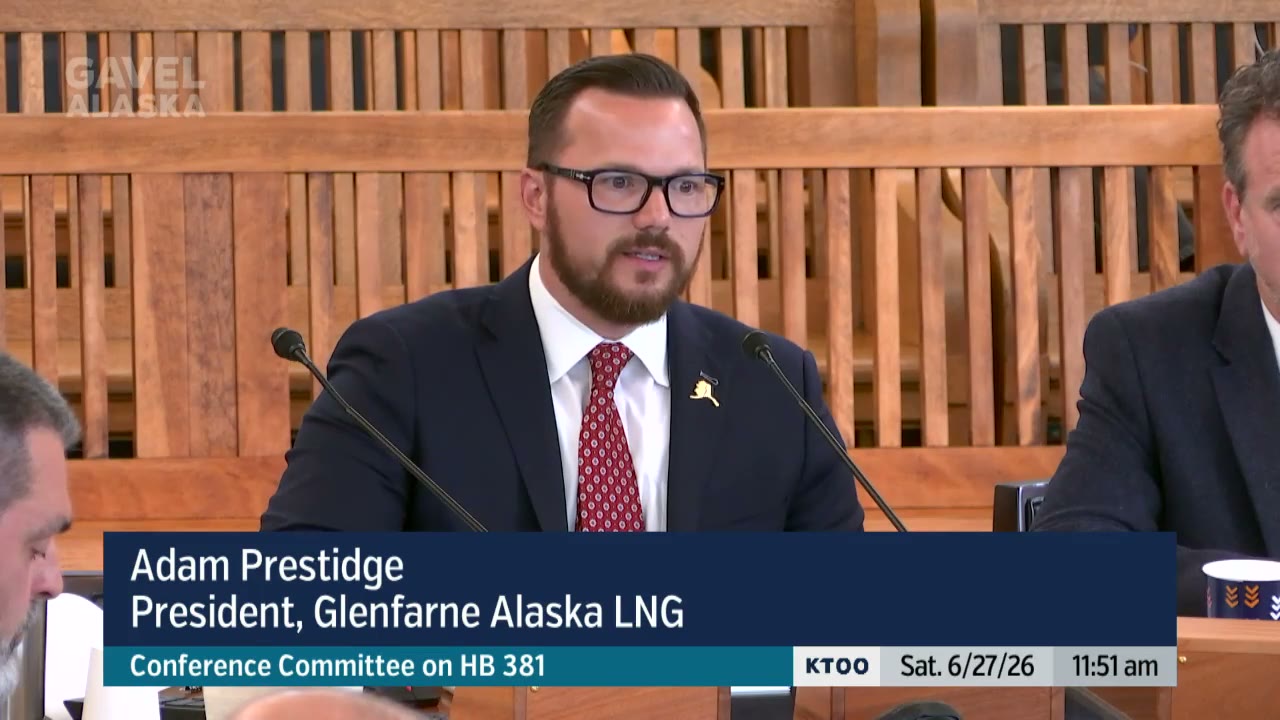
“That penalty is— would be losing the tax— the tax treatment of the project. The result of that would be at the front end, investors would look at this as additional risk, And they would have to price in that risk into how they invest in the project. And so the ultimate outcome of this would be making the project more expensive and require more investment capital.”Alaska Legislature: Joint Conference on HB381, 6/27/26, 10am · Jun 27, 2026
Adam Prestidge
“the 2 mills 2 mils is a concept that was first introduced by Wood Mackenzie and other— and Gas Strategies and other consultants to AGDC quite some time ago, and it was an assumption that went into our ability to commit to a $16 price cap. And so I don't see that there was a commitment to $16 at any time before we had an assumption that was based on 2 mils.”Alaska Legislature: Senate Finance - June 15, 2026 1:30pm · Jun 15, 2026
Adam Prestidge
“that price cap, that commitment that we can get this project done with a cap on the price at $16, is an extraordinary commitment. It is a commitment that we're able to make on the basis of how 381 was put together. If there were a significant change to the tax structure, for example, going from 2 mils to 3 mils would be a 50% increase on the tax burden as set out in HB 381. That would really put in— that would really challenge our ability to maintain that $16 price cap.”Alaska Legislature: Senate Finance - June 15, 2026 1:30pm · Jun 15, 2026
Bert Stedman
“I would suggest that on the interest rate you use, not something below 5, but use the government bond rate.— as a base. I think the Department of Energy was talking about 20-year bond rate plus 3/8 and then step it up.”Alaska Legislature: Senate Finance - June 15, 2026 1:30pm · Jun 15, 2026
Bert Stedman
“I don't want to get personally lost into big dollars if the whole project is built and it's full of gas and everything's wonderful. I think we should be concentrating on the economic of the project and trying to see how close we are to the hurdle rate to get it to FID or not.”Alaska Legislature: Senate Finance - June 15, 2026 1:30pm · Jun 15, 2026
Bert Stedman
“The issue at the table is the gas line. And what would be nice if we could see an analysis on the gas line itself and also the marginal impact of the change in property tax from the 20 mills to, you know, the— to the 2 mills, which is basically what's on the table.”Alaska Legislature: Senate Finance - June 15, 2026 1:30pm · Jun 15, 2026
Adam Prestidge
“one of the benefits, one of several benefits that we see with the alternative volumetric tax is that it is calculated based on a reportable throughput on the pipeline that is then calculated by multipliers, and there's no value— there's no question of valuation applied to that. And so what that means is that we avoid, for all parties involved, the potential for litigation over what is the value of this property over the decades to come.”Alaska Legislature: Senate Finance - June 15, 2026 1:30pm · Jun 15, 2026
Dan Stickel
“we certainly have produced the Phase 1 analysis and will be happy to provide that for the version of the bill that passed out of the House. And we do have extremely detailed model assumptions document. Provide that to the committee, and then I think we can go from there on providing any additional information that would be helpful and any additional sensitivities the committee would like to see. We'll go ahead and get that information. We'll see where we can slide that into our hearing schedule.”Alaska Legislature: Senate Finance - June 15, 2026 1:30pm · Jun 15, 2026
Dan Stickel
“it's a 20 mils tax or 2% of assessed value, and that assessment is done centralized by the State Department of Revenue. We manage the appraisal and assessment process for all oil and gas property in the state, and then any municipal oil and gas property taxes are allowed as a credit against that state tax.”Alaska Legislature: Senate Finance - June 15, 2026 1:30pm · Jun 15, 2026
Dan Stickel
“we calculate based on our, our assumptions that the effective rate would be somewhere between 10 and 11 cents per 1,000 cubic feet.”Alaska Legislature: Senate Finance - June 15, 2026 1:30pm · Jun 15, 2026
Jesse Kiehl
“through some of my history, both here in the Capitol and in municipal government, it's pretty good we know what it means is never good enough on tax law. You have to have the words on the paper.”Alaska Legislature: Senate Finance - June 15, 2026 1:30pm · Jun 15, 2026
Bert Stedman
“I think there's a couple months difference in when the 16 cents was in play and when the concept of the effective 2 mil tax rate was put on the table or put in play.”Alaska Legislature: Senate Finance - June 15, 2026 1:30pm · Jun 15, 2026
Bert Stedman
“I think 2 mils of our 2% of $16 billion is somewhere around $320 million. So I just need to, I guess, get some of these numbers adjusted. And I'd rather, Mr. Chairman, have us look at the aggregate dollars and going to the state, and then if there's a split to the municipalities like we do with our oil tax, we look at the whole, you know, the portion that goes to each borough and then a portion that goes to the state. But if we don't use the aggregate dollar amount, we get our tax modeling off.”Alaska Legislature: Senate Finance - June 15, 2026 1:30pm · Jun 15, 2026
Dan Stickel
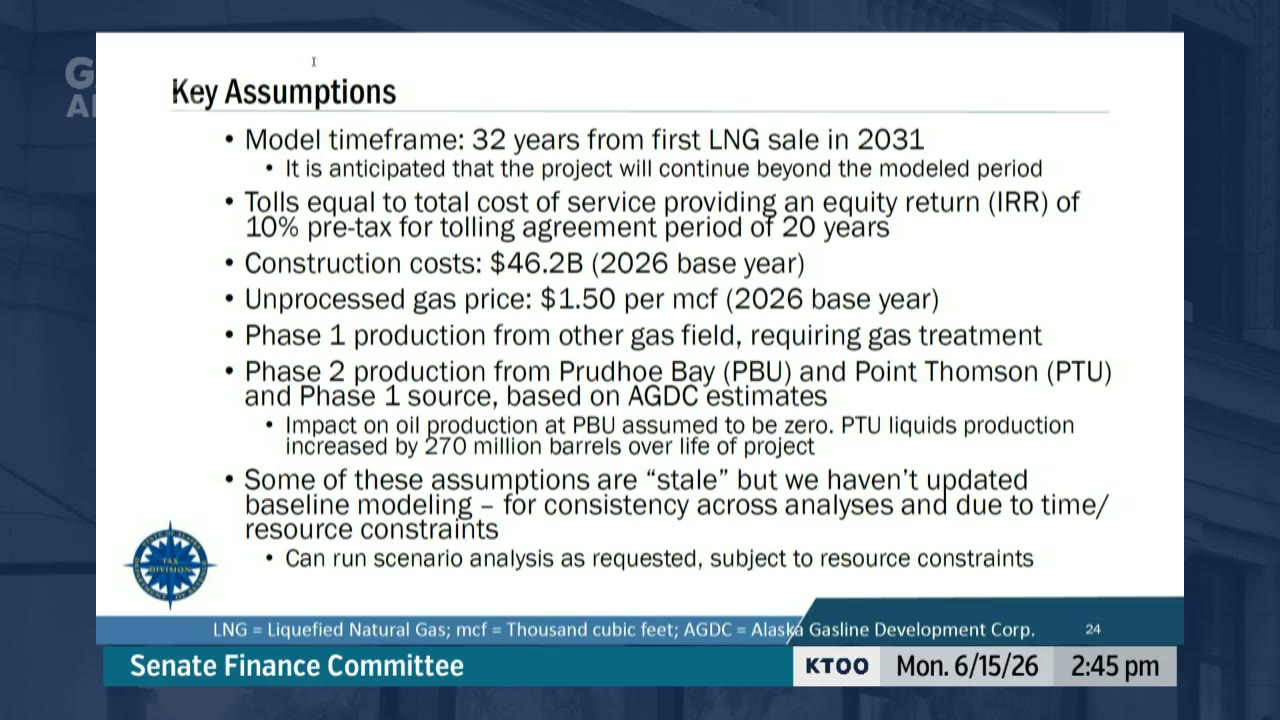
“given the time and resource constraints with a special session that ends in 4 days, we have maintained our baseline model assumptions at this point.”Alaska Legislature: Senate Finance - June 15, 2026 1:30pm · Jun 15, 2026
Dan Stickel
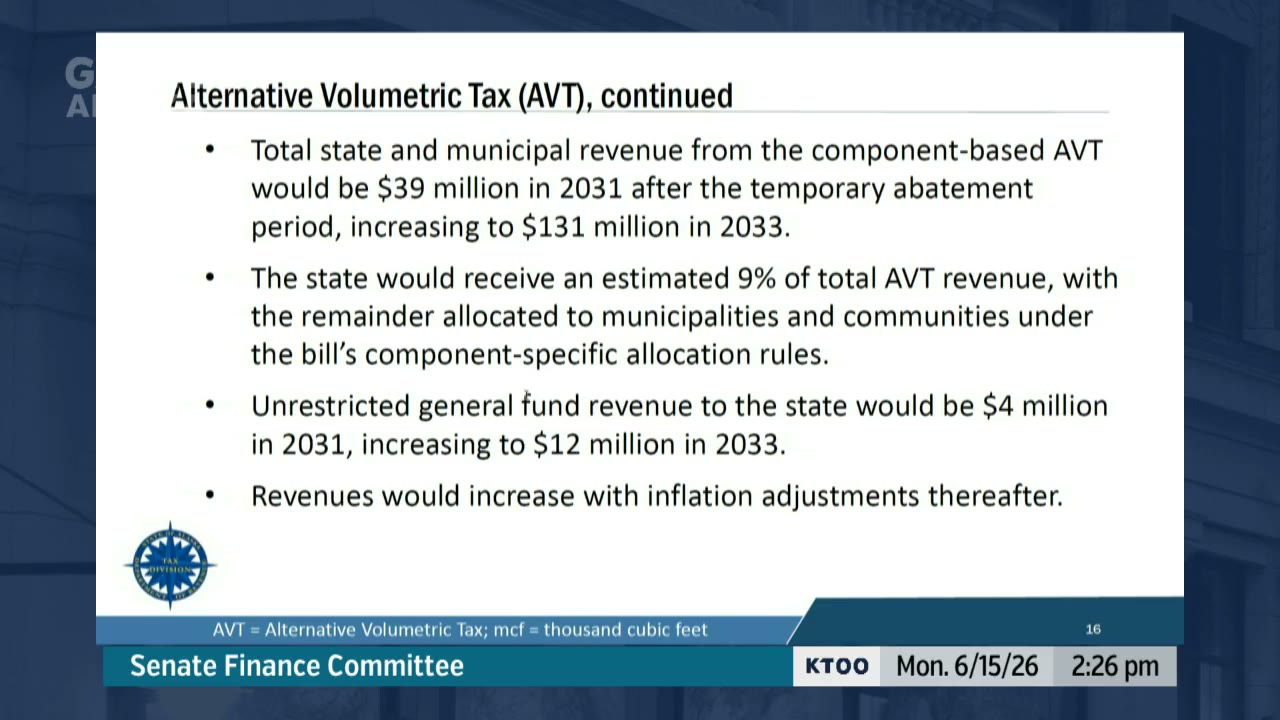
“we look at, under our baseline modeling, 2031 is the first year of exports when the first train comes online, and that would be the first year of tax liability for the alternative volumetric tax with a total of $39 million paid in, and that would increase to $131 million by 2033, which would be the first year of the full export operations. Under this version of the bill, the state would receive about 9% of the total AVT revenue, with the remainder allocated to the various municipalities and communities as outlined in this bill.”Alaska Legislature: Senate Finance - June 15, 2026 1:30pm · Jun 15, 2026
Adam Prestidge
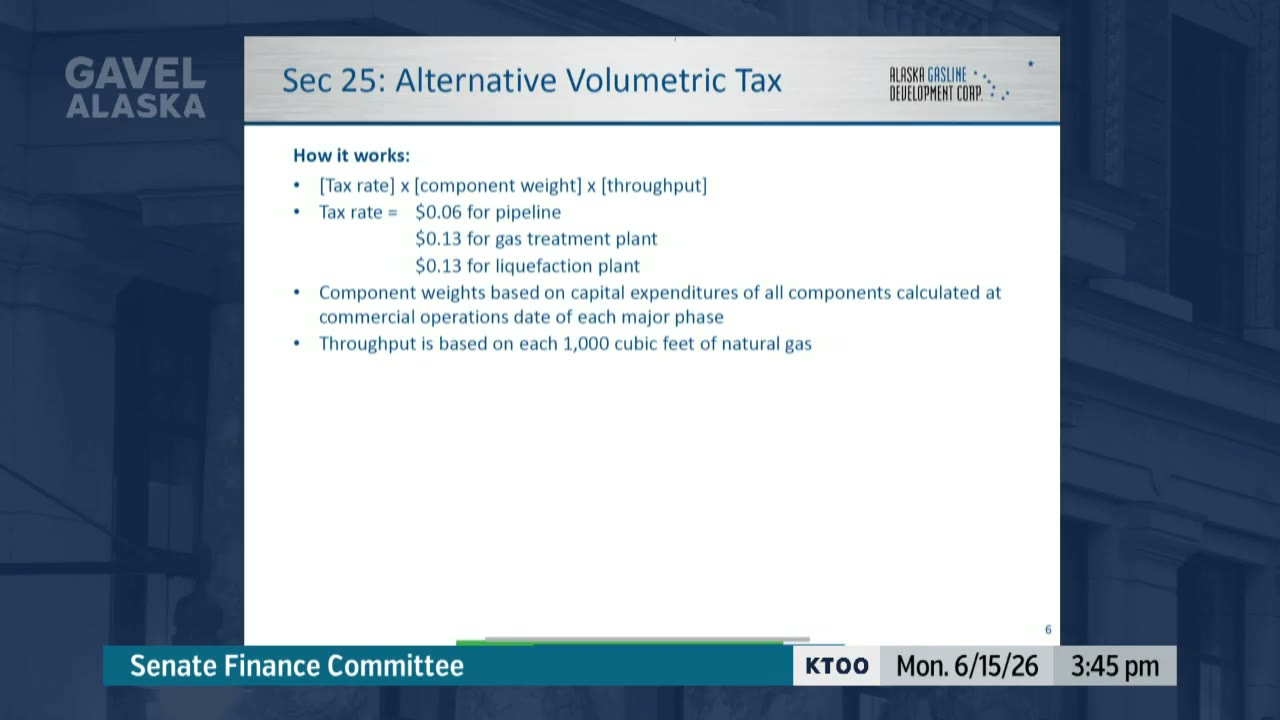
“this tax structure, the alternative volumetric tax, has the benefit of creating alignment. And so the more, the more gas that flows on the pipeline, the greater the revenue to, to the state. The more gas that flows on the pipeline, the lower the cost of gas to the ratepayers.”Alaska Legislature: Senate Finance - June 15, 2026 1:30pm · Jun 15, 2026
Bert Stedman
“isn't there a timing difference between when the $0.16 was agreed to and when the concept of the volumetric tax numerics were put in play, like a couple of months difference in time?”Alaska Legislature: Senate Finance - June 15, 2026 1:30pm · Jun 15, 2026