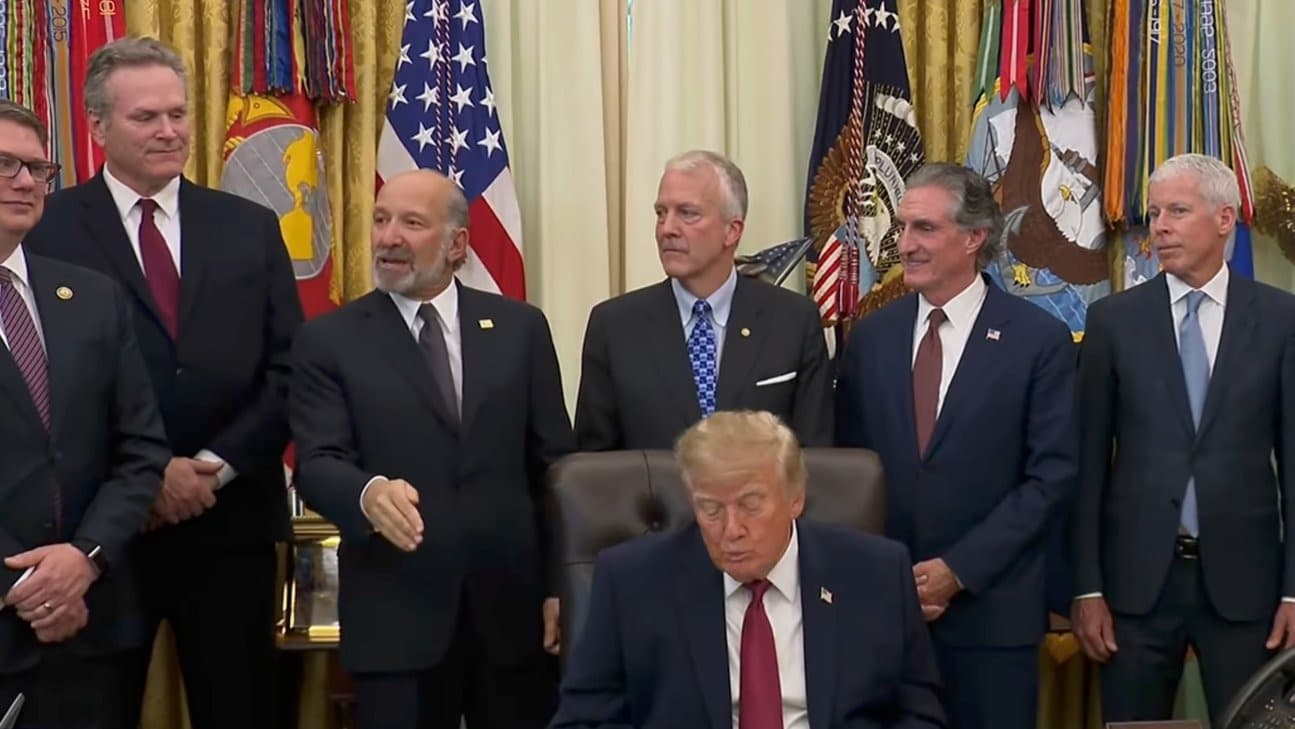
Trump at the Sept. 30 Oval Office event where he said South Korea would invest in Alaska LNG. Lutnick, Gov. Dunleavy, Sen. Sullivan and Rep. Begich attended. (White House video) · Photo source
Where Alaska LNG stands after Lutnick's 'federalized' remark
Commerce Secretary Howard Lutnick told a rally in Wasilla on Tuesday that President Donald Trump had "federalized" the Alaska LNG project, that South Korea had committed $50.1 billion to build it and that Taiwan would invest $4.4 billion more.
"The president has federalized this project," Lutnick said. The next day, Trump wrote on social media that the project "is now a U.S. Federal Government Project." Neither said what that meant, and Alaska News found no White House or Commerce Department document that explains it. The most recent ownership statement filed with the state, made Oct. 2, 11 days before the rally, lists a private developer and the state as the project's owners.
Trump signed an executive order on his first day in office in January 2025 directing federal agencies to prioritize Alaska's LNG potential, including permits for the Alaska LNG pipeline and export infrastructure.
The project has its major federal permits. No committed money to build it has been made public. South Korea says it is still reviewing its investment, Taiwan says its terms are still to be negotiated and no closed financing deal has been announced. Final sales contracts and a state tax deal are also unsettled. Here is where the gas line stands.
What would be built
Alaska LNG would move North Slope natural gas through an 807-mile, 42-inch pipeline to Nikiski on the Kenai Peninsula. A plant on the North Slope would treat the gas first, and a plant in Nikiski would chill it into liquefied natural gas for export.
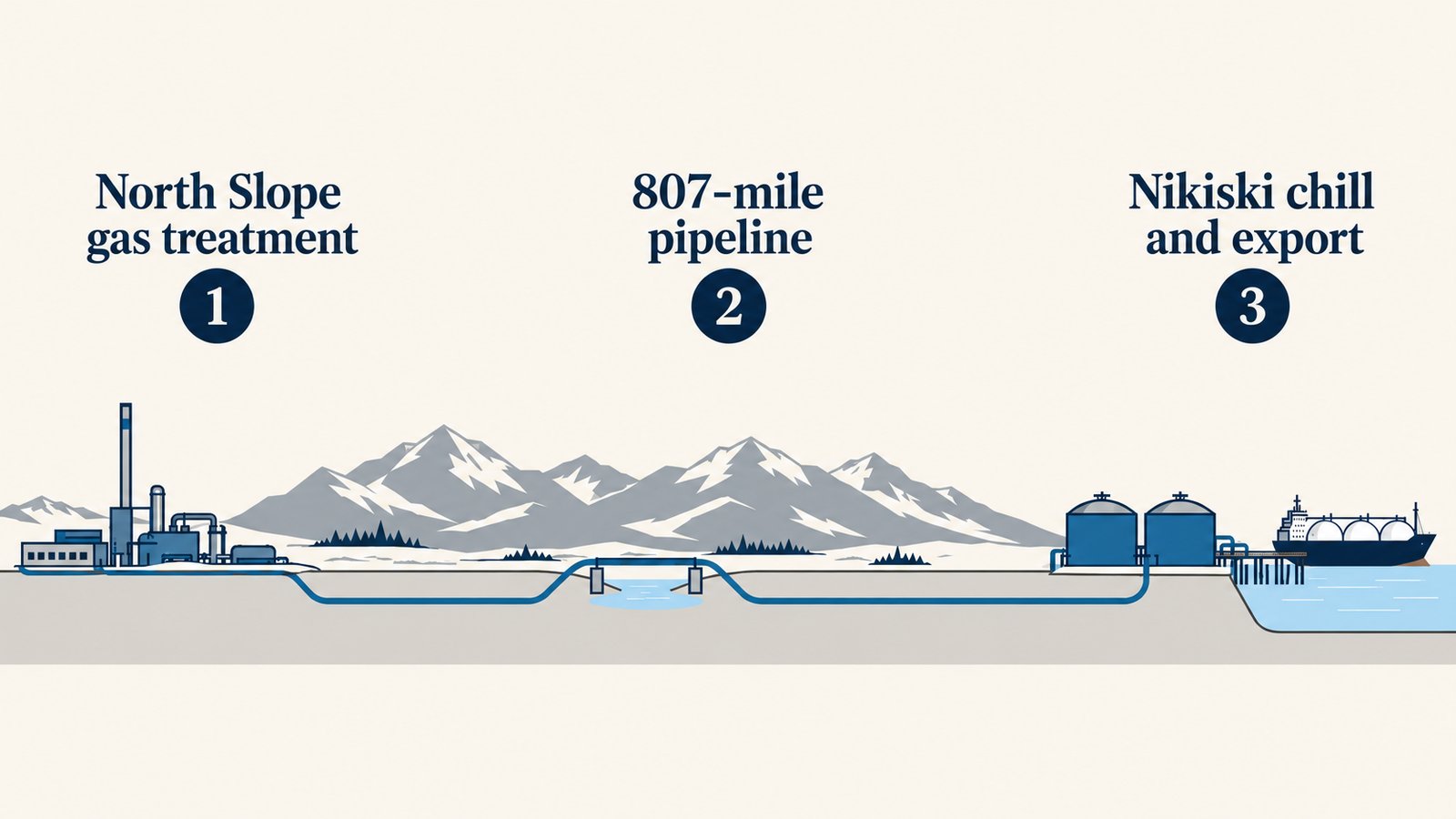
The developer plans to build in two phases: the pipeline first, to supply Alaska utilities, then the LNG export infrastructure. AGDC has said it put the pipeline first in response to the Cook Inlet energy shortage, to get North Slope gas to Alaskans as quickly as possible. The project's latest report to the U.S. Department of Energy keeps a 2028 target for finishing the in-state pipeline.
The project holds its major federal permits, including a 2020 approval from the Federal Energy Regulatory Commission. Glenfarne's public cost estimate, released in June, puts the full project at $44.5 billion to $54.5 billion. The Alaska Senate majority has cited $65 billion to $70 billion, Alaska News has reported.
Who owns it
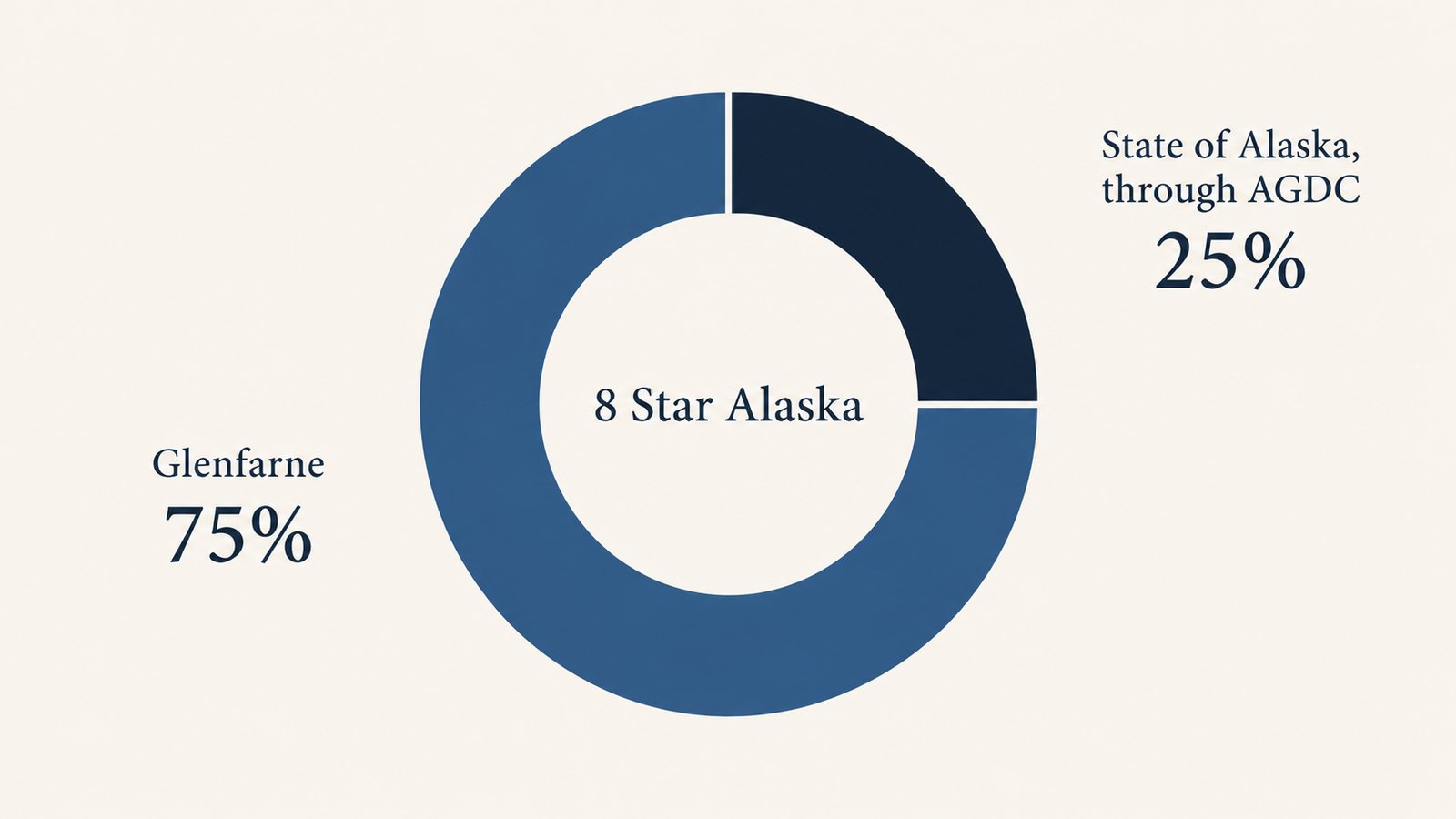
Glenfarne, a private energy company, owns 75% of 8 Star Alaska, the project company that holds its key federal authorizations. The state owns the other 25% through the Alaska Gasline Development Corp., or AGDC, according to the Oct. 2 state filing.
Glenfarne took over in March 2025. It agreed to pay development costs until the owners decide whether to build, a step known as a final investment decision. If Glenfarne walks away before then, the state does not have to repay it, AGDC and Glenfarne officials told the Senate Finance Committee in June.
The state also has an option to invest up to 25% in each of the project's three parts, according to AGDC, and AGDC holds approval rights over some major decisions, including structural changes to 8 Star.
In a statement welcoming Trump's remarks on the day of the rally, AGDC listed three requirements for the project: rights to enough gas for Alaska's own needs, no financial liability for state taxpayers and clear ownership and protection of the project's data, permits and physical assets.
Neither owner can sell its share until the pipeline is in commercial operation and the project's other two parts reach a final investment decision, or until 2035, whichever comes first, AGDC and Glenfarne representatives told legislators. The agreements themselves are confidential.
Where the money stands
Lutnick said Taiwan would invest its $4.4 billion "on top of the Koreans" and buy 30% of the project's gas. Neither he nor Trump said whether any agreement had been signed, Alaska News reported. On Wednesday, Taiwan's Ministry of Economic Affairs said the government was considering investing up to $4.4 billion, with details to be set through later negotiations and commercial contracts, as reported by the Taipei Times. The ministry said Taiwan's CPC Corporation would buy 6 million tonnes of LNG a year under the letter of intent it signed in March 2025. That is 30% of the export plant's planned 20 million tonnes a year, and the letter is nonbinding.
The Korean figure dates to Sept. 30, when Trump announced in the Oval Office that South Korea would put more than $50 billion into the project. Korea's government said it had agreed only to review the project, which it calls "Project North," for whether it makes commercial sense and complies with Korean law, Alaska News reported. Two days after the announcement, Trump said Korea was "still studying" it.
AGDC's board met by phone and video at 9 am Tuesday, hours before the rally. The agenda listed an item on "8 Star Governance & Support" and a closed-door executive session, with no subject given for the session. The governance item was a roughly $1.3 million budget to manage the state's 25% stake this fiscal year, Alaska News reported. In his report for the meeting, AGDC President Frank Richards wrote that details of the Korean funding were "understood to be still under discussion." The posted materials do not show whether the board took any action after the closed session.
Separately, 8 Star told the state on Oct. 2 that it plans to finance the project with debt backed only by the project's own assets, contracts and cash flow, supporting more than $50 billion in total capital. The filing describes a plan. It does not show that financing has closed. Glenfarne CEO Brendan Duval said in May that global banks had submitted financing terms for the pipeline, Alaska News reported.
No final investment decision has been announced. In May, Duval said he expected one within 90 to 120 days, pending a state tax deal and regulators' approval of a gas sale to Enstar. Dates mentioned earlier, last December and then this April, had already passed, AGDC commercial director Matt Kissinger told senators in June. Before financing can close, the project needs final contracts with gas suppliers and buyers, construction contracts and, for sales to Alaska utilities, approval from the Regulatory Commission of Alaska. "These things all have to be done ahead of a true financial close, and we all know that," Kissinger said.
Who would buy the gas
8 Star's Oct. 2 filing lists letters of intent to buy LNG from Taiwan's CPC, Japan's JERA and Tokyo Gas, and TotalEnergies. ExxonMobil, Hilcorp and ConocoPhillips have signed precedent agreements to supply the gas.
Closer to home, Enstar signed a nonbinding letter of intent with Glenfarne in January for a 30-year gas supply from the pipeline, and Chugach Electric signed one in June.
The project's Oct. 1 report to the Energy Department says it holds no long-term LNG export or supply contracts. Kissinger rated the supply and sales deals on a stoplight scale in June. They are on track, he said, but still need to become final contracts. "So that's not a green, that's a yellow," he said.
What the state still has to decide
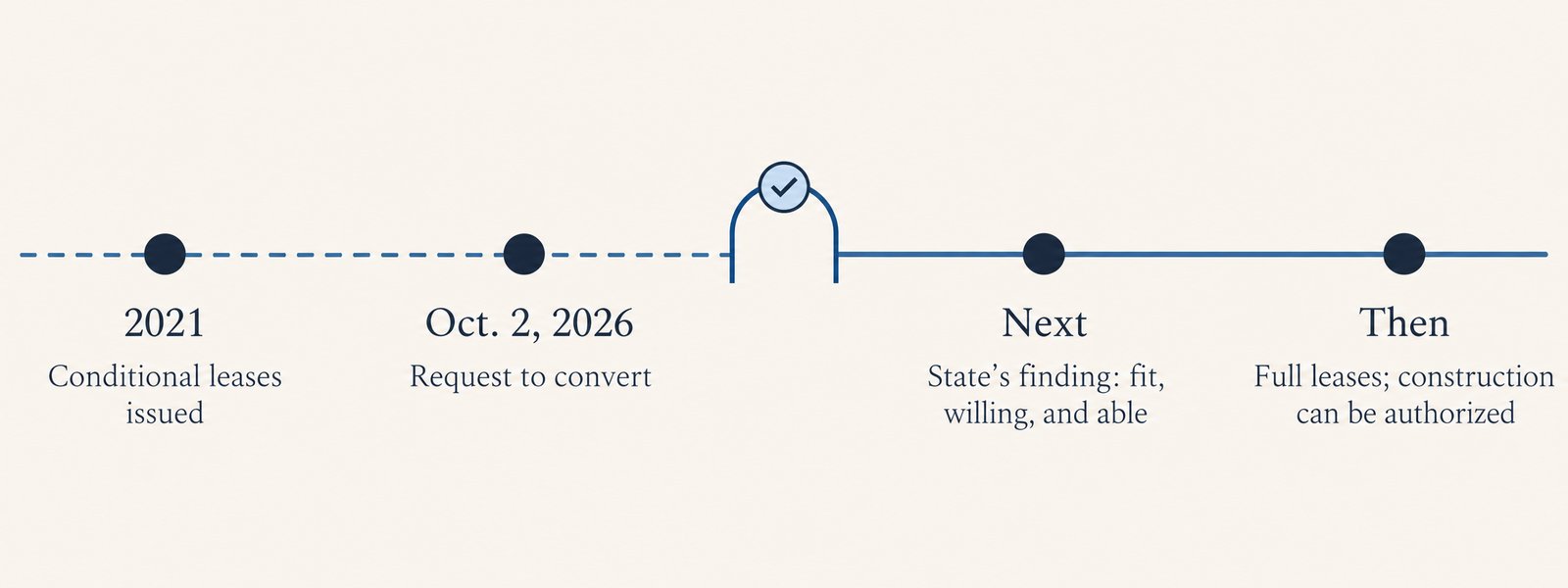
The first is the pipeline's right-of-way across state land. AGDC holds two conditional state right-of-way leases for it, issued in 2021. On Oct. 2, 8 Star asked the Department of Natural Resources to convert them to full leases. Before construction can be authorized, the natural resources commissioner must find in writing that the leaseholder is "fit, willing, and able" to carry out the project, including financially.
The second is taxes. Under current law, the pipeline and North Slope gas plant would pay the state's 2% annual oil and gas property tax once they are operating. Gov. Mike Dunleavy proposed replacing it with a tax on each unit of gas shipped. The Department of Revenue estimated the change would cut the project's annual taxes from nearly $750 million to roughly $200 million by 2033, a figure that depends on what the project costs, Alaska News reported.
Glenfarne argued the break has to last as long as the pipeline's 30-year loans, because lenders judge a project on its full forecast. A break that later returned to the 2% rate "really challenges the project's viability," Glenfarne Alaska LNG President Adam Prestidge told senators in June.
Even with the Senate's version of the break, the project's exported gas would still cost more to produce than buyers in Asia were paying, Department of Revenue chief economist Dan Stickel told lawmakers in June. "It does look like a challenging project even with the tax relief," he said.
Lawmakers spent three special sessions on a gas line tax break this year. The central dispute was over a separate tax the Senate added on privately held oil and gas companies. Some lawmakers said it was needed to make sure the state got a fair share, and Dunleavy said he would veto the bill over it. A compromise passed the Senate 11-8 on July 16, then tied 19-19 in the House the same day, killing it.
In August, Dunleavy sent lawmakers a new bill with a flat 2% tax on those companies, in place of rates that topped out at 9.4%. The Legislature did not vote on it, and the special session ended that month.
What comes next
DNR's notice on the leases does not say when the commissioner will decide. AGDC officials told legislators in June they would not predict a date for a final investment decision.
If the project moves ahead, the plan 8 Star filed with the state calls for contractors to start work in 2027 on material sites, camp pads and pipe storage yards.
What a federal project would mean is still unexplained. Alaska News has found no White House or Commerce Department statement saying whether "federalized" means federal money, ownership or control.
Federal financing has come up before. In June, Prestidge told senators that Glenfarne was prioritizing private bank loans over a federal loan for the pipeline, partly because the federal process takes longer, and that federal financing remained an option. AGDC's statement on the day of the rally praised federal support but did not describe any change in ownership.
If ownership or control did change, the project would have to notify the Energy Department, which treats a shift of 10% or more as a change in control, Kissinger told legislators in June.
Assembled from public records the newsroom collected.
Made by our human newsroom with AI. Reviewed by Cale Green. How humans and AI work here · Grow with our newsroom
Stay informed. Support what matters.
Free, permanent access to local news you can verify. Subscribe to support Walter AlaskaNews and go ad-free.
Related Coverage
Trump says Taiwan will buy 30% of Alaska LNG gas, the share in a 2025 letter
Alaska News · 2d ago
Trump says South Korea will finance $50 billion of Alaska LNG; Seoul hasn't committed
Alaska News · 2w ago
Alaska LNG report targets 2028 completion for in-state pipeline
Alaska News · 1w ago
Trump says South Korea is still studying Alaska LNG, threatens to 'double it up'
Alaska News · 2w ago
Seoul protested U.S. Alaska LNG announcement, says investment remains under review
Alaska News · 2w ago
Comments
Sign in to leave a comment.
No comments yet. Be the first to share your thoughts.