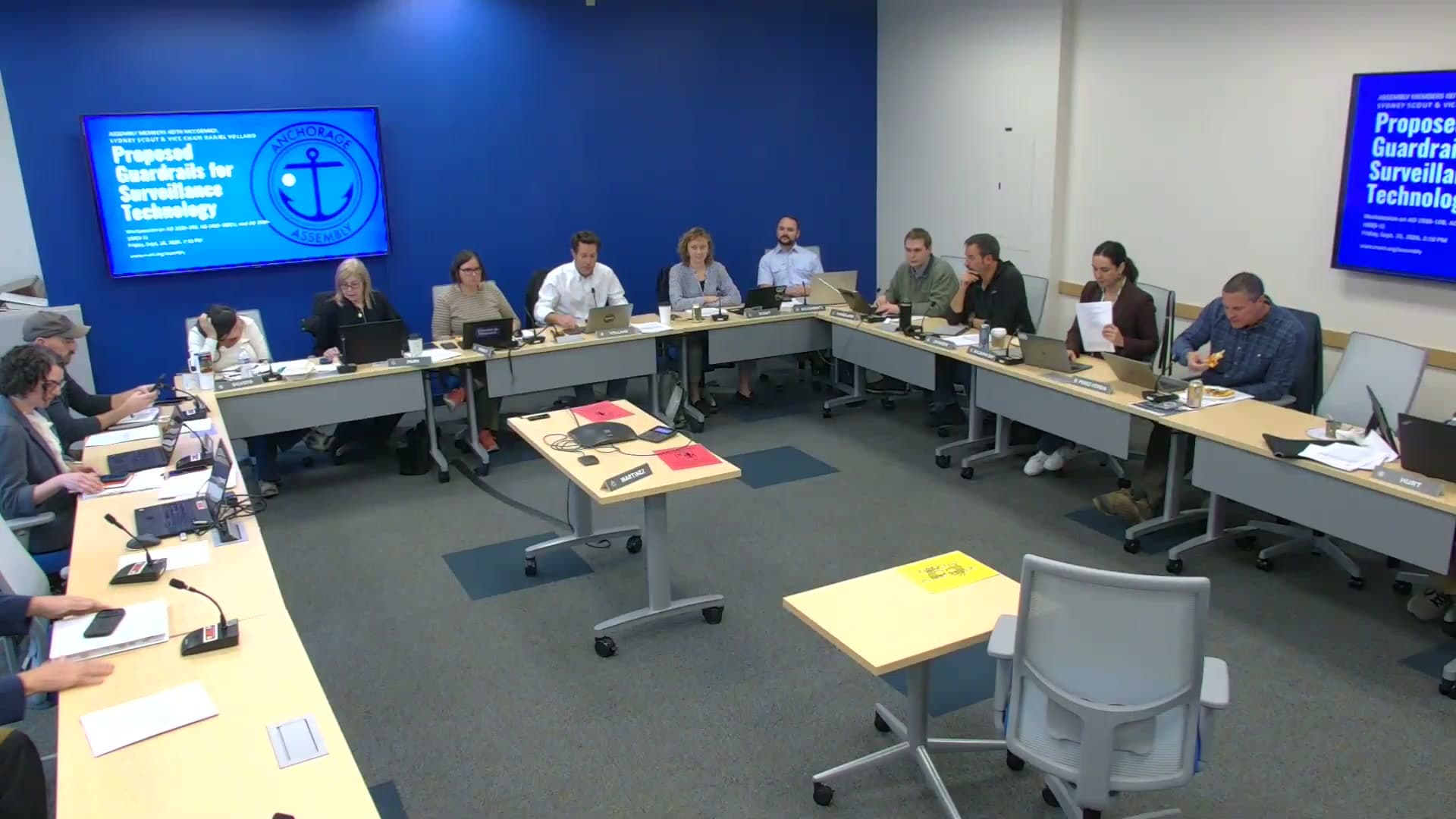
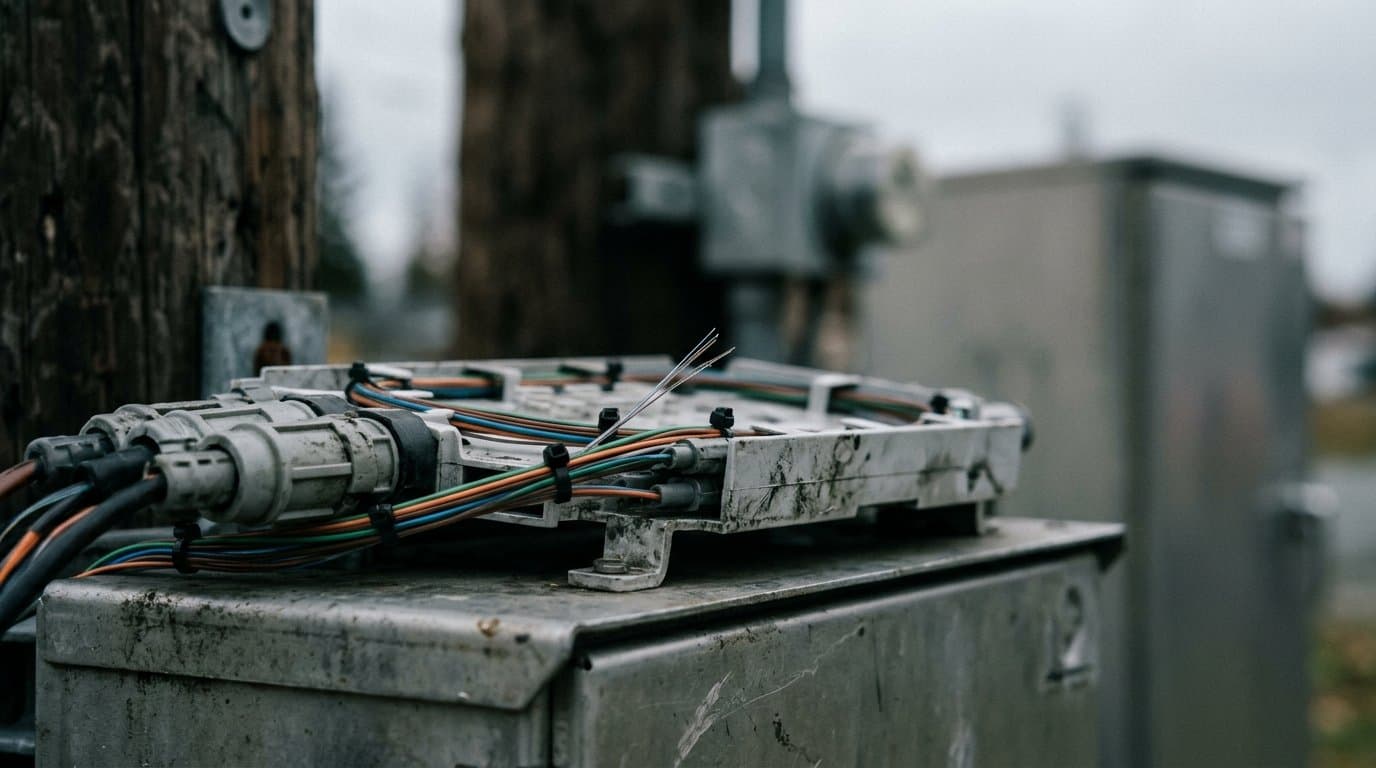
Frame from "Anchorage Assembly" · Photo source
Warrant rule for sharing police camera data splits Anchorage Assembly surveillance drafts
Anchorage police run a Real Time Crime Center, built out under an $11.8 million Axon contract. The Assembly is deciding whether an outside agency should need a warrant before police share what it collects. Four have asked this year.
That warrant question is the whole split between the Assembly's two competing surveillance drafts. Municipal Attorney Eva Gardner told members at a Friday work session that the stricter of the two, known as the S-1, would reach joint federal, state and local investigations.
Both are substitute versions of Ordinance AO 2026-108, and both would amend Chapter 3.102 of the municipal code. That chapter already covers drones, facial recognition and body camera evidence and requires annual reporting. The substitutes would add use limits for the crime center and license plate readers and expand Assembly oversight and public reporting.
Both substitutes let the Anchorage Police Department keep running the crime center. They part on what happens when the department hands data outward. "The S-1 requires a warrant or a court order for APD to share information with other criminal justice agencies, whereas the S allows APD to share information for the purposes of criminal justice, law enforcement, with other law enforcement agencies," Gardner said. The broader version also bars police from sharing data to enforce another jurisdiction's criminal laws against conduct that is lawful in Alaska, though it carries no warrant condition of its own.
Gardner said the requirement would fall on the requesting agency, not on police. "The S-1 says, and the other agency needs a warrant or court order. And so it's that hurdle. It's not that APD would have to get a warrant," she said. Asked whether that would have touched past operations, she named the massage parlor case that produced seven trafficking arrests and Operation Summer Heat, and said referrals of felony cases to state prosecutors would also be affected, because body-worn camera footage appears in nearly every case.
Gardner said she doubted courts would issue warrants for continuing collaboration such as the longstanding high-intensity drug trafficking area effort. "Early on in an investigation when you're developing your case, you aren't going to have probable cause at that point," she said.
Assembly Member Keith McCormick, a sponsor, pressed on that reasoning, asking whether the answer meant the cameras exist to gather enough data to build the probable cause that warrants require. He then asked Darryl Thompson, an Anchorage attorney invited by the sponsors, for his reading. Thompson pointed to U.S. Supreme Court decisions on GPS tracking and cellphone location data and said even a 14-day look-back at plate reads should require a warrant. That, he said, is where the ordinance would be open to challenge under Alaska law.
Outside requests come into the Real Time Crime Center as internal requests, Police Chief Sean Case said, and four have arrived this year. Two were granted, two were not.
Assembly Vice-Chair Daniel Volland, a sponsor, said the code should name the moment data becomes shareable. "I just don't have a grasp on what is the trigger point," he said. The administration's position is that department policy already draws that line.
The Assembly approved an Axon contract worth up to about $11.8 million in September 2025 that built out the crime center. The public hearing has closed. Debate and amendments are set for Oct. 20.
What did you make of this story? (no account needed)
Made by our human newsroom with AI. Reviewed by Lucas Brown. How humans and AI work here · Grow with our newsroom · Transcript byWalter AlaskaNews
Get Alaska News in your inbox
Create your free account and get the day’s top stories around 6 each morning, in a few minutes’ read.
Top stories, around 6 each morning.
Stories on what you follow, on Sundays.
This article is based on a public meeting of Municipality of Anchorage — Anchorage Assembly: Worksession re AO 2026-108, AO 2026-108(S), and AO 2026-108(S-1), amending Anchorage Municipal... ().










Comments
Sign in to leave a comment.
No comments yet. Be the first to share your thoughts.