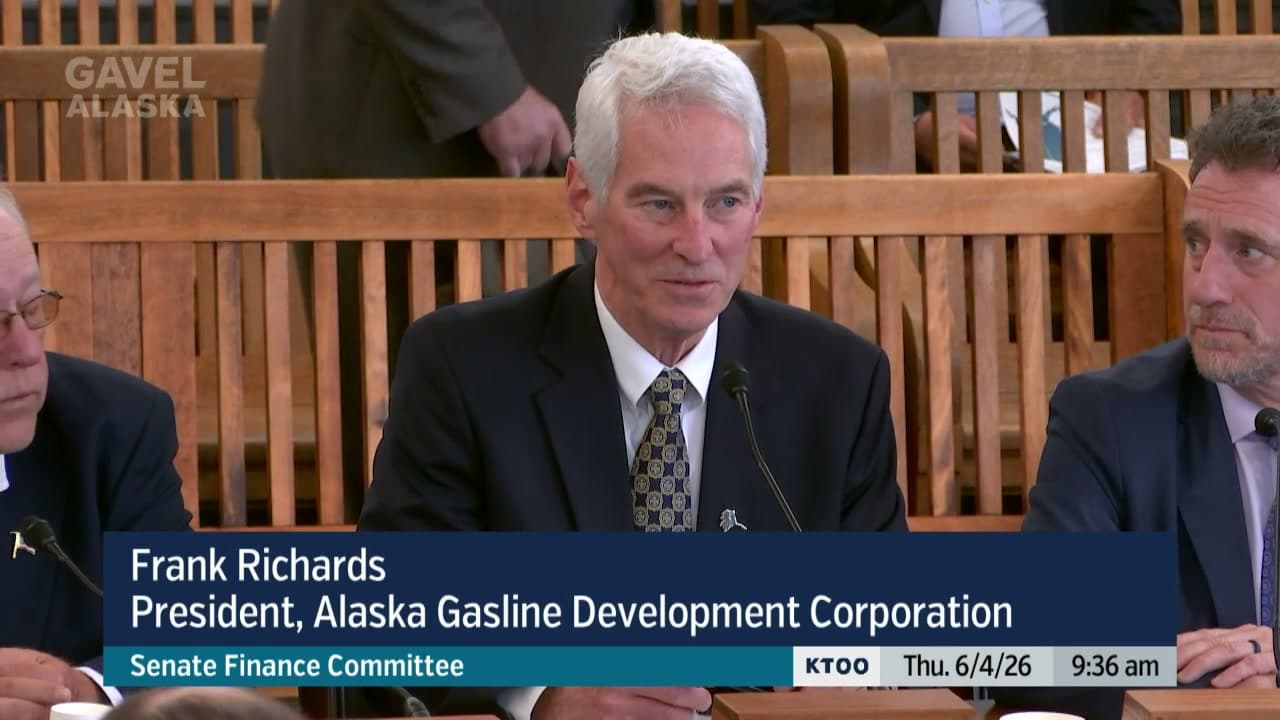
Frame from "Alaska Legislature: Senate Finance — June 4, 2026 10:00am" · Source
Title: Glenfarne's own cost estimate for Alaska LNG is now significantly higher than AGDC's — and the state's equity option sits in the middle of the new math
The private developer building Alaska's LNG project just told state lawmakers it could cost meaningfully more than the figures the state has been using.
In a June 3 presentation to the Senate Finance Committee, Glenfarne — which took 75 percent ownership of Eight Star Alaska from the Alaska Gasline Development Corporation in March 2025 — pegged total project costs at $44.5 billion to $54.5 billion. AGDC's most recent number, by contrast, was $38.7 billion. The Glenfarne range covers Phase I (the 807-mile pipeline) at $13.2 to $16.9 billion, with Phase II (the Nikiski LNG terminal and North Slope gas treatment plant) accounting for the remainder.
That higher number lands in the middle of a live equity conversation. AGDC president Frank Richards told the same committee that the state retains a 5 to 25 percent equity buy-in option, exercisable within a 180-day window after final investment decision. "We've reserved that for the legislature between 5 and 25% equity option," Richards said. If the legislature passes, the option opens to Alaskans and Alaska corporations. AGDC also receives 25 percent of developer-economics fees from sub-projects either way.
Matt Kissinger, AGDC commercial director, said FID requires sufficient funding to construct the project, including contingency reserves. Sen. Lyman Hoffman flagged the timing risk if FID falls between legislative sessions and suggested the equity clock should start when the legislature convenes.
Glenfarne used the presentation to push for property tax reform — the issue at the center of the Senate's broader review. Under the current 20-mill rate, Sen. Bert Stedman has noted, the project would owe roughly $380 million a year during construction — nearly $2 billion over five years. Glenfarne argues the project isn't financeable that way. Department of Revenue figures cited by Glenfarne project that the proposed Alternative Value Tax would unlock $22.5 billion in state revenue, support 12,000 construction jobs, and deliver up to $1,450 a year in residential energy savings.
Glenfarne also pointed to commercial momentum since taking over: signed agreements for engineering, steel, pipeline equipment, and LNG compression between July and November 2025, plus roughly 13 million metric tons per annum of accumulated buyer interest against a 20 MTPA design. The developer pledged to support language barring the state or regulated ratepayers from absorbing cost overruns, anchored by an RCA-approved $16 per MMBtu locked in-state pipeline tariff.
Glenfarne runs the project day-to-day as managing member. The 8 Star Pipeline board has four seats — two for Glenfarne (CEO Brendan Duval as chair, Adam Prestidge), one for AGDC (Richards), and a non-voting independent Alaska seat held by Janet Weiss. AGDC's consent is required on 11 categories of major decisions, including scope changes, capital calls, M&A, and tax choices.
AI-assisted, reviewed by editors. Spot an error?
Watch key moments from the source meeting. Click to expand.
Related Coverage
Alaska LNG could cost $70 billion; state's 25% stake faces dilution
Alaska News · 1w ago · 19 views · 90% match
State wins option to buy 25% of Alaska LNG after investors commit
Alaska News · just now · 86% match
Senate panel debates $1B tax break for Alaska LNG amid cost secrecy
Alaska News · 1mo ago · 5 views · 86% match
Senate Finance hears $18 billion revenue trade-off for Alaska LNG tax break
Alaska News · 3d ago · 4 views · 86% match
Alaska House examines $4 billion LNG equity option, Fairbanks spur-line tax break
Alaska News · 6d ago · 5 views · 85% match
Comments
Sign in to leave a comment.
No comments yet. Be the first to share your thoughts.