AI image
Students get to fire the HAARP transmitter at UAF's summer school
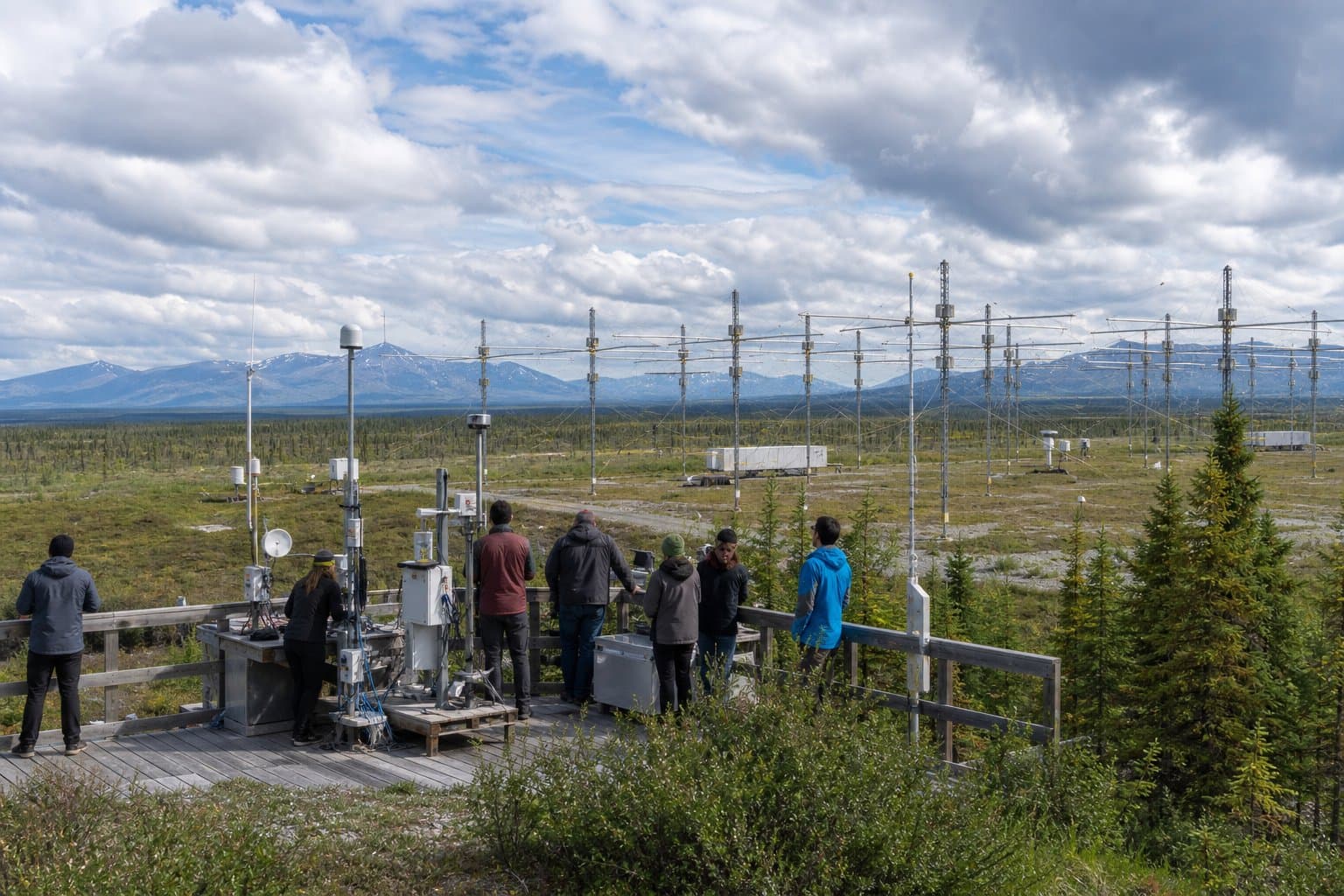
At the HAARP research site in Gakona, students will get to do what almost no one outside the facility can: design their own experiments and run them on the array that beams energy into the upper atmosphere. A $199,999 National Science Foundation award to UAF funds the next round, the 2026 Polar Aeronomy and Radio Science summer school.
The point is hands-on training that's otherwise hard to get. Studying the ionosphere, the electrically charged layer of the upper atmosphere that carries radio signals, usually means working with someone else's data. Here, participants develop experiments, clear the safety and operations reviews, and actually run them on HAARP's transmitter alongside its other instruments. The skills feed directly into fields the country cares about: communications, navigation and space-weather resilience.
HAARP is a former military installation now run by UAF's Geophysical Institute, and the summer school puts students on real equipment at a site most people only read conspiracy theories about. The program brought more than 50 researchers to Alaska when it resumed in 2023.
Source: National Science Foundation, National Science Foundation: NSF Award [GWF-Geosciences Workforce] → University of Alaska Fairbanks Campus: Conference: 2026 Polar Aeronomy and Radio Science (PARS) Summer School and Training Workshop (PI: Jessica Matthews) ($199 ().
Drafted with AI. Edited by Cale Green (1 revision). No full editor review is on record. Who is accountable.
Stay informed. Support what matters.
Free, permanent access to local news you can verify. Subscribe to support Melinda Communities.News and go ad-free.
Related Coverage
UAF glaciology program returns to McCarthy for eighth summer
Alaska News · 3mo ago
UAF is buying an instrument its accredited chemistry program has gone without
Alaska News · 3w ago
A $1.6 million grant to help Alaska burn on purpose, before wildfire does
Alaska News · 1mo ago
NSF awards UAF $877,501 for mass spectrometer to support fisheries and minerals research
Alaska News · 2mo ago
NSF awards UAF $1.77 million to build AI geohazard forecasting tools
Alaska News · 2mo ago
Comments
Sign in to leave a comment.
No comments yet. Be the first to share your thoughts.