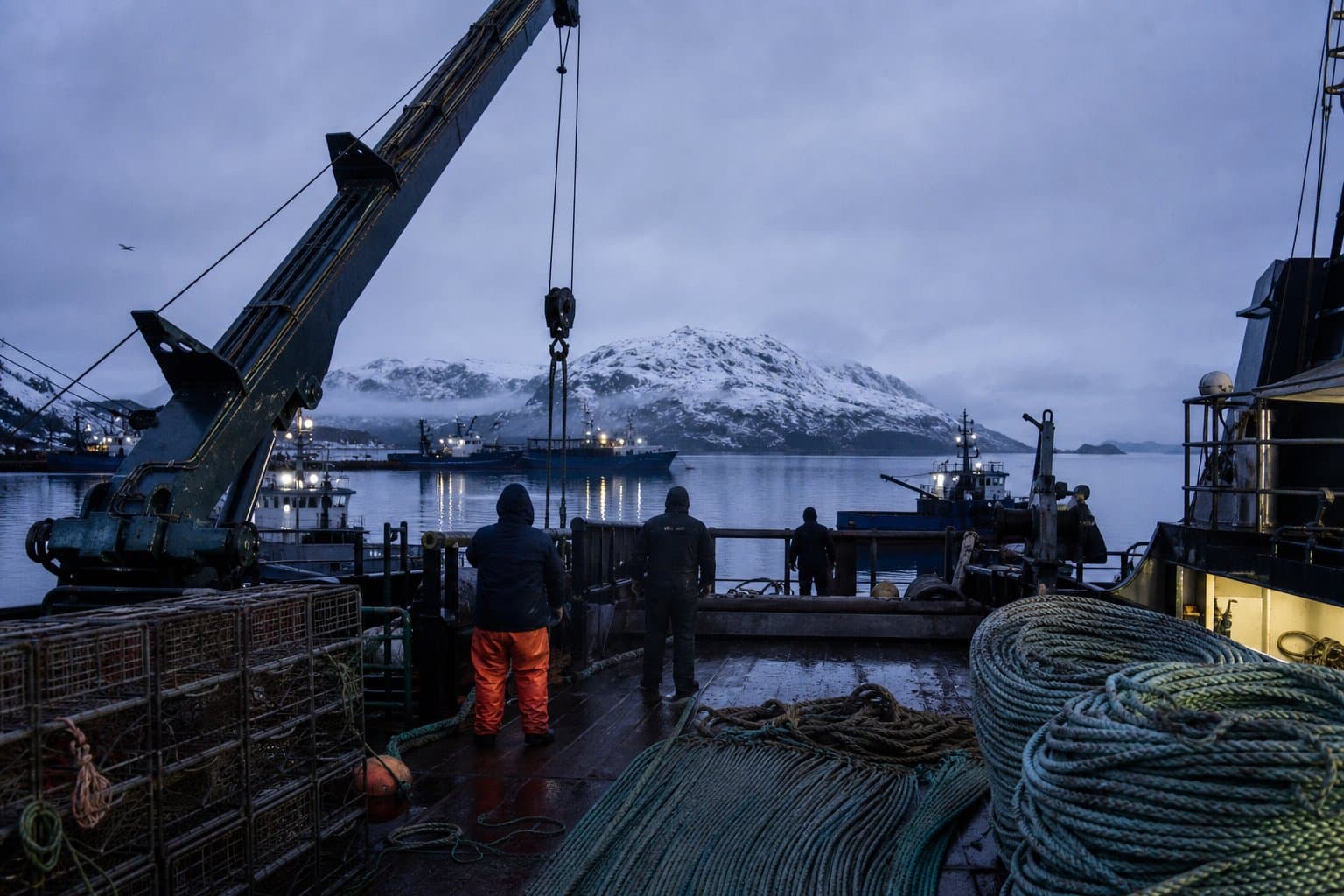
AI image
Snow crab limit would rise 13 percent, and the reason is the safety margin, not the crab
The federal limit that constrains Bering Sea snow crab fishing would rise 13 percent this winter under the recommendation now in front of the North Pacific Fishery Management Council, and the stock is not the reason. The increase comes entirely from cutting the safety margin subtracted for scientific uncertainty roughly in half.
What the fleet out of St. Paul, St. George and Dutch Harbor actually fishes is a state quota, set by the Alaska Department of Fish and Game beneath whatever number the Council adopts. Last season that quota was 9.30 million pounds, and fishermen retained 9.11 million.
The 2026 stock assessment for eastern Bering Sea snow crab, written by Grant Adams and Cody Szuwalski of the Alaska Fisheries Science Center, went before the Council's Crab Plan Team in Seattle this week.
The overfishing limit for the 2026/27 season falls 16 percent, from 20.11 to 16.98 thousand tonnes. The acceptable biological catch, the figure that actually constrains the fishery, rises 13 percent, from 12.07 to 13.58 thousand tonnes. The authors explain the gap in one sentence: "The rise in the ABC is therefore entirely a consequence of the buffer, not of a change in the stock or the control rule."
The buffer is the share subtracted from the overfishing limit to account for scientific uncertainty. The authors propose 20 percent. The Council's Scientific and Statistical Committee applied 25 percent in 2021 and 2022, 50 percent in 2023, 65 percent in 2024 and 40 percent last year. Twenty percent would be the smallest figure applied to this stock in five years, and about half the five-year average of 41 percent. In June the science committee endorsed using that five-year average as a starting point for the buffer.
The stock underneath the number moved very little by the measure the control rule uses, the formula that lowers the allowed fishing rate as the stock falls below its target. Morphometrically mature male biomass, meaning males with a large claw relative to their carapace width, fell 2.77 percent in the survey, while the smoothed series the rule actually acts on rose about 4 percent. By the measure the fleet buys and sells, the picture is different. Biomass of preferred males, those above 101 millimeters, fell 29.0 percent, from 22.36 to 15.88 thousand tonnes. Abundance fell 27.8 percent to 28.33 million crab. That is the fourth-lowest value in a 44-year survey series.
Fishing at the proposed limit "could remove a considerable proportion of industry-preferred males: the OFL of 16.98 kt is 107 percent of the observed preferred-male survey biomass." That comparison is made before any allowance for natural mortality between the survey and the fishery, or for crab killed in discarding. The same document also gives the limit as 74 percent of large-male biomass, at or above 95 millimeters.
A Measurement Choice That Changes the Story
The authors also write that "the choice of maturity definition, rather than the survey, determines whether the stock appears stable or declining." Under morphometric maturity, the stock sits at 0.747 of its target. Under a 95 millimeter definition, the same stock sits at 0.253 to 0.276 of target. Last year's assessment recommended the 95 millimeter definition, arguing that morphometric reference points "permit the removal of essentially all large males while the trend in large males is firmly negative." This year's assessment uses morphometric maturity because the science committee directed it.
Asked whether the stock is approaching an overfished condition, the authors answer "Unknown," and write that no reliable projection of mature male biomass is available. Tier 3, the full size-structured population model, does "not converge reliably" and its "recruitment estimates have high retrospective bias," and Tier 4, the simple smoothing of the survey series used in its place, produces no projection at all. The science committee moved the stock off the Tier 3 model in October 2025 over those convergence problems.
The diagnostics describe a fragile fit. Jittering the Tier 3 model, restarting it from randomly varied starting values to see if it lands in the same place, returned its reported fit in 1 of 78 converged runs.
The assessment gives two reasons for the smaller buffer. The Tier 4 limit is "considerably lower" than the limits produced by the excluded Tier 3 models, which range from 43.8 to 147.3 thousand tonnes. And the ecosystem profile indicates favorable conditions for juvenile crab. The authors' own 95 percent range on the limit runs from 9.27 to 30.36 thousand tonnes.
Rebuilding Timeline Still in Doubt
Snow crab has been in a rebuilding plan since it was declared overfished on Oct. 19, 2021. The directed fishery closed for the 2022 and 2023 seasons, and Amendment 53 took effect before the 2023/24 season. Median projections put rebuilding in 2029 with no fishing and 2030 fishing at the acceptable biological catch. If mortality events like those of 2018 and 2019 recur about one year in seven, the stock does not rebuild within the projection horizon under either scenario.
The authors do not call the stock rebuilt. Mature male biomass is estimated at 109.30 thousand tonnes against a target of 146.29, with an overfished threshold of 73.14. The 95 percent confidence interval sits entirely above the overfished threshold and entirely below the rebuilt one.
Written public comment on this week's meeting closed at 5 p.m. on Sept. 13, and the meeting page records no comments received. The assessment was uploaded at 9:34 a.m. on Sept. 14, the morning the meeting opened. The Crab Plan Team's report on what it recommends had still not been posted as of Wednesday evening, Sept. 16.
No fisherman, processor, community or quota holder is named or quoted in any of the documents. The fleet appears only in aggregate through a skipper survey in the ecosystem profile, in which about 50 percent of respondents reported more preferred males than last season and 47 percent reported more hybrids, the crosses between snow crab and Tanner crab. The science committee, which sets the buffer, has published no reasoning of its own. This account rests entirely on those federal documents.
What Happens Next
The science committee that sets the buffer meets first, at the Egan Center in Anchorage from Oct. 5 to 7, and takes oral testimony in person and remotely. The Council then takes up final catch specifications there from Oct. 8 to 13, with snow crab one of five crab stocks on the agenda item alongside Bristol Bay red king crab, Tanner crab, St. Matthew blue king crab and Western Aleutian Islands red king crab. Written public comment closes at noon Alaska time on Oct. 2.
Source: The proposed snow crab catch limit is larger than every market size male the 2026 survey found, and the allowable catch rose only because the safety margin was halved ().
AI-assisted. No editor review is on record for this article. Who is accountable.
Stay informed. Support what matters.
Free, permanent access to local news you can verify. Subscribe to support Walter AlaskaNews and go ad-free.
Related Coverage
Aleutian Islands golden king crab quota rises 13% for 2026/27
Alaska News · 2mo ago
North Pacific Fisheries Management Council limit golden king crab catch limits
Alaska News · 2mo ago
Southeast king crab quota rests on a figure the state's own report gives two ways
Alaska News · 3d ago
The panels that shape Alaska's pollock and cod catch limits meet next month
Alaska News · 1mo ago
Bering Sea halibut boats would get a catch cap double the rest of Alaska
Alaska News · 1w ago
Comments
Sign in to leave a comment.
No comments yet. Be the first to share your thoughts.