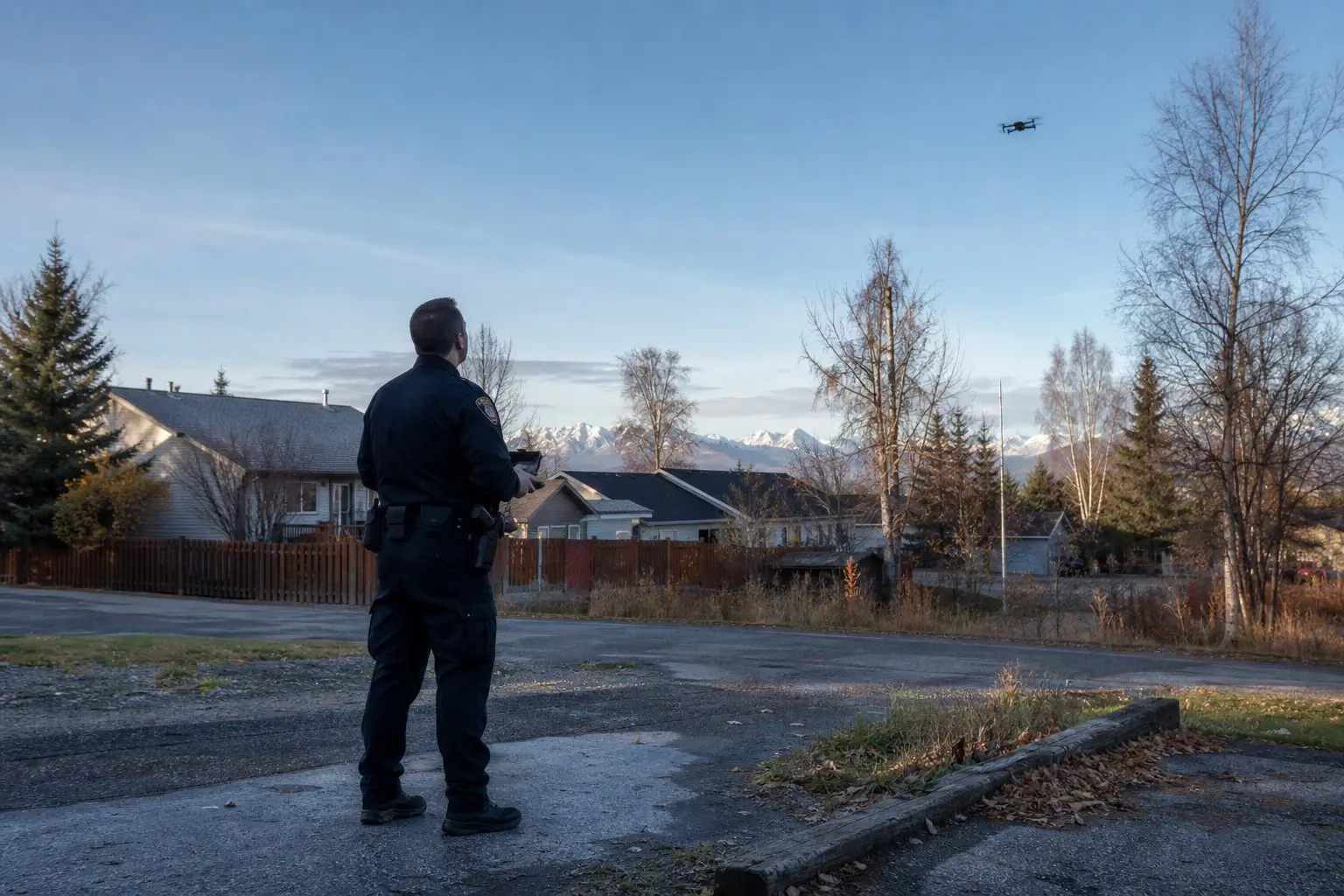
AI image
Revised APD drone report adds required warrant data, showing warrants for about one in four flights
A breakdown of what Anchorage's police drone log shows, what the law requires and where the record has gaps.
The Municipality of Anchorage has resubmitted its annual drone report with the warrant information city code requires, and the revised police log shows officers listed a search warrant for about one in four of more than 500 drone flights from May 2022 to April 2026.
City code requires an annual report to the Assembly, due June 1, on how city departments used drones, including whether police flights were done under a warrant or an exception to one. It's how the Assembly and the public keep track of the city's drone use. This year's original report reached the Assembly months late and had no field for warrant status. The revised report is on the Assembly's Oct. 6 agenda.
The police department supplied the data. Most recently, APD sent its drone data by email to the co-chairs of the Assembly's public safety committee, according to the administration's cover memo, and this filing returns the reports to a public Assembly memo, as was the practice from 2018 to 2022. The memo says all municipal drone use "is understood to have complied" with the city's restrictions, and it lists the court rulings behind each warrant exception APD cites.
What the log shows
The log also shows police use of drones growing quickly. Officers logged about 30 flights in the last eight months of 2022, about 80 in 2023, about 160 in 2024 and about 210 in 2025, with about 50 more in the first four months of 2026. The share of flights with a warrant has stayed at roughly a quarter to a third each year.
Not every drone flight requires a warrant. Courts recognize several exceptions, and for each flight without a warrant, the log names the one officers relied on. The most common, cited roughly 160 times, is listed in the log as "Search - No Reasonable Expectation of Privacy." It's based on U.S. Supreme Court rulings, and the city's legal table describes it as observing public places or areas with no protected privacy interest. Officers used it for exterior searches for suspects who fled on foot, burglary calls and overwatch during K-9 tracks.
Other flights cite consent from an owner or resident; emergency aid, when someone such as a missing person may need immediate help; exigent circumstances, when waiting for a warrant would risk an escape, destroyed evidence or danger; hot pursuit of a fleeing suspect; or protective sweeps for people who could pose a danger. And some flights, such as photographing or mapping a crash scene, aren't looking for people or evidence at all, so the warrant question doesn't come up.
The log also records drones at SWAT callouts, missing-person searches, homicide scenes and officer-involved shootings. Drones assisted camp abatement twice in summer 2025, once for 180 minutes, and were used to search an abandoned building with the owner's permission and for a code enforcement inspection.
What the law requires
The Assembly set the city's drone rules in 2018 through AO 2018-5, an ordinance "to protect the privacy of the people of Anchorage and establish parameters for the use of UAS (Drones) by the Municipality," according to its public hearing notice. That ordinance created the annual report, now Anchorage Municipal Code 3.102.040; its original version required a count of each department's drone uses and a description explaining how they weren't prohibited, and a later amendment added the warrant details.
Under the rules, a drone "shall not be used for routine patrol activities" or for "warrantless searches that are specifically seeking evidence as part of a criminal investigation." Nor may it be used in a way that violates a person's reasonable expectation of privacy, unless officers have a warrant or rely on a judicially recognized exception to the warrant requirement. The log alone does not show whether each exception was properly applied.
Observing places open to public view is generally not a search, so the no-reasonable-expectation label can be a valid basis for flying without a warrant. Two entries raise a narrower question. They describe warrantless flights as evidence searches, "Evidence search for a knife" in May 2023 and "Search for Evidence" in June 2024, both logged under that label. The code separately bars warrantless drone searches "specifically seeking evidence as part of a criminal investigation," and that ban lists no exceptions. Whether that ban covers evidence searches of public places, which aren't searches in the constitutional sense, isn't spelled out in the code; APD's log labels these flights as searches. The log does not explain how those two flights fit the rule.
One July 2022 entry notes the flight "Occurred prior to SOA v. McKelvey." In that case, decided in 2024, the Alaska Supreme Court held that police need a warrant before using an aircraft and vision-enhancing technology to observe the area around a home that's shielded from ground-level view. The log does not say how the department applies the ruling. Since that decision, officers have cited "no reasonable expectation of privacy" for flights including a search of a trailer for an assault suspect and a search of a house for trespassers. The log does not say what cameras those drones carried. The ruling turned on a telephoto lens, and some police drones have telephoto, zoom or thermal cameras built in. The administration's legal table notes that McKelvey limits the no-reasonable-expectation exception for homes and the area around them. At a Sept. 25 Assembly work session, Municipal Attorney Eva Gardner said, "APD does, you know, follow developments in case law regarding constitutional issues and does try to update its policies as the law changes."
Gaps in the record
The log's flaws complicate exact totals, so the counts here are approximate. The 2025-2026 flights are split across two tables that partly overlap, and some dates are malformed. Some entries are inconsistent: one 2022 SWAT flight is marked as having no warrant but lists "Search Warrant Obtained." At the Assembly's request, the report also leaves out where APD drones flew, though the memo says the department recorded the locations.
What's next
The Assembly is scheduled to take up a broader surveillance ordinance, AO 2026-108, on Oct. 20. It would carry the existing drone rules forward nearly unchanged.
Source: Municipality of Anchorage.
AI-assisted. Reviewed by Cale Green. How we use AI
Stay informed. Support what matters.
Free, permanent access to local news you can verify. Subscribe to support Walter AlaskaNews and go ad-free.
Related Coverage
Anchorage's drone report leaves out the one thing the code requires
Alaska News · 1mo ago
Anchorage confirms drone deployment was omitted and checks for others
Alaska News · 2w ago
APD's new drone notice leaves annual-report questions unanswered
Alaska News · 2w ago
Warrant rule for sharing police camera data splits Anchorage Assembly surveillance drafts
Alaska News · 1w ago
Anchorage is considering expanding its surveillance network. The privacy rules are still a draft.
Alaska News · 2mo ago
Comments
Sign in to leave a comment.
No comments yet. Be the first to share your thoughts.