Pollock fleet builds empirical database of trawl seafloor contact as Congress weighs gear restrictions
The North Pacific Fishery Management Council heard on June 7 that Brad Harris, a professor of fishery science at Alaska Pacific University, has documented nearly 300 trawls under the Gear Innovation Initiative, building an evidence base for how pollock trawl gear actually behaves near the seafloor. The data are scheduled to reach the council's Scientific and Statistical Committee for review in February 2027.
The initiative collects gear catalogs, haul logs, fishing practice profiles, and numerical simulations to replace what Harris described at the June 7 meeting as "expert-derived opinion with a heavy dose of precaution" currently embedded in the Fishing Effects Model. A Trident Seafoods researcher, Dr. Noel Yoakam, presented a parallel effort: a modified foot rope design tested under an exempted fishing permit. Using a back-of-the-envelope calculation that assumed full contact across the foot rope, Yoakam estimated a roughly 96 percent reduction in contact footprint compared to a standard design, while cautioning that "these are not hard numbers that we have estimated with empirical research, but this is just an approximation." Preliminary captain feedback and an initial look at catch data showed no differences in catch efficiency, though statistical analysis is ongoing.
Harris described a planned bridging analysis that will show incrementally how updated inputs, including new gear parameter tables, a revised catch-and-areas database, and updated habitat data, affect Fishing Effects Model outputs, allowing the SSC to trace changes from prior iterations. He emphasized that no updated gear parameters will be used in the fishing effects analysis until reviewed and approved by the SSC.
D1 presentations and next steps
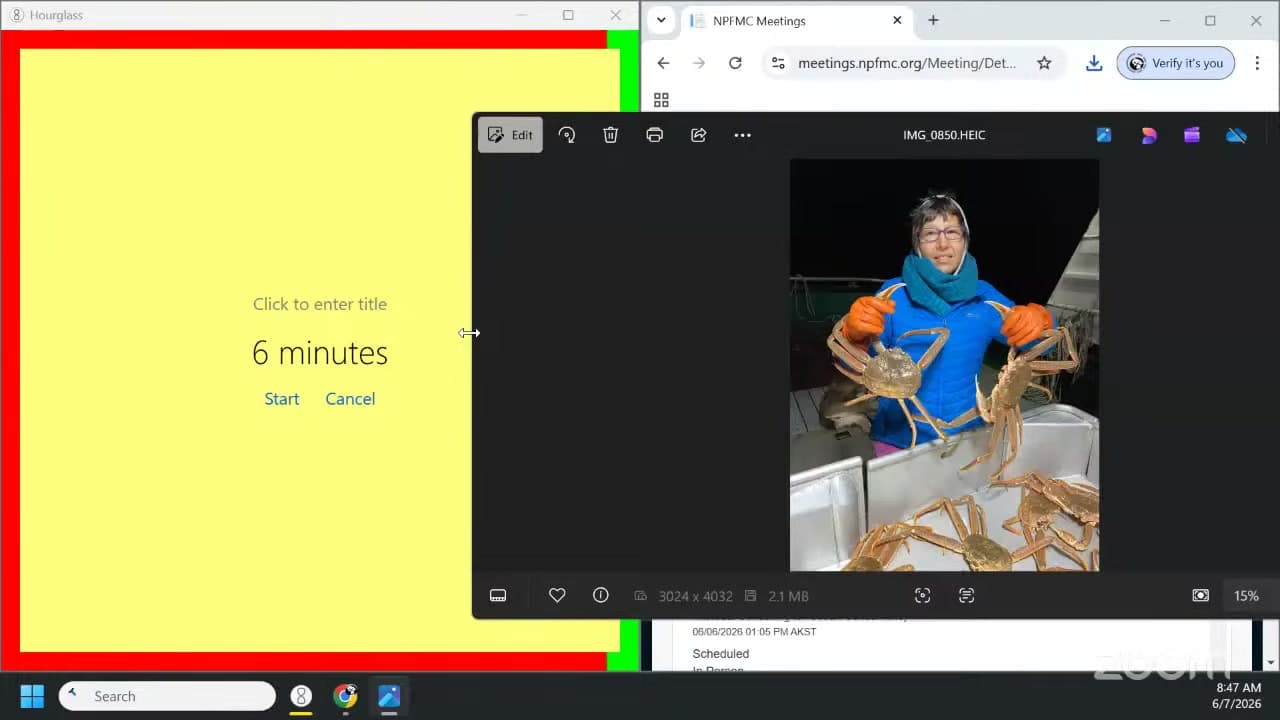
The D1 agenda item at the June 7 meeting consisted of multiple presentations, including the APU Gear Innovation Initiative update, the Trident exempted fishing permit update, and a Bering Sea Fisheries Research Foundation crab research update. The council heard the presentations and public comment but did not initiate a formal analysis or take a management decision on D1 at this meeting. Staff noted the council could choose to take no further action, request a discussion paper, or initiate an analysis at a future meeting.
This article is based on a public meeting of NPFMC - Council & SSC Meetings — NPFMC 279 Day 4 - June 7, 2026 ().
AI-assisted. How we use AI Transcript byLucas Brown
Stay informed. Support what matters.
Free, permanent access to local news you can verify. Subscribe to support Bill AlaskaNews and go ad-free.
Related Coverage
North Pacific council moves toward enforceable pelagic trawl gear standards
Alaska News · 3mo ago
Pollock fleet asked to repeat voluntary crab closures in 2027 after proof-of-concept season
Alaska News · 3mo ago
Fishery managers will meet on trawl seafloor contact, with no power to recommend
Alaska News · 1w ago
North Pacific council directs Ecosystem Committee to revise 2004 groundfish policy goals
Alaska News · 3mo ago
NPFMC directs NOAA to update pollock roe rules after seizure highlighted regulatory gap
Alaska News · 3mo ago
Comments
Sign in to leave a comment.
No comments yet. Be the first to share your thoughts.