North Pacific council directs Ecosystem Committee to revise 2004 groundfish policy goals
Alaska's groundfish management policy goals are heading for their first significant language update in more than two decades, with tribal representatives pressing the council to ensure that subsistence communities and Western Alaska salmon interests are not left behind in a narrow revision.
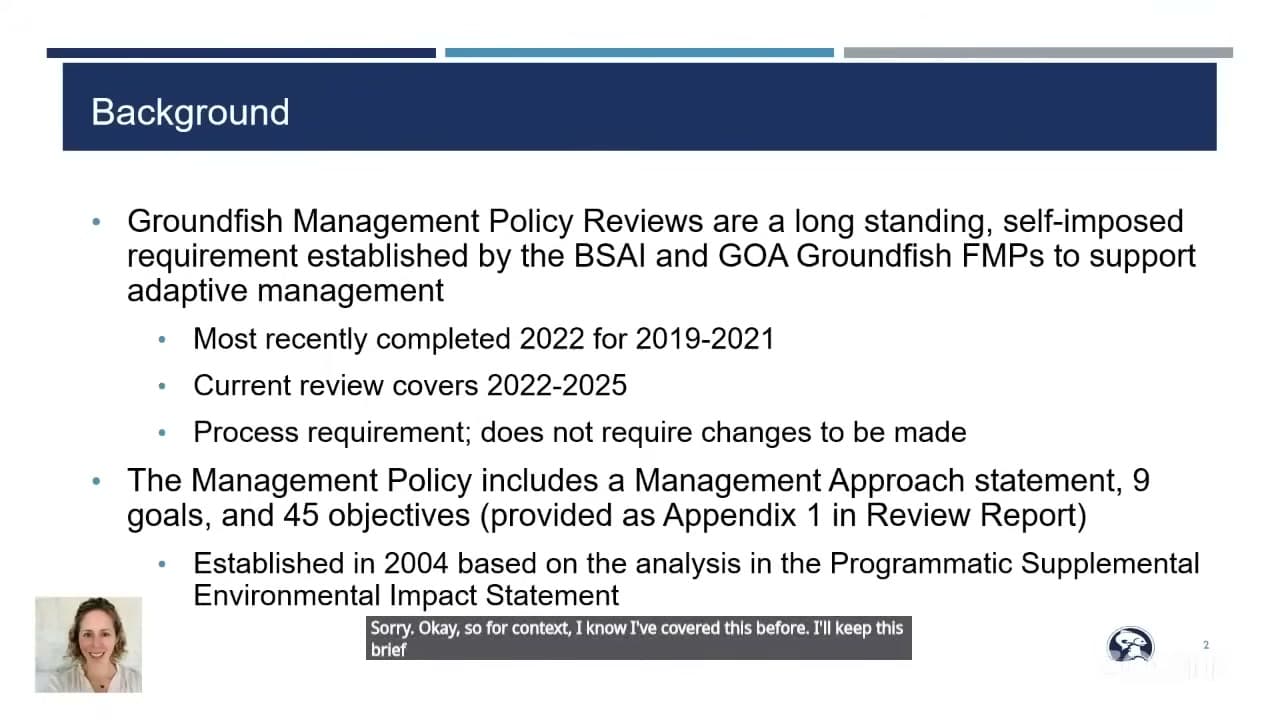
The North Pacific Fishery Management Council voted Tuesday to close its triennial policy review and sent the Ecosystem Committee back to work on specific language changes before any formal fishery management plan amendment begins. The motion, made by council member Kimball and seconded by Pamplin, passed without objection. It found that the review document was complete and that the council's work during the three-year review period generally aligns with the current management policy.
The review centers on goals written in 2004 that provide high-level guidance for the council's groundfish work, including bycatch limits, habitat protections, and engagement with communities affected by groundfish fisheries. Two goals drew the most scrutiny. Goal 3, on preserving the food web, needs updating to address marine ecosystems and climate resilience. Goal 8, on Alaska Native consultation, carries a terminology problem the Ecosystem Committee flagged: the word "consultation" now has a specific legal meaning referring to government-to-government talks between NOAA and federally recognized tribes, which is not how the council used it in 2004. "The group felt that the term engagement or something similar would be more appropriate here," the Ecosystem Committee report stated.
The Advisory Panel unanimously supported the Ecosystem Committee recommendations. Any actual modifications to the goals and objectives would require a fishery management plan amendment, which the council chose not to initiate at this time.
Tribal representatives from two river commissions testified that the changes don't go far enough. The policy director of the Yukon River Intertribal Fish Commission told the council it should treat Yukon River salmon as ecosystem indicators, not bycatch footnotes. "The ongoing collapse of these stocks suggests that the Council should treat Yukon River salmon not as simply as incidentally bycatch concerns, but as ecosystem indicators with direct management implications for directed ground fisheries in the Bering Sea," he said.
The Policy and Programs Director for the Kuskokwim River Intertribal Fish Commission pushed the council to treat local and traditional knowledge as part of best available science and asked whether the council's actions actually match its stated values. "Zooming out to the big picture, this policy statement and the suite of objectives should be guiding all of the work the council all of the work of the council, and the Kuskokwim Fish Commission urges the council to reflect on whether that is the case, particularly when it comes to prioritizing habitat protections, bycatch reductions, and providing sustainable opportunities for subsistence communities fishing on the same level as promoting the optimum yield of large-scale trawl fisheries. Are your values, priorities, and actions truly aligning with this policy statement, goals, and objectives?" she asked.
Tribal testifiers expressed concern that a revision focused only on Goals 3 and 8 may leave unchanged the policy goals that are supposed to guide every council decision on groundfish, potentially continuing to underweight the salmon collapses and subsistence needs that Western Alaska communities depend on. Additional public testimony during the triennial review came from Linda Behnken, representing commercial fishing interests, along with Terese Vicente, Jim Simon, Sarah Webster, and Nick Jacuk, among others.
The Ecosystem Committee is expected to take up the language work before the council's next scheduled meeting in October 2026. No timeline for a formal fishery management plan amendment was set, leaving open how long the rewrite could take before binding changes reach the fisheries these communities depend on.
This article is based on a public meeting of NPFMC - Council & SSC Meetings — NPFMC 279 Day 6 - June 9, 2026 ().
Made by our human newsroom with AI. How humans and AI work here · Grow with our newsroom Transcript byLucas Brown
Stay informed. Support what matters.
Free, permanent access to local news you can verify. Subscribe to support Alaska News and go ad-free.
Related Coverage
NPFMC directs NOAA to update pollock roe rules after seizure highlighted regulatory gap
Alaska News · 4mo ago
North Pacific council moves toward enforceable pelagic trawl gear standards
Alaska News · 4mo ago
Outside scientists find NOAA's Alaska fishing observer program sound, recommend no 2027 changes
Alaska News · 1d ago
Council votes 8-3 to study halibut bycatch rules for Golden Fleece replacement vessel
Alaska News · 4mo ago
The council that runs Alaska's fisheries has no tribal vote
Alaska News · 2mo ago
Comments
Sign in to leave a comment.
No comments yet. Be the first to share your thoughts.